



Ostomy Care Market Size, Share, Trends, Companies, and Forecast 2026-2035
Deepa Pandey is a healthcare market research analyst. She followed ostomy surgery trends, uptake of products, patients' preferences, reimbursement policies, and new technologies affecting ostomy care. Her research proves valuable for medical device companies, healthcare providers, and healthcare payers for competitive benchmarking and medical device strategic decision-making. The ostomy care market size is estimated at USD 4.01 billion in 2026.
Source: https://www.precedenceresearch.com/ostomy-care-market
 Get a Sample
 Table Of Content


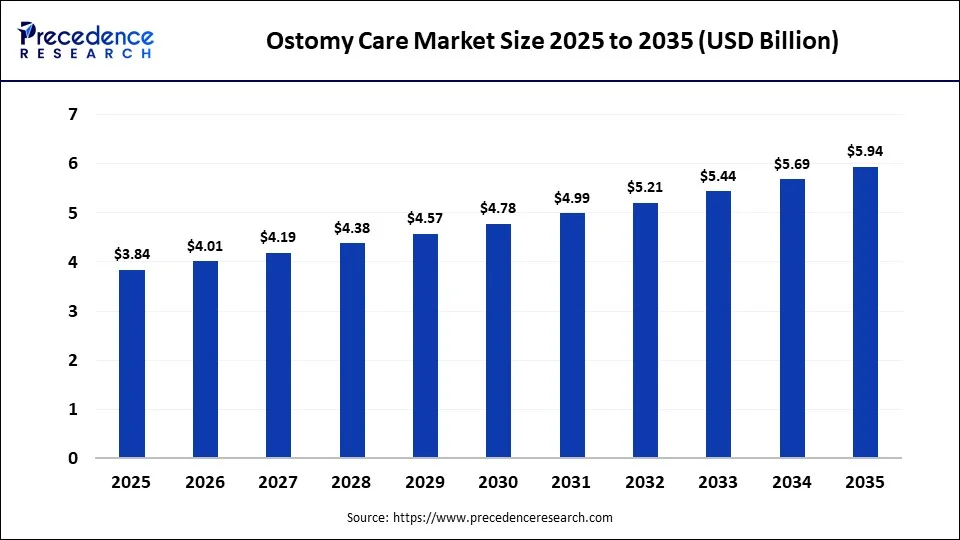
Ostomy Care Market Size and Forecast 2026 to 2035
Deepa Pandey has more than 5 years of experience in medical device and chronic care healthcare analysis. She believes that the ostomy care market is transitioning to a more patient-centric phase. As colorectal cancer is becoming more prevalent in society, patients are becoming more aware of effective ostomy care. With innovations in pouching technology and skin protection products, patients are having more options that will allow them to enjoy more comfortable and reliable long-term care. The global ostomy care market was valued at USD 4.01 billion in 2026 and is growing at a CAGR of 4.46% over the forecast period. Additionally, the number of elderly citizens and the increasing incidence of colorectal and gastrointestinal diseases are anticipated to continue to be the drivers of market growth.
Key Takeaways
- By product type, the ostomy bags segment led the market with a share of 58.35% in 2026.
- By ostomy type, the colostomy segment led the market with a 46.85% share in 2026.
- By system type, the one-piece system segment captured a major revenue share of 62.4% in 2026.
- By bag type, the drainable bags segment captured the largest market share of 54.75% in 2026.
- By skin barrier type, the flat barriers segment led the market with a 43.25% share in 2026.
- Coloplast dominates the global ostomy market with a 35-40% share.
- North America, led by the U.S., is the primary competitive battleground in the ostomy market, contributing 56% (USD 1.358 billion) of Convatec's total revenue.
- Coloplast, Convatec, and Hollister collectively dominate the ostomy market, with Coloplast leading at 35-40% global share.
- Coloplast's Heylo system shifts ostomy care from reactive leak management to proactive leak prevention.
- With 70% U.S. penetration, 15-20% U.S. market share, and only 35-40% global share, Coloplast has substantial headroom for international growth.
Market Overview
The ostomy care market has been estimated at USD 4.01 billion in 2026 and is estimated to grow at 4.46% CAGR through 2035. Certainly, ostomy care is not like other categories of medical devices where product use may be sporadic, the patient-provider relationship is shorter-lived, and product selection rarely affects patient care. The market is relatively concentrated and includes large market share players such as Coloplast, Convatec, Hollister, and competition for niche market segments within niche geographic areas between providers of regionally based manufacturing and specialty equipment providers who sell as accessories to the large market players. In addition to design, pouch strength is heavily reliant on skin protection, leak protection, accessories, patient enablement, and distribution.
Key Insight: This USD 4.01billion market, expanding at 4.46 % to USD 5.94 billion by 2035, is dominated by three big global players and is bolstered by ongoing patient needs.
Who Are the Leading Companies in the Ostomy Care Market?
| Company | Market Position | Ostomy Exposure | Major Strength | Latest Public Indicator |
| Coloplast | Global leader | Very Strong | Ostomy systems, skin protection, patient support | Reports 35-40% global ostomy market share |
| Convatec | Global leader | Very Strong | Ostomy bags, accessories, skin protection | USD 676M Ostomy Care revenue in 2025, +6.6% reported |
| Hollister/Dansac | Global leader | Very Strong | Pouches, barriers, accessories, clinical support | One of the three dominant global suppliers |
| B. Braun | Major global competitor | Strong | Enterostomal therapy, pouches and accessories | Broad global medical-device infrastructure |
| Salts Healthcare | Specialist leader | Very Strong | Ostomy appliances and accessories | Strong specialist positioning, particularly in Europe |
| Welland Medical | Specialist competitor | Strong | Ostomy appliances and skin protection | Strong UK/international presence |
| ALCARE | Regional/global specialist | Strong | Ostomy appliances and accessories | Strong Japanese and Asian presence |
| TG Eakin/Eakin | Specialist competitor | Strong | Seals, skin protection and accessories | Important accessory/skin-care franchise |
| Marlen Manufacturing | Specialist competitor | Strong | Ostomy pouches, barriers and accessories | Established U.S. specialist |
| Dansac | Specialist brand | Strong | Ostomy systems and accessories | Part of Hollister/ConvaTec's broader ecosystem |
| Torbot Group | Specialist | Moderate-Strong | Ostomy accessories and skin care | U.S. specialist supplier |
| Nu-Hope Laboratories | Specialist | Moderate | Custom ostomy products and accessories | Niche/custom positioning |
Three companies are sitting on top of the others in this market. Coloplast claims 35-40% global market share for ostomy devices. They are undoubtedly the leaders in the industry. Convatec has just been surpassed, with USD 676 million of ostomy care revenue in 2025. Hollister brand in certain markets completes the top three and is one of the three leading providers worldwide but does not provide as detailed statistics as its two competitors. Below this level, B. Braun is a strong global competitor for its competitors brought by the medical-device infrastructure as well as the ostomy-only ones.
Key Insight: Convatec reports an estimated USD 676 million in 2025 ostomy care revenue, the clearest publicly published figures for the entire competitive landscape.
Source: Precedence Research Database
Coloplast: The Global Ostomy Care Benchmark
| Indicator | Public Data |
| Global ostomy market share | 35-40% |
| U.S. ostomy market share | 15-20% |
| U.S. two-piece share of bags/plates market | ~70% |
| Key platform | SenSura Mio |
| Supporting-product platform | Brava |
| Digital leakage technology | Heylo |
| Primary strategic focus | Two-piece penetration + superior user experience |
Coloplast is still one of the key players to be monitored when analyzing the global ostomy care market, as it publicly announces its standing in the market and product strategy. It has been successful in incorporating its new platform, SenSura Mio, into its ostomy portfolio, including technologies that integrate two-piece systems and additional products. The company works on products and services for patients and healthcare professionals, which add to the pouches. This bigger picture creates a favourable buying environment for Coloplast, with a market of fit, comfort, reliability, and user experience becoming increasingly vital to repeat sales.
Key Insight: Coloplast occupies 35-40% of the global stomy market, thus providing essential and important competitive benchmarks for the platform and its ecosystem of patient support.
Source: Precedence Research Database
Convatec: A USD 676 Million Ostomy Business
| Convatec Ostomy Indicator | 2025 |
| Ostomy Care revenue | USD 676M |
| 2024 revenue | USD 634M |
| Reported growth | 6.60% |
| Constant-currency growth | 5.00% |
| Organic growth | 4.50% |
| Share of group revenue | 28% |
| Group revenue | USD 2.439B |
| Products manufactured/sold across group | >1 billion |
| Employees | >10,000 |
| Manufacturing locations | 7 |
There are only a handful of companies willing to demonstrate their complete ostomy math, with Convatec being one. Its ostomy care unit reported revenue of USD 676 million, up 6.6% from the prior-year level of USD 634 million, narrowing a 4.5% rise to 5.0% on a constant-currency basis following isolation of organic growth. Convatec's total group revenue is USD 2.439 billion, with ostomy care accounting for 28% of total revenue.
Esteem Body, the company's one-piece soft convex pouch, gained particularly robust numbers, although Convatec's opportunity extends beyond the pouch. The company's Esenta accessory products accounted for about 20% of the company's total Ostomy Care sales.
Key Insight: Each year, the ostomy unit at Convatec saw growth when specificity is given to its services on Convatec strips (around 20% of the ostomy total), a clear sign that accessories are as important as the pouch itself in the group.
Convatec's Geographic Exposure
| Geography | 2025 Revenue | Share |
| North America | USD 1.358B | 56% |
| Europe | USD 723M | 30% |
| Rest of World | USD 358M | 14% |
| Total | USD 2.439B | 100% |
Aman states that North America accounts for USD 1.358 billion of the global market, representing 56% of the global revenue. A total of USD 2.439 billion is generated globally, 36 million of which is provided by the rest of the world (USD 358 million, which accounts for the remaining 14% of revenue), and Europe's revenue is USD 723 million, or 30%. That's what makes the U.S. such a highly divided territory for the advanced ostomy product, patient support program, and home-care delivery segments. The last part of Convatec's business is already growing in the U.S.
Key Insight: North America accounts for 56% of Convatec's USD 2.439 billion group revenue (USD 1.358 billion), and this segment of the market has a significant weight, resulting in the U.S. as a single point of focus as a competitive battleground.
Source: Precedence Research Database
What Products Are Driving Competition?
| Product/Technology | Commercial Importance | Competitive Objective |
| One-piece pouches | Very High | Convenience and simplicity |
| Two-piece systems | Very High | Flexibility and repeat usage |
| Skin barriers | Very High | Prevent peristomal skin complications |
| Convex systems | Very High | Improve fit and leakage control |
| Protective seals | High | Leakage prevention |
| Adhesive removers | High | Improve changing experience |
| Barrier rings | High | Improve skin protection |
| Belts/support products | Moderate-High | Security and comfort |
| Odor-control products | Moderate | Quality-of-life improvement |
| Digital leakage monitoring | Emerging | Predictive/connected ostomy care |
| Patient-support programs | High | Adherence and brand loyalty |
The market is slowly changing to move away from just being a business of bags to a more holistic ostomy-management model. In that transition are four key factors. Various companies provide a core set of hardware, including one-piece pouches, two-piece systems, skin barriers, and convex systems. Each ostomy patient requires these, and they can be considered to carry very high commercial importance. Behind that, but equally important, are protective seals and adhesive removers, which, although not as large, contribute to the comfort of the day.
Key Insight: The future of product innovation is clearly on two-piece, one-piece, skin barrier, and convex systems. Thus, digital leakage monitoring rates have very high commercial importance.
Source: Precedence Research Database
Why Accessories Are Becoming a Major Competitive Battlefield
Beyond the pouch, there's a greater level of competition in ostomy care. Now, several factors related to the health of the peristoma, prevention of leakage, adhesion, and comfort are areas where companies can distinguish themselves. They have more to offer to users. Some leading suppliers are now creating more comprehensive product systems to integrate not only the pouch/barrier/seal/and adhesive, but also skin protection/digital tools/patient support. The shift is evident in Convatec's sales of its ostomy care brand, with shavers, combs, and other self-care accessories making up around 20% of these sales in 2026.
Key Insight: Accessories are gaining commercial viability, accounting for around 20% of ostomy care revenues in 2026, through the Convatec lineup of Esenta products.
Competitive Positioning of the Major Companies
| Company | Product Breadth | Ostomy Expertise | Global Reach | Innovation | Patient Services | Overall Position |
| Coloplast | Very Strong | Very Strong | Very Strong | Very Strong | Very Strong | Global Leader |
| Convatec | Very Strong | Very Strong | Very Strong | Very Strong | Very Strong | Global Leader |
| Hollister | Very Strong | Very Strong | Very Strong | Strong | Very Strong | Global Leader |
| B. Braun | Strong | Strong | Very Strong | Strong | Strong | Global Challenger |
| Salts Healthcare | Strong | Very Strong | Strong | Strong | Strong | Specialist Leader |
| Welland Medical | Strong | Strong | Strong | Strong | Moderate | Specialist Challenger |
| ALCARE | Strong | Strong | Strong in Asia | Strong | Strong | Asian Specialist |
| Eakin | Moderate | Very Strong | Strong | Strong | Strong | Accessory Specialist |
| Marlen | Strong | Strong | Moderate | Strong | Moderate | U.S. Specialist |
| Torbot | Moderate | Strong | Moderate | Moderate | Moderate | Niche Specialist |
Three companies in the top positions, with very strong ratings across almost all dimensions, are Coloplast, Convatec, and Hollister, which are global leaders. B. Braun rates its performance as strong to very strong and finishes off as a global challenger. Slightly smaller than the top three on most measures, and at company size, it is capable of going well everywhere. Salts Healthcare is a specialist leader, with a smaller global scale of operations, yet varied and strong on ostomy experience.
Key Insight: Coloplast, Convatec, and Hollister are very strong in almost all the competitive dimensions and have been rated as global leaders, whereas Salts Healthcare is the strongest specialist, with ratings of very strong, particularly in ostomy expertise.
Source: Precedence Research Database
What Determines Market Leadership?
| Competitive Factor | Importance |
| Product safety and clinical performance | Very High |
| Skin-contact performance | Very High |
| Leakage prevention | Very High |
| Adhesion technology | Very High |
| Regulatory approvals | Very High |
| Clinical evidence | High |
| Stoma-care nurse relationships | Very High |
| Hospital relationships | High |
| Home-care/distribution network | Very High |
| Patient loyalty | Very High |
| Reimbursement/access | Very High |
| Product comfort | High |
| Digital monitoring | Emerging |
| Manufacturing scale | High |
There are very high barriers to entering this market, and four reasons help to explain most of that. Skin-contact performance, leakage prevention, and adhesion all justify the designation of very high importance. The very high tier also covers regulatory approvals and home-care distribution networks, which are both time-consuming and costly if a new player is to establish itself.
Key Insight: Skin-contact performance, leakage prevention, adhesion technology, and stoma-care nurse relationships all rate very high importance, together explaining why clinical trust can matter as much as manufacturing scale in this market
Source: Precedence Research Database
The U.S. is a Major Competitive Battleground
Coloplast sees the global market at 35%-40% of its market share, with a U.S. market share of 15%-20%, and is looking to penetrate heavily into the U.S. market. There is also a big share for 2-piece systems in the U.S. bags-and-plates business, about 70%. This provides a chance for manufacturers to deepen partnerships between hospitals, post-acute providers, home-care segments, and hospital surgical patients who go on to use the products in the long-term.
Strategic Opportunity
The best commercial prospect might be in the care of the entire transition from hospital treatment to continuing long-term at home. Relationships established prior to discharge and relationships sustained post-discharge can enhance a company's recurring demand. Patients can be influenced in numerous ways to stay with a particular brand over time, including education, product onboarding, fitting support, follow-up care, and reliable supply.
Key insight: Seventy percent U.S. penetration and a cited 15-20% market share, with only 35-40% globally, suggest a competitive opportunity for growth.
Patient Support Is Becoming a Competitive Moat
An ostomy is not a medical device transaction, but an ongoing relationship with the patient. The customer journey can start before the surgery, with the placement, continue through hospital discharge, stoma education, first product choice, home care visit, product change/replacement, accessory delivery, and repeat pouch change. This is making patient support more and more vital to your competitive edge. With patient support programs like Convatec's me+, companies are developing engagement plans beyond the product by engaging patients and health professionals.
Key insight: Patient-service ecosystems create value beyond the surgical procedure and discharge and continue to extend person-to-person in terms of the ostomy pouch.
Technology Is Moving Beyond the Traditional Ostomy Bag
Steps are beginning to be taken to improve the identification and management of ostomy complications due to technology. In the UK, in 2024, Coloplast launched a new digital system for leakage notifications, known as Heylo. This is a connected system that brings the care of ostomats from a leak management approach to one of anticipation. Future innovations could include sensors, internet connectivity on smartphones, forecasting, remote monitoring, digital nurse support, and data-driven product selection. These technologies may become embedded in traditional consumable products over time to form a digital services branch and a more seamless approach to the patient's care over time.
Key Insight: The industry's shift toward connected ostomy healthcare is highlighted by the combined leakage detection and digital monitoring of patients by Coloplast with its new product Heylo in the UK during 2024.
Market Share: What Can Actually Be Proven?
Market share estimates for the ostomy care market should be used with caution as different market definitions used by companies and research sources do not always correspond. Some estimates do not include the skin barrier, accessories, hospital products, or homecare products. Finally, the numbers reported are affected by geographic scope. Although this is also a third-party estimate and not disclosed company information, the combined share of Coloplast, Convatec, and Hollister is estimated to be around 62-68% across the world in 2026. On the other hand, Coloplast's reportable sales of 35-40% of global sales are more clearly distinguishable than those of other companies.
Key Insight: The combined global share, estimated at 62-68%, of Coloplast, Convatec and Hollister needs to be interpreted with caution, and Coloplast reported a global share of between 35-40% for the company.
Competitive Ranking
| Company | Competitive Position |
| Coloplast | Global Market Leader |
| Convatec | Global Market Leader |
| Hollister | Global Market Leader |
| B. Braun | Global Challenger |
| Salts Healthcare | Specialist Leader |
| Welland Medical | Specialist Challenger |
| ALCARE | Asia-Pacific Specialist |
| Eakin | Accessory / Skin-Care Specialist |
| Marlen Manufacturing | U.S. Specialist |
| Torbot Group | Niche Specialist |
Coloplast, Convatec, and Hollister are at the top as global market leaders, and B. Braun is just behind as the number one global challenger. Aditi believes specialist leader Salts Healthcare is in fourth place. Welland Medical is the specialist challenger, while its own strong positioning as Asia Pacific's clear specialist and the performance of ALCARE at accessory and skin-care specialist allow it to carve out a niche for itself in fifth. Marlen and Torbot close out the list as U.S. specialist and niche specialist, respectively. A competitive position ranking is a good benchmark to follow, as the inputs are a mix of disclosed data and competitive judgment.
Key Insight: Coloplast, Convatec, and Hollister are the leading three companies in the global market leaders in the sector, with the other 7 companies all having their own niche area.
Source: Precedence Research Database
Where Will the Next Growth Come From?
| Growth Area | Opportunity | Why It Matters |
| Two-piece systems | Very High | Large U.S. installed opportunity |
| Convex appliances | Very High | Leakage and fit management |
| Skin barriers | Very High | Recurring accessory revenue |
| Protective seals | Very High | Leakage prevention |
| Home-care channels | Very High | Recurring consumption |
| Digital leakage detection | High | Emerging connected-care opportunity |
| Premium comfort products | High | Patient experience differentiation |
| Emerging markets | High | Lower penetration |
| Ostomy education | High | Improves product adoption |
| Personalized appliances | High | Better fit and adherence |
| Sustainable ostomy products | Medium-High | Environmental pressure |
| Direct-to-patient services | High | Greater manufacturer-patient connection |
Two-piece, convex appliances, skin barriers, protective seals, and home-care channels all have a very high opportunity. Corresponding to an increasing installed-base gap in the U.S., improved leakage and fit management, home-care recurring accessory revenue, leakage prevention, and how much consumption continues to happen post-home placement. High opportunity, a play emerging in connected care, rates digital leakage detection, while premium comfort products are a simple differentiation lever on patient experience. The high tier is also completed by emerging markets. They are at present fairly valuable because there's still plenty of space for market penetration. At medium-high, sustainable ostomy products also have a valid but less urgent value proposition, based on ecolo-political events, instead of clinical need.
Key Insight: The chances of growth are rated very high for two-piece systems, convex appliances, skin barriers, protective seals, and home-care channels five clear, converging bets for vendors to take rather than just one.
Source: Precedence Research Database
Strategic White-Space Opportunities
The future of ostomy care will most likely be through enhanced user satisfaction, not another standard pouch. There are some specific areas that are appealing to manufacturers and technology firms.
Leakage prediction
One of the most challenging issues that ostomy patients face is leakage. Early warning technologies may support patients in tackling issues prior to leakage occurring. Thereby building patient confidence and minimize unnecessary complications.
Personalized fitting
There are a lot of differences in shapes, sizes, locations, and the skin around the stoma of patients. Digital-supported measurement and AI-assisted product selection might assist in understanding how to match patients with a more suitable pouching product and barrier to help improve selection.
Connected ostomy care
Consumable products that consist solely of physical items could incorporate digital aspects, due to sensors, mobile applications, and remote-monitoring devices. This presents good opportunities for companies to develop longer-term engagement models with products that are being bought time and time again.
Emerging-market access
Many patients in emerging markets continue to experience restrictions in access to sophisticated ostomy products and to stoma-care expertise. Long-term opportunities could arise from upscaling distribution, making good use of the thinned-out education, and making it more accessible.
Accessory expansion
Skin-care and accessory product line expansion illustrates that value can be generated throughout the broader ostomy-care product-service value chain. Focusing on products that can help with adhesion, skin protection, sealing, and leakage can expand product width and recurring revenue opportunities.
Hospital-to-home integration
Product choice can be heavily affected by the time shortly after ostomy surgery. Transition to home care and continued product supply by hospitals could positively influence continuity of care and increase the level of patient retention for such companies.
Key Insight: Potential white-space opportunities range beyond standard pouches to leakage prediction, personalized fitting, integration into connected care, emerging-market access, accessories, and integration in hospital/at-home care.
Overall Assessment of the Ostomy Care Market
Ostomy care is a distinct competitive industry with recurring consumption, special consideration for clinical products, and long-term patient relationships. Rather than racking up pouch features, high-profile companies are emerging with other differentiators: skin protection and leakage resistance, accessories, product fit, digital features, and patient support.
Coloplast is the most transparent publicly available example of the firm's global leadership, with an estimated market share of 35-40% as opposed to 15-20% in the U.S. market. This gap highlights its strength in the global market. That also just shows how much growth potential there is for the business within U.S. geographic boundaries.
Convatec offers a solid financial standard, generating over USD 676 million in ostomy care revenue for FY2025 versus more than USD 634 million in FY2024. The Roloff's product categories of Esenta were about a quarter of ostomy care's total 2025 sales. This has continued to grow and show the role skin health, adhesion, and leakage products play in the context of the pouch.
Key Insight: The market is moving away from a pouch-based approach to a more comprehensive support-of-the-ostomy-care ecosystem, with Coloplast's 35-40% share of the global market. The increased revenue of Convatec's accessories and digital services, which stood at USD 676 million for FY2025 setting the stage for fierce competition.
Segmentation Analysis
Product Type Insights
| Segment | 2026 Share | 2035 Share | CAGR | Growth Factor |
| Ostomy Bags | 58.35% | 56% | 4.05% | Recurring replacement demand and rising ostomy procedures maintain dominance. |
| Ostomy Accessories | 20.25% | 22% | 5.20% | Increasing focus on leakage prevention, comfort, and appliance longevity drives adoption. |
| Ostomy Care Products | 12.90% | 14% | 5.00% | Greater emphasis on peristomal skin health supports demand. |
| Irrigation Products | 5.15% | 5% | 4.95% | Adoption among selected colostomy patients supports steady growth. |
| Other Products | 3.35% | 3.20% | 3.95% | Niche products remain relevant across specialized care requirements. |
There is a steady increase in the number of ostomy procedures, complemented by the ability to replace the ostomy bags regularly and frequently to achieve periodic renewal of the product. Leading to the continued dominance of ostomy bags, with half of the market (58.35% in 2026, at a 4.05% CAGR). Ostomy accessories will increase their market share from 20.25% to 21.75% over five years, with a 5.20% CAGR.
Key Insight: Despite the category's dominant presence in Asia, the market share of ostomy bags has dropped to 58.35%, yet remains the stalwart of the category.
Source: Precedence Research Database
Ostomy Type Insights
| Segment | 2026 Share | 2035 Share | CAGR | Growth Factor |
| Colostomy | 46.85% | 45% | 4.10% | High procedure volume and established long-term care requirements support the largest share. |
| Ileostomy | 37.60% | 39% | 4.80% | Increasing colorectal procedures and greater need for specialized management support growth. |
| Urostomy | 15.55% | 16% | 4.75% | Growing demand for urinary diversion care and improved appliance technologies supports expansion. |
High patient volumes and existing long-term care pathways give colostomy the largest market share at 46.85% in 2026 and are forecast to drop to 45.25% in 2035 at a 4.10% CAGR. At 4.75% CAGR, urostomy, the smallest of the three, is gaining share from 15.55% to 15.95%. Urinary-diversion care and the continued evolution of appliance technology are driving this growth.
Key Insight: Colostomy is the largest drainage type with 46.85% market share, while Ileostomy is fastest growing with a 4.80% CAGR, and will tighten the gap as volumes of colorectal procedures increase.
Source: Precedence Research Database
System Type Insights
| Segment | 2026 Share | 2035 Share | CAGR | Growth Factor |
| One-Piece System | 62.40% | 59.85% | 4.02% | Simplicity, convenience, and ease of application support widespread use. |
| Two-Piece System | 37.60% | 40.15% | 5.15% | Flexible appliance replacement and growing patient preference for customization support faster growth. |
One-piece systems have a larger share of 62.40% in 2026, which reduces to 59.85% by 2035 at a rate of 4.02% CAGR, and the reason for their replacement is simply that they are easier to apply. Two-piece systems are gaining market share quickly, with increasing demand to replace one part, the pouch, versus the entire appliance, and are expected to have a market share of 40.15% by 2020 at a 5.15% CAGR.
Key Insight: Two-piece systems experience a higher CAGR of 5.15%, compared with one-piece systems' CAGR of 4.02%, and will account for 40.15% of the market by 2035. Due to growing preference among patients for replacement flexibility over simplicity.
Source: Precedence Research Database
Bag Type Insights
| Segment | 2026 Share | 2035 Share | CAGR | Growth Factor |
| Drainable Bags | 54.75% | 55.80% | 4.65% | Particularly strong relevance for ileostomy and high-output patients. |
| Closed-End Bags | 30.15% | 28.65% | 3.90% | Convenience in selected short-term and lifestyle-oriented applications supports demand. |
| Urostomy Bags | 15.10% | 15.55% | 4.75% | Rising urological procedures and urinary diversion requirements drive growth. |
Drainable bags are the top market leader at 54.75% in 2026, expanding to 55.80% by 2035 with a CAGR of 4.65%. Especially pertinent for ileostomy and high-output patients who do not require replacement but require drainage. The smallest urostomy bag type grows from 15.10% to 15.55% with a 4.75% CAGR, subsequently and directly mirroring urological procedures.
Key Insight: Drainable bags are the largest market segment at 54.75% of total sales and are trending upward by 4.65% CAGR. On the other hand, urostomy bags are the fastest-growing of the three, at 4.75% CAGR, due to continual growth in volumes of urological procedures.
Source: Precedence Research Database
Skin Barrier Type Insights
| Segment | 2026 Share | 2035 Share | CAGR | Growth Factor |
| Flat Barriers | 43.25% | 40% | 3.60% | Broad compatibility maintains high usage across routine ostomy care. |
| Convex Barriers | 27.80% | 32% | 5.85% | Increasing focus on leakage prevention and challenging abdominal contours accelerates adoption. |
| Cut-to-Fit Barriers | 18.65% | 18% | 4.15% | Flexible sizing makes them useful across diverse patient anatomies. |
| Pre-Cut Barriers | 10.30% | 11% | 4.70% | Convenience and easier application support steady demand. |
Broad compatibility across routine cases secures flat barriers a total of 43.25% share in 2026 and drops to 39.80% in 2035 with a CAGR of 3.60%. Convex barriers are popular for leakage prevention, and the challenging contours of the abdomen force more people onto the wall of the convex fit, growing at a 5.85% CAGR. The fastest-growing region in the table, rising from 27.80% to 31.60% market share during the forecasting period.
Key Insight: At 5.85% CAGR, convex barriers will record the highest growth of all the barrier types available and attain 31.60% market share.
Source: Precedence Research Database
Material Insights
| Segment | 2026 Share | 2035 Share | CAGR | Growth Factor |
| Plastic | 48.65% | 45% | 3.70% | Lightweight, flexible, and cost-effective properties sustain extensive use. |
| Hydrocolloid | 35.20% | 38% | 5.25% | Strong skin-protection characteristics make hydrocolloid increasingly important in barriers. |
| Silicone | 10.85% | 12% | 5.55% | Skin-friendly properties and product innovation support premium applications. |
| Other Materials | 5.30% | 5% | 3.40% | Specialty materials remain concentrated in specific products. |
Plastic continues as the largest proportion in the market for 2026. Its 2035 market share is expected to reach 45.30%, compounding at 3.70% CAGR due to its light weight, flexibility, and low cost. The smallest of the three, silicone's market share has risen rapidly at a 5.55% CAGR, from 10.85% to 11.95%, as a result of being easily applied to skin and ongoing product development.
Key Insight: Though the smallest market, silicone exhibits the fastest growth rate at 5.55% CAGR, and with skin-friendly properties becoming more significant than the cost benefit of plastic, silicone is starting to overpower hydrocolloid's 5.25% CAGR.
Source: Precedence Research Database
Application Insights
| Segment | 2026 Share | 2035 Share | CAGR | Growth Factor |
| Permanent Ostomy | 71.65% | 70% | 4.22% | Long-term appliance replacement creates a consistent recurring demand base. |
| Temporary Ostomy | 28.35% | 30% | 5.02% | Increasing surgical interventions and enhanced postoperative management support growth. |
Permanent ostomy holds a market share of 71.65%, which is expected to rise slightly to 70.10% by 2035 at 4.22% CAGR, driven by the predictable and recurring demand for replacement of appliances over the long-term. The favorable conditions above are expected to fuel the growth of temporary ostomy, growing at 28.35-29.90% in market share from 2010-2015 with a 5.02% CAGR.
Key Insight: Temporary ostomy's growth over the last five years is measured at 5.02% CAGR, which is closing the gap on permanent ostomy (with 4.22%), yet still retaining the large majority of the overall market.
Source: Precedence Research Database
End User Insights
| Segment | 2026 Share | 2035 Share | CAGR | Growth Factor |
| Hospitals | 52.80% | 50% | 3.85% | High procedure volumes and hospital-based postoperative care maintain leadership. |
| Homecare Settings | 27.45% | 31% | 5.85% | Shift toward self-management and home-based chronic care increases demand. |
| Specialty Clinics | 9.80% | 10% | 4.15% | Specialized ostomy consultations support steady product utilization. |
| Ambulatory Surgical Centers | 6.15% | 6% | 4.65% | Increasing outpatient procedures support gradual expansion. |
| Others | 3.80% | 3.15% | 2.55% | Smaller institutional settings account for the remaining demand. |
With the continuous increase in procedure volume and hospital-based postoperative care, hospitals are the largest end-user segment at 52.80% market share in 2026. But it will wane to 49.90% by 2035 at a CAGR of 3.85%. Patient self-management and home-based chronic care services continue to gain momentum as homecare settings experience the fastest growth of all five, which will strengthen from 27.45% to 31.15% market share at a 5.85% CAGR.
Key Insight: Homecare comes in second place in end-user volume growth with a CAGR of 5.85% and will see its share of the market rise to 31.15% due to the move toward self-managed, home-based chronic care taking volume out of hospital settings.
Source: Precedence Research Database
Distribution Channel Insights
| Segment | 2026 Share | 2035 Share | CAGR | Growth Factor |
| Hospital Pharmacies | 31.80% | 29% | 3.35% | Hospital-based prescriptions and immediate postoperative requirements support demand. |
| Retail Pharmacies | 36.25% | 35% | 3.95% | Accessibility and recurring purchases maintain the largest distribution position. |
| Online Pharmacies | 17.15% | 23% | 7.55% | Home delivery, privacy, and increasing digital purchasing accelerate adoption. |
| Specialty Stores | 9.65% | 9% | 3.15% | Specialist product availability supports a focused customer base. |
| Direct Sales | 5.15% | 5.00% | 4.10% | Institutional and manufacturer-direct purchasing remains relevant. |
Retail pharmacies have the most distribution in 2026 at 36.25%, which will slow down to 34.60% by 2035 at a 3.95% CAGR, owing to their geographic position and the nature in which they are repeatedly bought. Online pharmacies are the big disruptor, growing from 17.15% to 23.10% market share at a 7.55% CAGR, with home delivery, privacy, and digital purchasing habits all creating positive momentum for this channel at once.
Key insight: Online pharmacies grow at a huge 7.55% CAGR, increasing their hold to almost 23% market share, up from almost 17%, significantly outstripping any other channel as privacy and home delivery become key determining factors in how ostomy patients are actually ordering supplies.
Source: Precedence Research Database
Regional Insights
| Segment | 2026 Share | 2035 Share | CAGR | Growth Factor |
| North America | 39.25% | 38% | 4.10% | Mature reimbursement systems, established ostomy care infrastructure, and high product adoption support leadership. |
| Europe | 31.40% | 31% | 4.25% | Aging populations and structured healthcare systems sustain strong demand. |
| Asia Pacific | 20.15% | 23% | 5.95% | Improving healthcare access, increasing diagnosis, and expanding surgical infrastructure drive faster growth. |
| Latin America | 5.35% | 5% | 3.95% | Gradual healthcare infrastructure development supports market expansion. |
| Middle East & Africa | 3.85% | 3.00% | 2.85% | Increasing healthcare access supports growth, although adoption remains comparatively limited. |
In 2026, North America holds 39.25% market share, which will be further bolstered by steady reimbursement systems and established ostomy care infrastructure to help it grow to 37.90% by 2035 (4.10% CAGR).
Asia Pacific's rise from 20.15% to 23.15% with a 5.95% CAGR is the fastest growth, as access to healthcare in the region is increasing, with better diagnostic facilities and a fast-growing surgical infrastructure.
Key Insight: Asia Pacific has the highest growth rate in the region (5.95% CAGR).
Source: Precedence Research Database
Expert Insights
The ostomy care industry will continue to evolve by moving away from traditional ostomy bags and skin-irritating membranes. This provides more patient-centered, comfortable, skin-friendly, and technology-driven products that support enhanced confidence, comfort, and quality of life. I believe emerging opportunities are going to become very visible in the fields of advanced pouching systems, better peristomal skin protection, effective and safe adhesion, odor control, and patient-specific product development. As colorectal cancer, inflammatory bowel disease, bladder disorders, and other indications for ostomy surgery continue to rise, more and more people are expected to be living with an ostomy.
Our Experts
Primary market research, methodology development, product segmentation, disease trends, regional dynamics, competitive product development and market forecasting were led by Deepa Pandey, which formed the basis of the analytical building blocks of the report.
By sourcing and validating regulatory texts, company financial information, product details, pricing information, and other quantitative information gathered from the field, Aman added credibility to the market estimates.
Aditi has completed the research work, validated and checked the quality, refined and fixed inconsistencies, and finalized the research document, making the provided facts accurate, consistent, and comprehensible.
Ostomy Care Market Segmentation
By Product Type
- Ostomy Bags
- Ostomy Accessories
- Ostomy Care Products
- Irrigation Products
- Skin Barrier Products
- Other Products
By Ostomy Type
- Colostomy
- Ileostomy
- Urostomy
By System Type
- One-Piece System
- Two-Piece System
By Bag Type
- Drainable Bags
- Closed-End Bags
- Urostomy Bags
By Skin Barrier Type
- Flat Barriers
- Convex Barriers
- Cut-to-Fit Barriers
- Pre-Cut Barriers
By Material
- Plastic
- Silicone
- Hydrocolloid
- Other Materials
By Application
- Permanent Ostomy
- Temporary Ostomy
By End User
- Hospitals
- Ambulatory Surgical Centers
- Specialty Clinics
- Homecare Settings
- Others
By Distribution Channel
- Hospital Pharmacies
- Retail Pharmacies
- Online Pharmacies
- Specialty Stores
- Direct Sales
By Region
- North America
- Europe
- Asia Pacific
- Latin America
- Middle East & Africa
Questions This Report Deliberately Leaves Open
- What will the global ostomy care market size be by 2030 & 2035?
- What is causing Coloplast's market share in the United States to be between 15-20% of global share, and how would they have to change things to reduce the difference?
- What role is there in the transition from one-piece systems to two-piece systems as share rose from 37.60% to 40.15% and at a 5.15% CAGR in the competitive business of Coloplast, Convatec, and Hollister?
- What does Convatec's announcement that the company is seeing that ostomy accessories' sales represent about 20% of its Ostomy Care sales suggest about where the company should look for future sales revenue growth?
- How comparable is the estimated combined proportion of Coloplast, Convatec, and Hollister that have established themselves as dominant specialist player, as opposed to specialist competitors like Salts Healthcare, Welland Medical, and ALCARE?
- In what way is a near-term innovation opportunity for a product better with Convex Barriers as the product line experiences a CAGR of 5.85% or in a CAGR of 5.25% with Hydrocolloid materials?
- How might Coloplast's Heylo digital leakage-notification system reshape competitive dynamics if it scales beyond its UK launch?
- What is the realistic timeline for Homecare Settings (27.45% to 31.15% share, 5.85% CAGR) to overtake Hospitals as the primary end-user channel?
- Online Pharmacies are the fastest-growing distribution channel at a 7.55% CAGR; how should regional specialists, like Marlen, Torbot and Nu-Hope respond?
- Asia-Pacific will see the market grow from a 20.15% to 23.15% share and turn out to be one of the fastest-growing regions in the market, with a 5.95% CAGR. What will be the role of this region in shaping the ostomy care market in the next 10 years?
- What portion of commercial value would a true leakage-prediction solution, different from a leakage valorization product, be able to achieve in the current installed base?
- Which company is best positioned to build an integrated hospital-discharge-to-homecare patient journey, and what would that require operationally?
- How should the market-share ambiguity flagged in this report (35-40% Coloplast-disclosed vs. 62-68% third-party combined-leader estimate) be resolved for investment or strategic-planning purposes?
- Where is there a realistic opportunity given the available services and buildout of specialist stoma-care infrastructure across emerging markets?
- What is the potential as a product/service opportunity for the temporary-ostomy segment, projected to gain share from 28.35% to 29.90% at 5.02% CAGR when compared to the permanent-ostomy base?
References
Precedence Research Database
"Ostomy Care Market - Company Landscape, Competitive Analysis, and Segmentation Data"
Data used: Market size, CAGR, all company competitive data (Coloplast, Convatec disclosures as supplied), and all segment share/CAGR tables presented throughout this report.
For inquiries regarding discounts, bulk purchases, or customization requests, please contact us at sales@precedenceresearch.com
Frequently Asked Questions
Tags





Ask For Sample
No cookie-cutter, only authentic analysis – take the 1st step to become a Precedence Research client
 Get a Sample
.webp)



 sales@precedenceresearch.com
 Schedule a Meeting
