


Outdoor Furniture Market Size, Key Companies, Company Product Portfolio, Manufacturing Output, Sales Performance, Cost Structure, Distribution Channels, Company Market Share, and Competitive Landscape
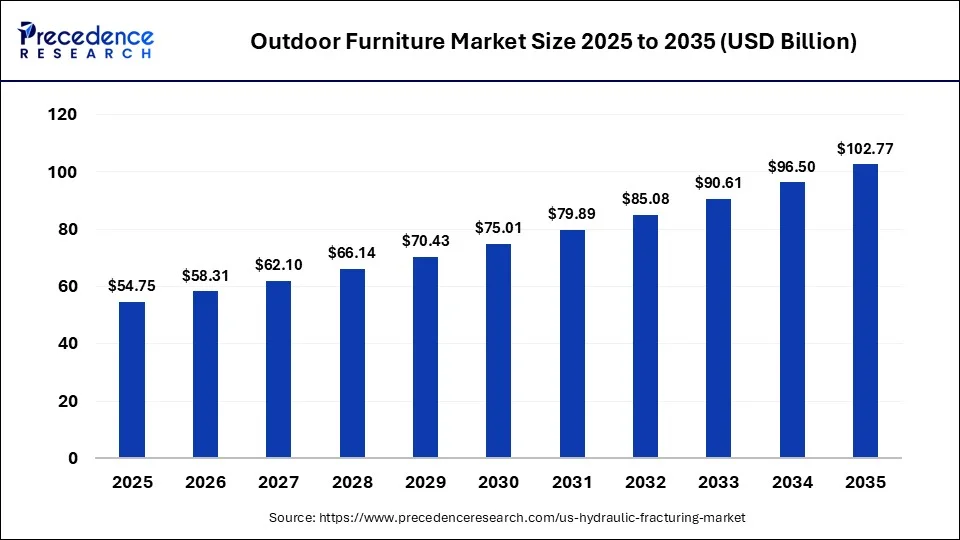
The outdoor furniture market reached USD 58.31 billion in 2026. The market growth is attributed to the growing demand for premium interior and décor and rising investments in hospitality. These trends were evaluated by our Senior Research Analyst, Vidyesh Swar, to curate this report. His report benefits multiple stakeholders, including manufacturers, furniture designers, commercial suppliers, investors, and business planning teams.
Source: https://www.precedenceresearch.com/outdoor-furniture-market
 Get a Sample
 Table Of Content


Outdoor Furniture Market Size, Trends, Share, and Innovations 2035
The outdoor furniture market is forecasted to expand from USD 58.31 billion in 2026 to USD 102.77 billion by 2035, growing at a CAGR of 6.5% from 2026 to 2035.
Key Takeaways
- The demand for outdoor furniture is increasing due to household expenditure on outdoor spaces, hospitality refurbishment, and residential construction.
- By material, the wood segment remains the largest segment, especially in premium residential and hospitality settings.
- The pricing of outdoor furniture ranges from USD 20 to more than 5000.
- The value chain follows the steps of sourcing raw materials, producing parts, frame production, weaving or molding, finishing, cushion assembly, quality inspection, packaging and distribution.
- China exported approximately USD 36.44 billion of outdoor furniture in 2026.
- Innovations in production and products arise due to technological developments.
What is the Significance of Outdoor Furniture?
The global outdoor furniture market is expanding due to continued expansion as residential outdoor living spaces, hospitality development, urban landscaping, and premium leisure spaces increase demand. Outdoor furniture comprises chairs, tables, sofas, loungers, dining sets, benches, and modular furniture suitable for use in gardens, patios, balconies, terraces, pool areas, and commercial outdoor facilities.
The economic characteristics of this market include the presence of a large volume of cheap furniture on sale, together with high-quality items with unique weather-proof properties, designs, materials, brands, and extended period of use.
There are three trends that affect market development: outdoor space of private residences tends to be viewed as a continuation of interior living space, which encourages sales of harmonious furniture collections and modular furniture; furniture in hotels, resorts, restaurants and similar facilities must have durability and be resistant to weather conditions; people pay attention not only to the cost of furniture, but also to maintenance needs and material sustainability.
The choice of materials is important in terms of product economics. Wood provides a natural appearance, metal provides strength and modern design, and plastic and artificial rattan provide lightweight furniture. Premium products increasingly combine metal frames, UV-resistant synthetic materials, quick-drying cushions, and replaceable components.
Competitive advantage is increasingly relying on combining design, durability, distribution, and end-of-life value rather than low manufacturing cost.
Coverage Highlights
- Global market size, historical development, forecast, and incremental revenue opportunity.
- Residential versus commercial demand and the economics of premium outdoor living.
- Product, material, price-tier, distribution, and geographic segmentation.
- Weather resistance, durability, design differentiation, and sustainability.
- Market concentration, regional manufacturing advantages, and competitive positioning.
How Does Premiumization and Commercial Outdoor Development Support Sustained Expansion?
\Market growth is supported by household expenditure on backyard development, hotel renovations, new builds, and damaged-weather furniture replacements. However, market sales still remain sensitive to discretionary income, construction levels, seasons and sentiment.
Forecast must also account for the difference between revenue growth and volume growth as well. Premiumization may lead to market growth even with slower unit shipment increase, while discounts and increased penetration of entry-level products may do the contrary. The full market model therefore evaluates value, volume, average selling price, material mix, and regional growth separately.
Scenario analysis evaluates a base scenario supported by resilient demand in residences and hospitality sectors, an upside scenario dependent on high premium adoption and corporate investment, and a downside scenario assuming weak housing construction, high transportation costs, and low consumer spending.
Coverage Highlights
- Revenue growth versus unit shipments and average selling prices.
- Incremental revenue by material, product, end use, and region.
- Sensitivity to housing activity, hospitality investment, inflation, and consumer expenditure.
Segmentation Analysis
What is the Segmental Outlook of the Outdoor Furniture Market?
Outdoor furniture is best assessed through overlapping product, material, end-use, price-tier, and distribution dimensions. No single classification captures the entire market because a premium metal dining set sold to a resort differs substantially from an entry-level plastic chair sold through an online retailer.
Wood remains an important aesthetic choice, particularly in premium residential and hospitality settings. Strength, modern design aesthetics, and compatibility with many design ideas characterize metal materials. Plastic and resin furniture has the following advantages: it is light, easier to clean and cheaper. Synthetic wicker and mixed-material designs occupy an important position between traditional aesthetics and modern weather resistance.
The residential sector offers a wide base for replacements and purchases, while the commercial sector can be affected by new hotels opening up, restaurant seating capacities, resort renovations, and project purchases. Buyers in the commercial sector generally consider durability, parts availability, and consistency more than buyers in the residential sector.
The highest value opportunities are not necessarily the highest-volume categories. High-end modular furniture, designer lines and hospitality furniture will command higher price per set, but usual chairs and tables will be more appropriate for mass production. In order to have final values for market segment shares and growth rates, defining correctly the product segment is key, as these figures cannot be derived from other sources.
Coverage Highlights
- Segment revenue, share, and growth by product and material.
- Residential versus commercial demand, including application-level forecasts.
- Economy, mid-range, premium, and luxury price-tier analysis.
- Modular systems, coordinated sets, and tailor-made furniture.
- Largest revenue pools, rapidly growing segments, and emerging whitespace.
What are the Potential Market Dynamics of the Outdoor Furniture Market?
The market's principal growth drivers are the expansion of usable outdoor living areas, hospitality development, premium home improvement, and demand for low-maintenance furniture. Balconies and small terraces are driving the need for stackable, space-saving furniture while larger living spaces require modular sofas, dining furniture, and outdoor lounges
Commercial demand has a different purchasing cycle. Hotels, restaurants, resorts, and leisure establishments tend to purchase furniture in batches; therefore, individual projects may be commercially significant. Nevertheless, procurement is more concerned about time frames of installation, durability requirements, total cost of ownership, and the possibility of replacing individual items without affecting the whole range of furniture.
Three constraints matter. Firstly, furniture is a discretionary purchase that families may delay in times of low confidence. Secondly, outside exposure causes quick color fading, corrosion, moisture damage and cushion degradation. Thirdly, large-sized products mean high cost for warehousing, packing, shipment and reverse logistics.
Among opportunities are compact urban furniture, renovation of hotels, replaceable cushions and parts, environmentally sustainable woods, recycled plastics, and durable designs for harsh environments. The threats are cheap alternatives, volatility of prices for materials, imitation products, and competitive prices online.
Successful business models might have a mix of good aesthetics, tested toughness, quick delivery, and availability of repair parts. Products that compete only by their appearance will face difficulties in maintaining differentiation in the presence of competitive products online.
Coverage Highlights
- Quantified assessment of demand drivers and restraints.
- Housing, renovation, tourism, hospitality, and seasonal demand indicators.
- Consumer trade-down and premiumization scenarios.
- Cycle of replacement, longevity of product, and life cycle economics.
- Opportunities in small, modular, and sustainable designs.
How Do Material Quality, Durability Against Weather, and Brand Positioning Lead to a Broader Price Range?
The price of outdoor furniture varies, depending on the type of materials used, the size of the furniture, how well it is made, the size and quality of the cushions, the finish, the brand, and how it is distributed. Entry-level plastic chairs and compact tables compete primarily on affordability, whereas hardwood dining sets, powder-coated metal collections, designer loungers, and modular outdoor sofas compete on design, comfort, and longevity.
Indicative retail price bands illustrate this differentiation. These are broad planning benchmarks rather than measured global average selling prices.
| Product category | Indicative retail price range |
| Basic outdoor chair | USD 20–100 |
| Mid-range outdoor dining table | USD 100–500 |
| Residential dining set | USD 250–2,000+ |
| Outdoor lounge chair or lounger | USD 100–1,000+ |
| Modular outdoor sofa configuration | USD 500–5,000+ |
| Premium or luxury coordinated collections | Several thousand to tens of thousands of USD |
Actual prices can fall outside these ranges, particularly for commercial contracts, custom designs, imported luxury products, and large modular configurations. Retail selling prices should be clearly separated from factory value as promotions, profit margins, shipping costs, installation and product returns all have an impact on income.
The critical areas of cost consist of wood aluminum, and steel, plastics and artificial fibers, foam and fabric, hardware, finishes, packaging, labor, and transportation. For outdoor products, agents that protect from rust, UV resistance, waterproofing, and so on increase the cost of manufacturing, which may lower the warranty reports.
Bulkiness is the key factor here. An item having a relatively low cost at the factory gates will have a considerably higher cost at the delivery point, taking into account such issues as packaging size, last-mile delivery, risk of breakage, and product return handling. Thus, flat-pack construction and the ability to stack gives a natural benefit, no matter the price of the material.
Coverage Highlights
- Indicative price tiers by product, material, and geography.
- Manufacturer realization versus retail selling price.
- Material, labour, finishing, packaging, and freight cost drivers.
- Premiumization, promotional intensity, and price elasticity.
- Gross-margin opportunities in direct sales, contract supply, and accessories.
What is the Demand Supply Analysis of the Outdoor Furniture Market?
Outdoor furniture manufacturing is spread out among existing furniture manufacturing facilities, design houses, and regional suppliers catering to the local market. Supply conditions vary by material: timber products depend on wood availability and processing, metal furniture on fabricated components and finishing, and resin furniture on polymer inputs, moulding capacity, and tooling.
It is difficult to make comparisons with the help of a reliable global installed capacity or capacity utilization ratio since furniture manufacturing companies tend to manufacture indoor and outdoor furniture in addition to outsourcing the assembly process. The analysis therefore distinguishes dedicated outdoor production from broader furniture capacity and separates nominal capacity from commercially usable output.
Demand is seasonal in many temperate markets, with purchasing and retailer inventory accumulation occurring ahead of spring and summer. It can lead to spikes in factory orders, port congestion, and inventory risk. While tropical markets and hospitality procurement can help offset some of the seasonality, project timing and tourism trends also have influence. Managing an interruption in the supply chain affects the transportation of oversized furniture, since hold-ups in shipments could result in issues with collection and hotel installations.
Businesses might attempt to alleviate risks by broadening sourcing, possessing supply nearer to customers, or certifying vendors in a number of countries. It can, however, increase working capital needs and diminish the advantage of offshoring production.
Coverage Highlights
- Production footprint and supplier capacity by material and region.
- Demand pattern, inventory level, lead time, and order cycle.
- Factory utilization where dedicated capacity data is available.
- Sourcing diversification and regional manufacturing economics.
- Supply-demand scenarios and exposure to freight or input-cost shocks.
How is Value Creation for Outdoor Furniture Influenced by Design, Raw Material Procurement and Distribution?
For value chain, the following raw materials are used: wood, metals, plastics, artificial fibers, fabrics, foam, and hardware. The next stage includes part manufacturing, frame manufacturing, weaving/molding, finishing, stuffing, quality control, packing, and distribution. Value is created at the retail level through design, branding, installation, and customer service.
Efficiency in manufacturing is key, but outdoor furniture is not merely an assembly commodity business. Weather-resistant coatings, joinery, fabric performance, ergonomic design, corrosion resistance, and dimensional consistency can materially influence product quality and customer satisfaction.
Distribution can be especially influential in profitability. Direct-to-consumer channels offers greater insight into customer behavior and inventory, but requires an additional investment in marketing, fulfilment, shipping, and handling returns. Retailing is an existing channel for physical verification of the goods, but brings in the margin of intermediation. Contract sales bring big volume sales, though involve competitive bidding, specific project requirements, and strict deadlines.
The most defensible value pools lie in differentiated designs, reliable product performance, efficient fulfilment, and strong customer relationships rather than assembly cost alone.
Coverage Highlights
- End-to-end value-chain mapping and cost contribution.
- Supplier relationships and material sourcing exposure.
- Retail, wholesale, e-commerce, and contract-channel economics.
- Logistics, packaging, warehousing, and return costs.
- Potential for vertical integration and margin improvement.
What Does the Trade Analysis of the Outdoor Furniture Market Indicate?
International trade is material to outdoor furniture, but broad furniture trade statistics cannot be treated as outdoor-furniture-specific data. In order to provide context, international commerce with regard to HS 9403, relating to furniture and fittings which were not otherwise specified in the heading, involved some USD 36.44 billion in Chinese exports for 2024. This category spans numerous furniture types and is therefore a trade proxy, not a direct measure of outdoor furniture shipments.
Competition across the border depends on relative costs of manufacturing, quality and design of products, lead time, policies and regulations of other countries, and closeness to consumer markets. Customs duties, classification, packaging, and the possibility of damage when shipping from far distances must be considered by importers too.
Producers that have competitive prices and cost-effectiveness, compliance, flexibility in order volume, and fast replenishment can leverage their opportunities. Luxury wooden furniture exporters require more from the supplier in terms of traceability and origin, whereas regional producers could have an advantage when handling commercial orders.
Coverage Highlights
- Country-level furniture trade indicators and outdoor-specific data where identifiable.
- Export competitiveness and destination-market dependence.
- Tariffs, shipping risks, alternative sources, and localization.
- Import substitution and export expansion opportunities.
- Distinction between broad furniture trade and outdoor-furniture-specific flows.
What are the Technological Innovations of Outdoor Furniture?
Innovation is primarily product- and process-led rather than software-led. Some of the technological innovations are: polymers that are capable of withstanding UV radiation, metals that are resistant to corrosion, outdoor materials that are capable of withstanding weather adversities, cushioned chairs that dry up fast, efficient drainage systems, lighter frame structures, and technology that can be altered and expanded upon.
Some of the innovations in manufacturing technology are: automation of cuts, CNC machines, robot welding and molding, and visualization of the finished product through computer technology. These technologies may allow for higher consistency, less material waste, and customization depending on the scale of production and complexity of the product.
Innovations in digitalization affect furniture search by consumers. With three-dimensional visualization, augmented reality positioning, and specifications in online form, consumers are able to evaluate furniture before buying, especially when it is costly or cannot be returned easily. The success of their products will be reliant on how accurate the measurements, color renderings, and deliveries will be.
Coverage Highlights
- Material and weather-resistance innovation.
- Modular, foldable, stackable, and repairable product designs.
- Manufacturing automation and customization economics.
- Digital visualization, online merchandising, and product configuration.
- Innovation investment and product-development benchmarking.
What are the Regulatory Requirements of Outdoor Furniture?
Regulatory exposure will depend on the destination and the materials used. These are some of the aspects that should be considered in this regard: chemicals, safety of the product, packaging, legality of the timber, and waste management. Furniture exported to the European Union may additionally have to comply with timber due diligence requirements for deforestation in accordance with product classification and timetable.
Sustainability differentiation is becoming more related to verifiable characteristics that include sustainable wood sourcing, recycled plastics, durability of the finishes, repairs, replacement of parts, and the increased longevity of the products. However, even the presence of recycled content does not mean that the product is environmentally superior since durability, distance traveled, manufacturing inputs, and waste handling should also be considered.
The manufacturer has to prove claims about recyclable, environmentally friendly, and sustainably sourced furniture. Otherwise, it could lead to other compliance burdens or erode the trust of retailers and commercial customers.
Coverage Highlights
- Destination-market product and chemical compliance.
- Timber traceability and responsible sourcing.
- Recycled content, repairability, and circular-design approaches.
- Packaging and end-of-life considerations.
- Sustainability claims, compliance costs, and commercial differentiation.
What are the Customer Preferences of Outdoor Furniture?
Consumers will look at things like appearance, comfort, cost, space, ease of maintenance and coordination with current décor. Purchases may be on an individual basis, seasonal purchases, or purchases tied to house remodeling. Internet discovery of products has become important, but physical inspection consider important for comfort, finish, and color.
The commercial consumer market consists of hospitality industry operators, restaurants, property developers, etc. They will concentrate on durability in the face of repeated usage, specifications, availability of replacements, logistics of delivery, and overall cost of ownership. Lower initial purchase cost does not look attractive when replacement is needed often.
Demand is therefore best divided into two commercial models: consumer-led retail, where assortment and brand positioning matter, and project-led procurement, where specifications, volume, service, and delivery reliability determine success.
Coverage Highlights
- Residential and commercial customer economics.
- Application-level demand and growth forecasts.
- Procurement criteria, replacement patterns, and lifecycle cost.
- Direct-to-consumer, retail, wholesale, and contract channels.
- High-value customer segments and unmet product needs.
What Competitive Strategies Will Decide Who Leads the Outdoor Furniture Industry?
The market is characterized by a fragmented competitive universe spanning mass market home furnishing groups, specialist manufacturers, recycled material producers, and premium European design houses. Competitive factors differ greatly depending on the price range. While mass market players rely on such factors as sourcing efficiency, availability, distribution, and pricing, premium brands compete using such factors as design reputation, materials engineering, customization, and connections with hospitality operators, architects, and landscape designers.
A competitive edge is often all about product positioning, knowledge of materials, and channel capability. Examples of companies that operate in the category of furniture distribution and residential positioning include IKEA and Ashley Furniture Industries, while examples of companies with different exposure to resins or recycled-plastic products include Keter, Nardi, and POLYWOOD.
Premium specialists such as Brown Jordan, Kettal, DEDON, Tribù, and Royal Botania focus on more design-sensitive categories, in which appearance, durability, and suitability of the solution can be more important than its price at first purchase. Those are the positioning cases in the competitive landscape and not the market share ranking of the competitors. There cannot be one winning strategy for all the products that are produced because companies that have effective sourcing and wide distribution networks are in a good position to compete on accessibility, and the premium specialists can distinguish themselves through design, quality of the material used, and custom residential and contract solutions.
Competitors should decide on the areas in which it would be easy to develop competitive advantages; they will not have to expand the portfolio with undifferentiated products. The use of recycled and weather-resistant materials can help them to differentiate based on durability and environmentally friendly features of their products, while modular collections, outdoor living lines, and project-related services can help them to build stronger relations with hotel and residential clients. But this will require other operational strategies from them. Best competitive advantages will come about through aligning these capabilities with targeted consumer groups and distribution channels.
The complete study analyzes the competitive position with respect to product range, pricing, geographic coverage, distribution, residential exposure, involvement in hospitality/contract business, material expertise, and production capability. It also examines exposure to revenue by individual firms using independent reporting when available, distinguishing between objective facts and subjective views, rather than looking at the universe of firms as a ranking.
The same intelligence can be structured into a company-level competitive benchmarking database, tracking manufacturer, headquarters, product categories, material specialization, price positioning, application exposure, geographic presence, distribution channels, and disclosed outdoor furniture revenue or related financial indicators. Companies can be filtered and compared by region, residential versus commercial exposure, premium versus mass-market positioning, and material category. The above data would help the strategic report through conducting competitor analysis, evaluation of market entry, benchmarking, and capability gaps identification.
Tentative Leading Company Universe
| Company | Headquarters | Market position/core strength | Major applications |
| Brown Jordan | USA | Premium outdoor furniture | Residential, hospitality |
| Tropitone | USA | Outdoor seating and dining | Residential, commercial |
| Agio International | USA | Outdoor collections and retail supply | Residential |
| Trex Company | USA | Recycled-material outdoor furniture | Residential |
| POLYWOOD | USA | Recycled-plastic furniture | Residential, hospitality |
| Lloyd Flanders | USA | Woven outdoor furniture | Premium residential |
| Ashley Furniture Industries | USA | Broad furniture distribution | Residential |
| IKEA | Netherlands | Accessible, design-led collections | Residential |
| Keter | Israel | Resin furniture and outdoor products | Residential |
| Grosfillex | France | Resin furniture | Hospitality, residential |
| Fermob | France | Coloured metal outdoor furniture | Residential, hospitality |
| EMU | Italy | Metal outdoor furniture | Residential, commercial |
| Nardi | Italy | Resin furniture | Residential, hospitality |
| Fast | Italy | Premium aluminium furniture | Residential, contract |
| Ethimo | Italy | Premium outdoor design | Hospitality, residential |
| Kettal | Spain | Premium modular collections | Architecture, hospitality |
| DEDON | Germany | Premium woven furniture | Luxury residential, hospitality |
| Tribù | Belgium | Luxury outdoor living | Residential, hospitality |
| Royal Botania | Belgium | Premium outdoor collections | Luxury residential |
| Gloster | United Kingdom | Premium teak and outdoor furniture | Residential, hospitality |
| Manutti | Belgium | Luxury outdoor furniture | Residential, contract |
| Gandia Blasco | Spain | Contemporary outdoor design | Residential, hospitality |
| Century Furniture | USA | Premium furnishings | Residential |
| HNI Corporation | USA | Furniture manufacturing and distribution | Residential-related, commercial |
| Zuo Modern | USA | Contemporary indoor and outdoor furnishings | Residential, hospitality |
Why a Fragmented Market Requires Product-Level Rather Than Revenue-Only Comparisons?
A defensible outdoor furniture market share ranking requires consistent definitions of outdoor-specific revenue. Many companies provide a combination of indoor and outdoor sales figures, but privately owned firms will not divulge financial information on a product basis. Consequently, corporate revenue alone cannot establish outdoor furniture leadership.
The competitive analysis draws out the difference between outdoor furniture revenue and total revenue. It also highlights that there is a difference between sales revenue and manufacturing revenue. This is because of the differences in distribution margins that exist between the two.
The results would reveal leaders with respect to the product, price range, materials, and geographic region.
Coverage Highlights
- Estimated outdoor-specific revenue and market share where measurable.
- Top-five and top-ten competitive positioning.
- Revenue concentration and fragmentation by product category.
- Share gains, diversification of portfolio, and regional competitors.
- Confidence assessment for reported versus estimated company figures.
What Does the Competitive Benchmarking of the Outdoor Furniture Market Indicate?
The competitive benchmarking evaluation takes into consideration manufacturers' outdoor product expertise, price, materials, sustainability, distribution, manufacturing and hospitality exposure.
| Competitive dimension | Strategic advantage |
| Scale and sourcing | Lower procurement costs and broader product availability |
| Design and brand | Higher realized prices and stronger customer preference |
| Material engineering | Improved durability and weather resistance |
| Premium specialization | Access to luxury residential and hospitality projects |
| Distribution | Greater reach, product visibility, and fulfilment capability |
| Sustainability | Differentiation through traceability and product longevity |
| Commercial contracts | Repeat orders and large-volume procurement relationships |
Large diversified businesses may benefit from sourcing scale, while specialists can differentiate through design and product expertise. Both models are not necessarily better than each other; it really depends on the level of the product and the customer segment.
Coverage Highlights
- Leader/strong/moderate/emerging assessments across relevant KPis.
- Range of products, geographical presence, and production capacity.
- Premiumization, sustainability, and channel differentiation.
- Relative advantages and vulnerabilities by competitive archetype.
Why Does Material Specialization Separate Mass Market and Premium Competitors?
Portfolio comparisons include chairs, tables, dining sets, sofas, lounge sets, modular furniture, and accessories using wood, metals, resin, synthetic wicker, and combinations of materials. Premium specialists are assessed for design depth and material quality; mass market competitors are evaluated for assortment, price accessibility, and availability.
Technology benchmarking takes into account the factors such as UV protection, corrosion protection, cushion performance, modularity and reparability, recycled content, manufacturing process and many other things. Patent numbers are not enough to determine leadership since innovations in the market mostly come through industrial design, material choice, manufacturing knowledge, and engineering of the product.
Coverage Highlights
- Portfolio breadth and price-tier exposure by company.
- Material specialization and product differentiation.
- Weather-resistance and modular-design capabilities.
- Recycled-content offerings and repairability.
- Product gaps and opportunities for portfolio expansion.
Where Do Differences in Regional Sourcing Generate the Most Competitive Advantage in the Outdoor Furniture Market?
Residential retail and hospitality or contract procurement reward different competitive capabilities. While residential buyers are more concerned about design, range, cost, and ease of delivery, the focus for hotels, resorts, restaurants, and other commercial buyers is more on weatherproofing, conformity to specifications, consistency in quality for large purchases, and availability of replacement.
In terms of geography, the potential in North America and Europe is seen in terms of premium outdoor living, remodeling, and replacement applications, whereas the APAC region has mature manufacturing capabilities along with rising demands from residential and hospitality segments.
Our analysis indicates that application specialization and geographic execution are critical determinants of competitive positioning. Suppliers who sell to hospitality and contract markets need to prove their capacity to deliver reliable scheduling of production, consistent product specifications, and the capability of handling large or staged order volumes.
Suppliers of residential products will be able to distinguish themselves through product diversification, visual merchandising, retail partnerships, and efficient e-commerce fulfillment. Locally, the presence of manufacturing and sourcing capabilities can help to increase the efficiency of cost performance and delivery times, and local distribution and stocking can provide lower delivery risks. Import-dependent companies have higher risks of higher cost due to higher freight costs, tariffs, currency movements, and supply chain disruption; hence, localization becomes an important competitive lever for them.
The best opportunities will be created through matching capabilities specific to applications with regional demand conditions rather than geographical expansion. Alternatively, localization can be achieved through moving into unsatisfied hospitality and contract niche markets, partnering with distributors and project specifiers, or by expanding manufacturing and sourcing on a regional basis. However, localization should take into consideration both possible benefits related to logistics and responsiveness and the cost implications of production.
The complete report assesses positioning of the company in the residential, hospitality, and contract segments; the company's geographic sales presence; manufacturing presence; exporting risks; distribution partnerships; and sourcing diversity. Additionally, the report points to the potential for whitespace in both segments and in terms of geographies, splitting opportunities that are easier to win with the more challenging ones.
The same intelligence can be organized into a company-application-geography benchmarking dataset, with fields covering company, country, target application, product category, manufacturing location, export-market exposure, distribution model, sourcing footprint, and disclosed regional or application-specific revenue where available. The structured database supplements the strategic report by allowing the organization to prioritize which markets to enter, choose the most suitable partners and regions, and benchmark performance against competitors.
How Does Capacity and Distribution Contribute to Competitiveness?
Factory comparisons look at facilities, sourcing, production flexibility, automation, quality control, and regional distribution. Comparative outdoor capacity and utilization statistics are not regularly disclosed, and therefore the research divides confirmed factory details from company manufacturing statistics.
Channel benchmarking involves direct sales, furniture dealerships, online channels, home improvement stores, distributors, and contracting purchases. The direct channel have a deeper understanding of customer needs and more pricing power, but are also exposed to sales costs and delivery costs.
Coverage Highlights
- Manufacturing footprint and capacity-expansion announcements.
- Outsourcing, vertical integration, and regional production.
- Distribution reach and channel economics.
- Customer concentration and commercial relationships.
- Delivery performance, replacement support, and fulfilment resilience.
What are the Strategic Developments and M&A Analysis of the Outdoor Furniture Market?
Strategic monitoring includes product launches, alliances with retailers, new ranges, manufacturing investments, distribution expansion, and sustainability initiatives for the past three years. M&A review includes M&As with additional capabilities in outdoor designs, premium brands, manufacturing expertise, geographic presence, or distribution networks.
Company profiles include the 25 companies, with headquarters, ownership structure, financials, products offered, geographic presence, outdoor furniture offering, innovations, strategic moves, strengths, and weaknesses. Where revenue data specific to outdoor furniture is not available, the study provides a clear distinction between the company's revenue and the market exposure.
Coverage Highlights
- Recent product launches and strategic partnerships.
- Relevant acquisitions, transaction values, and integration rationale.
- Company financials and outdoor-specific revenue exposure.
- Manufacturing, distribution, and geographic expansion.
- Competitive positioning and future growth priorities.
Why are Different Business Models Suited to Different Growth Pools?
The assessment categorizes the individuals into scale leaders, premium design leaders, materials experts, regional leaders, or emerging challenges. Broadly diversified businesses may be positioned to capture accessible outdoor living demand, while specialist brands may be better placed to monetize premium design, luxury hospitality, and architect-specified projects.
Futuristic positioning will depend on product innovation, pricing discipline, fulfillment, sustainability credibility, and exposure to fast-growing customer segments. The research work reveals how competitors align themselves with these opportunities without developing an unsubstantiated competitive index.
What are the Potential Opportunities and White Spaces in the Outdoor Furniture Market?
High potential opportunities include space-efficient balcony furniture, modular outdoor sofas, hospitality-grade products, replacement cushions and components, recycled-material collections, and climate-specific furniture. Emerging market urbanization and hospitality development may also support localized designs and distribution models.
The opportunity model measures its potential revenues at the product and customer level, identifies premiumization opportunities, and assesses the economic implications of market entry. It distinguishes between market size and market revenue and takes into account competition, pricing, costs of distribution, and product fitness.
Coverage Highlights
- Premium and sustainable product opportunities.
- Compact urban furniture and modular configurations.
- Hospitality and contract procurement.
- Regional expansion and import substitution.
- Revenue pools, penetration gaps, and competitive white spaces.
What Determines Industry Attractiveness and Profitability?
Porter's Five Forces analyzes supplier power, buyer power, barriers to entry, threat of substitutes, and competitive rivalry. Supplier power depends on materials availability and sources; buyer power is generally higher in standardized categories but can be mitigated through design variations and branding. Barriers to entry are higher for companies that require a strong brand, engineering capabilities, and business relationships compared to those that have outsourced products marketed via digital channels.
PESTLE analysis includes consumer spending, housing and tourism cycles, urbanization, e-commerce, product safety, wood provenance, chemicals legislation, and waste management.
| Opportunity area | Indicative attractiveness | Principal consideration |
| Premium residential furniture | Attractive | Brand and design differentiation |
| Hospitality and contract furniture | Attractive | Project execution and durability |
| Entry-level standardized furniture | Moderate | Price competition and logistics |
| Sustainable and repairable furniture | Attractive, execution-dependent | Verifiable claims and cost |
| Compact urban outdoor furniture | Attractive | Space constraints and affordability |
Which Growth Drivers and Competitive Priorities Will Shape the Outdoor Furniture Market Through 2035?
These opportunities exist in the realm of residential outdoor living, hospitality refurbishment, and premium products. Yet, to forecast beyond 2025, further assumptions have to be made instead of projecting the current trend. Market development will hinge on the replacement rate, residential renovation spending, hospitality investments, and customers' inclination to pay for design, durability, and weather resistance.
Market growth will not automatically drive profitability in various product categories. Generic furniture is expected to be even more vulnerable to competitive pricing, promotion, and raw material prices. On the other hand, design and durable materials should give more room for premium pricing. The base case assumes that the market is driven by residential consumption and renovation, while an upside scenario hinges on hospitality investments, success in expanding modular collections and sustainable products. Otherwise, low consumer spending, high freight and manufacturing costs, and inventories will hamper revenue and margins.
Sustainability in the long term will depend upon the combination of product differentiation and reliability. Manufacturers and brands could build themselves a sustainable position by developing products that suit the climate conditions, by offering repairable and durable products, a diversified supply chain, digital visualizations of the product, and better relationships with the retailers and hospitality partners. But the focus of investments will need to take into account regional demands and bulky goods.
The full report develops 2030 and 2035 base-, upside-, and downside-case forecasts, with deeper analysis of growth by product type, material, application, and geography; premium pricing opportunities; manufacturing-cost and margin pressures; sustainable design and emerging technologies; and the competitive and investment priorities most relevant to each scenario.
The forecast intelligence can also be organized as a market outlook and scenario database, where annual market value and growth rate per year, region, product type, material, and application, together with the scenario assumptions, price indicators, cost drivers, and growth drivers are monitored. The users can compare the base, upside, and downside trends for each market segment, find out which market segments have higher forecast momentum, and examine how the different assumptions impact the growth priorities. This database will help in completing the strategic report through 2035.
Key Strategic Questions Addressed
- What is the global outdoor furniture market size, and how could it evolve through 2035?
- What product segments, materials, and price brackets create the largest pools of revenue?
- How is residential versus commercial demand different in terms of growth, purchase criteria, and replacement cycles?
- What product segments have the greatest potential for premiumization?
- How do material, manufacturing, logistics, and distribution costs impact pricing and margins?
- Where are manufacturing capabilities located, and how robust are the supply chains?
- How is e-commerce and direct-to-consumer business impacting customer acquisition and distribution economics?
- Which companies are best positioned across mass-market, premium, and hospitality furniture?
- What can be reliably established about company market shares and competitive rankings?
- Which materials and technology solutions are most differentiated?
- How will the constraints posed by sustainability impact materials selection and design?
- Which geographies provide the most promising combination of demand growth and competition?
- Where can partnerships, acquisitions, and localizing manufacturing deliver competitive advantage?
- Who are the customer segments that current product offerings fail to reach?
- Which priorities will be key for manufacturers to capitalize on the next wave of market growth?
Outdoor Furniture Market Segments
By Product Type
- Chairs
- Tables
- Dining sets
- Sofas
- Sectionals
- Loungers
- Benches
- Swings
- Other outdoor furniture
By Material
- Wood
- Metal
- Plastic/resin
- Synthetic wicker
- Mixed materials
By End Use
- Residential
- Commercial
By Application
- Residential
- Gardens
- Patios
- Balconies
- Terraces
- Decks
- Poolsides
- Commercial
- Hotels
- Resorts
- Restaurants
- Cafés
- Offices
- Public spaces
- Leisure facilities
By Price Tier
- Economy
- Mid-range
- Premium
- Luxury
By Distribution
- Specialty stores
- Furniture retailers
- Home-improvement stores
- E-commerce
- Direct-to-consumer
- Contract sales
By Configuration
- Individual pieces
- Coordinated sets
- Modular systems
- Custom furniture
By Region
- North America
- Europe
- Asia Pacific
- Latin America
- Middle East and Africa
For inquiries regarding discounts, bulk purchases, or customization requests, please contact us at sales@precedenceresearch.com
Frequently Asked Questions





Ask For Sample
No cookie-cutter, only authentic analysis – take the 1st step to become a Precedence Research client
 Get a Sample




 sales@precedenceresearch.com
 Schedule a Meeting