



Perishable Goods Transportation Market Size, Key Companies, Company Market Share, Freight Volume, Logistics Cost, Fleet Utilization, Trade Flows, Competitive Positioning, and Demand Trends
Perishable Goods Transportation Market (By Type: MPS, Dairy and Frozen Desserts, Vegetables & Fruits, Bakery & Confectionery; By Mode of Transportation: Rail Transportation, Air Transportation, Marine Transportation, Road Transportation) - Global Industry Analysis, Size, Trends, Leading Companies, Regional Outlook, and Forecast 2026 to 2035
Source: https://www.precedenceresearch.com/perishable-goods-transportation-market
 Get a Sample
 Table Of Content


What is the Perishable Goods Transportation Market Size?
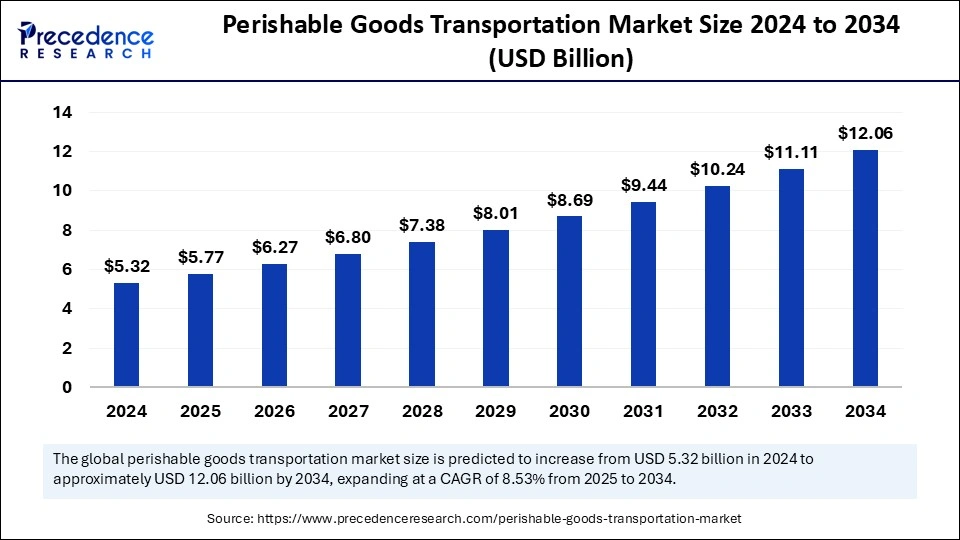
The global perishable goods transportation market size is valued at USD 5.77 billion in 2025 and is predicted to increase from USD 6.27 billion in 2026 to approximately USD 12.96 billion by 2035, expanding at a CAGR of 8.43% from 2026 to 2035. The raised demand for fresh and perishable products is the key factor driving market growth. Innovations in cold chain logistics technology, coupled with the surge in online food delivery, can fuel market growth further.
Perishable Goods Transportation Market Key Takeaways
- North America dominated the perishable goods transportation market in 2025.
- Asia Pacific is expected to grow at the fastest CAGR over the forecast period.
- By type, the MPS segment held the largest market share in 2025.
- By type, the dairy and frozen desserts segment is expected to grow at the fastest CAGR over the forecast period.
- By transportation mode, the road transportation segment contributed the highest market share in 2025.
- By transportation mode, the air transportation segment is anticipated to grow at the fastest CAGR during the projected period.
What is the Role of Artificial Intelligence (AI) in Enhancing Operational Efficiency for Perishable Transportation?
Artificial Intelligence provides a powerful facility for perishable transportation to optimize operations, reduce losses, and improve overall efficiency by streamlining routes and forecasting demand to monitoring temperature to ensure grade control. Furthermore, AI is transforming how perishable goods are shipped and managed. Algorithms can also process historical sales data, weather patterns, seasonality, and social media trends to create precise demand forecasts.
- In July 2024, Walmart embraced AI and automation to boost its supply chain through new builds, expansions, and retrofits. This initiative comes at a crucial time when the global food industry is grappling with unprecedented challenges, from climate-induced disruptions to geopolitical tensions affecting distribution networks.
What is Perishable Goods Transportation?
Perishable goods transportation is the service that implies the movement of moisture and temperature-sensitive products from one location to another. It involves the transport of vegetables, fruits, meats, dairy products, seafood, pharmaceuticals, and bakery goods. The most commonly utilized modes of transportation include reefer containers, refrigerated trucks, sea freight, and air cargo. The perishable goods transportation market services are widely used to ensure safety, maintain product quality, and extend shelf life.
What are the Growth Factors in the Perishable Goods Transportation Market?
- The growing adoption of plant-based and natural diets, such as vegetables, berries, and fresh fruits, is expected to boost market growth soon.
- The surge in the adoption of electric vehicles (EVs) that are sustainable can propel market growth shortly.
- The ongoing implementation of various government policies will likely contribute to the perishable goods transportation market expansion.
Perishable Goods Transportation Market Outlook
- Industry Growth Overview: The perishable goods transportation market was projected to have strong growth from 2025 to 2030 as a result of increased demand for safe, temperature-controlled logistics. Factors driving growth included global food exports, more stringent quality regulations, and the growth of Online Grocery Platforms. Additionally, the upgrade of cold chain solutions in the Asia-Pacific and North America regions drove higher transport/ shipment volumes over long distances.
- Sustainability Trends: Sustainability influenced the perishable goods transportation market as companies transitioned to more fuel-efficient fleets and eco-friendly refrigeration, along with investing in smart route planning to reduce the total transportation emissions. In response to the more stringent climate regulations in the United States and Europe, larger cold chain operators increased their investments in solar-powered storage facilities and low global warming potential refrigeration systems.
- Global Expansion: The major players in the perishable goods transportation market have expanded their operations into Southeast Asia, Eastern Europe, and LATAM to be closer to their suppliers and reduce transportation lead times. Numerous companies have opened new cold chain hubs in Vietnam, Poland, and Mexico to support the growth in exports and provide a more reliable delivery within the region.
- Major Investors: Private equity firms and logistics experts have increased their presence in the marketplace due to their high profitability and reliable future demand. Additionally, both private equity firms and logistics experts also consider their environmental responsibilities (ESG) when deciding where to invest. Major opportunities for larger investors now exist within refrigerated fleet operators and cold-storage network developers located throughout North America and South America.
- Startup Ecosystem: Companies focused on providing innovative smart refrigeration products, utilizing sensor-based tracking systems, and employing AI technology for optimizing delivery routes have received great interest. Examples of successful start-ups include TempAlytics (USA) and FrostLink Labs (India), which have attracted significant venture capital investment based on their energy-saving refrigerator systems and real-time spoilage-risk analysis of perishable goods being shipped.
Market Scope
| Report Coverage | Details |
| Market Size by 2035 | USD 12.96 Billion |
| Market Size in 2025 | USD 5.77 Billion |
| Market Size in 2026 | USD 6.27 Billion |
| Market Growth Rate from 2026 to 2035 | CAGR of 8.43% |
| Dominated Region | North America |
| Fastest Growing Market | Asia Pacific |
| Base Year | 2025 |
| Forecast Period | 2026 to 2035 |
| Segments Covered | Type, Mode of Transportation, and Regions |
| Regions Covered | North America, Europe, Asia-Pacific, Latin America and the Middle East & Africa |
Market Dynamics
Drivers
The expansion of the e-commerce industry
The surge of e-commerce grocery platforms has substantially raised the demand for the perishable goods transportation market. Consumers are increasingly preferring fresher and faster deliveries, facilitating logistics companies and retailers to invest heavily in temperature-controlled transportation. In addition, the popularity of frozen food subscriptions, meal-kit services, and fast commerce grocery models has boosted the adoption of efficient cold chain logistics.
- In March 2025, Kenya Railways announced the deployment of Reefer wagons for transporting perishable goods to the Port of Mombasa. The Corporation has introduced Reefer wagons, which will facilitate the transportation of perishable cargo. Fresh produce/perishables can now be collected from Fresh Produce Consolidation Centres and transported via rail to the Port of Mombasa.
Restraint
Short shelf life
The short shelf life of perishable goods is the major factor hindering the perishable goods transportation market expansion. Perishable goods have limited shelf life, requiring timely and efficient logistics processes to make sure they reach customers in good condition. Moreover, minor delays in delivery can substantially affect the shelf life of perishable goods, which can lead to financial losses and spoilage.
Opportunity
Increasing adoption of eco-friendly vehicles
The market is increasingly using eco-friendly vehicles, fueled by the need for eco-friendly practices and environmental concerns. Hence, fuel-efficient options such as electric vehicles are gaining traction. Furthermore, the adoption of EVs includes refrigerated trucks, which are gaining popularity as they provide zero-emission transportation and minimize carbon footprints. Major players are also heavily investing in fuel-convenient vehicles to reduce environmental impact.
- In June 2024, Revfin, the digital lending platform for sustainable mobility, announced a collaboration with Kalyani Powertrain Ltd (KPTL), the electric mobility arm of Bharat Forge Ltd, and Bluwheelz, a provider of sustainable logistical solutions. Together, they aim to introduce retrofitted electric trucks to the Indian logistics sector.
Segment Insights
Type Insights
The MPS segment held the largest perishable goods transportation market share in 2025. The dominance of the segment can be attributed to its capability to offer streamline and more detailed logistics solutions. This factor ensures smooth cold chain operations and optimized overall efficiency. In addition, the increasing need for processed and fresh foods, the globalization of trade, and technological innovations in cold chain logistics will impact positive segment growth soon. Consumers are increasingly preferring fresher and healthier food options such as meat, poultry, and seafood.
The dairy and frozen desserts segment is expected to grow at the fastest rate over the forecast period. The growth of the segment can be credited to the innovations in cold chain technology, globalization, and rising demand for this product across the globe, which leads to efficient and safe transportation. Additionally, the need for thermal-controlled storage and transportation of dairy and frozen desserts has also impacted the segment's growth positively. Urbanization and globalization have facilitated the demand for frozen and fresh products, such as frozen desserts and dairy, which require reliable and efficient transportation solutions.
- In October 2024, Kaiser, a new brand specializing in frozen oat-based desserts, launched across select retailers in Quebec. The brand was developed by Nathan Kaiser, a Canadian farmer with extensive experience in small-batch oat production. The range includes family-sized tubs and chocolate-dipped bars, with flavors such as Salted Caramel, Mint Chip, and Cookies & Cream.
Transportation Mode Insights
The road transportation segment dominated the perishable goods transportation market in 2025 by holding the largest share. The dominance of the segment can be linked to the cost-effectiveness, flexibility, and wide reach of this mode of transportation into various geographical areas. Moreover, unlike sea or air transport, roadways provide last-mile connectivity, which makes them convenient for short to medium-distance transportation. Also, the enhanced highway networks ensure sophisticated temperature-controlled logistics.
The air transportation segment is anticipated to grow at the fastest rate during the projected period. The growth of the segment can be driven by a surge in global food trade along with the consumer demand for processed and fresh foods. Furthermore, consumers are prioritizing healthy dietary habits, which leads to a greater demand for natural and fresh foods, which are generally transported via air.
- In November 2024, an Odisha-based startup, Bon V Aero, launched a fully autonomous logistics drone service called Air Orca. The launch of drone service was launched in the presence of venture capitalist Tim Draper.
Regional Insights
North America dominated the perishable goods transportation market in 2025. The dominance of the region can be attributed to the increasing demand for perishable and fresh products coupled with the wide agricultural production in the region. Moreover, strict food safety regulations by the USDA and FDA necessitate the strict management of perishable goods, boosting funding for refrigerated transport solutions.
- In September 2024, Kuehne + Nagel introduced a blockchain-powered digital platform for perishable goods tracking. It enhances transparency by allowing real-time monitoring of shipments. This reduces spoilage risks and ensures product quality across the supply chain.
U.S. Market Trends
In North America, the U.S. led the perishable goods transportation market. Owing to the rising integration of Internet of Things (IoT) technology, the country is improving temperature monitoring, real-time tracking, and predictive analytics. Also, raised consumer awareness regarding the green perishable goods transportation can propel market growth soon.
Asia Pacific is expected to grow at the fastest rate in the perishable goods transportation market over the forecast period. The growth of the region can be credited to the increasing urbanization and growing population, coupled with the rise in the middle class in developing countries such as China and India. Furthermore, the growth of urban food delivery services propels regional market expansion.
China Market Trends
In Asia Pacific, China led the market. The dominance of the country is due to the growth of the e-commerce industry, especially for fresh food, which is creating lucrative demand for more reliable and efficient cold chain logistics. Advancements in temperature-controlled warehousing, refrigerated transportation, and real-time monitoring systems are enhancing quality and efficiency.
Why did Europe grow at a considerable rate in the Perishable Goods Transportation Market?
With solid export markets for food products, strict safety regulations, state-of-the-art fleets of refrigerated transport, growing populations, and high demand for organic goods, Europe was expanding considerably. In terms of innovation, Europe has focused on developing low-emission cooling systems and smart, efficient monitoring systems for refrigerated products. Continuing to create cross-border logistics, cold storage facilities, and investments would provide additional growth for Europe.
Germany Perishable Goods Transportation Market Trends
Germany was the leader in this growing Europe due to strong logistics systems, laws controlling the transportation of food and medicines, and an extremely high export demand for dairy products, bakery goods, and meat, allowing for the transport of large volumes of refrigerated goods. A rigorous investment in digital tools to monitor and maintain appropriate temperature conditions for food has helped Germany to remain at the forefront of refrigerated transport and logistics in Europe.
Why did Latin America grow at a steady rate in the Perishable Goods Transportation Market?
A consistent increase in exports of fruits, vegetables, seafood, and meats contributed to a steady increase in Latin America's economy, increasing the level of investment in refrigerated storage and temperature-controlled delivery systems across many countries. A strong trade relationship between North America and Europe aided the expansion of the food industry of Latin America, leading to an increase in the number of opportunities available for companies that provided moderate temperatures to transport their products throughout the world.
Brazil Perishable Goods Transportation Market Trends
The largest exporter of meat and fruits in Latin America was Brazil. Brazil modernized its cold chain centers to enable the transportation of products over long distances. Supermarkets and food chain operators requested a large number of trucks equipped with refrigeration. Through the expansion of Brazilian ports to accommodate large volumes of perishable products and through other factors, Brazil became the leading player in the development of the Latin American refrigerated logistics market.
Why did the Middle East & Africa grow at a considerable rate in the Perishable Goods Transportation Market?
The Middle East & Africa have been steadily expanding over the past couple of years, due to growing urbanization creating greater demand for fresh dairy products, meats, and imported fruit. The hot temperatures in many areas have necessitated the use of temperature-controlled transportation. The majority of these areas have invested in building new refrigerated warehouses and purchasing modern refrigerated trucks. In addition, there has also been growth in tourism, hospitality, and pharmaceuticals, which have all aided in the development of this region's cold-chain markets.
The UAE Perishable Goods Transportation Market Trends
Due to the development of high-tech logistics centres, the United Arab Emirates has become the leader in cold-chain service development throughout the region, primarily due to its significant need for food imports. As a result, the UAE has been able to expand its modern cold-storage warehouses and enhance its refrigerated fleet to increase its ability to handle international shipments. With the continued growth of the tourism/hospitality sectors, there has been an increasing desire for dependable cold-chain services.
Perishable Goods Transportation Market Companies
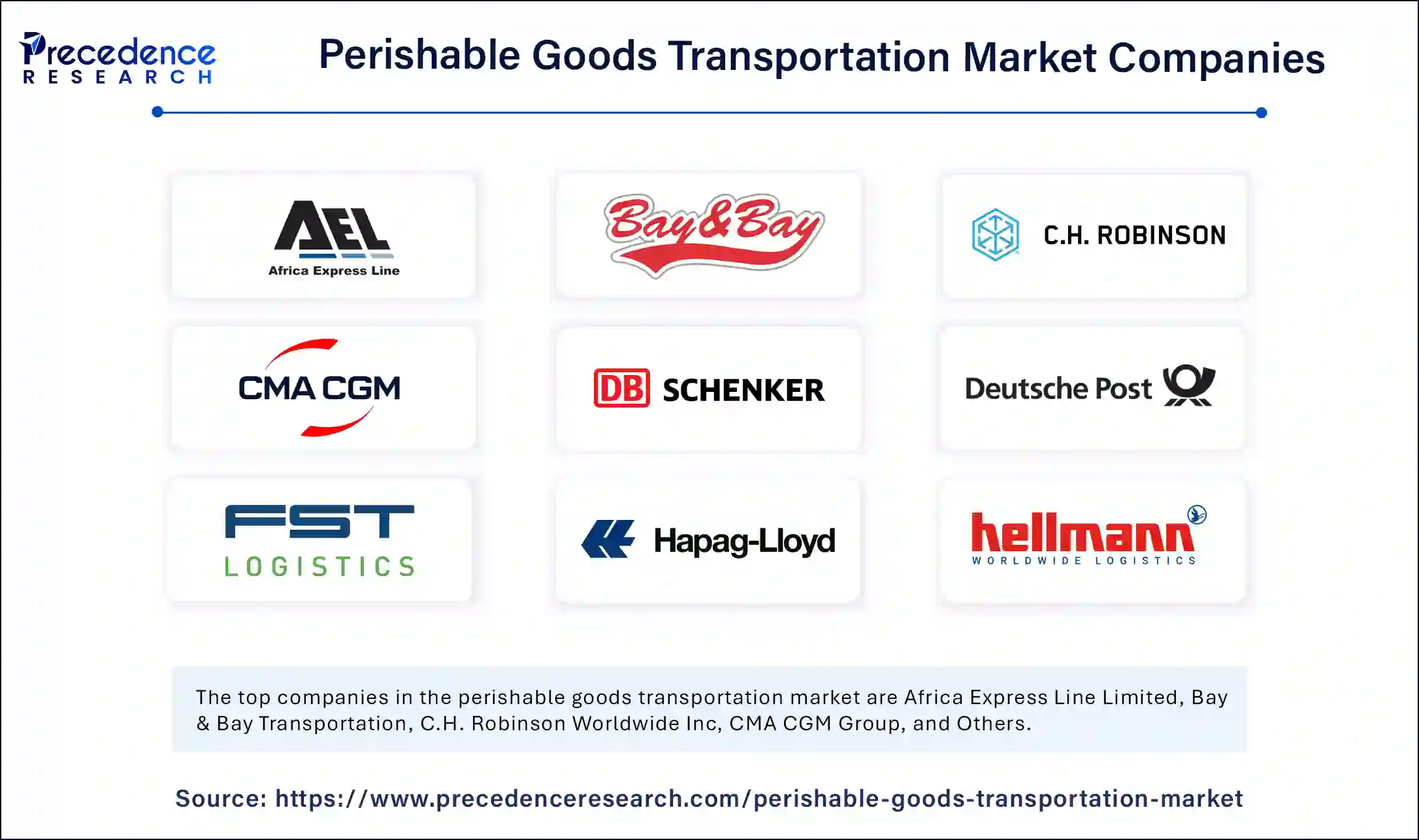
- Africa Express Line Limited
- Bay & Bay Transportation
- C.H. Robinson Worldwide Inc
- CMA CGM Group (MERIT France SAS)
- DB Schenker
- Deutsche Post AG
- FST Logistics Inc
- Hapag-Lloyd AG
- Hellmann Worldwide Logistics SE
- K Line Logistics Ltd (Kawasaki Kisen Kaisha Ltd)
Latest Announcements by Market Leaders
- In November 2024, FST Logistics, a leading provider of third-party logistics solutions, announced the opening of a new warehouse in Fort Worth, Texas. This expansion is vital to FST Logistics' strategic growth plan to enhance its network and better serve its customers across the U.S. The new 383,930-square-foot facility will significantly increase FST Logistics's total storage capacity.
- In February 2025, Hapag-Lloyd announced it would use green financings for the 24 large container ships it ordered in October 2024. The new buildings will have a combined capacity of 312,000 TEUs and involve a combined investment volume of around USD 4 billion. The financing consists of four components. Around USD 900 million of the purchase price will be financed using the company's funds.
Recent Developments
- In December 2024, Maersk introduced a fleet of refrigerated containers with IoT sensors for real-time monitoring of perishable goods. This technology enhances efficiency and safety in transporting temperature-sensitive products. By maintaining optimal conditions, the initiative ensures product integrity throughout the supply chain.
- In November 2024, DHL expanded its cold chain logistics with temperature-controlled warehouses and transport solutions. This initiative meets the rising demand for efficient perishable goods transportation. Industries like pharmaceuticals and fresh food benefit from improved storage and distribution reliability.
- In September 2024, The Rhenus Group launched Rhenus Fresh in Spain, offering temperature-controlled transport for perishables. This service provides door-to-door maritime and air logistics for fresh and frozen goods. Rhenus aims to meet growing demand while enhancing efficiency and sustainability in Spain's supply chain.
- In May 2023, Hirschbach Motor Lines, Inc., a developing refrigerated trucking company, and Aurora Innovation, Inc., a U.S.-based self-driving car technology company, announced plans to launch a commercial pilot in May 2023 to test and safely implement autonomous trucking for refrigerated cargo between Dallas and Houston.
Segments Covered in the Report
By Type
- MPS
- Dairy and Frozen Desserts
- Vegetables & Fruits
- Bakery & Confectionery
By Mode of Transportation
- Rail Transportation
- Air Transportation
- Marine Transportation
- Road Transportation
By Geography
- North America
- Europe
- Asia Pacific
- Latin America
- Middle East and Africa
For inquiries regarding discounts, bulk purchases, or customization requests, please contact us at sales@precedenceresearch.com
Frequently Asked Questions





Ask For Sample
No cookie-cutter, only authentic analysis – take the 1st step to become a Precedence Research client
 Get a Sample




 sales@precedenceresearch.com
 Schedule a Meeting
