



Pharma 5.0 Market, Global Market Size, Segmentation, Regional Analysis, Human-Centric Pharmaceutical Manufacturing, Smart Factory Transformation, AI-Driven Drug Development
The pharma 5.0 market is valued at USD 8.05 billion in 2025 at a CAGR of 22.07%. The market is moving forward, with the incorporation of AI, robotics, digital twins, advanced analytics, connected manufacturing systems, and human-centric production models. Deepa Pandey, Sr. Research Analyst, researched applications for competitive benchmarking or strategic decision-making for pharmaceutical companies, biotechnology companies, technology providers, healthcare organisations, and investors.
Source: https://www.precedenceresearch.com/pharma-50-market
 Get a Sample
 Table Of Content


Pharma 5.0 Market Growth, Innovations and Market Size Forecast
The pharma 5.0 market is forecasted to expand from USD 9.83 billion in 2026 to USD 59.14 billion by 2035, growing at a CAGR of 22.07% from 2026 to 2035. Deepa Pandey has more than 5 years of experience in healthcare analytics and explains that the time for technology-driven transformation in the pharmaceutical industry has arrived. The global pharma 5.0 market size is expected to grow at a CAGR of 22.07% during the forecast period.
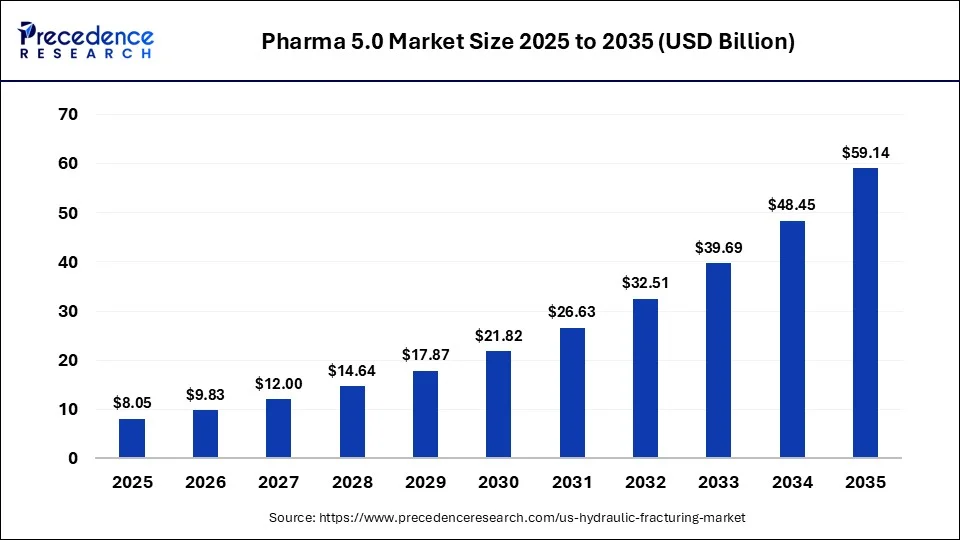
Deepa Pandey states that the rising use of AI and machine learning, smart manufacturing platforms, collaborative robotics, digital twins, and real-time data analytics are the biggest game-changers to watch closely. Additionally, the emphasis is moving towards personalized treatments, flexible manufacturing, sustainability, and collaboration of human and machine elements. This trend is likely to reinforce Pharma 5.0 implementation in pharmaceutical and biotechnology manufacturing.
Key Takeaways
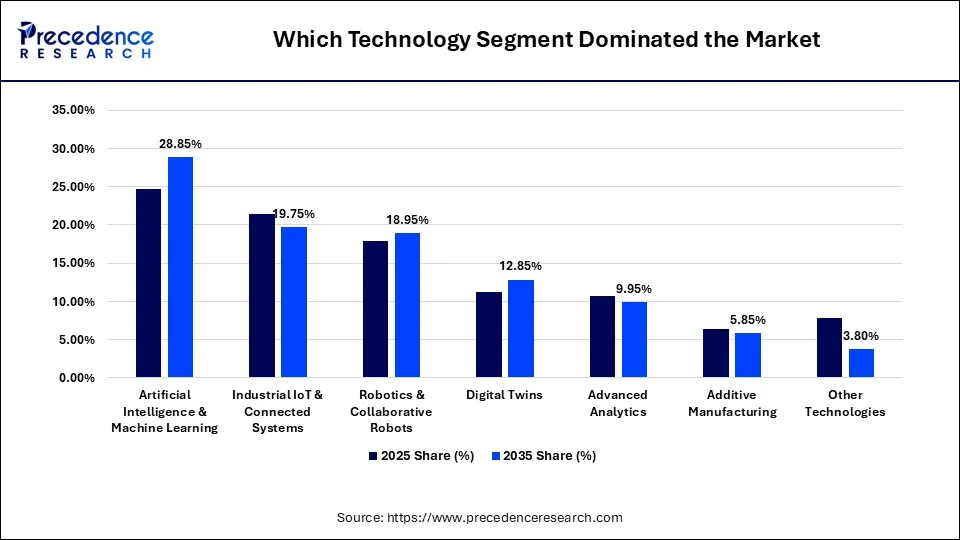
- By technology, the artificial intelligence and machine learning segment led the market with a share of 24.65% in 2025.
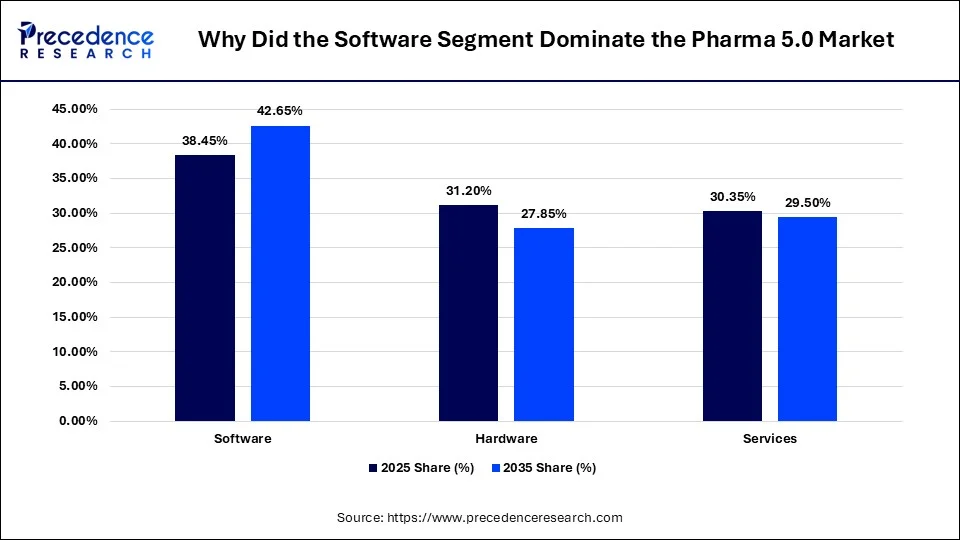
- By component, the software segment led the market with a 38.45% share in 2025.
- By application, the manufacturing and production segment captured a major revenue share of 28.75% in 2025.
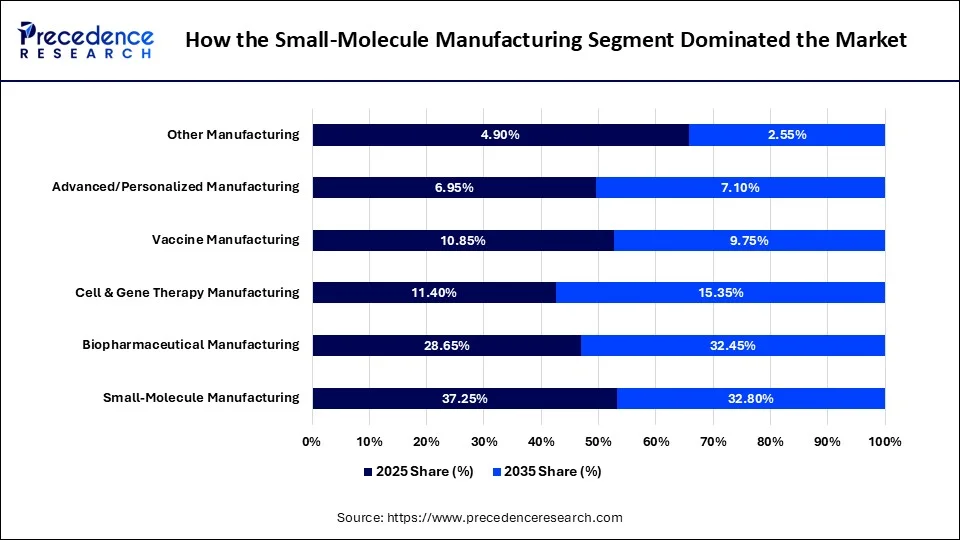
- By manufacturing type, the small molecule manufacturing segment captured the largest market share of 37.25% in 2025.
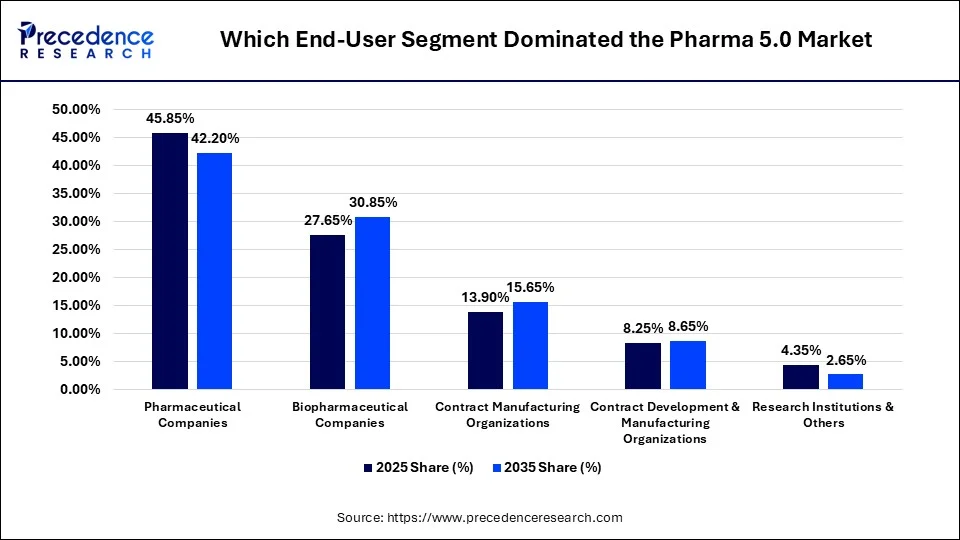
- By end-user, the pharmaceutical companies segment led the market with a share of 45.85% in 2025.
- Sanofi is leading the way in AI supply chain forecasting, forecasting 80% of stock disruptions and identifying the underlying cause of 65% of supply chain risks.
- The U.S. remains the world leader in the use of artificial intelligence, smart factories, advanced manufacturing, cloud technologies, and robotics.
- An upfront technology cost is a significant hurdle for small and medium manufacturers in scaling up digital transformation.
- The most significant opportunities for Industry 4.0 are in AI, Digital twins, IIoT, Robotics, Cloud, and advanced analytics, particularly in Cell & Gene Therapy,
- Biologics, Lab Automation, and Cloud-based Manufacturing.
- Measurable operational benefits are being achieved with the use of digital tools: deviations have been reduced by more than 20%, raw-material stocks have been reduced by 30%+, and lead times are now shortened by more than 35%.
Market Outlook
The global Pharma 5.0 market is expected to reach approximately USD 59 billion by the end of the 2030s at a CAGR of 22.07% through 2035. Combines AI and machine learning, industrial IoT, robotics, collaborative robots, digital twins, advanced analytics, cloud platforms, and connected quality and flexible manufacturing technologies. The shift is a direct evolution from Pharma 4.0. But with a significantly more pronounced focus on building a human-machine system as opposed to mere automation, as well as sustainability, resilience, and adaptive production.
The European Commission sees three key elements as the principles and fundamentals of this more encompassing Industry 5.0 transformation. Human-centricity, sustainability and resilience, and ISPE's Pharma 4.0 define other key pillars. These require greater connectedness of production, greater real-time decision-making, adaptive operations, digital twins, closer integration between operational and information technology (OT/IT), AI and machine learning, and robotization.
Expert Analyst View - Market Outlook
The high technology structure and 22.07% CAGR are not just the typical pharmaceutical manufacturing upgrade cycle. I see greater opportunities as manufacturers shift away from individual automation projects and create a dream repository of integrated environments that place AI, plant-floor data, MES, lab systems, quality management, digital twins, and cloud infrastructure all together.
Regulatory acceptance is also becoming increasingly important. The FDA published draft guidance on risk-based credibility assessment for AI models to assist in regulatory decisions regarding drugs and biological products in January 2025. The agency has also pinpointed AI in manufacturing as an emerging manufacturing technology that should be further developed through regulation.
Which Technology Segment Dominated the Market?
Source: Precedence Research Database
AI and machine learning are the primary technology segment with 24.65 % market share in 2025. This will grow to 28.85 % by 2035 at a CAGR of 23.95 %, forming the intelligent decision-making layer. It aggregates process optimisation throughout a plant.
Digital twins are showing the fastest rate of overall growth in the entire category, starting from 11.25 to 12.85 % share at 25.05 % CAGR. Due to their ability to help manufacturers model processes, anticipate issues, and optimize manufacturing without having to actually do it physically.
Expert Analyst View - Technology
AI/ML is being developed to become the intelligence layer in Pharma 5.0. IIoT is the backbone of data infrastructure, and robotics is the physical side of automation. The added value of digital twins lies in their ability to keep engineering, manufacturing, validation, and operational data together in a single place.
There is a great business opportunity to combine AI with a system in the factory rather than standalone apps. Sanofi claims to have leveraged AI and probabilistic planning to forecast 80% of stock disruptions, pinpoint root causes for 65% of risks, and to deploy digital twins at its factories.
Why Did the Software Segment Dominate the Pharma 5.0 Market?
Source: Precedence Research Database
This category dominates, with the software component commanding 38.45 % of the total market in 2025. Rising to 42.65 % by 2035 at a 23.25 % CAGR. Driven by the reliance of manufacturers on AI platforms, analytics, digital twins, MES, and connected quality tools that are provided through software, not just hardware.
Services eased by a modest 30.35 % to a growth rate of 21.75 %, amid integration, consulting, implementation, and continuous upkeep activities. These rarely generate airwaves for technologies but are essential to actually have and maintain if one were to deploy technologies.
Expert Analyst View - Component
As more value is being added to software, so are pharmaceutical companies deploying significant automation hardware but needing more data and intelligence. While implementation is not a trivial process, it includes validation, system integration, cyber security, data governance, change management, and regulatory compliance, and it is essential that services continue to play a role. Cybersecurity, system integration, interoperability, and validation are key factors to think about during the transition to connected digital architectures, ISPE emphasises.
Which Application Segment Led the Pharma 5.0 Market?
Source: Precedence Research Database
Manufacturing and Production is the highest-occupying segment with 28.75 % market share in 2025. This will grow at 21.25 % CAGR to 26.85 % by 2035, supported by the demand for smart and flexible production lines. Laboratory automation shows the sharpest increase in the table, growing from 7.35 % to 8.40 % share in the forecast period at a compound annual growth rate of 24.65 %. Driven by the need for automated testing and workflows. The slowest growth is seen in workforce/human-machine collaboration, shrinking from 6.80 % to 5.10 % with only 18.25 % growth.
Expert Analyst View - Application
The market is transitioning from being based on simple production automation to closed-loop operational intelligence. Predictive maintenance can detect failures in equipment before they occur, and laboratory automation can enhance data integrity, repeatability, and throughput.
Pharmaceutical digitalisation is under tight validation and data-integrity requirements. Therefore, quality management is still very relevant. In FDA's framework for advanced manufacturing, AI in manufacturing is part of the technologies that will be further developed in the regulatory context.
How the Small-Molecule Manufacturing Segment Dominated the Market?
Source: Precedence Research Database
The installed base is in small molecule manufacturing, gaining 37.25% of the market in 2025, further leveling off at 32.80% by 2035 at a CAGR of 20.10%, owing to the decades of installed base. The increased emphasis on personalized medicine is giving cell and gene therapy manufacturing the fastest growth in growth rate here, rising from 11.40% to 15.35% at a 26.95% CAGR.
Expert Analyst View - Manufacturing Type
Cell and gene therapy are closely related to Pharma 5.0 by the fact that their production is very personalized, very sensitive to batch, and data-intensive. These attributes foster flexibility in automation, digital batch records, real-time monitoring, robotics, advanced data analysis, and integrated quality systems. Biopharmaceutical production is also an important component. In the biologics sector, Lonza reported further capacity growth in both its Visp (8000 L) and Portsmouth (2000 L) facilities; further capacity growth is on the horizon.
Which End-User Segment Dominated the Pharma 5.0 Market?
Source: Precedence Research Database
In the 45.85% (21.05% CAGR) overall pharmaceuticals accounted for the highest share in 2025, diminishing to 42.20% by 2035 due to massive digital transformation initiatives built into the industry. Biopharmaceutical companies closed at 27.65%, up to 30.85% on a 23.45% advance, outpacing pharmaceutical companies as biologics manufacturing continues to increase.
Expert Analyst View - End-User
Biopharma and advanced CDMO environments dominate the market, with manufacturing processes ranging from complex and diverse; the ROI of real-time monitoring and predictive analytics is becoming increasingly paramount. This trend is supported by Lonza's activity in 2025, in which contracting activity continued to perform well across all of Lonza's Integrated Biologics network, and investment in large-scale manufacturing capacity for biologics remains on track.
Why Did the On-Premise Segment Dominate the Market?
Source: Precedence Research Database
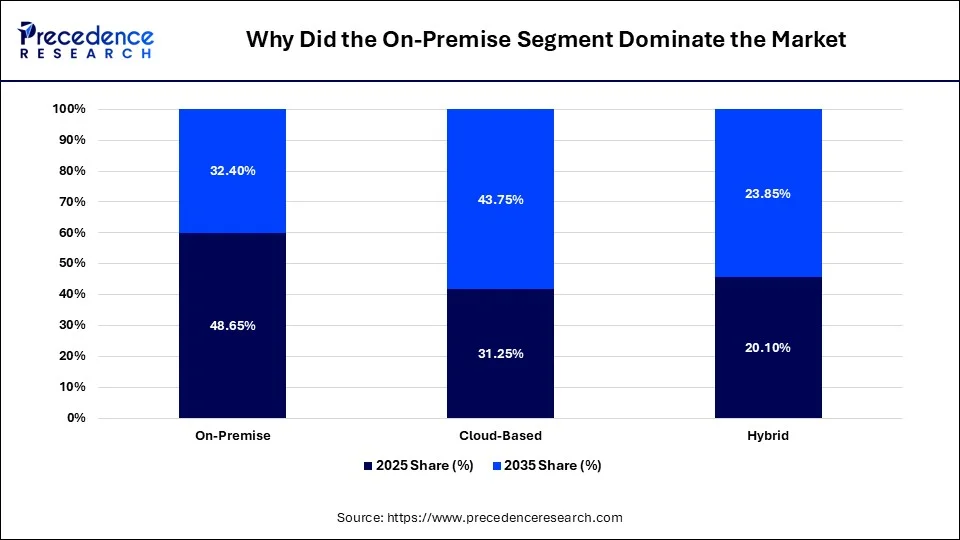
On-premises deployment captures the bigger share in 2025 (48.65%), but this retreats sharply to only 32.40% by 2035, at a CAGR of 17.80%. This segment has the slowest growth of all the deployment types as legacy deployments start losing ground. On-forecast pushers of cloud-based deployment are also demonstrating a strong tendency to outpace on-premise results. They registered a 43.75% share with 25.85% CAGR preliminary gains, well ahead of on-premise before the forecast period comes to an end, owing to the demand for scalable, connected platforms.
Expert Analyst View - Deployment Analysis
Chemical manufacturing's journey to a fully cloud-native environment will most likely be a gradual one owing to the fact that validated legacy systems, OT infrastructure, and site-specific equipment exist. Thus, in the transition, hybrid architectures still play important roles. The strategic importance of utilising the cloud continues to go beyond replacement of plant-floor systems. It builds a scalable enterprise data layer that links a number of manufacturing units, laboratories, and supply-chain operations.
Regional Analysis
Source: Precedence Research Database
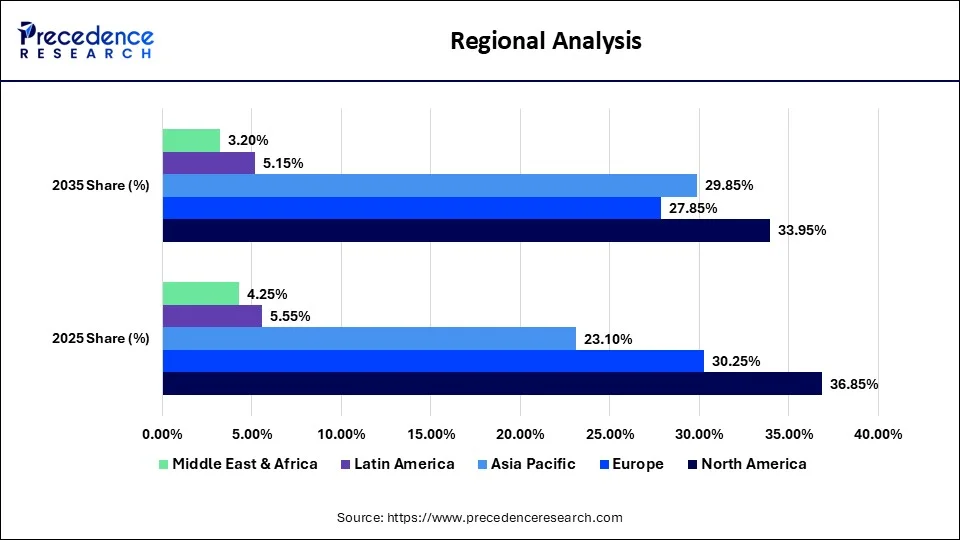
Pharmaceutical technology adoption is picking up momentum in North America, with the region retaining the largest share in 2035 at 33.95% on a CAGR of 20.85 %, as existing technologies are already mature in the region. Europe is also following at 30.25%, declining to 27.85 % growth. Fuelled by strong manufacturing automation, which has been developing over a number of years. On a percentage basis, Asia Pacific will be seeing the highest growth in the entire table and is expected to gain 25.15 % CAGR in pharmaceutical production capacity as the growth is expected to gain significant momentum across the region.
Expert Analyst View - Region
According to our senior researcher, Aman Singh, Pharma 5.0 is becoming a more widely geographically spread transformation in manufacturing, previously a North American and European story of technology adoption. Pharmaceutical manufacturing capacity, biologics, CDMO activity, automation, and digital infrastructure are booming in the APAC region. Making it an important area to watch. There is thus a window of smart-factory engineering, MES integration, automation hardware, data platforms, validation services, and cybersecurity.
Country-Level Opportunity Map
| Country | Strategic Pharma 5.0 Opportunity | Key Demand Areas |
| United States | Very High | AI, smart factories, advanced manufacturing, cloud, robotics |
| Germany | Very High | Automation, industrial IoT, digital twins, engineering |
| Switzerland | Very High | Biologics, CDMO, advanced analytics, digital manufacturing |
| United Kingdom | High | AI, R&D digitalization, advanced manufacturing |
| France | High | Biologics, vaccines, automation, digital supply chain |
| Japan | High | Robotics, precision automation, smart manufacturing |
| China | High | Manufacturing automation, AI, domestic pharma production |
| India | High | Generic manufacturing, vaccines, CDMO, AI and digitalization |
| Singapore | High | Biologics, vaccines, smart factories, regional manufacturing |
| South Korea | High | Biopharma, biologics, automation, digital manufacturing |
| Ireland | High | Large-scale pharma manufacturing, automation, digital quality |
| Italy | Medium–High | Pharma manufacturing, automation and process optimization |
| Spain | Medium–High | Biopharma, manufacturing automation, digital quality |
| Brazil | Medium | Manufacturing modernization and supply-chain digitalization |
| Saudi Arabia | Emerging–High | Local pharmaceutical production and smart manufacturing |
| UAE | Emerging–High | Advanced healthcare manufacturing and digital infrastructure |
Source: Precedence Research Database
Four countries with high strategic opportunity rates on this map are very high. Aditi, vice president at Precedence Research, states that the U.S. is at the forefront across all dimensions of AI, smart factories, advanced manufacturing, cloud, and robotics. These all while being the biggest, most advanced pharmaceutical manufacturing location on the planet. Germany is also scored near the top worldwide in terms of automation, industrial IoT, digital twins, and engineering prowess. This has established a long history of industrial-automation success that goes far beyond the pharma industry.
The second tier of high opportunity includes countries such as the United Kingdom, France, Japan, China, India, Singapore, South Korea, and Ireland. They are not quite as high as the very high opportunity countries. Although they all have at least some of those desired qualities in combination, the scale of meaningful pharmaceutical manufacturing plus digital investment is active.
Expert Analyst View - Country-level Opportunity Map
For near-term opportunities, there is an increased focus on countries that boast both big manufacturing portfolios in the pharmaceutical sector and a high level of digital maturity. The development of another layer of growth is underway in countries ramping up local pharmaceutical and biologics manufacturing. Across Asia Pacific, India, China, Singapore and South Korea are key markets where manufacturing scale is increasingly becoming wedded to automation and biologics.
Industry Data & Operational Evidence
| Indicator | Reported Figure / Development | Pharma 5.0 Relevance |
| Sanofi stock disruption prediction | 80% | AI-enabled supply-chain resilience |
| Sanofi risk correlation | 65% | AI-driven root-cause analysis |
| Sanofi digitized Modulus facilities. | Singapore + Neuville, France | Flexible digital manufacturing |
| Lonza Visp large-scale asset | 20,000 L | Advanced biologics manufacturing |
| Lonza Portsmouth asset | 2,000 L | Scalable biologics production |
| Thermo Fisher effective capacity improvement | 10% | Digital/operational productivity |
| Thermo Fisher Pharma Services deviation reduction | 20%+ | Digital quality improvement |
| Thermo Fisher raw-material inventory reduction | 30%+ | Data-driven supply optimization |
| Thermo Fisher lead-time improvement | 35% | Manufacturing and supply-chain efficiency |
Source: Precedence Research Database
Sanofi's efforts to leverage AI into the supply chain are leading the way for the group. They have predicted 80 % of stock disruption events and correlated 65 % of supply-chain risks to underlying causes, not a pilot project that requires no more than a minor tweak. Thermo Fisher is claiming, among its operating improvements, the ability to gain 10 % capacity efficiency. Further helping to lower deviations by more than 20 % within its Pharma Services business, keeping raw-material inventories at critical sites down by more than 30 %, and cutting lead time by more than 35 % using its digital tools.
Expert Analyst View - Operational Evidence
The examples highlight that the investments in Pharma 5.0 are becoming more justifiable based on measurable operational KPIs. Instead of technology adoption for the sake of it. I believe it is important that the most commercial solutions that come from here prove to be real gains in a reasonably specific array of metrics, such as
- OEE and effective capacity
- Batch-release cycle time
- Deviation rates
- Predictive-maintenance accuracy
- Inventory levels
- Manufacturing lead times
- Energy consumption
- Yield and throughput
- Quality-event detection
- Workforce productivity
Company Intelligence & Competitive Landscape
| Company | Relevant Pharma 5.0 Capability | Strategic Development |
| Pfizer | AI, ML, digital manufacturing and supply | Applying AI/ML across manufacturing and supply operations |
| Sanofi | AI, automation, digital twins | Digitized Modulus facilities and AI-enabled supply planning |
| Lonza | Smart technology, biologics manufacturing, digital modeling | Expansion of advanced biologics manufacturing capacity |
| Thermo Fisher Scientific | AI, analytics, automation, digital manufacturing | Digital tools supporting Pharma Services productivity |
| Roche | AI, advanced analytics, digital healthcare | AI deployment alongside advanced diagnostics and pharma operations |
| AstraZeneca | Digital transformation and data-driven R&D/manufacturing | Broad digitalization across pharmaceutical operations |
| GSK | AI, data and advanced manufacturing | Digital transformation supporting productivity and supply |
| Siemens | Industrial automation, digital twins, industrial software | Enabling technologies for smart pharmaceutical facilities |
| Schneider Electric | Automation, industrial software and energy management | Digital plant and sustainable manufacturing infrastructure |
| Dassault Systèmes | Digital twins and virtual manufacturing | Virtual modeling and simulation for life sciences |
Source: Precedence Research Database
The four companies stand out most clearly in the competitive landscape. AI and machine learning are used throughout the Pfizer business. Including its manufacturing processes and its supply chain, Pfizer reports that its 2025 impact will emphasize the value of digital, data, and AI approaches complementary to human expertise. The clearest example in the whole dataset is Sanofi's use of AI, probabilistic planning, and digitized manufacturing facilities. These are already in operation, not a roadmap. Thermo Fisher Scientific completes the package with digital solutions that are already proving themselves to drive tangible productivity improvements within its Pharma Services portfolio.
Expert Analysis Overview - Company Intelligence
The two biggest companies out there in terms of being practically using these technologies are Sanofi. I think it has advanced algorithmic drug discovery and has treatment deployments with measurable results related to AI and digital. Pfizer, which is enabling us to take novel therapeutics to market and develop product characteristics based on data from AI-driven systems. Thus. There are other companies such as Sanofi, Lonza, Siemens, and Dassault Systèmes as enablers. Further providing the industrial automation and digital-twin software that these firms are developing.
Buyer Intelligence
| Buyer Group | Primary Requirement | Purchase Driver | Key Evaluation Criteria |
| Manufacturing Operations | Smart production systems | Productivity | OEE, throughput, integration |
| Quality & Compliance | Digital quality systems | Compliance | Validation, auditability, data integrity |
| IT / Digital | Enterprise data platforms | Digital transformation | Cybersecurity, interoperability, scalability |
| Engineering | Automation and digital twins | Process optimization | Simulation, integration, reliability |
| Supply Chain | Predictive planning | Resilience | Forecasting, visibility, disruption detection |
| R&D | AI/analytics platforms | Faster development | Model performance, data quality |
| Laboratory Operations | Automation | Productivity | Accuracy, throughput, workflow integration |
| Procurement | Technology platforms | Cost optimization | TCO, implementation time, vendor support |
| Plant Management | Integrated smart-factory systems | Operational excellence | ROI, uptime, workforce productivity |
Source: Precedence Research Database
Manufacturing operations teams desire to see smart production systems. That are based on productivity gains, measured by OEE, system throughput, and integration quality. Practically everything else is a secondary issue. Compliance and quality teams are mostly directed towards quality systems in the digital world. This depends on compliance requirements, prioritizing compliance, validation, and auditability, as well as the integrity of the data. The engineering, R&D, laboratory processes, procurement, and plant management add to the buyer map, with different aspects to consider in each section. Ranging from simulation reliability within the engineering section to TCO within procurement.
Expert Analyst View - Buyer Intelligence
Pharma 5.0 purchasing decisions are made by multiple functions and are not only IT-related. It is common for large deployments to have manufacturing, quality, engineering, IT, supply chain, validation, cybersecurity, and procurement teams. Vendors are thus required to prove both technology performance and regulatory readiness. In addition to technical capabilities, buyers consider factors such as system integration, explainability, change-control requirements, cybersecurity, and validation when evaluating AI and automation solutions in a pharmaceutical context.
Key Growth Drivers
AI-enabled manufacturing intelligence
AI processes vast numbers of data relating to production, quality, and the supply chain, enabling predictive operational insights.
Increasing biologics complexity
Tightly controlled, optimized manufacturing environments are necessary for biologics, advanced modalities, and cell and gene therapies.
Predictive maintenance
The manufacturing industry crisis is transforming from failing it will become possible to prevent failures through predictive models of equipment degradation.
Digital twins
Digital twins allow manufacturers to make changes to a process virtually, improve the manufacturing process, and minimize risks involved in physical experimentation.
Workforce augmentation
Pharma 5.0 is based on the principle of people and machines working together, not to replace people.
Supply-chain resilience
Geopolitical change, shortages, and increasingly dispersed manufacturing networks are increasing the need for predictive planning and real-time supply-chain visibility.
Sustainability
AI solutions have the potential to help optimize energy use, reduce waste, and leverage resources in more efficient ways for energy-intensive manufacturing, such as in the pharmaceutical industry.
Key Market Challenges
| Challenge | Market Impact |
| High implementation cost | Slows adoption among smaller manufacturers |
| Legacy systems | Makes enterprise-wide integration difficult |
| Regulatory validation | Extends deployment timelines |
| Data quality | Limits AI model performance |
| Cybersecurity | Expands risk across connected plants |
| Workforce skills gap | Creates demand for specialized training |
| Interoperability | Makes multi-vendor environments difficult |
| Change management | Requires organizational and cultural transformation |
| AI explainability | Important for regulated decision-making |
| ROI uncertainty | Can delay large-scale investment |
Source: Precedence Research Database
Large upfront technology investments are particularly off-putting to smaller manufacturers as they generally have less capacity to implement at high costs. Enterprise-wide integration is a real challenge when connecting legacy systems. Most pharmaceutical plants become non-modern-oriented in terms of connectivity over time. Regulatory validation will significantly add to deployment timelines, as any new system that will be at any point in a regulated process must undergo formal validation before it can be deployed.
Expert Analyst View - Risks
The challenge is not always around technology availability. It's about the ability to integrate, validate, and scale advanced technologies while complying with different regulatory manufacturing environments. There are multiple challenges involved regarding digital transformation in pharmaceuticals, including increasing connectivity, point-to-point integration and validation, and multi-site scaling.
Strategic Market View
The evolving world of Pharma 5.0 is moving beyond discrete automation to intelligent, connected and adaptive pharmaceutical operations. The intelligence layer that links equipment, manufacturing processes, labs, quality systems and supply chains is becoming increasingly vital – and increasingly powered by AI and software.
Combining AI, the digital twin, IIoT, robotics, cloud and advanced analytics is where the brightest possibilities lie. The areas highlighted as critical growth areas within the segmentation covered are: cell and gene therapy, biologics, lab automation, and cloud-based manufacturing.
The competition is also heading to an outcome-driven DT. The pressure on pharmaceutical manufacturers to deliver measurable improvements in capacity, quality, inventory, lead times, maintenance, resilience, and more than technology deployment only is growing. Both Sanofi and Thermo Fisher have shown this trend toward improving measurable productivity and supply-chain results in their operational examples recently.
Expert Insights
Shifting from automated and manufacturing-oriented approaches towards a human-oriented and connected Pharma 5.0 ecosystem for the pharmaceutical industry. There is a great opportunity to find attractive solutions to the various challenges organisations face in the field of AI, advanced robotics, digital twins, and flexible manufacturing platforms. I believe this pace of change within the pharmaceutical industry is driving the next era of pharmaceutical transformation.
Organisations seek to ramp up their ability to develop drugs faster, manufacture them more accurately, make them harder to sabotage in the supply chain, and personalise medicines. Furthermore, pharmaceutical firms will increasingly prioritize the integration of human talent and intelligent solutions.
Our Experts
Deepa Pandey, a Senior Research Analyst, conducted the primary market research, methodology development, segmentation, region/industry concepts, competition, technology adaptation and forecasts, and created the analytical template for the report.
Amit Singh, a Head of Research & Multidisciplinary Strategist, handled the collection and validation of regulatory interventions, corporate financial information, R&D activity of the companies, and other quantitative information sourced independently, which helps in building the facts database on which the market estimates are based.
Aditi, Vice President, analysed the entire research paper, quality-checked it, validated and refined its content, and corrected inconsistencies to achieve accuracy and clarity in the report.
Pharma 5.0 Market Complete Segmentation List
By Technology
- Artificial Intelligence & Machine Learning
- Industrial IoT & Connected Systems
- Robotics & Collaborative Robots
- Digital Twins
- Advanced Analytics
- Additive Manufacturing
- Other Technologies
By Component
- Software
- Hardware
- Services
By Application
- Manufacturing & Production
- Quality Management & Compliance
- Supply Chain Management
- Research & Development
- Predictive Maintenance
- Laboratory Automation
- Workforce & Human-Machine Collaboration
By Manufacturing Type
- Small-Molecule Manufacturing
- Biopharmaceutical Manufacturing
- Cell & Gene Therapy Manufacturing
- Vaccine Manufacturing
- Advanced/Personalized Manufacturing
- Other Manufacturing
By End User
- Pharmaceutical Companies
- Biopharmaceutical Companies
- Contract Manufacturing Organizations
- Contract Development & Manufacturing Organizations
- Research Institutions & Others
By Deployment
- On-Premise
- Cloud-Based
- Hybrid
By Region
- North America
- US
- Canada
- Mexico
- Rest of North America
- South America
- Brazil
- Argentina
- Rest of South America
- Europe
- Western Europe
- Germany
- Italy
- France
- Netherlands
- Spain
- Portugal
- Belgium
- Ireland
- UK
- Iceland
- Switzerland
- Poland
- Rest of Western Europe
- Eastern Europe
- Austria
- Russia & Belarus
- Turkiye
- Albania
- Rest of Eastern Europe
- Asia Pacific (APAC)
- China
- Taiwan
- India
- Japan
- Australia and New Zealand
- ASEAN Countries (Singapore, Malaysia)
- South Korea
- Rest of APAC
- Middle East and Africa (MEA)
- GCC Countries
- Saudi Arabia
- United Arab Emirates (UAE)
- Qatar
- Kuwait
- Oman
- Bahrain
- South Africa
- Egypt
- Rest of MEA
- GCC Countries
For inquiries regarding discounts, bulk purchases, or customization requests, please contact us at sales@precedenceresearch.com
Frequently Asked Questions





Ask For Sample
No cookie-cutter, only authentic analysis – take the 1st step to become a Precedence Research client
 Get a Sample
.webp)



 sales@precedenceresearch.com
 Schedule a Meeting
