



Physical Rehabilitation Center Market Size, Companies, Share, Patient Volume, Treatment Adoption Rates, Pricing Analysis, Regulatory Landscape, Competitive Positioning, and Demand Forecast
Physical Rehabilitation Center Market (By Program: Standard Outpatient Programs, Intensive Outpatient Programs, Partial Hospitalisation Programs, Hybrid Tele-Outpatient Programs, Specialised Day Rehabilitation; By Therapy: Physical Therapy, Occupational Therapy, Speech & Language Therapy, Cognitive Behavioural Therapy, Contingency Management, Motivational Interviewing, Virtual-Reality-Assisted Therapy, Aquatic/Ocean Therapy; By Condition Treated: Musculoskeletal Rehabilitation, Neurological Rehabilitation, Cardiac Rehabilitation, Pulmonary Rehabilitation, Substance-Use-Disorder Rehabilitation, Others; By End User: Paediatric Population, Adult Population, Geriatric Population, Sports-Injury Patients, Workers’ Compensation Cases) - Global Industry Analysis, Size, Trends, Leading Companies, Regional Outlook, and Forecast 2026 to 2035
Source: https://www.precedenceresearch.com/physical-rehabilitation-center-market
 Get a Sample
 Table Of Content


What is the Physical Rehabilitation Center Market Size in 2026?
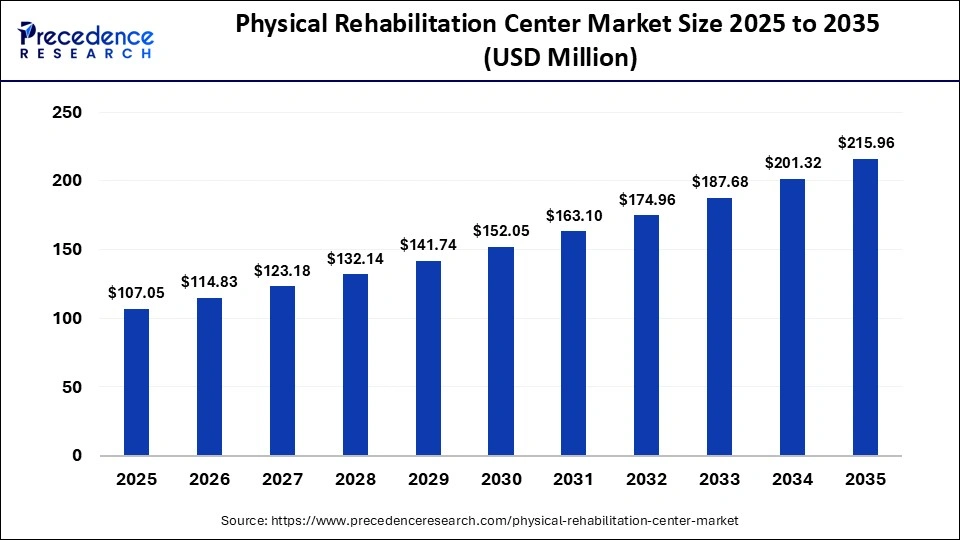
The global physical rehabilitation center market size accounted for USD 107.05 billion in 2025 and is predicted to increase from USD 114.83 billion in 2026 to approximately USD 215.96 billion by 2035, expanding at a CAGR of 7.27% from 2026 to 2035. The market is rapidly growing due to the increasing aging population and chronic illnesses, rising injuries and post-surgical needs, rising developmental disorders in children, and specialized care needs for the elderly, which are driving specific service sectors and a shift towards outpatient and value-based care.
Key Takeaways
- North America held the largest physical rehabilitation center market share in 2025.
- Asia-Pacific is expected to grow at the fastest CAGR during the foreseeable period.
- By program, the standard outpatient programs segment held the largest market share in 2025.
- By program, the hybrid tele-outpatient programs segment is expected to grow at the fastest CAGR during the forecast period.
- By therapy, the physical therapy segment held the largest market share in 2025.
- By therapy, the virtual reality-assisted therapy segment is expected to grow at the fastest CAGR between 2026 and 2035.
- By condition treated, the musculoskeletal rehabilitation segment held the largest market share in 2025.
- By condition treated, the cardiac rehabilitation segment is expected to grow at the fastest CAGR during the foreseeable period.
- By end user, the adult population segment held the largest market share in 2025.
- By end user, the sports-injury patients segment is expected to grow at the fastest CAGR during the foreseeable period.
What are Physical Rehabilitation Centers?
The physical rehabilitation center market comprises a high-growth healthcare sector focused on specialized, multidisciplinary interventions designed to optimize functional independence and mitigate disability following acute medical events or chronic disease progression. A rapidly aging global population, the rising prevalence of chronic musculoskeletal diseases, increased awareness of preventive healthcare, and rapid technological advancements in robotic-assisted rehabilitation and AI-driven diagnostics drive market growth.
The rising demand for post-acute care to prevent re-hospitalization and the expansion of outpatient, cost-effective, and telerehabilitation services are bolstering market expansion. The industry is witnessing a strong shift towards specialized, personalized care, particularly in the orthopaedic and geriatric sectors.
How is AI Influencing the Physical Rehabilitation Center Market?
The integration of artificial intelligence (AI), specifically machine learning (ML), is shifting traditional, manual therapies toward data-driven, personalized care that improves patient outcomes and operational efficiency. Market growth is driven by AI-enabled wearable sensors and computer vision, which allow for real-time movement tracking and automated posture correction during exercises. AI enables highly personalized treatment plans by analyzing large datasets of patient histories to predict recovery trajectories or gamified experiences. AI-powered robotics and remote tele-rehabilitation tools are expanding access to care beyond clinic walls, allowing for continuous monitoring and reducing the need for frequent in-person visits.
Physical Rehabilitation Center Market Trends
- Rise of Hybrid and Tele-Rehabilitation Models: The growing use of in-clinic, hands-on treatment with remote, digital, or home-based follow-ups has become a standard, enhancing flexibility and patient adherence.
- Integration of AI: AI is being used to analyze patient data, track movement patterns, and customize rehabilitation programs, providing more precise and efficient treatment plans. AI acts as a clinical assistant, helping therapists identify imbalances and predict recovery trajectories, enabling data-driven, personalized care that improves long-term outcomes.
- Expansion of Wearable Technology and Real-Time Monitoring: Wearable devices monitor patient mobility and progress outside the clinical settings in real-time. This technology provides therapists with objective data regarding gait, strength, and range of motion, allowing for immediate adjustments to treatment protocols and better, more personalized care.
- Adoption of Virtual Reality and Robotics in Therapy: VR creates engaging, interactive environments that motivate patients, while robotics and exoskeletons provide precise, repetitive movements for neuro-rehabilitation.
- Growing Center of Rehabilitation: Rehab centers increasingly focus on quantifiable functional outcomes rather than just the number of sessions, aligning with the industry's shift toward value-based, cost-effective care.
Market Scope
| Report Coverage | Details |
| Market Size in 2025 | USD 107.05 Billion |
| Market Size in 2026 | USD 114.83 Billion |
| Market Size by 2035 | USD 215.96 Billion |
| Market Growth Rate from 2026 to 2035 | CAGR of 7.27% |
| Dominating Region | North America |
| Fastest Growing Region | Asia Pacific |
| Base Year | 2025 |
| Forecast Period | 2026 to 2035 |
| Segments Covered | Program, Therapy, Condition Treated, End User, and Region |
| Regions Covered | North America, Europe, Asia-Pacific, Latin America, and Middle East & Africa |
Segmental Insights
Program Insights
Which Program Segment Dominated the Physical Rehabilitation Center Market?
The standard outpatient programs segment held the largest market share in 2025. This is because of the optimized reimbursement frameworks and the superior cost-efficiency of ambulatory care models compared to high-overhead inpatient stays. The integration of digital health technologies, such as AI and IoMT, ensures high clinical efficacy and real-time monitoring within flexible, community-based settings. Market expansion is fundamentally underpinned by an aging global demographic and a rising burden of chronic disease, necessitating scalable, long-term therapeutic interventions.
The hybrid tele-outpatient programs segment is expected to show the fastest growth over the forecast period due to leveraging AI-driven remote monitoring and IoMT integration. Providers can ensure high patient adherence and real-time intervention, significantly enhancing value-based care metrics. The model's economic viability is reinforced by favorable reimbursement shifts and reduced overhead, offering a cost-effective solution for managing the rising global burden of chronic and age-related conditions.
Therapy Insights
Why Did the Physical Therapy Segment Dominate the Physical Rehabilitation Center Market?
The physical therapy segment contributed the biggest market share in 2025, as providers are shifting from reactive treatment to high-margin, long-term wellness management due to the growing awareness of robotic-assisted technologies and preventative care. The high utilization of specialized physical therapy across diverse demographics, from geriatric patients to victims of acute trauma. The integration of data-driven outcomes and advanced diagnostics ensures this vertical remains the cornerstone of physical rehabilitation market profitability.
The virtual reality-assisted therapy segment is expected to gain the highest market share between 2026 and 2035 due to the facilitation of neuroplasticity through high-repetition, task-specific stimuli. VR-based systems deliver superior outcomes in complex neurological and geriatric cases compared to conventional methods. From a business perspective, the transition toward portable, FDA-authorized hardware enables scalable tele-rehabilitation models that capture objective biometric data for precise, remote outcome tracking. These systems optimize clinician efficiency and reduce long-term care costs, fostering the segment's growth.
Condition Treated Insights
How the Musculoskeletal Rehabilitation Segment Dominated the Physical Rehabilitation Center Market?
The musculoskeletal rehabilitation segment accounted for the highest market share in 2025, as a critical intersection of an aging global demographic and the high clinical volume of chronic degenerative conditions. By integrating robotic-assisted technologies and IoMT-enabled diagnostics, providers are shifting toward a value-based care model that optimizes post-surgical recovery and long-term functional independence. This sector benefits from a diversified revenue stream, capturing demand from both geriatric care and rising rates of sports-related and occupational injuries.
The cardiac rehabilitation segment is expected to witness the fastest growth in the market over the forecast period due to a strategic shift toward secondary prevention and long-term management of increasing cardiovascular event rates. By leveraging AI-enabled wearables and automated referral systems, providers are capturing a larger patient base through highly accessible, home-based care models. The transition to remote, continuous monitoring enhances clinical adherence and reduces hospital readmissions, positioning cardiac rehab as a vital driver of future healthcare profitability.
End-User Insights
Which End-User Segment Led the Physical Rehabilitation Center Market?
The adult population segment led the market in 2025. This is because high volumes of surgical interventions and chronic condition management necessitate consistent, long-term therapeutic engagement. By shifting towards flexible outpatient models, providers are successfully capturing active professionals who require specialized recovery for sports and workplace injuries without disrupting daily productivity. The rising incidence of lifestyle-related diseases is driving sustained demand for high-margin, multi-disciplinary rehabilitation services.
The sports-injury patients segment is expected to expand rapidly in the market in the coming years due to the strategic integration of regenerative medicine and advanced performance analytics to meet the demand for accelerated recovery. By deploying specialized clinics that focus on return-to-play timelines, providers are capturing a lucrative market of both professional athletes and a growing demographic of high-activity amateurs. The adoption of robotic-assisted tissue repair and AI-driven monitoring shifts the clinical focus from reactive treatment to proactive, long-term injury prevention.
Regional Insights
What Made North America the Dominant Region in the Physical Rehabilitation Center Market?
North America registered its dominance in the market in 2025. This is mainly due to the sophisticated convergence of advanced clinical infrastructure and a high-volume demand for chronic disease management. The favorable reimbursement frameworks, such as Medicare Part B, incentivize the transition towards high-margin, cost-effective outpatient models. The rise of specialized sports medicine for "weekend warriors" and the integration of tele-rehabilitation ensure a diversified and resilient revenue stream. There is a global benchmark for technological adoption and value-based care delivery in post-acute settings.
U.S. Market Analysis
The market in the U.S. is growing due to the strategically fragmented landscape of clinics, offering significant white-space opportunities for institutional consolidation and regional expansion. By integrating AI-enabled platforms, tele-rehabilitation providers are successfully meeting insurer mandates for cost-effective, value-based care. The rapid adoption of robotic-assisted devices and smart mobility aids ensures that standardized, clinic-based services remain the primary vehicle for capturing the rising needs of an aging demographics.
How is Asia-Pacific Growing in the Physical Rehabilitation Center Market?
Asia-Pacific is expected to experience the fastest growth during the predicted timeframe, due to the aggressive government infrastructure investment and a rapid transition toward outpatient-centric models. By integrating high-growth technologies like AI-driven robotics and tele-rehabilitation are overcoming geographic barriers and addressing a rising burden of chronic and traumatic injuries. The combination of rising disposable incomes and digital health adoption positions the region, particularly India and China, as the primary global engine for scalable healthcare innovation.
China Market Analysis
In China, the market is evolving due to the powerful convergence of epidemiological shifts and a rapid digital transformation across the healthcare continuum. A shift toward high-growth segments like sports rehabilitation and AI-integrated outpatient models is successfully scaling services to meet the needs of a burgeoning geriatric and fitness-conscious population. This expansion is further fortified by favorable government policies and expanded insurance coverage, which incentivize the adoption of cost-effective, home-based, and technology-driven care.
Why is Europe Experiencing a Notable Growth in the Physical Rehabilitation Center Market?
Europe is expected to grow at a notable CAGR in the foreseeable future, due to a robust statutory insurance framework, particularly in hubs like Germany and France, which facilitates high utilization of both specialized inpatient and outpatient services. The region's focus on multidisciplinary, technology-enabled care positions Europe as a global leader in high-acuity neurological and musculoskeletal recovery models. National health systems are increasingly prioritizing rehabilitation infrastructure as a cost-containment strategy to reduce long-term disability and hospital readmissions.
Germany Market Analysis
Germany's primary innovation hub is anchored by a robust statutory framework that integrates holistic, non-pharmacological care into the national health strategy. By accelerating the shift toward high-margin outpatient models and DiGA-approved digital therapeutics, providers are successfully optimizing cost-effectiveness while managing a high volume of musculoskeletal and post-operative cases. The rapid deployment of AI-driven personalization and automated mobility solutions, such as advanced patient lifts, is addressing critical labor shortages and enhancing clinical safety standards.
Why is Latin America Significantly Growing in the Physical Rehabilitation Center Market?
Latin America is considered to be a significantly growing area, due to significant private sector investment and the deployment of high-tech infrastructure, including AI-guided tools and robotic-assisted systems, to address a high burden of chronic disease and trauma-related disability. By pivoting towards specialized orthopedic and cardiac care, regional providers are successfully bridging the gap in public health systems through more accessible, high-margin clinical models.
Will the Middle East and Africa Grow in the Market?
The Middle East and Africa are expected to grow at a considerable CAGR in the upcoming period, driven by the integration of AI-enabled tele-rehabilitation and robotics. Providers are successfully addressing a surging burden of chronic diseases and diabetes-related amputations, with patient preference for home-based care. An aging demographic and a rising demand for advanced sports medicine as regional fitness participation expands. The development of specialized, technology-driven infrastructure positions the GCC as a premier global destination for high-value, post-acute clinical investment.
Physical Rehabilitation Center Market Supply Chain Analysis
- Inputs and Equipment Supply (Raw Materials & Technology)
This stage involves the manufacturing and supplying of essential rehabilitation equipment, including physiotherapy tools, robotic-assisted devices, exercise apparatus, and electrotherapy units.
Key Players: Medline Industries, Invacare Corporation, Dynatronics Corporation, Smith+Nephew, Esko Bionics, Drive Devilbiss Healthcare.
- Infrastructure Development and Facility Setup
This stage focuses on establishing the physical environment, including hospital-based rehabilitation units, outpatient clinics, and specialized centers.
Key Players: Select Medical, Kindred Healthcare, Encompass Health, Kessler Institute for Rehabilitation, Shirley Ryan AbilityLab.
- Marketing, Sales, and Referral Networks
This stage involves securing patient referrals from primary care physicians, hospitals, and orthopedic surgeons.
Key Players: eviCore Healthcare
Physical Rehabilitation Center Market Companies
- Select Medical Holdings
- Encompass Health
- Kindred Healthcare
- ATI Physical Therapy
- Shirley Ryan AbilityLab
- LHC Group
- Mayo Clinic
- Brooks Rehabilitation
- Kessler Institute for Rehabilitation
- U.S. Physical Therapy Inc.
Recent Developments
- In November 2025, GE HealthCare announced that it received 510(k) clearance from the FDA for new, AI-driven SIGNA MRI technologies, featuring the high-performance 3T SIGNA Bolt and the sustainable, helium-free 1.5T SIGNA Sprint with Freelium. Both systems utilize the SIGNA One platform for advanced workflow automation to enhance clinical efficiency and diagnostic precision.(Source: https://www.gehealthcare.com)
- In June 2025, Net Health acquired Limber Health to integrate hybrid musculoskeletal (MSK) solutions, combining specialized EHR technology with remote therapeutic monitoring to facilitate a "hospital-to-home" care model. This acquisition, supported by Limber's clinically validated, AI-driven, and patient-focused digital tools, aims to enhance patient engagement and improve value-based outcomes in rehab therapy.(Source: https://www.nethealth.com)
Segments Covered in the Report
By Program
- Standard Outpatient Programs
- Intensive Outpatient Programs (IOP)
- Partial Hospitalisation Programs (PHP)
- Hybrid Tele-Outpatient Programs
- Specialised Day Rehabilitation (Neuro, Cardiac, Ortho)
By Therapy
- Physical Therapy
- Occupational Therapy
- Speech & Language Therapy
- Cognitive Behavioural Therapy (CBT)
- Contingency Management (CM)
- Motivational Interviewing (MI)
- Virtual-Reality-Assisted Therapy
- Aquatic/Ocean Therapy
By Condition Treated
- Musculoskeletal Rehabilitation
- Neurological Rehabilitation
- Cardiac Rehabilitation
- Pulmonary Rehabilitation
- Substance-Use-Disorder Rehabilitation
- Others (Burn, Oncology, etc.)
By End User
- Paediatric Population
- Adult Population
- Geriatric Population
- Sports-Injury Patients
- Workers' Compensation Cases
By Region
- North America
- Asia Pacific
- Europe
- Latin America
- Middle East & Africa
For inquiries regarding discounts, bulk purchases, or customization requests, please contact us at sales@precedenceresearch.com
Frequently Asked Questions





Ask For Sample
No cookie-cutter, only authentic analysis – take the 1st step to become a Precedence Research client
 Get a Sample
.webp)



 sales@precedenceresearch.com
 Schedule a Meeting
