



Positron Emission Tomography Market Size, Companies, Share, Patient Volume, Treatment Adoption Rates, Pricing Analysis, Regulatory Landscape, Competitive Positioning, and Demand Forecast
Positron Emission Tomography Market (By Product: Standalone PET Systems, PET/CT Systems, PET/MRI Systems; By Application: Oncology, Cardiology, Neurology, Other; By End User: Hospitals and Surgical Centers, Diagnostic and Imaging Clinics, Ambulatory Surgical Centers, Other) - Global Industry Analysis, Size, Trends, Leading Companies, Regional Outlook, and Forecast 2026 to 2035
Source: https://www.precedenceresearch.com/positron-emission-tomography-market
 Get a Sample
 Table Of Content


What is the Positron Emission Tomography Market Size in 2026?
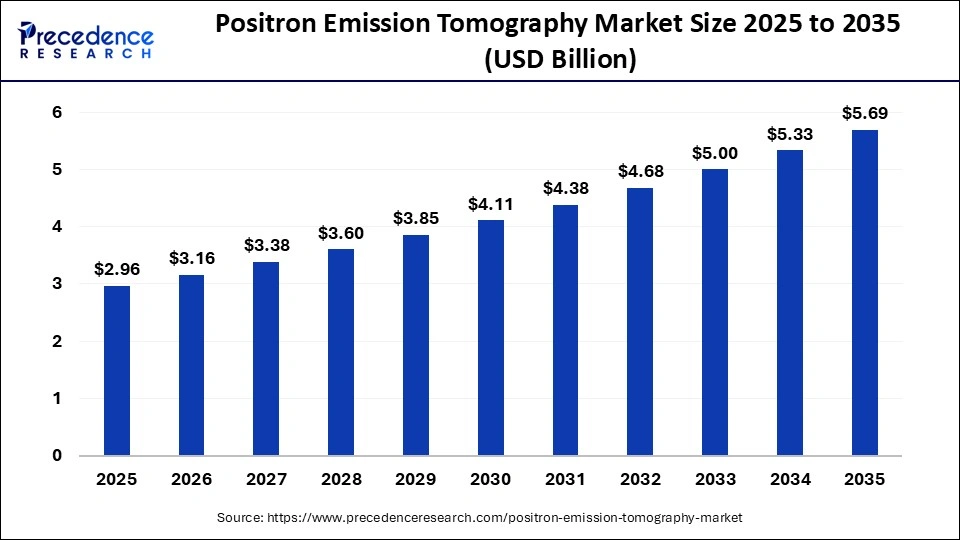
The global positron emission tomography market size was calculated at USD 2.96 billion in 2025 and is predicted to increase from USD 3.16 billion in 2026 to approximately USD 5.69 billion by 2035, expanding at a CAGR of 6.75% from 2026 to 2035.The market is rapidly growing due to the rising chronic disease burden, growing awareness, and increasing investments in healthcare infrastructure. Innovations in PET technology, specifically hybrid imaging systems and digital detectors, enhance diagnostic accuracy, improve image resolution, and accelerate scan times.
Key Takeaways
- North America held the largest market share in 2025.
- Asia-Pacific is expected to grow at the fastest CAGR during the foreseeable period.
- By product, the PET/CT systems segment held the largest market share in 2025.
- By product, the PET/MRI systems segment is expected to grow at the fastest CAGR during the forecast period.
- By end user, the hospital and surgical centers segment held the largest market share in 2025.
- By end user, the diagnostic and imaging clinics segment is expected to grow at the fastest CAGR between 2026 and 2035.
- By application, the oncology segment held the largest market share in 2025.
- By application, the neurology segment is expected to grow at the fastest CAGR during the foreseeable period.
What is Positron Emission Tomography?
The positron emission tomography market comprises a functional, non-invasive molecular imaging technique that uses radiotracers to visualize and metabolic processes, blood flow, and chemical composition in the body. The market growth is driven by the rising prevalence of chronic conditions, such as cancer, Alzheimer's, and cardiac diseases, as well as the increasing adoption of hybrid imaging modalities. The superior sensitivity for early disease detection, precise cancer staging, and effective monitoring of treatment response often identifies issues before structural changes appear.
How is AI Influencing Positron Emission Tomography?
The integration of AI, specifically machine learning (ML), is transforming the positron emission tomography (PET) industry by significantly enhancing image quality, reducing scan times, and enabling more precise, quantitative diagnostics. Advanced deep learning algorithms, such as convolutional neural networks, are used to reconstruct high-quality images from low-count data, which allows for substantial reductions in tracer dosage and radiation exposure. These technologies also facilitate automated, accurate, and consistent lesion detection and segmentation, reducing interobserver variability and improving diagnostic efficiency for complex cancers.
Positron Emission Tomography Market Trends
- Rise of Digital PET Detectors: Digital PET scanners, specifically those using silicon photomultiplier tubes, are rapidly replacing older anode photomultiplier tube systems. These digital detectors offer superior image resolution, higher sensitivity, and faster time-of-flight capabilities, resulting in sharper images and lower radiation doses for patients.
- Expanded Applications: Oncology remains the largest application for PET; its use in neurology and cardiology is growing rapidly. The development of new tracers, such as amyloid-targeting tracers, is expanding PET's role in early disease diagnosis and personalized patient care.
- Adoption of Hybrid Imaging Modalities: The demand for hybrid imaging is increasing, with PET/MRI systems gaining popularity in specialized centers over traditional PET/CT for superior soft-tissue contrast.
- Expansion of Total-body PET Scanners: Total-body PET/CT systems are an emerging trend designed with a much larger axial field of view to capture images of the entire human body simultaneously. These scanners offer significantly higher sensitivity, allowing for ultra-low-dose imaging, faster scanning, and tracking of radiotracers across multiple organs in real-time.
Market Scope
| Report Coverage | Details |
| Market Size in 2025 | USD 2.96 Billion |
| Market Size in 2026 | USD 3.16 Billion |
| Market Size by 2035 | USD 5.69 Billion |
| Market Growth Rate from 2026 to 2035 | CAGR of 6.75% |
| Dominating Region | North America |
| Fastest Growing Region | Asia Pacific |
| Base Year | 2025 |
| Forecast Period | 2026 to 2035 |
| Segments Covered | Product, Application, End User, and region |
| Regions Covered | North America, Europe, Asia-Pacific, Latin America, and Middle East & Africa |
Segmental Insights
Product Insights
Why Did the PET/CT Systems Segment Lead the Market?
The PET/CT systems segment led the positron emission tomography market in 2025. This is because of the integration of metabolic and structural data for superior diagnostic accuracy, particularly in oncology, operational efficiency, and technological breakthroughs in high-precision, low-radiation imaging. These systems expand into cardiac and neurological applications; they remain the essential standards for comprehensive disease staging and monitoring.
The PET/MRI systems segment is expected to show the fastest growth over the forecast period due to its integration with high-sensitivity detectors and simultaneous data acquisition, which is driving adoption in advanced neuroimaging and oncology. It offers superior soft-tissue contrast and significantly reduces radiation compared to PET/CT, making it ideal for pediatrics and chronic disease monitoring.
End User Insights
Which End User Segment Dominated the Positron Emission Tomography Market?
The hospital and surgical centers segment contributed the biggest market share in 2025, due to high patient volumes and the specialized infrastructure required to house complex hybrid scanners and radiopharmaceuticals. The established reimbursement systems and a multidisciplinary approach that integrates PET data across oncology, cardiology, and neurology. Despite significant government investment, hospitals remain the primary hubs for advanced, high-acuity diagnostic imaging globally.
The diagnostic and imaging clinics segment is expected to gain the highest market share between 2026 and 2035 due to the shift of high-end imaging from hospitals to more accessible, outpatient settings. By adopting AI-enhanced digital systems and hybrid PET/MRI technology, these centers offer faster scans and superior accuracy at lower operational costs. This transition directly addresses the rising global demand for early oncology and neurology detection while improving patient throughput. The move toward specialized, efficient diagnostic hubs is democratizing precision medicine and driving significant market expansion.
Application Insights
Why Did the Oncology Segment Dominate the Positron Emission Tomography Market?
The oncology segment registered its dominance over the market in 2025, due to the rising worldwide cancer burden, which has established PET imaging as a cornerstone for high-precision staging and monitoring. By integrating hybrid PET/CT and PET/MRI technologies, clinicians can now detect metastases earlier and tailor personalized therapies, clinicians can now detect metastases earlier and tailor personalized therapies with superior accuracy. The technological shift directly improves patient survival rates and treatment efficiency across various oncology segments.
The neurology segment is expected to witness the fastest growth in the market over the forecast period due to the integration of PET/MRI and novel radiopharmaceuticals. These scans provide the precision necessary for early diagnosis and long-term disease monitoring. Significant research funding and tracer development are further accelerating the adoption of these technologies in clinical settings. The surge in neurodegenerative conditions like Alzheimer's has established PET imaging as a vital tool for capturing molecular-level metabolic brain changes.
Regional Analysis
Why North America Dominated the Positron Emission Tomography Market?
North America held a major market share in 2025. This is mainly due to high research and development investment and a robust reimbursement framework that makes advanced hybrid imaging accessible to a large aging population. The region serves as the primary hub for AI-driven diagnostic tools and next-generation PET/MRI systems, fostering rapid clinical adoption.
The synergy between market-leading manufacturers and specialized research institutions ensures North America remains at the forefront of molecular imaging innovation. Strong funding for oncology studies and molecular imaging research, high prevalence of cancer and chronic disease, combined with favorable reimbursement policies and the rapid adoption of advanced hybrid imaging, augment the market.
U.S. Market Analysis
The market in the U.S. is growing due to the rapid expansion into neurology and cardiology, which is broadening the clinical utility of hybrid PET/CT and PET/MRI systems. Market leaders like GE Healthcare and Siemens are solidifying their dominance through strategic acquisitions and high-resolution SiPM technology. These innovations are transforming PET from a specialized tool into an efficient, high-throughput standard for precision molecular diagnostics.
Why is Asia-Pacific Rapidly Expanding in the Positron Emission Tomography Market?
Asia-Pacific is expected to experience the fastest growth during the predicted timeframe due to the massive government funding in China and India, with China aiming to install 500 new scanners in tier-2 cities. The surge in aging populations and the rising prevalence of chronic diseases such as cancer and Alzheimer's, which necessitate advanced diagnostic infrastructure. Additionally, the region benefits from increasing medical tourism and the entry of cost-effective local manufacturers.
China Market Analysis
In China, the market is evolving due to the massive infrastructure investment and the rise of powerful domestic players like United Imaging. The integration of AI-driven software and hybrid PET/CT systems is significantly optimizing scan times and radiation safety across high-volume clinical settings. The adoption of novel radiotracers like FAPIs is broadening diagnostic reach into complex oncology and neurology cases. This combination of technological sovereignty and clinical innovation is cementing China's role as a primary engine for global PET market expansion.
Will Europe Grow in the Positron Emission Tomography Market?
Europe is expected to grow at a notable CAGR in the foreseeable future, due to an aging population and a high prevalence of chronic diseases, which have led to a surge in specialized PET/CT and PET/MRI installations across the continent. Strategic government initiatives, such as the UK's investment in digital imaging, are modernizing infrastructure while favorable reimbursement policies ensure broader patient access. Collaborative R&D between European research institutions and industry leaders like Siemens Healthineers further accelerates the development of next-generation radiotracers.
Germany Market Analysis
Germany's innovation in high-resolution SiPM detectors is leading the market to be increasingly defined by the transition of PET services into outpatient diagnostic centers. This expansion is directly supported by Germany's aging population and newly established reimbursement pathways for non-hospital settings.
Why is Latin America Significantly Growing in the Positron Emission Tomography Market?
Latin America is considered to be a significantly growing area, due to an aging population, which is significantly increasing the demand for advanced oncology and neurology diagnostics. Investments in private healthcare infrastructure and the adoption of hybrid PET/MRI and AI-driven software are further modernizing the diagnostic landscape. The shift toward earlier disease detection and localized manufacturing incentives is positioning Latin America as a critical emerging hub for molecular imaging.
Brazil Market Trends
Brazil's expansion of hybrid PET/CT and PET/MRI units in urban centers specifically addresses the surge in complex oncology and cardiology cases. The increasing domestic investment in cyclotron-produced radiopharmaceuticals, such as Gallium-68, is ensuring a more stable supply of tracers for precise molecular imaging. These advancements are establishing Latin America as a rapidly modernizing hub for high-throughput, personalized precision medicine.
Will the Middle East and Africa Grow in the Positron Emission Tomography Market?
The Middle East and Africa are expected to grow at a considerable CAGR in the upcoming period, driven by the shift toward standalone imaging centers and AI-integrated digital scanners, which are drastically improving the diagnostic accuracy of regional deaths linked to non-communicable diseases. The expansion of public-private partnerships is overcoming historical infrastructure gaps, ensuring more consistent access to advanced oncology and neurology services. This strategic investment in hybrid PET/CT and PET/MRI technology is positioning the GCC as a leader in high-end molecular imaging across the emerging markets.
Saudi Arabia Market Trends
Saudi Arabia's massive government investments and international partnerships are successfully bridging infrastructure gaps, particularly in the GCC and Egypt. The region is emerging as a high-growth hub for advanced molecular imaging and specialized diagnostic centers. The high regional burden of cancer and neurological disorders, hybrid PET/CT and PET/MRI systems have become the standard for precise clinical staging.
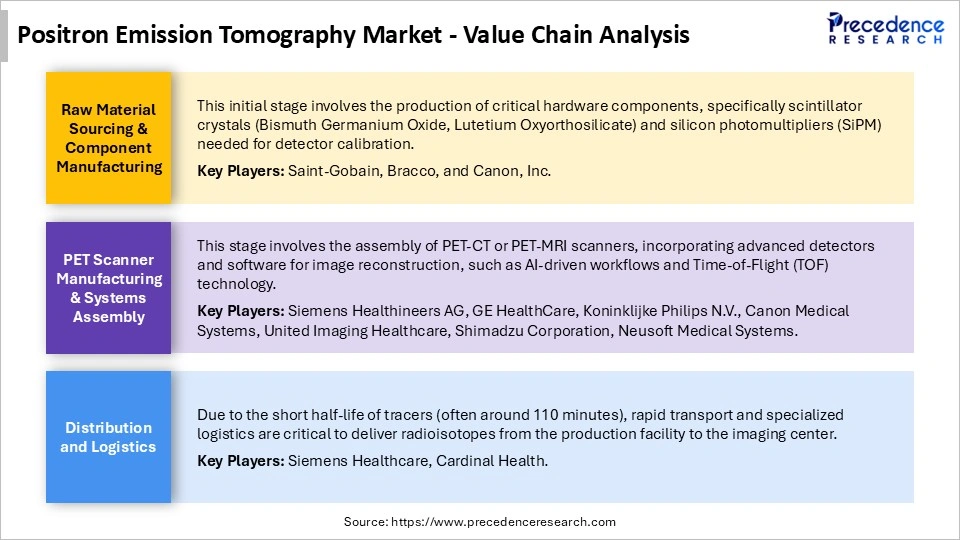
Positron Emission Tomography Market Value Chain Analysis
Positron Emission Tomography Market Companies
- Bracco S.p.A.
- Cardinal Health Inc.
- Canon Inc.
- CellSight Technologies Inc.
- GE Healthcare Technologies Inc.
- CMR Naviscan Corp.
- Jubilant Pharmova Ltd.
- Mediso Ltd.
- Koninklijke Philips NV
- MinFound Medical Systems Co. Ltd.
- Mediso Ltd.
- Neusoft Corp.
- Positron Corp.
- PETsys Electronics SA
- Shimadzu Corp.
Recent Developments
- In December 2025, the SNMMI, EARL, and ARTnet launched a unified PET/CT and PET/MR accreditation framework to standardize quantitative imaging worldwide. This initiative shifts to a contrast recovery coefficient (CRC)–based system, enhancing reproducibility and reducing redundant testing for clinical trials and patient care, with full implementation set.(Source: https://eanm.org)
- In June 2025, Shimadzu Corporation obtained FDA clearance for its PositView PET system, a specialized, compact scanner designed to deliver twice the resolution of conventional systems for head and breast imaging. Scheduled for the U.S. The 28 cm detector ring specifically targets amyloid-β and tau protein visualization to aid in early Alzheimer's disease diagnosis and therapeutic monitoring.
(Source: https://trial.medpath.com) - In June 2024, Siemens Healthineers unveiled the Biograph Trinion, a high-performance PET/CT scanner featuring a unique air-cooled design that reduces installation and operational costs while offering ultrafast time-of-flight performance. The system, designed for applications in oncology, theranostics, and neurology, incorporates AI-driven workflows and on-site scalability to improve patient care and energy efficiency.(Source: https://www.siemens-healthineers.com)
Segments Covered in the Report
By Product
- Standalone PET Systems
- PET/CT Systems
- PET/MRI Systems
By Application
- Oncology
- Cardiology
- Neurology
- Other
By End User
- Hospitals and Surgical Centers
- Diagnostic and Imaging Clinics
- Ambulatory Surgical Centers
- Other
By Region
- North America
- Latin America
- Europe
- Asia-pacific
- Middle and East Africa
For inquiries regarding discounts, bulk purchases, or customization requests, please contact us at sales@precedenceresearch.com
Frequently Asked Questions





Ask For Sample
No cookie-cutter, only authentic analysis – take the 1st step to become a Precedence Research client
 Get a Sample




 sales@precedenceresearch.com
 Schedule a Meeting
