



Precision Hand Tools Market Trends, Leading Companies, Company Revenue / Sales Performance, Production Capacity, Equipment Utilization, Pricing Analysis, Distribution Performance, Competitive Landscape, and Demand Forecast
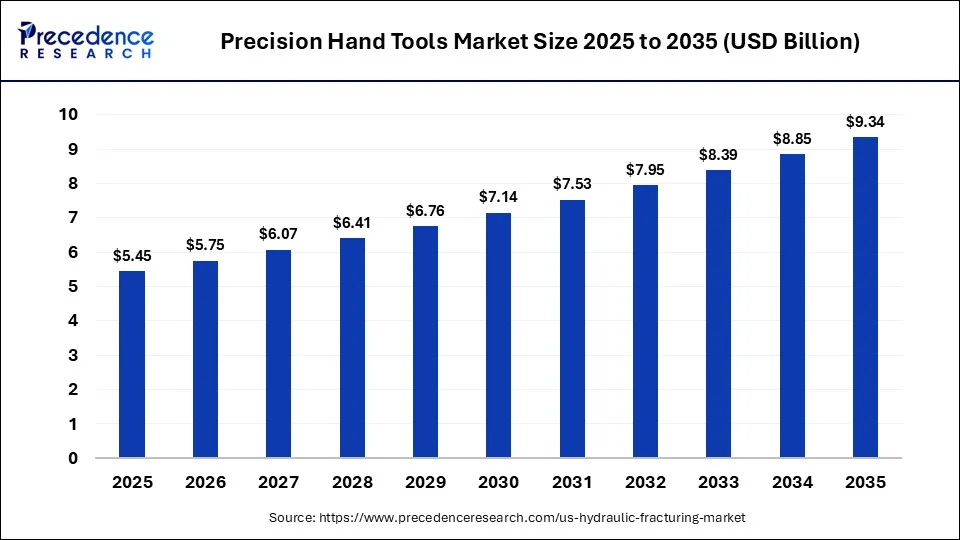
The precision hand tools market was valued at USD 5.75 billion in 2026, expanding at a CAGR of 5.54% by 2035. Market growth is driven by rising demand for durable, ergonomic, and high-precision tools across automotive, electronics, aerospace, industrial, and maintenance applications. Key trends include adoption of torque-controlled, digitally enabled, lightweight, and specialized tools, alongside growing demand for professional-grade and calibrated solutions. Increasing automation, stringent quality requirements, and expanding industrial manufacturing are expected to create new opportunities for precision hand tool manufacturers through 2035.
Source: https://www.precedenceresearch.com/precision-hand-tools-market
 Get a Sample
 Table Of Content


Precision Hand Tools Market Trends, Share, and Growth Analysis 2035
The global precision hand tools market is driven by growing demand for accuracy, repeatability, durability, and ergonomic performance across automotive, electronics, aerospace, defense, medical devices, and precision manufacturing applications. The precision hand tools market is forecasted to expand from USD 5.75 billion in 2026 to USD 9.34 billion by 2035, growing at a CAGR of 5.54% from 2026 to 2035. Torque tools represent a major product segment, while Asia Pacific leads regional demand with approximately 34.4% of global revenue in 2025.
 Key Takeaways
- The global precision hand tools market is estimated at USD 5.75 billion in 2026 and is projected to reach approximately USD 9.34 billion by 2035, reflecting a 5.54% CAGR.
- Asia Pacific accounted for approximately 34.4% of global revenue in 2025, making it the largest regional market for precision hand tools.
- Automotive and transportation represented approximately 38.1% of global demand in 2024, making it the leading end-use sector.
- Torque tools accounted for approximately 31.2% of total market revenue and are projected to grow at around 5.9% CAGR, highlighting rising demand for accuracy and repeatability.
- The market identifies 10 product categories, including precision screwdrivers, pliers and cutters, tweezers and forceps, wrenches, torque tools, files, hammers, measuring tools, tool kits, and other precision hand tools.
- The precision hand tools market covers 6 material categories, including carbon steel, alloy steel, stainless steel, aluminum, titanium, and engineered composites and other materials.
- The market is divided into 3 precision levels standard precision, high precision, and ultra-precision, reflecting increasing demand for accuracy-critical professional applications.
- The market covers 5 major geographic regions, namely North America, Europe, Asia Pacific, Latin America, and the Middle East and Africa.
- India is identified as an attractive growth market, with the source citing approximately USD 5.54 billion in 2025 and a projected 5.54% CAGR through 2035, although some
- India-specific figures in the source contain inconsistencies.
- The competitive landscape includes 23 companies, spanning diversified tool manufacturers and specialist brands focused on torque tools, precision drivers, pliers, electrical tools, and professional mechanics equipment.
Precision Hand Tools Are Shifting From Commodity Implements Toward Accuracy-Critical Professional Equipment
The global precision hand tools market is estimated at approximately USD 5.75 billion in 2026, following a market size of about. The market is projected to reach approximately USD 9.34 billion by 2035, implying a 5.54% CAGR during 2026-2035 and an incremental revenue opportunity of roughly USD 2.3 billion. Asia Pacific represented approximately 34.4% of global revenue in 2024, making it the largest regional market. Automotive and transportation accounted for approximately 38.1% of 2024 demand, while electronics, electrical assembly, aerospace, defense, medical-device manufacturing, optical equipment, and precision engineering are creating additional high-value demand pools.
The market is structurally different from the broader hand-tools industry: precision products command higher ASPs because dimensional accuracy, torque control, ergonomics, corrosion resistance, repeatability and application-specific engineering matter more than basic functionality. The opportunity is therefore increasingly concentrated in torque tools, precision screwdrivers, cutters and pliers, micro-tools, measuring tools and specialized assembly tools, rather than conventional low-cost hand tools.
Key Coverage
- 2026–2035 market sizing and CAGR
- Product, material, application, end-use and channel segmentation
- Automotive, electronics, aerospace, medical and industrial demand
- Precision-tool pricing and premiumization
- Regional manufacturing and import dependence
- Technology and ergonomic innovation
- Competitive positioning of 20+ specialist and diversified manufacturers
Market Size - Approximately USD 9.34 Billion of Incremental Revenue Is Available Through 2035
The market is estimated at approximately USD 5.75 billion in 2026, with available estimates placing 2026 revenue near USD 9.34 billion and 2035 revenue at approximately USD 6.7-6.8 billion. At a 5.54% CAGR, the market adds roughly in annual revenue between 2026 and 2035.
The growth profile is relatively defensive compared with technology hardware because precision hand tools are recurring-use products with long service lives, but demand remains linked to manufacturing activity, professional maintenance, vehicle production, electronics miniaturization, and skilled-labor productivity. India represents a particularly attractive growth pocket: its precision hand tools market generated approximately USD 5.75 billion in 2026 and is projected to reach USD 9.34 billion by 2035, equivalent to approximately 5.54% CAGR. Torque tools represented the largest Indian product segment in 2025.
Key Coverage
- 2020-2025 historical market development
- 2025 base-year sizing
- 2026-2033 forecast
- Revenue and incremental opportunity
- Regional contribution
- Product-level revenue pools
- Base, upside and downside scenarios
Segmentation Analysis - Automotive Leads Today, While Electronics and Specialized Assembly Create the Higher-Growth Precision Pool
Automotive and transportation generated approximately 38.1% of global precision hand-tool revenue in 2024, making it the largest end-use segment. The sector uses torque-controlled tools, precision drivers, cutters, pliers, and specialized assembly equipment throughout vehicle manufacturing, component assembly, and maintenance.
Product segmentation is increasingly polarized between high-volume precision screwdrivers or nut drivers and higher-value torque tools, while pliers or cutters and measuring instruments occupy important professional niches. Material selection is moving toward engineered steels, stainless steel, corrosion-resistant alloys, and specialized composites where weight reduction and durability justify higher prices.
Key Coverage
- Screwdrivers and nut drivers
- Pliers and cutters
- Tweezers and forceps
- Wrenches and spanners
- Torque tools
- Measuring and inspection tools
- Files, deburring and drilling tools
- Electronics, automotive, aerospace, medical and industrial applications
- Wholesale, specialist retail and e-commerce channels
Market Dynamics - Miniaturization, EVs, Manufacturing Automation and Technician Productivity Are Raising Precision Requirements
Demand is being reshaped by the increasing complexity of manufactured products. Electronics miniaturization requires tools capable of manipulating smaller components without damaging assemblies, while EVs introduce high-voltage systems, battery modules, sensors and advanced electronics that require controlled assembly and maintenance.
Automotive electrification is particularly important because the value of precision tooling is increasingly linked to controlled torque, repeatability, and technician safety, rather than simply mechanical strength. At the same time, labor shortages encourage manufacturers and service organizations to use ergonomic tools that reduce fatigue and improve repeatability.
The primary restraints are long product life, relatively low replacement frequency for premium tools, counterfeit and low-cost alternatives, steel-price volatility, and the ability of professional users to continue operating existing tools for many years.
Tentative Leading Company Universe - 23 Companies Shaping the Precision Hand Tools Ecosystem
| Company | Headquarters | Market Position | Core Strength | Major Applications/Segments |
| Stanley Black & Decker | US | Global diversified leader | Scale/portfolio | Industrial, automotive, DIY |
| Snap-on | US | Professional specialist | Precision/service tools | Automotive, repair |
| Apex Tool Group | US | Global industrial supplier | Professional hand tools | Industrial, automotive |
| KNIPEX | Germany | Precision specialist | Pliers/cutters | Industrial, electrical |
| Wera | Germany | Premium specialist | Drivers/fastening | Industrial, electronics |
| Wiha | Germany | Precision specialist | Screwdrivers/pliers | Electrical, industrial |
| Klein Tools | US | Professional specialist | Electrical tools | Electrical, construction |
| Bahco / SNA Europe | Europe | Professional specialist | Cutting/torque tools | Industrial, automotive |
| GEDORE | Germany | Premium industrial | Torque/mechanics | Automotive, industrial |
| PB Swiss Tools | Switzerland | Precision specialist | Drivers/small tools | Electronics, medical |
| Hilti | Liechtenstein | Professional systems | Construction tools | Construction, installation |
| Techtronic Industries | Hong Kong | Global diversified | Tool ecosystems | Industrial, professional |
| Makita | Japan | Global tool manufacturer | Professional tools | Industrial, automotive |
| Bosch | Germany | Global diversified | Engineering/distribution | Industrial, automotive |
| TONE | Japan | Precision/mechanics specialist | Sockets/torque | Automotive, industrial |
| FACOM | France | Professional specialist | Mechanics tools | Automotive, aerospace |
| Felo | Germany | Precision specialist | Screwdrivers | Industrial/electrical |
| Stahlwille | Germany | Premium specialist | Torque tools | Aerospace, industrial |
| Channellock | US | Pliers specialist | Pliers | Plumbing, industrial |
| Wright Tool | US | Industrial specialist | Mechanics tools | Heavy industry |
| IDEAL Industries | US | Specialist | Electrical tools | Electrical |
| Unior | Slovenia | Industrial specialist | Hand/mechanics tools | Automotive, industrial |
| Beta Utensili | Italy | Professional specialist | Mechanics/precision tools | Automotive, industrial |
Which Pricing Dynamics Are Expanding the Premium Pool in Precision Hand Tools?
The global precision hand tools market is estimated at USD 5.75 billion in 2025, rising to approximately USD 5.75 billion in 2026 and USD 9.34 billion by 2035, implying a 5.54% CAGR. Within this market, torque tools represented, while the segment is projected to grow at CAGR through 2033. This mix is important for pricing analysis because precision tools do not compete purely on unit cost: calibration, accuracy, material grade, ergonomic design, durability, and application-specific requirements create substantial ASP differences.
Our analysis indicates that pricing power is increasingly concentrated in tools where precision directly reduces operational risk. Calibrated torque tools, fine-pitch screwdrivers, electronics-grade tools, specialized pliers, and measurement/alignment products can command a premium over conventional hand tools because buyers are purchasing repeatability and process reliability rather than simply a physical tool. The broader tool industry also demonstrates that price increases can materially support profitability even when volumes soften; for example, a major diversified tool manufacturer reported 6% higher pricing against a 10% volume decline in its Tools & Outdoor business during Q4 2025, while its adjusted segment margin increased to 14.6%. This supports our assessment that premiumization and price realization are becoming important margin levers in professional tool categories.
In our view, the most significant implication is that future ASP growth will be increasingly mix-driven rather than dependent on broad-based price inflation. Products incorporating tighter tolerances, digital measurement, calibration/traceability, advanced alloys, corrosion resistance, ESD protection, and ergonomic engineering should retain greater pricing flexibility than standardized tools. India illustrates the opportunity: its precision hand tools market was at a significant market size in 2025, with torque tools accounting for a notable share, and the market is projected to expand substantially by 2033. From our assessment, this combination of market growth and a high-value torque-tool mix creates room for premium suppliers and application-specific products to expand revenue faster than basic unit volumes.
Precision Hand Tool Supply Keeping Pace With Demand, or Are Capacity and Capability Gaps Emerging?
The global precision hand tools market is estimated at a significant market size in 2024 and is projected to expand to a notable market value by 2033, reflecting a positive growth trajectory. Torque tools accounted for a substantial share of 2024 revenue and are projected to experience steady expansion, indicating that demand is increasingly concentrated in higher-value tools where accuracy, repeatability, and application-specific performance are critical. Automotive and transportation represented a sizeable share of market revenue, reinforcing the importance of industrial production and maintenance demand in overall consumption.
Our analysis indicates that supply is broadly aligned with market growth, but the competitive constraint is shifting from basic manufacturing capacity toward specialized production capability. Precision machining, controlled tolerances, advanced materials, calibration, quality inspection, and application-specific engineering can create greater supply constraints than conventional tool production. We believe this means suppliers with scalable precision manufacturing and consistent quality systems are better positioned to capture incremental demand, particularly as torque, electronics-grade, and other specialized tool applications expand faster than standard hand-tool categories.
In our view, the most significant implication is that future supply expansion will increasingly depend on capability localization and product-mix optimization rather than simply adding manufacturing volume. Regional manufacturers can gain share where shorter lead times, lower logistics costs, and localized technical support matter, while global suppliers may retain advantages in complex precision categories requiring stringent specifications and certification. India, for example, represents an expanding demand pool, with its precision hand tools market estimated at a notable market value in 2025 and projected to reach a significant market size by 2033; this creates potential for additional regional production and distribution capacity.
Which Customer and Application Segments Are Driving the Highest-Value Demand for Precision Hand Tools?
The automotive and transportation sector accounted for approximately 37.1% of global precision hand tools revenue in 2024, making it the largest identifiable application pool. Torque tools represented approximately 31.2% of total market revenue and are projected to grow at around 5.9% CAGR, indicating strong demand for applications where controlled torque, repeatability, and assembly accuracy directly affect product quality. Demand also extends across electronics, industrial manufacturing, maintenance and other precision-intensive applications, where tool performance increasingly influences purchasing decisions.
Our analysis indicates that customer demand is becoming more specification-driven as precision hand tools move deeper into quality-critical workflows. Automotive assembly, industrial maintenance and electronics applications place greater emphasis on torque accuracy, dimensional consistency, ergonomics, durability and repeatable performance than on basic tool functionality alone. Our assessment is that customers in these segments are therefore more likely to evaluate total operating value, including productivity, error reduction, tool life and maintenance requirements, rather than purchase solely on upfront price.
In our view, the most significant implication is the emergence of application-specific value pools within an otherwise fragmented hand-tools market. From our assessment, this creates opportunities for manufacturers to develop differentiated product configurations for automotive assembly, electronics servicing, industrial maintenance, aerospace-related precision work, and other specialized environments. Suppliers that align tool specifications with customer workflow requirements can potentially capture higher-value demand, while standardized products remain more exposed to price-based competition.
Where is Value Created Across the Precision Hand Tools Value Chain, and Which Stages Offer the Greatest Margin and Differentiation Potential?
The precision hand tools value chain spans specialty steel and alloy sourcing, forging and machining, heat treatment, surface finishing, precision assembly, calibration and quality control, packaging, distribution and aftermarket services. With the global market estimated at a significant market size in 2024 and torque tools accounting for a substantial share of market revenue, value creation is increasingly concentrated in stages that determine accuracy, durability and repeatability rather than in basic material conversion alone.
Our analysis indicates that the highest strategic value is shifting toward precision manufacturing, quality assurance, calibration, and application-specific engineering. Raw materials remain an important cost component, but differentiation becomes stronger as products move through tighter-tolerance machining, specialized heat treatment, advanced coatings, ergonomic engineering, and calibration processes. Our assessment is that manufacturers with greater control over these capability-intensive stages can protect product quality, reduce rework, and support premium positioning, while suppliers relying primarily on standardized manufacturing and downstream distribution face greater exposure to price competition.
In our view, the most significant implication is that value-chain integration can become a competitive lever when it improves consistency, lead-time control and cost visibility. From our assessment, localized sourcing and manufacturing can create advantages in markets where logistics costs, delivery times and customer-specific requirements are increasingly important, while specialized upstream suppliers remain critical for advanced alloys, precision components and other technically demanding inputs. This creates opportunities for manufacturers to selectively integrate high-value processes rather than pursue complete vertical integration across the chain.
Precision Hand Tools Market Segments Covered in the Report
By Product Type
- Precision Screwdrivers & Nut Drivers
- Precision Pliers & Cutters
- Precision Tweezers & Forceps
- Precision Wrenches & Spanners
- Torque Tools
- Precision Files & Deburring Tools
- Precision Hammers & Mallets
- Measuring & Alignment Tools
- Precision Tool Kits & Sets
- Other Precision Hand Tools
By Material
- Carbon Steel
- Alloy Steel
- Stainless Steel
- Aluminum
- Titanium
- Engineered Composites & Other Materials
By Precision Level
- Standard Precision
- High Precision
- Ultra-Precision
By Application
- Assembly & Fastening
- Inspection & Measurement
- Cutting & Stripping
- Repair & Maintenance
- Deburring & Finishing
- Alignment & Adjustment
- Component Handling
By End-Use Industry
- Automotive & Transportation
- Electronics & Electrical
- Aerospace & Defense
- Industrial Manufacturing
- Medical Devices
- Telecommunications
- Construction & Infrastructure
- Energy & Power
- Watchmaking, Jewelry & Optics
- Other Specialized Industries
By Customer Type
- OEMs & Manufacturers
- MRO & Industrial Maintenance
- Professional Technicians
- Contractors
- Distributors & Resellers
- DIY/Individual Professionals
By Distribution Channel
- Direct Sales
- Industrial Distributors
- Specialty Tool Dealers
- Online/E-commerce
- Retail Stores
- OEM/Contract Supply
By Region
- North America
- Europe
- Asia Pacific
- Latin America
- Middle East & Africa
For inquiries regarding discounts, bulk purchases, or customization requests, please contact us at sales@precedenceresearch.com
Frequently Asked Questions
Tags





Ask For Sample
No cookie-cutter, only authentic analysis – take the 1st step to become a Precedence Research client
 Get a Sample




 sales@precedenceresearch.com
 Schedule a Meeting
