



3T MRI System Market Revenue to Attain USD 6.63 Bn by 2035
Published: 09 Jul 2026
Author: Precedence Research



3T MRI System Market Revenue and Trends 2026 to 2035
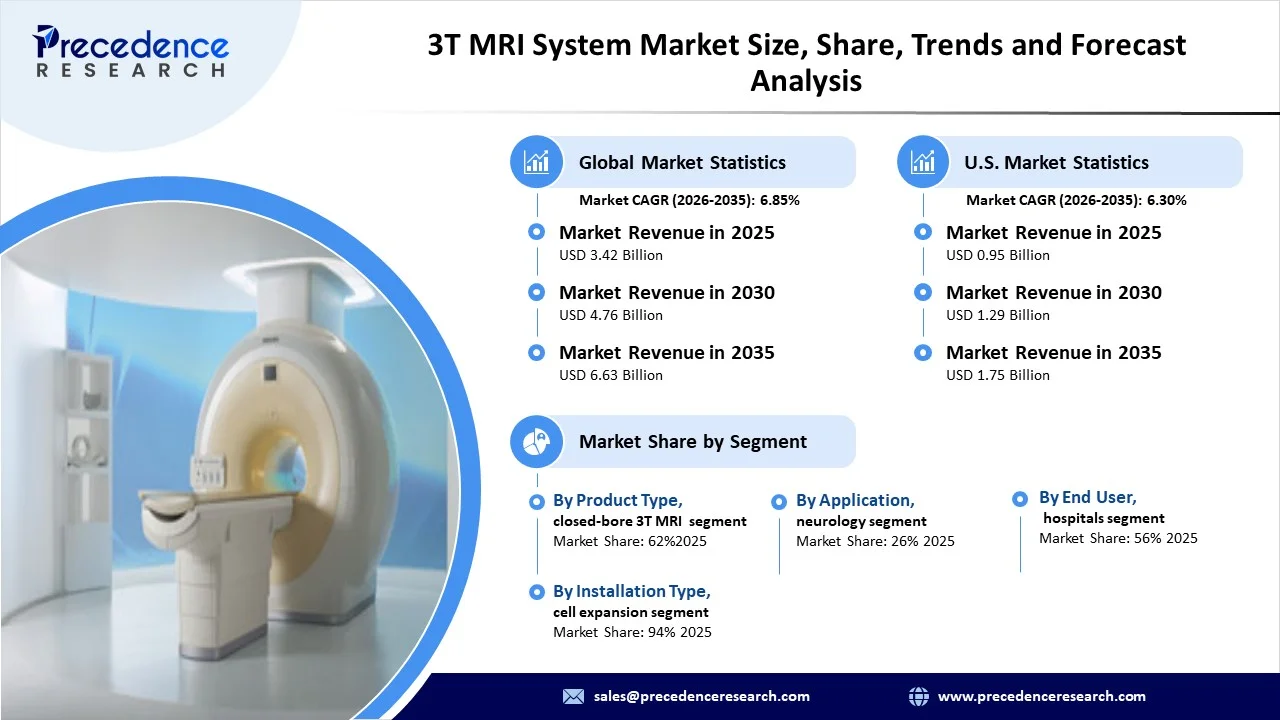
The global 3T MRI system market revenue was valued at USD 3.42 billion in 2025 and is expected to attain around USD 6.63 billion by 2035, growing at a CAGR of 6.85% during forecast period. The market is driven by the increasing need for accurate diagnosis and improved speed in the imaging of diseases in neurology, musculoskeletal, and oncology areas, and the increasing prevalence of chronic diseases across the globe.
High-Field MRI for Accurate Diagnosis
The 3T MRI system market is composed of the manufacture, distribution, installation, and servicing of magnetic resonance imaging (MRI) equipment with the field strength of 3.0 Tesla (3T). It provides an excellent signal-to-noise ratio (SNR), resolution, and imaging speed. 3T MRI systems have found widespread use for clinical and research purposes for high-resolution neuroimaging (brain and spine), musculoskeletal imaging (joints, tendons, cartilage), cardiac and vascular imaging, and abdominal and pelvic imaging.
The market covers whole-body MRI systems, as well as advanced MRI coils, MRI software (including AI-based imaging, motion correction, spectroscopy), and servicing agreements. The applications of this market include neurology (stroke, multiple sclerosis, epilepsy, Alzheimer’s), orthopedics, oncology, and cardiovascular imaging. This market has been adopted by hospitals, imaging facilities, academic medical centers, and research organizations.
Simplified Sitting and Expanded Access with Helium-Free 3.0 MRI Platform
A new development in the field of 3T MRI systems is a platform featuring a helium-free magnet without the necessity of using thousands of liters of liquid helium, which makes installation easier and reduces costs. This platform combines various AI-driven tools that increase scan speed and improve image clarity. In the RSNA 2025 conference, Philips launched the BlueSeal Horizon platform as the world’s first 3.0T MRI system with a helium-free magnet that does not require liquid helium. The platform features AI-based tools, including SmartPlanning, SmartSpeed Precise, and SmartReading.
Usage of Advanced 3T MRI Machines in Developing Markets
3T MRI machine installations in the 3T MRI system market have been on an upward trajectory in recent years, owing to hospital adoption of high-field machines in emerging markets in response to increasing patient demands for quick and accurate diagnosis. Modern 3T machines come with features that enhance patient experience, such as AI-enabled accelerated diagnosis, ultra-wide bore systems, and noseless scanning. In 2025, the first installation of an OMEGA 3T MRI machine was witnessed at the Lilavati Hospital in Mumbai, India. The 75cm ultra-wide bore technology, AI-powered imaging technology, and other advanced features enable the system to carry out scan procedures within 10-12 minutes.
Research Funding Enables Access to High-Field Imaging
Several governments and national research institutes have made efforts to provide funding for the purchase of 3T MRI scanners. The objectives of these funding measures include increasing diagnostic capabilities, conducting advanced research on neuroscience and medicine and enhancing patients’ access to high magnetic field imaging. In 2025, the National Imaging Facility (NIF) and Monash University in Australia unveiled the Siemens Healthineers MAGNETOM Cima.X 3T MRI scanner in Victoria, Australia. The machine is equipped with the world’s strongest gradient strength, which facilitates high-speed and high-resolution imaging for research on dementia, schizophrenia, epilepsy, and cancer.
Alder Hey Acquires a USD 4 Million MRI Scanner for Kids in 2025
In 2025, Alder Hay Children’s Hospital in Liverpool acquired an advanced MRI machine worth USD 4 million, becoming the first children’s hospital in Europe to own a research-grade 3 Tesla scanner. The new MRI scanner at Alder Hay includes child-friendly in-bore television, lighting and sound experience, and equipment designed for comfort. It is funded by the NIHR and is used for early-phase clinical trials and child brain development studies.
Market Segmentation Overview
- By product type, the closed-bore 3T MRI systems segment led the 3T MRI system market with a 62% share in 2025, due to their excellent magnetic field homogeneity and gradient capability, which gives high-quality imaging needed in neuroimaging, musculoskeletal, and functional MRI procedures. The cylinder shape of the bore has been the industry standard high-field system design for many years now.
- By product type, the wide-bore 3T MRI systems segment is expected to expand at the highest CAGR of 8% during the forecast period, owing to the increasing incidences of obesity and fear of claustrophobia among patients, resulting in an increased demand for this segment. This trend is further augmented by the fact that wide-bore 3T MRIs have a smaller installed base relative to that of standard closed-bore systems.
- By application, the neurology segment dominated the market with a 26% share in 2025, as the 3T MRI has the best signal-to-noise ratio and spatial resolution in today’s MRI technology. This helps explain why it is the optimal modality in studying small structures of the brain, minor white matter abnormalities, and microvascular processes. This technology has been widely adopted to treat patients suffering from multiple sclerosis, stroke, epilepsy, and Alzheimer’s disease.
- By application, the breast imaging segment is expected to grow at the fastest CAGR of 7.9% from 2026 to 2035, since breast cancer has significant prevalence globally and because the 3T MRI can provide better soft tissue contrast and is ideal for detecting cancer in patients with dense breast tissue.
- By end user, the hospitals segment led the market with a 56% share in 2025 because they undertake the greatest number and most diverse diagnostic imaging cases related to neurology, oncology, cardiology, and musculoskeletal disorders, allowing them to benefit from powerful field equipment and use it more actively for their clinical work.
- By end user, the academic and research institutes segment is expected to expand at the highest CAGR of 7.8% during the forecast period, owing to their key role in developing high-end neuroimaging, fMRI applications, and new pulse sequences. These applications require a superior signal-to-noise ratio and gradient performance, thus prompting the rapid adoption of 3T and ultra-high-field MRI systems.
- By installation type, the fixed MRI systems segment dominated the 3T MRI system market with a 94% share in 2025 and is expected to grow at the fastest CAGR of 6.9% from 2026 to 2035, as 3T MRI equipment is heavy and usually requires reinforced flooring, a special cooling system, and a dedicated RF-shielded room.
- By installation type, the mobile MRI systems segment held the second-largest market share of 6% in 2025, due to adoption in faraway and underprivileged regions in order to perform imaging in places where the installation of conventional units is not feasible, owing to small numbers of patients.
- By distribution channel, the direct sales segment led the market with a 68% share in 2025 and is expected to expand at the highest CAGR of 7.1% during the forecast period, because a 3T MRI machine is an expensive equipment investment that involves lots of technical consultations, specialized site designations, and complicated negotiations with hospital C-suites and directors of radiology departments.
- By distribution channel, the medical equipment distributors segment held the second-largest market share of 22% in 2025, as they act as the main distribution route to smaller hospitals, healthcare providers in rural areas, and imaging centers that lack the capabilities within the organization to handle sophisticated negotiations with the manufacturers.
Regional Analysis
North America dominated the 3T MRI system market with a 37% share in 2025, owing to high spending on healthcare services, early adoption of advanced imaging techniques, and the significant presence of key companies and research institutes involved in constant innovations and product upgrades. The U.S. led the market in North America because of the highest worldwide adoption of 3T units, government funding through the NIH and other organizations for conducting neuroimaging studies and developing functional MRIs, and a reimbursement system favoring use of high-field imaging for neurology. Canada witnessed notable market growth through governmental investment in healthcare facilities, collaboration between research institutes and private companies, and increasing installations of 3T MRI units in major city hospitals.
Asia-Pacific is expected to grow at the fastest CAGR of 8.6% from 2026 to 2035, since it has the largest and aging population in the world, which results in increased incidences of chronic diseases like cancer and neurodegenerative diseases, leading to the need for diagnostic imaging. China dominated the market in Asia Pacific by virtue of its large investments from the government into its public hospital infrastructure, academic medical centers, and research institutions. India is a significant contributor to the market due to the rapid expansion in the private hospital sector, growing medical tourism, increased insurance coverage, and government initiatives that are improving medical facilities in underprivileged districts.
Europe held the second-largest market share of 29% in 2025, owing to the mature infrastructure of healthcare facilities and to high levels of investments being made by both the government and private sectors in adopting advanced diagnostic imaging procedures and the presence of a conducive regulatory ecosystem for the introduction of high-field MRI technologies. Germany led the market in Europe, as it has a high density of university hospitals and research institutions that have adopted 3T technologies for neurology-based treatments, and significant healthcare investment in the medical imaging sector. The U.K. witnessed notable market growth owing to the NHS’s efforts to expand diagnostic capabilities and reduce waiting times by investing in 3T MRI technologies.
3T MRI System Market Coverage
| Report Attribute | Key Statistics |
| Market Revenue in 2025 | USD 3.42 Billion |
| Market Revenue by 2035 | USD 6.63 Billion |
| CAGR from 2026 to 2035 | 6.85% |
| Quantitative Units | Revenue in USD million/billion, Volume in units |
| Largest Market | North America |
| Base Year | 2025 |
| Regions Covered | North America, Europe, Asia-Pacific, Latin America, and the Middle East & Africa |
Top Companies in the 3T MRI System Market
Siemens Healthineers, GE Healthcare, Philips Healthcare, and Canon Medical Systems are some of the key players that manufacture 3T MRI equipment, which is used in various fields. Fujifilm Holdings and United Imaging Healthcare are two of the major rivals in the 3T MRI industry. Esaote S.p.A and Neusoft Medical Systems that focus on the niche and value-based MRI market. Synaptive Medical provides intraoperative MRI equipment. The 3T MRI market is highly competitive, and Siemens, GE, Philips, and Canon dominate the market; however, United Imaging Healthcare is aggressively expanding its market share through competitive technology and price.
Segments Covered in This Report
By Product Type
- Closed-Bore 3T MRI Systems
- Wide-Bore 3T MRI Systems
- Open 3T MRI Systems
By Architecture
- Superconducting MRI Systems
- Permanent Magnet MRI Systems
By Application
- Neurology
- Orthopedics
- Cardiology
- Oncology
- Breast Imaging
- Abdominal Imaging
- Musculoskeletal Imaging
- Vascular Imaging
- Whole Body Imaging
- Others
By End User
- Hospitals
- Diagnostic Imaging Centers
- Ambulatory Surgical Centers (ASCs)
- Academic and Research Institutes
- Specialty Clinics
By Installation Type
- Fixed MRI Systems
- Mobile MRI Systems
By Field Configuration
- Horizontal Field MRI Systems
- Vertical Field MRI Systems
By Patient Type
- Adult
- Pediatric
- Geriatric
By Distribution Channel
- Direct Sales
- Medical Equipment Distributors
- Third-party Procurement and Leasing
By Region
- North America
- Latin America
- Europe
- Asia-pacific
- Middle and East Africa
Get this report to explore global market size, share, CAGR, and trends, featuring detailed segmental analysis and an insightful competitive landscape overview @ https://www.precedenceresearch.com/sample/8540
You can place an order or ask any questions. Please feel free to contact us at sales@precedenceresearch.com |+1 804 441 9344