



Aircraft Turbofan Engine Market Revenue to Attain USD 186.20 Bn by 2035
Published: 02 Apr 2026
Author: Precedence Research



Aircraft Turbofan Engine Market Revenue and Trends 2026 to 2035
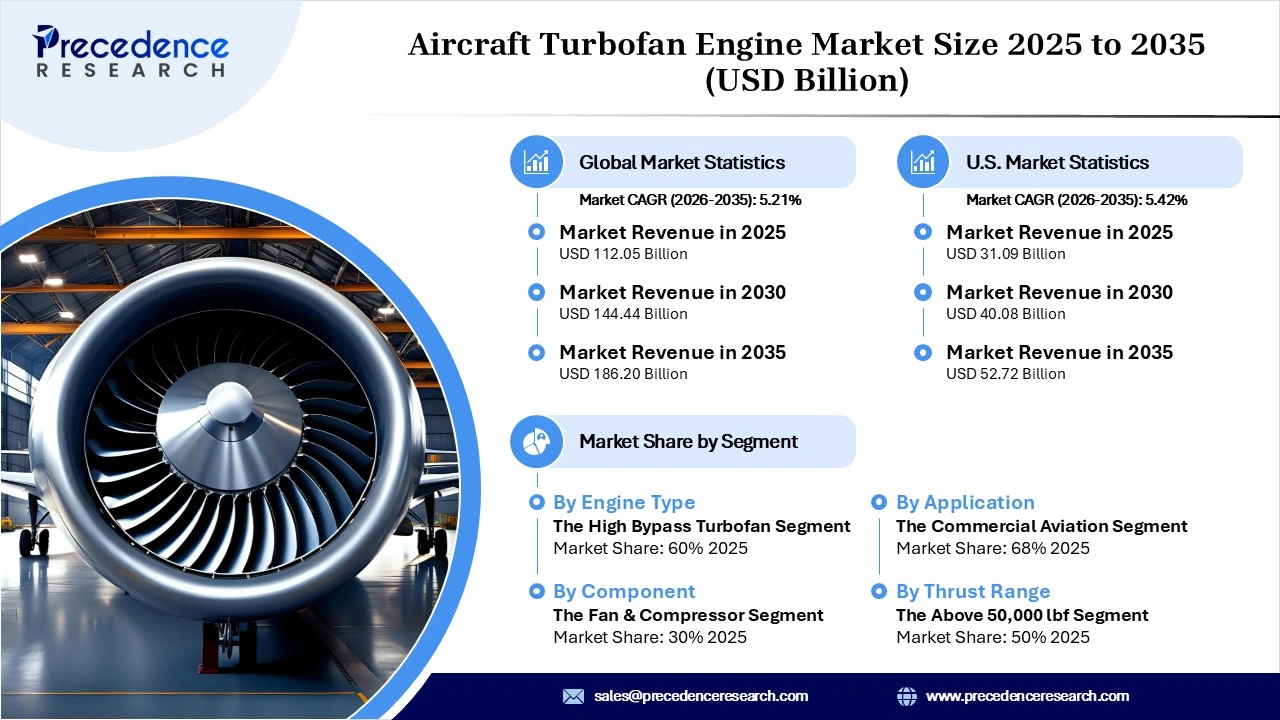
The global aircraft turbofan engine market revenue reached USD 112.05 billion in 2025 and is predicted to attain around USD 186.20 billion by 2035 with a CAGR of 5.21%. The aircraft turbofan engine market is driven by growing commercial air travel, rising defense spending, and continuous advancements in fuel-efficient and high-performance engine technologies.
Market at a Glance
The aircraft turbofan engine market focuses on the design, production, and maintenance of turbofan engines, which are widely used in commercial, business, and military aircraft. Turbofan engines combine a gas turbine core with a large fan to provide efficient thrust, reduced fuel consumption, and quieter operation compared to older engine types. The market spans the full lifecycle of turbofan engines, from new production to ongoing support, covering both operational efficiency and technological innovation.
What Drives the Growth of the Aircraft Turbofan Engine Market?
Rising investments in R&D drive the growth of the market by enabling the development of more fuel-efficient, quieter, and environmentally friendly engines, which are increasingly demanded by airlines and regulatory bodies. Advanced research allows manufacturers to improve engine performance, durability, and integration with next-generation aircraft, giving them a competitive edge. It also accelerates innovation in materials, aerodynamics, and digital monitoring systems, supporting both new engine designs and aftermarket services, thereby expanding market opportunities.
GE Aerospace invested $2.7 Billion in research and development and aims to achieve a net-zero carbon footprint by 2050, showing a strong inclination toward next-gen turbofan and hybrid electric systems. CFM International intends to develop open-fan engines targeting approximately 20% lower fuel burn, showing a massive push towards next-gen turbofan architecture.
Efficiency vs. Weight: Trends in Turbofan Engine Design


As the graph shows, increasing bypass ratio (BPR) significantly reduces specific fuel consumption (SFC), but diminishing returns appear beyond a 12:1 BPR, motivating the shift toward ultra-high bypass and open fan designs. The thrust-to-engine mass relationship highlights a non-linear rise in structural weight due to larger fans and mass flow, creating a trade-off between efficiency and integration. Market-wise, this drives demand for advanced materials, geared systems, and high-margin MRO services, as heavier, more complex engines require more maintenance and encourage efficiency-focused upgrades.
Market Segmentation Overview
By Engine Type
The High-bypass turbofan segment led the market with the largest share of 60% in 2025. This is because of its propulsive efficiency, employing bypass ratios of approximately 8:1 to 12:1 to achieve 15 to 20% lower fuel consumption than low-bypass engines.
On the other hand, the geared turbofan segment is expected to grow at the fastest CAGR during the forecast period because of the reduction gearbox that allows for different fan and turbine speeds, thus permitting a larger and slower fan and a faster and more efficient core engine.
By Application
The commercial aviation segment led the aircraft turbofan engine market with the highest share of 68% in 2025. The dominance of this segment is attributed to an increase in air passenger traffic, which prompts commercial airlines to expand their fleets. Meanwhile, the business & general aviation segment is expected to expand at the fastest rate in the coming years due to the increasing demand for private jets driven by the need to cater to the requirements of high-net-worth individuals and corporate travel.
By Component
The fan & compressor segment led the market with a 30% share in 2025. This is because fans and compressors are the core components of a turbofan engine. They control airflow and overall thermodynamic efficiency of the engine.
Meanwhile, the gearbox segment is expected to grow at the fastest rate from 2026 to 2035. The growth of the segment is driven by the increasing popularity of geared turbofan engines, where a reduction gearbox separates fan speed and turbine speed.
By Thrust Range
The above 50,000 lbf segment dominated the market while holding a 50% share in 2025. This is because it caters primarily to large commercial and military aircraft, which require high thrust for long-haul flights and heavy payloads. These engines offer superior efficiency, reliability, and performance for wide-body jets and advanced transport aircraft.
The 20,000 to 50,000 lbf segment is expected to grow at the highest CAGR during the forecast period because it targets narrow-body commercial aircraft, regional jets, and business jets, which are seeing increasing demand due to expanding air travel and regional connectivity. These engines balance efficiency, performance, and cost, making them ideal for operators seeking lower fuel consumption and maintenance costs while maintaining sufficient thrust for short- to medium-haul flights.
Regional Analysis
North America led the aircraft turbofan engine market with a major share of 37% in 2025. The region’s dominance is attributed to the strong presence of leading aircraft and engine OEMs such as GE Aerospace and Pratt & Whitney. Robust R&D investments in advanced propulsion technologies have accelerated the adoption of next-generation engines in commercial, business, and military aviation across the region.
Asia Pacific is expected to grow at the fastest rate from 2026 to 2035. The market growth in this region is attributed to the expanding air travel demand, rising commercial aircraft deliveries, and the modernization of domestic fleets. Strong government support, investments in aerospace infrastructure, and the emergence of regional engine manufacturers are further accelerating market growth, while increasing low-cost carriers drive demand for fuel-efficient and high-performance engines.
Aircraft Turbofan Engine Market Coverage
| Report Attribute | Key Statistics |
| Market Revenue in 2025 | USD 112.05 Billion |
| Market Revenue by 2035 | USD 186.20 Billion |
| CAGR from 2026 to 2035 | 5.21% |
| Quantitative Units | Revenue in USD million/billion, Volume in units |
| Largest Market | North America |
| Base Year | 2025 |
| Regions Covered | North America, Europe, Asia-Pacific, Latin America, and the Middle East & Africa |
Top Companies in the Aircraft Turbofan Engine Market
Key players in the turbofan engine market comprise GE, Rolls-Royce, Pratt and Whitney, Safran, Honeywell, MTU Aero Engines, IHI, Kawasaki, Mitsubishi, and GKN Aerospace, focusing on advanced technology, high research and development investment, and global MRO networks.
Segments Covered in This Report
By Engine Type
- High Bypass Turbofan
- Low Bypass Turbofan
- Geared Turbofan (GTF)
By Application
- Commercial Aviation
- Military Aviation
- Business & General Aviation
By Component
- Fan & Compressor
- Turbine
- Combustor
- Gearbox
- Exhaust System
By Thrust Range
- Below 20,000 lbf
- 20,000–50,000 lbf
- Above 50,000 lbf
By Region
- North America
- Asia Pacific
- Europe
- South America
- Middle East & Africa
Get this report to explore global market size, share, CAGR, and trends, featuring detailed segmental analysis and an insightful competitive landscape overview @ https://www.precedenceresearch.com/sample/8267
You can place an order or ask any questions, please feel free to contact us at sales@precedenceresearch.com |+1 804 441 9344