



Aircraft Turbofan Engine Market Trends, Companies, Contract Wins / Project Pipeline, Defense Contracts, Procurement Volume, Government Spending, Production Capacity, Competitive Positioning, and Growth Outlook
Aircraft Turbofan Engine Market (By Engine Type: High Bypass Turbofan, Low Bypass Turbofan, Geared Turbofan (GTF); By Application: Commercial Aviation, Military Aviation, Business & General Aviation; By Component: Fan & Compressor, Turbine, Combustor, Gearbox, Exhaust System; By Thrust Range: Below 20,000 lbf, 20,000-50,000 lbf, Above 50,000 lbf) - Global Industry Analysis, Size, Trends, Leading Companies, Regional Outlook, and Forecast 2026 to 2035
Source: https://www.precedenceresearch.com/aircraft-turbofan-engine-market
 Get a Sample
 Table Of Content


What is the Aircraft Turbofan Engine Market Size in 2026?
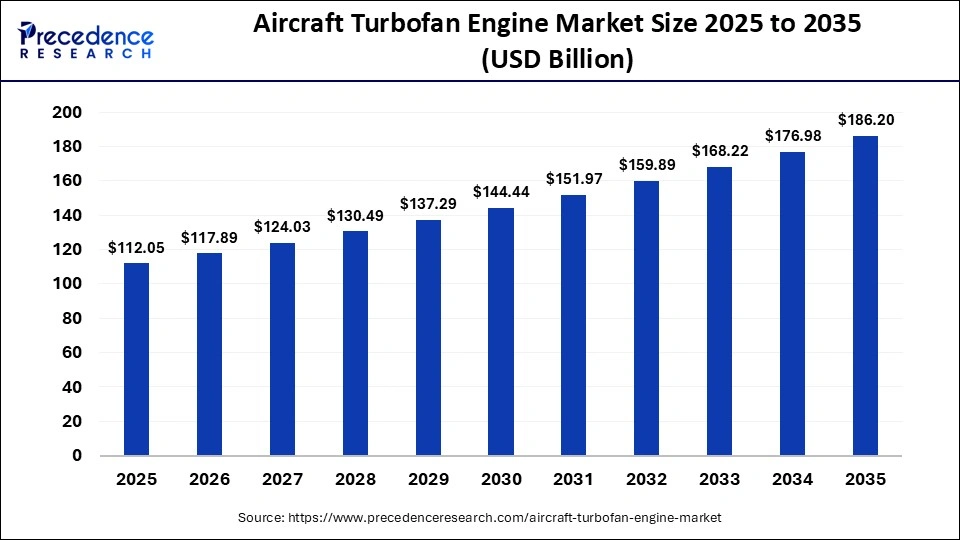
The global aircraft turbofan engine market size accounted for USD 112.05 billion in 2025 and is predicted to increase from USD 117.89 billion in 2026 to approximately USD 186.20 billion by 2035, expanding at a CAGR of 5.21% from 2026 to 2035. The market is experiencing unprecedented growth, driven by a rise in air travel demand and significant investments in advanced materials.
Key Takeaways
- North America held the largest market share of 37% in 2025.
- Asia Pacific is expected to expand at the fastest CAGR between 2026 and 2035.
- By engine type, the high bypass turbofan segment held the largest market share of approximately 60% in 2025.
- By engine type, the geared turbofan (GTF) segment is expected to grow at the fastest CAGR between 2026 and 2035.
- By component, the fan & compressor segment contributed a major share of approximately 30% in the market in 2025.
- By component, the gearbox segment is expected to expand at the fastest growth rate between 2026 and 2035.
- By application, the commercial aviation segment held a dominant market share of approximately 68% in 2025.
- By application, the business & general aviation segment is expected to grow at the fastest rate from 2026 to 2035.
- By thrust range, the above 50,000 lbf segment held a dominant share of approximately 50% in 2025.
- By thrust range, the 20,000–50,000 lbf segment is expected to grow at the fastest rate from 2026 to 2035.
Market Overview
An aircraft turbofan engine is a type of air-breathing jet engine that is commonly used in modern aviation. It is characterized by a large, ducted fan that accelerates air around a central core (bypass air) to generate high thrust efficiently at subsonic speeds. In the turbofan engine, the core engine is surrounded by a fan in the front and an additional turbine at the rear. The fan and turbine consist of several blades, similar to the core compressor and turbine, and are connected to an additional shaft. This engine design combines the efficiency of a propeller with the high speed of a turbojet, achieving higher fuel efficiency by directing most of the air around the core.
How is AI Impacting the Aircraft Turbofan Engine Market?
In the rapidly evolving technological landscape, Artificial Intelligence (AI) integration emerges as a game-changer in the aircraft turbofan engine market. Integrating AI enhances the operational efficiency of aircraft turbofan engines through predictive maintenance, optimizing design, and minimizing development time. AI tools enable generative design for complex and lightweight components that boost fuel efficiency. AI significantly optimizes engine aerodynamics and material selection, which assists in shortening design cycles. Machine Learning (ML), along with the IoT sensors, allows for real-time monitoring and efficient forecasting of engine health, which assists engineers in predicting maintenance needs before failure occurs.
AI improves fuel efficiency and lowers emissions by optimizing flight paths and enabling the development of advanced materials, such as superalloys and lightweight composites, ensuring compliance with stricter regulations. AI enhances fuel efficiency and lowers emissions by optimizing flight paths and supporting the development of advanced materials like superalloys and lightweight composites, ensuring compliance with stringent regulations.
What are the Emerging Trends in the Market?
- Continuous fleet modernization programs across commercial and military aviation are expected to promote the market's growth during the forecast period.
- The rising adoption of lightweight composite materials and additive manufacturing, which improves durability, performance, and engine efficiency, is expected to accelerate the growth of the market during the forecast period.
- The rising focus on defense modernization has significantly increased the investment in defense and military transport aircraft, bolstering the market's growth.
- The increasing aftermarket services are expected to contribute to the overall growth of the market. As airlines work to extend the life of existing fleets, the demand for maintenance, repair, and overhaul (MRO) services has increased.
Market Scope
| Report Coverage | Details |
| Market Size in 2025 | USD 112.05 Billion |
| Market Size in 2026 | USD 117.89 Billion |
| Market Size by 2035 | USD 186.20 Billion |
| Market Growth Rate from 2026 to 2035 | CAGR of 5.21% |
| Dominating Region | North America |
| Fastest Growing Region | Asia-Pacific |
| Base Year | 2025 |
| Forecast Period | 2026 to 2035 |
| Segments Covered | Engine Type, Application, Component, Thrust Range, and Region |
| Regions Covered | North America, Europe, Asia-Pacific, Latin America, and Middle East & Africa |
Market Dynamics
Drivers
Rise in Aircraft Production
The increase in aircraft production is expected to drive the growth of the aircraft turbofan engine market during the forecast period. Several major manufacturers like Boeing and Airbus are significantly increasing their production to meet the ongoing air passenger demand and fleet modernization, which is consequently driving up the procurement volume of new turbofan engines.
Global commercial aircraft deliveries reached their highest level in 7 years in 2025, as manufacturers increased output and airlines placed more orders amid a sustained recovery in air travel demand, according to new industry data from ADS. The UK aerospace trade body reports that 1,411 commercial aircraft were delivered worldwide last year, a 25% increase on 2024 and the strongest annual performance since 2018. A total of 2,175 new aircraft were ordered during 2025, representing a 50% year-on-year increase and signaling renewed confidence among airlines in both short- and long-haul markets.
Restraint
High Initial Cost
The high initial cost associated with the aircraft turbofan engine is expected to hamper the market's growth. The substantial capital required for developing new-generation and high-performance engines often burdens manufacturers. In addition, the market often faces supply chain disruptions due to the shortages of critical materials and logistics delays, which hinder production schedules and deliveries.
Opportunities
Increasing Demand for Fuel-Efficient Engines and Environmental Regulations
The increasing demand for fuel-efficient engines and environmental regulations is projected to offer lucrative opportunities in the market during the forecast period. Stringent emissions norms are pushing manufacturers to focus on developing next-generation engines that offer lower fuel consumption and reduce environmental impact. Several airlines are increasingly prioritizing reducing operational costs by adopting fuel-efficient engines. The turbofan engine offers improved fuel efficiency compared to older engine models. This shift is influenced by rising regulatory pressures and an increasing awareness of sustainability among airlines.
Segment Insights
Engine Type Insights
Aircraft Turbofan Engine Market Share, By Engine Type, 2025-2035 (%)
| Engine Type | 2025 | 2035 |
| High Bypass Turbofan | 60% | 55% |
| Low Bypass Turbofan | 20% | 18% |
| Geared Turbofan (GTF) | 20% | 27% |
The High Bypass Turbofan Segment Held a 60% Market Share in 2025
The high bypass turbofan segment dominated the aircraft turbofan engine market with the largest share of 62.0% in 2025. This is because the high bypass turbofan engine is commonly used in commercial aircraft, owing to its lower noise, superior fuel efficiency, lower operating costs, and compliance with emission standards. By using a large front fan to circulate significant volumes of air around the engine core, these engines attain higher thrust at lower speeds, providing an ideal balance of performance and efficiency for modern commercial aviation.
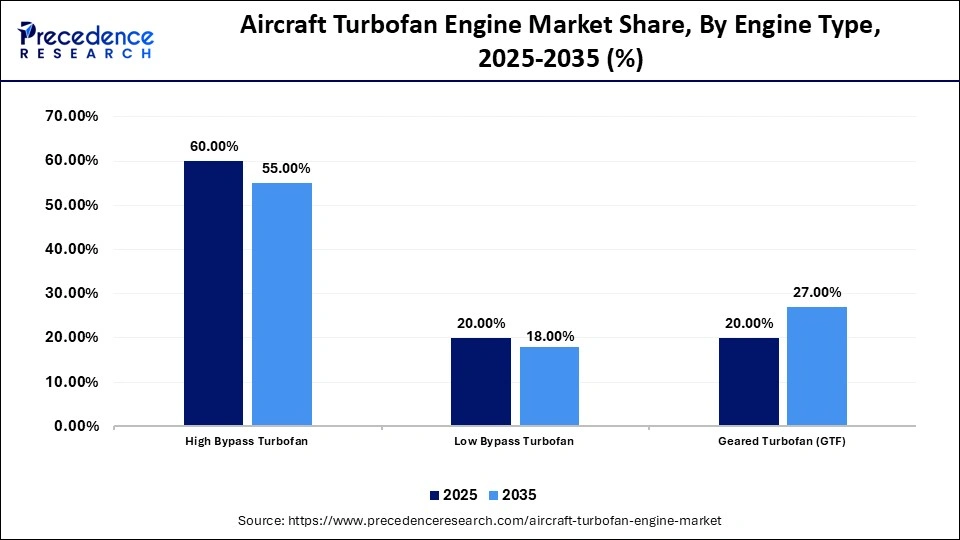
The low bypass turbofan segment held a market share of 20% in 2025, owing to its wide usage in military aircraft requiring higher speed and performance capabilities. Lower bypass engines produce relatively higher thrust at high altitudes, which facilitates faster cruise speeds than high-bypass designs.
The geared turbofan (GTF) segment held a 20% market share in 2025 and is expected to grow at the fastest rate in the upcoming period. This is because of an increase in its adoption, owing to improved fuel efficiency, lower emissions, significantly quieter operations, and technological advancements in gear systems. The GTF's reduction gearbox allows the fan to turn at a slower speed while the turbine spins faster, which increases its efficiency.
Application Insights
Aircraft Turbofan Engine Market Share, By Application , 2025-2035 (%)
| Application | 2025 | 2035 |
| High Bypass Turbofan | 60% | 55% |
| Low Bypass Turbofan | 20% | 18% |
| Geared Turbofan (GTF) | 20% | 27% |
The Commercial Aviation Segment Held a Share of 68% in 2025
The commercial aviation segment led the aircraft turbofan engine market with the highest share of 68% in 2025, owing to the increasing demand for fuel-efficient aircraft, rising fleet expansion, and a surge in air passenger traffic. Commercial aviation widely uses modern high-bypass turbofan engines that deliver nearly 15% lower fuel consumption than older models, thereby reducing operating costs and lowering carbon emissions.
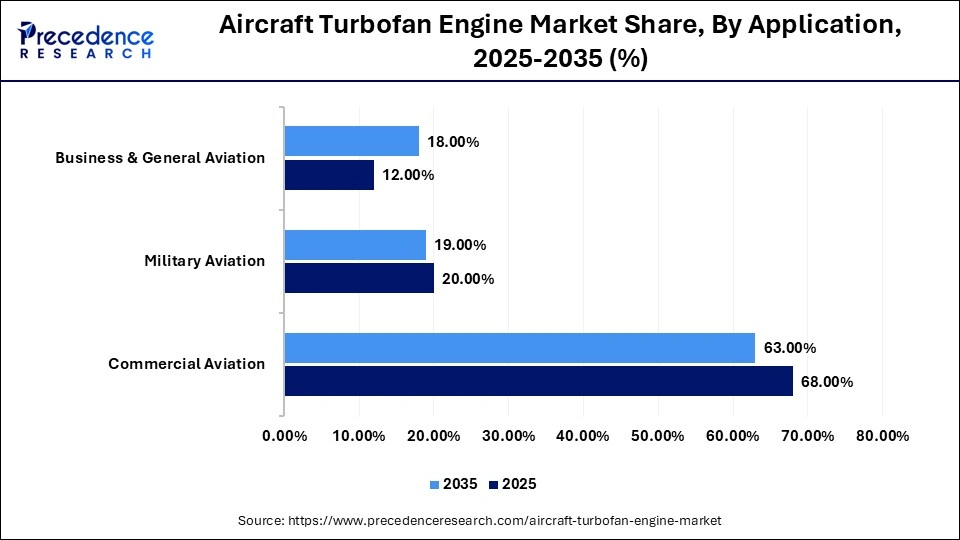
The military aviation segment is the second-largest shareholder, holding approximately 20% share in 2025, and is expected to grow at the fastest rate over the forecast period. This is due to the rising defense modernization programs and growing demand for advanced fighter jets. The increase in military spending to replace aging fleets with advanced aircraft requires continuous next-generation turbofan engines, driving the segment's growth.
The business & general aviation segment held approximately 12% share of the market in 2025, driven by the growing demand for private jet and charter services and rising demand for fuel-efficient & lower-noise engines in modern aircraft. An increase in the number of high-net-worth individuals (HNWIs) has significantly increased the demand for private jets, which bolsters the market for turbofan engines in new business jets.
Thrust Range Insights
Aircraft Turbofan Engine Market Share, By Thrust Range, 2025-2035 (%)
| Thrust Range | 2025 | 2035 |
| Below 20,000 lbf | 18% | 20% |
| 20,000–50,000 lbf | 32% | 36% |
| Above 50,000 lbf | 50% | 44% |
The Above 50,000 lbf Segment Led the Market with a 50% Share in 2025
The above 50,000 lbf segment held the largest market share of 50% in 2025, owing to the rising demand for wide-body aircraft and long-haul operations. Engines producing over 50,000 lbf of thrust are widely adopted to power the most popular wide-body aircraft, such as the Airbus A350 and Boeing 777X. They are mainly essential for long-haul and high-capacity flights. As airlines continue to modernize fleets to meet the ongoing increasing global travel demand, resulted in a rapid shift toward more efficient and higher-thrust engines.
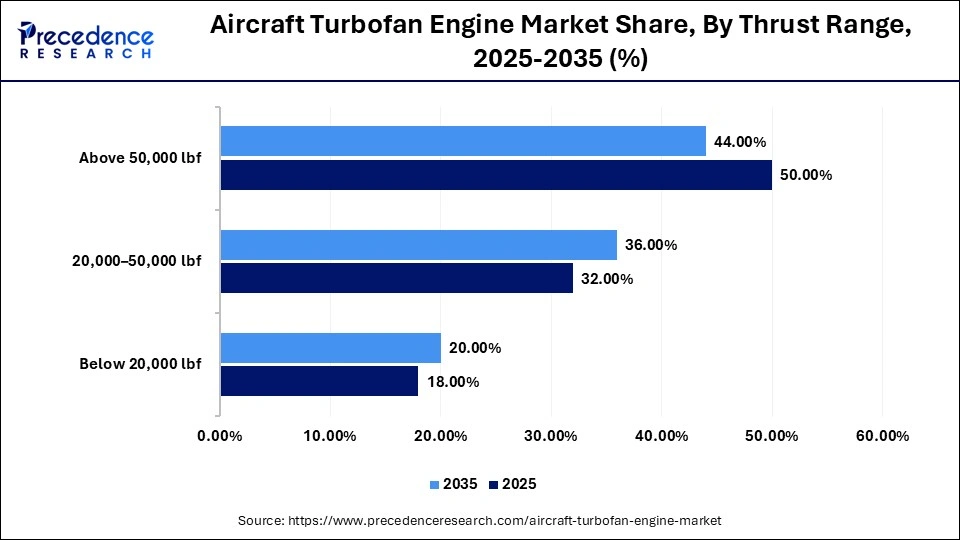
The 20,000-50,000 lbf segment is the second-largest shareholder, holding a share of 32% in 2025, and is expected to grow at the fastest rate during the projection period. This is mainly due to the increasing use of this range of engines in narrow-body aircraft and mid-range commercial jets. The majority of the world's commercial aircraft typically require engines in the 20,000-35,000 lbf range to operate efficiently on short-to-medium-haul routes
The below 20,000 lbf segment held a 18% market share in 2025, due to the massive volume of regional jets, business jets, and specialized military aircraft. The growth in private aviation and business jet charters relies heavily on engines in the below 20,000 lbf range. Moreover, the demand for high-efficiency, low-emission, and reliable propulsion, especially on shorter routes, is expected to drive the segment's growth during the forecast period.
Component Insights
The Fan & Compressor Segment Dominated the Market With a 30% share in 2025
In 2025, the fan & compressor segment held the largest share of 30% in the aircraft turbofan engine market. This is because fans and compressors are the core components that drive airflow and efficiency improvements in turbofan engines. These critical components are responsible for superior fuel efficiency, thrust generation, and operating cost reduction. The fan accelerates a large mass of air around the core, offering high-efficiency propulsion that lowers fuel consumption, whereas the compressor is vital in determining the overall engine pressure ratio (OPR).
The turbine segment is the second-largest shareholder, holding a market share of 25% in 2025, owing to its critical role in maximizing fuel efficiency, enhancing power generation, and improving overall thrust performance. Turbines function under extreme temperatures and speeds. The rising advancement in blade material science, along with the increasing demand for durable, efficient, and low-emission engines, makes them essential to engine manufacturing.
Aircraft Turbofan Engine Market Share, By Component, 2025-2035 (%)
| Component | 2025 | 2035 |
| Commercial Aviation | 68% | 63% |
| Military Aviation | 20% | 19% |
| Business & General Aviation | 12% | 18% |
The combustor segment held a 18% share of the market in 2025, driven by its rising focus on emission reduction and fuel efficiency. The combustor is the core component that is responsible for increasing engine efficiency, emissions compliance, and thrust performance.
The gearbox segment held a 12% share of the aircraft turbofan engine market in 2025, driven by increasing adoption of geared turbofan technology. The gearbox in the geared turbofan (GTF) engine design allows the large front fan and low-pressure compressor to operate at different and optimal speeds, overcoming traditional limitations. It enables the fan to rotate more slowly for improved efficiency and reduced noise, while the low-pressure (LP) compressor and turbine spin faster for higher efficiency, reducing fuel consumption.
Regional Insights
North America Aircraft Turbofan Engine Market Size and Growth 2026 to 2035
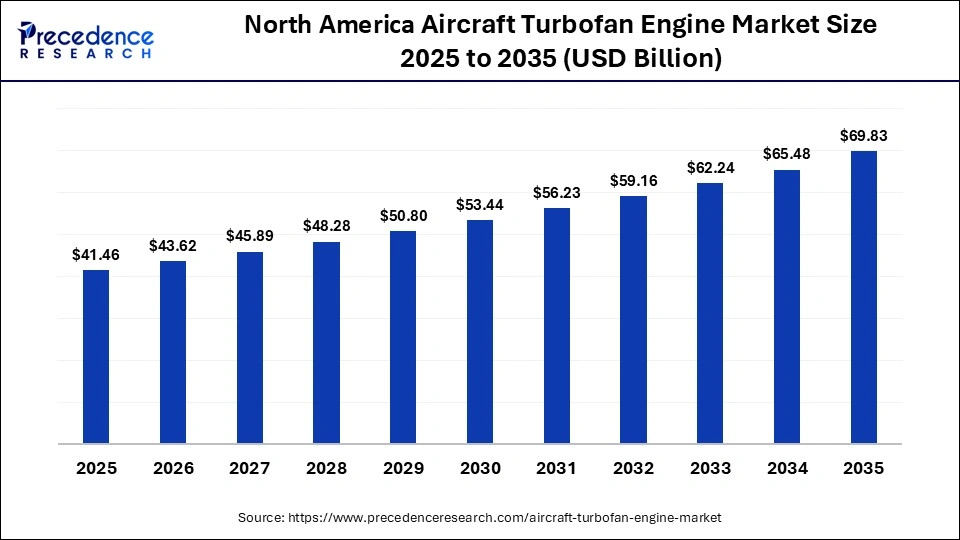
The North America aircraft turbofan engine market size is estimated at USD 41.46 billion in 2025 and is projected to reach approximately USD 69.83 billion by 2035, with a 5.35% CAGR from 2026 to 2035.
What Made North America the Dominant Region in the Aircraft Turbofan Engine Market?
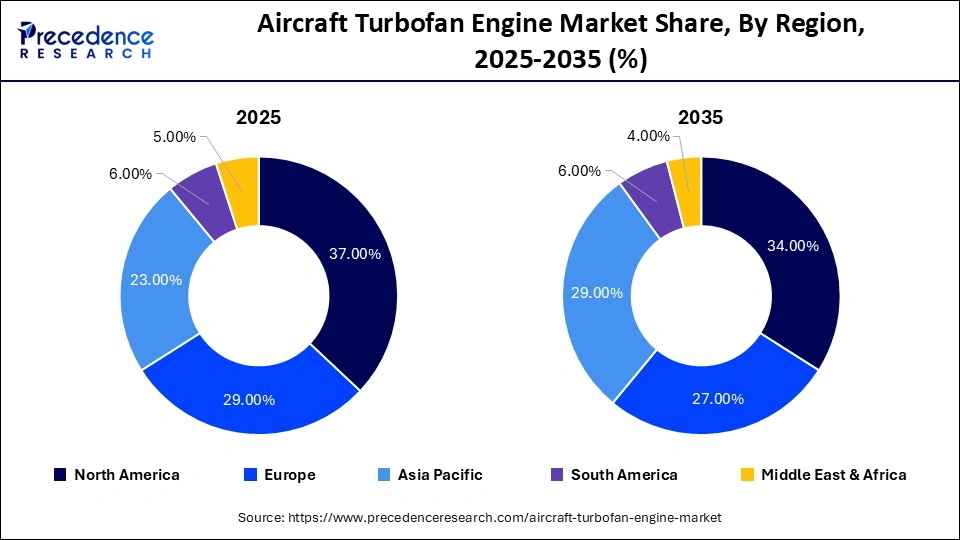
North America dominated the global aircraft turbofan engine market with a share of 37% in 2025. The region's leadership position is attributed to the rising investment in R&D and its increasing focus on developing sophisticated technologies such as geared turbofans, high-bypass ratios, and lightweight composite materials for improved fuel efficiency and lower emissions. The region is also experiencing the highest demand for new aircraft, mainly driven by the surge in air travel and an increase in military defense contracts requiring advanced engines. The presence of leading engine manufacturers like General Electric and Pratt & Whitney, coupled with established aviation hubs such as Seattle, Connecticut, and Ohio, ensures access to a highly skilled workforce and integrated supply chains.
U.S. Aircraft Turbofan Engine Market Size and Growth 2026 to 2035
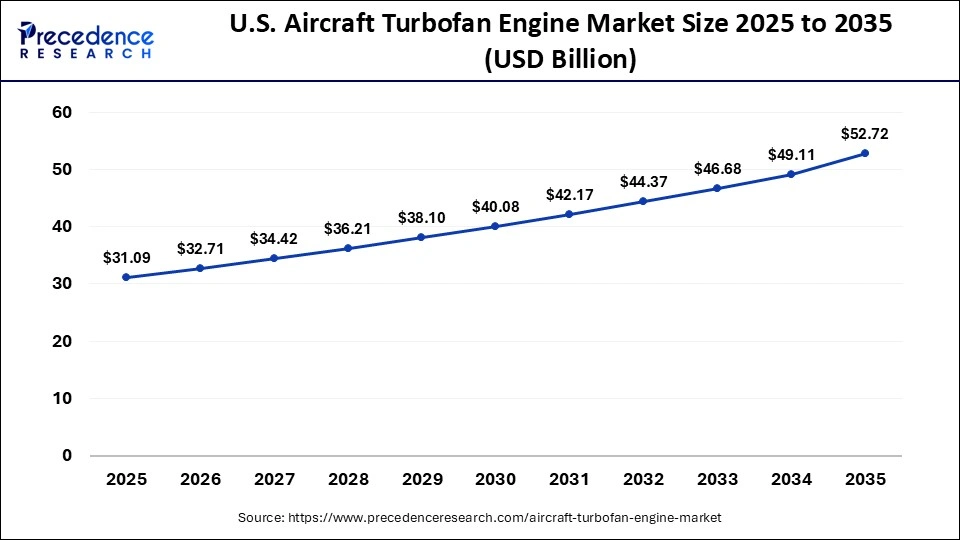
The U.S. aircraft turbofan engine market size is calculated at USD 31.09 billion in 2025 and is expected to reach nearly USD 52.72 billion in 2035, accelerating at a strong CAGR of 5.42% between 2026 and 2035.
U.S. Aircraft Turbofan Engine Market Analysis
The U.S. is a major contributor to the market within North America. The government's stringent environmental regulations have compelled manufacturers to adopt next-generation engine technology to lower carbon footprints and meet strict emission standards. The region is home to leading market players such as GE Aerospace, Pratt & Whitney, Honeywell International Inc., Williams International, and others. The country also leads in manufacturing, fleet modernization, and MRO services, with a high demand for sustainable and high-performance engines.
Asia Pacific: The Fastest-Growing Region
Asia Pacific held a 23% share of the market in 2025 and is expected to grow at the fastest rate during the forecast period. The region's growth is attributed to the rising concentration of leading engine manufacturers, growth in aviation traffic, rising investments in R&D for fuel-efficient and advanced technologies, and the rapid expansion of the commercial & military aviation sector. Countries like China, Japan, and India are major markets, with high aircraft adoption for domestic and international routes.
China Aircraft Turbofan Engine Market Analysis
The market in China is expanding due to a significant rise in air travel demand, which necessitates fleet expansions. The country's growth is largely driven by the booming commercial sector, the replacement of aging fleets, strict government emission regulations, robust Maintenance, Repair, and Overhaul (MRO) infrastructure, and rising innovations in materials and design of turbofan engines. The government in the country is heavily investing in military modernization, which includes the adoption of sophisticated aircraft engines.
How is the Opportunistic Rise of Europe in the Aircraft Turbofan Engine Market?
Europe is the second-largest shareholder, holding a 29% market share in 2025, and is expected to grow at a significant rate over the forecast period. Europe is home to several industry leaders, such as Rolls-Royce and Safran, which hold a significant share of the global market, driving rapid innovations in high-bypass engine technology. The growth of the region is attributed to the robust commercial & military demand, significant R&D investment, rising focus on defense modernization, and stringent environmental regulations requiring advanced fuel-efficient engines. Several business aviation operators in the region are actively replacing older aircraft with new, technologically advanced turbofan-powered models to reduce emissions and improve efficiency.
Germany Aircraft Turbofan Engine Market Analysis
The market in Germany is expanding, supported by a combination of factors such as the strong presence of leading market players, increasing focus on sustainable aviation technologies, rise in R&D investment, stringent emission standards, and rising integration of digital technologies to enhance operational efficiency and enable predictive maintenance capabilities. The surge in passenger traffic and the rapid modernization of airline fleets necessitate constant upgrades and new engine deliveries in the country. Several airlines in the country are increasingly adopting advanced and fuel-efficient turbofan engines to reduce environmental impact, lower noise, and minimize fuel consumption.
Aircraft Turbofan Engine Market Companies
- General Electric (GE Aerospace)
- Rolls-Royce Holdings plc
- Pratt & Whitney (RTX Corporation)
- Safran Aircraft Engines
- Honeywell International Inc.
- MTU Aero Engines AG
- IHI Corporation
Kawasaki Heavy Industries - Mitsubishi Heavy Industries
- Aero Engine Corporation of China (AECC)
- GKN Aerospace
- Avio Aero
- Techspace Aero
- Volvo Aero (GKN Aerospace Sweden)
- NPO Saturn
Recent Developments
- In March 2026, Honeywell Aerospace unveiled the HON6000, a high-performance turbofan engine designed for collaborative combat aircraft, light combat aircraft, unmanned aerial vehicles, and advanced jet trainers. The engine has been designed to support the operational needs of collaborative combat aircraft, which are autonomous platforms intended to work alongside crewed fighter aircraft.(Source: https://www.manufacturingtodayindia.com)
- In January 2026, GE Aerospace announced a new test milestone for hybrid electric aviation, successfully demonstrating power transfer, extraction, and injection in a high-bypass commercial turbofan engine. In 2025, ground testing of a modified passport engine was completed at Peebles Test Operation as part of NASA's Turbofan Engine Power Extraction Demonstration project.(Source: https://www.geaerospace.com)
Segment Covered in the Report
By Engine Type
- High Bypass Turbofan
- Low Bypass Turbofan
- Geared Turbofan (GTF)
By Application
- Commercial Aviation
- Military Aviation
- Business & General Aviation
By Component
- Fan & Compressor
- Turbine
- Combustor
- Gearbox
- Exhaust System
By Thrust Range
- Below 20,000 lbf
- 20,000-50,000 lbf
- Above 50,000 lbf
By Region
- North America
- Latin America
- Europe
- Asia-pacific
- Middle and East Africa
For inquiries regarding discounts, bulk purchases, or customization requests, please contact us at sales@precedenceresearch.com
Frequently Asked Questions





Ask For Sample
No cookie-cutter, only authentic analysis – take the 1st step to become a Precedence Research client
 Get a Sample




 sales@precedenceresearch.com
 Schedule a Meeting
