



Citronellol Market Revenue to Attain USD 2.54 Bn by 2035
Published: 12 Jun 2026
Author: Precedence Research



Citronellol Market Revenue and Trends 2026 to 2035
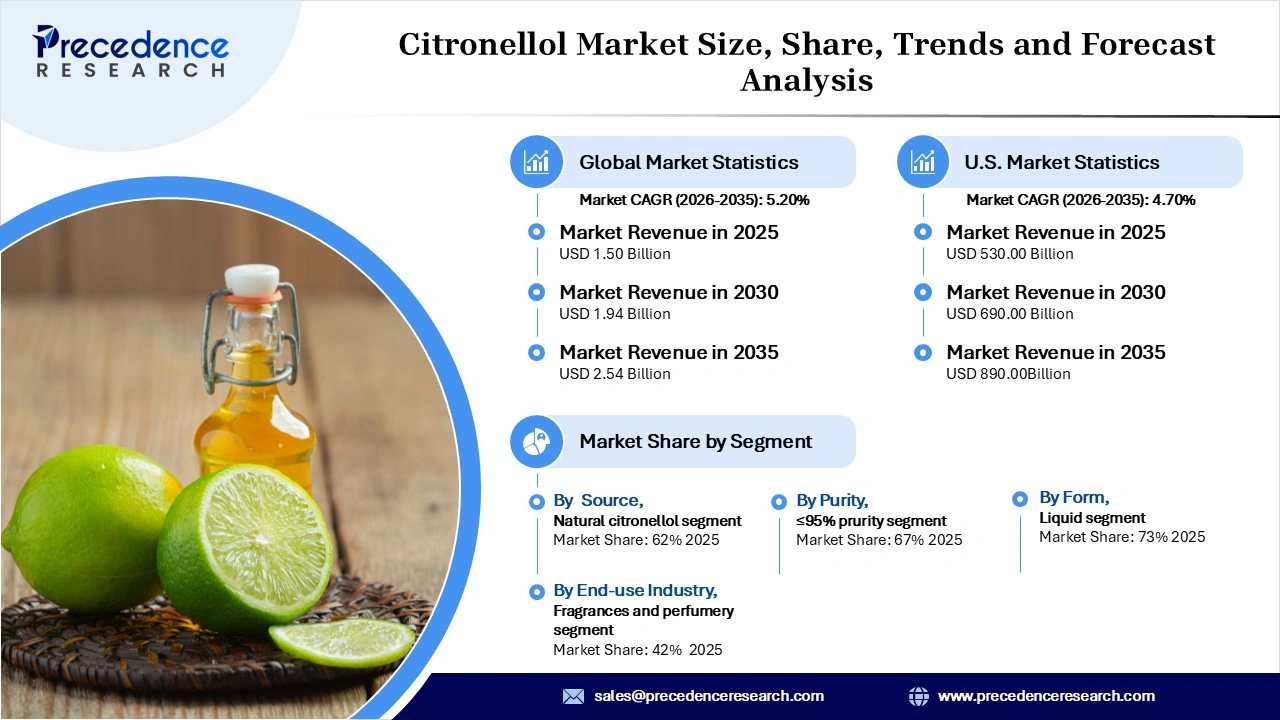
The global citronellol market revenue was valued at USD 1.50 billion in 2025 and is expected to attain around USD 2.54 billion by 2035, growing at a CAGR of 5.20% during forecast period. The market is driven by its increasing use as an ingredient in perfumes, soaps, and body lotions, its capability to act as a natural insect repellent, and rising consumer preference for botanical ingredients used in cosmetic and cleaning products.
Floral Monoterpenoid - Harvesting the Essence of Natural Rose Fragrance
The citronellol market involves the process of manufacturing, extraction, and worldwide supply of citronellol, which is a naturally occurring acyclic monoterpenoid alcohol that forms a major component of rose oil, geranium oil, and citronella oil. There are two enantiomers of citronellol, namely R-(-)-citronellol and S-(+)-citronellol. These are used because of their pleasant smell of roses, fixative effect, and antimicrobial properties.
In addition to natural citronellol obtained from plants, there is artificial citronellol prepared through hydrogenation of citronellal or myrcene. It is used as an ingredient in fragrances, cosmetic products, cleaning agents, and industrial products like metalworking fluids and flotation reagents. It is also utilized as an intermediate in producing rose oxide, citronellyl esters, and other aromatic chemicals. This market has been adopted by fragrance, cosmetic, household cleaning product, and flavoring companies.
Monoterpenoids Derived from Plants Show Potential as Metabolic Disorder Drugs
The market is seeking alternative uses of the compound besides its conventional applications in perfumes and flavoring, especially in pharmaceutical and nutritional products. Several studies have been carried out to explore the biological activities of citronellol-containing natural sources in terms of antidiabetic, anti-inflammatory, and antioxidant properties. Such studies can help expand the scope of the market for the compound as a therapeutic or functional food ingredient. In 2026, a paper published in the journal Phytomedicine Plus reported that citronellol isolated from Naregamia alata was able to lower the blood glucose content of diabetic rat models by 60.2%. It was able to increase the concentration of C-peptide in the serum, elevating it from 0.21 ng/mL to 0.74 ng/mL.
Use of Renewable Terpenoid Additives for Sustainable Pharmaceutical Manufacturing
There is growing potential for the citronellol market beyond its use as a fragrance due to its applications in green chemistry as a sustainable process additive. New studies have shown that naturally occurring terpenoids such as beta-citronellol can be used to eliminate the use of phosphine ligands and decrease energy usage during palladium-catalyzed cross-coupling reactions. In a report published in 2026 by researchers in ChemRxiv, it was reported that beta-citronellol provides the capacity for mechanochemical Suzuki-Miyaura cross-coupling of aryl halides and boronic acids without phosphine ligands or heating.
Government Initiatives to Improve the Availability of Feedstock for the Fragrance Industry
Governments across the globe have implemented policies to encourage the cultivation of aromatic plants such as citronella plants to facilitate the availability of locally grown feedstocks for the manufacture of citronellol and other natural fragrances. The national agricultural missions enable farmers to produce aromatic plants and increase the availability of crude natural oils from which citronellol can be extracted. In 2025, through the CSIR-Aroma mission in India, the CSIR-North East Institute of Science and Technology (NIEST) has cultivated aromatic plants such as citronella, lemongrass, and patchouli on more than 5,000 hectares in northeast India.
Yeast Engineering Leads to Unprecedented Yield of Citronellol
In 2025, an engineered Saccharomyces cerevisiae strain was used to boost citronellol production through optimization of the mevalonate pathway, resulting in a yield 1.5 times higher than before. It also resulted in a yield enhancement of 16% by increasing the NADPH pool. Selection of transporters led to titers of 3.38 g/L, while the final fed-batch bioreactor fermentation at 100 L resulted in 10.556 g/L citronellol, the highest yield ever recorded in commercial manufacturing of citronellol.
Market Segmentation Overview
- By source, the natural citronellol segment led the citronellol market with 62% share in 2025 and is expected to expand at the highest CAGR of 6.2% during the forecast period, because of consumers’ desire for plant-based components in fragrances, cosmetics, and other products. Moreover, environmental and regulatory pressure has forced big companies to use natural citronellol instead of its artificial alternative.
- By source, the synthetic citronellol held the second-largest market share of 38% in 2025, since it produces a high-purity product that is cost-effective. It can be used in industrial applications like cleaning detergents and fragrance products that do not need to be from a natural source, as they need consistency and reliability of supply. The supply of synthetic citronellol is not affected by seasonal changes and other agricultural factors.
- By purity, the ≤95% purity segment dominated the market with 67% share in 2025, as this much purity is cheaper to achieve and it fulfils the needs of large-scale industrial use in products like soaps, detergents, industrial cleaners, and intermediates for chemical synthesis, where high purity is not required. This segment has been extensively adopted in the manufacturing of perfumes and household products.
- By purity, the >95% purity segment is expected to grow at the fastest CAGR of 6.9% from 2026 to 2035, because high-end personal care products, fine perfumes, and pharmaceutical industry applications need a product of very high purity levels to achieve reliable olfactory properties and prevent any skin reactions. The increasing consumer demand for high-quality ingredients, along with the introduction of new applications like bioactive compounds, boosts the demand for this segment in the expensive product category.
- By form, the liquid segment led the citronellol market with 73% share in 2025 and is expected to expand at the highest CAGR of 5.5% during the forecast period, due to the natural tendency of citronellol to be found in the form of a colorless to slightly yellow fluid, which means that liquid is its basic state. This state of substance facilitates its processing, dispensing, and adding to various products, since no extra processing is required.
- By form, the solid segment held the second-largest market share of 27% in 2025, because of its use in dry formulations, such as powdered detergents, solid perfumes, and pressed cosmetic powder. Dry formulations are needed because it provides controlled-release profile and offer greater protection against oxidative breakdown than liquid formulations.
- By end-use industry, the fragrances and perfumery segment dominated the market with 42% share in 2025, because citronellol is a key compound in rose and floral-type fragrance bases, making it a readily available natural or artificial means of achieving a fresh and delicate floral scent that blends perfectly with other essential oils and fragrances. Citronellol is an important ingredient in various perfumes, colognes, and scented personal care products.
- By end-use industry, the personal care and cosmetics segment is expected to grow at the fastest CAGR of 6.4% from 2026 to 2035, due to growing consumer preference for fragrances with multiple functions, including anti-aging, moisturizing, and soothing properties, along with the fragrance, making citronellol well-suited to be used in the formulation of such products. The increasing preference for clean and naturally derived products is boosting the adoption rate of plant-derived citronellol.
Regional Analysis
North America led the citronellol market with 42% share in 2025, owing to the significant presence of prominent fragrance and flavor brands, a well-developed manufacturing sector, and consumer preference for aromatic products in personal care and home care categories. The U.S. dominated the market in North America due to its high indigenous production capabilities, significant research and development efforts in synthetic aroma chemicals, and the presence of global perfume manufacturers purchasing huge amounts of citronellol to use in fine perfumes and air care products. Canada witnessed notable market growth because of strong demand for scented personal care products, cleaning items, and natural cosmetics, a robust distribution system, and ready access to the necessary raw materials from both local and foreign sources.
Asia-Pacific is expected to expand at the highest CAGR of 7.2% in the citronellol market during the forecast period, due to the fast-paced development of the personal care and home fragrances sector, increasing disposable incomes, and an emerging middle class that prefers scented products. China led the market in Asia-Pacific because of its large production of natural and synthetic citronellol, in addition to the export of fragrance ingredients. India is a significant contributor to the market owing to its low-cost manufacturing of aroma chemicals, burgeoning cosmetics industry, and government policies favoring the cultivation of essential oils for the fragrance industry.
Europe held the second-largest market share of 25% in 2025, because of an extensively developed fragrance and cosmetics industry that consists of perfume makers and other companies involved in the manufacturing of quality fragrances using citronellol. Germany dominated the market in Europe due to its well-developed chemical and aroma chemical industry that manufactures synthetic and natural citronellol products for indigenous use and for export. France witnessed notable market growth owing to its well-established perfumery industry located in Grasse, along with the presence of numerous luxury cosmetics firms, which need citronellol that is pure and constant in its quality.
Citronellol Market Coverage
| Report Attribute | Key Statistics |
| Market Revenue in 2025 | USD 1.50 Billion |
| Market Revenue by 2035 | USD 2.54 Billion |
| CAGR from 2026 to 2035 | 5.20% |
| Quantitative Units | Revenue in USD million/billion, Volume in units |
| Largest Market | Asia Pacific |
| Base Year | 2025 |
| Regions Covered | North America, Europe, Asia-Pacific, Latin America, and the Middle East & Africa |
Top Companies in the Citronellol Market
BASF SE, Givaudan SA, International Flavors and Fragrances Inc. (IFF), and Symrise AG are some of the key players who manufacture and supply top-quality synthetic and natural citronellol in the world. Takasago International Corporation, Robertet SA, and Treatt plc manufacture only natural citronellol derived from essential oils such as citronella oil, rose oil, and geranium oil. Kao Corporation and Privi Specialty Chemicals Limited manufacture citronellol along with various aroma chemicals, catering to their own internal needs in the case of Kao Corporation and also catering to external market needs in the case of Privi Specialty Chemicals Limited.
Bo International, Jiangxi Global Natural Spice Co., Ltd., Lubon Industry Co., Ltd., and Crescent Fragrances Pvt. Ltd. manufacture cost-effective citronellol in India and China, which is derived by the process of fractionation of citronella oil. The major trend involves the production of citronellol based on biochemistry using renewable resources, which is the focus of BASF SE and International Flavors and Fragrances (IFF). However, natural extraction-based products are premium-priced due to the limitations in the production of rose and geranium oil.
Segments Covered in This Report
By Source
- Natural Citronellol
- Synthetic Citronellol
By Purity Level
- ≤95% Purity
- >95% Purity
By Form
- Liquid
- Solid
By End-Use Industry
- Fragrances and Perfumery
- Personal Care and Cosmetics
- Household Products
- Food and Beverage Flavoring
- Pharmaceuticals
- Others
By Region
- North America
- Latin America
- Europe
- Asia-pacific
- Middle and East Africa
Get this report to explore global market size, share, CAGR, and trends, featuring detailed segmental analysis and an insightful competitive landscape overview @ https://www.precedenceresearch.com/sample/8475
You can place an order or ask any questions. Please feel free to contact us at sales@precedenceresearch.com |+1 804 441 9344