



Firefighting Aircraft Market Revenue to Attain USD 9.80 Bn by 2035
Published: 10 Apr 2026
Author: Precedence Research



Firefighting Aircraft Market Revenue and Trends 2026 to 2035
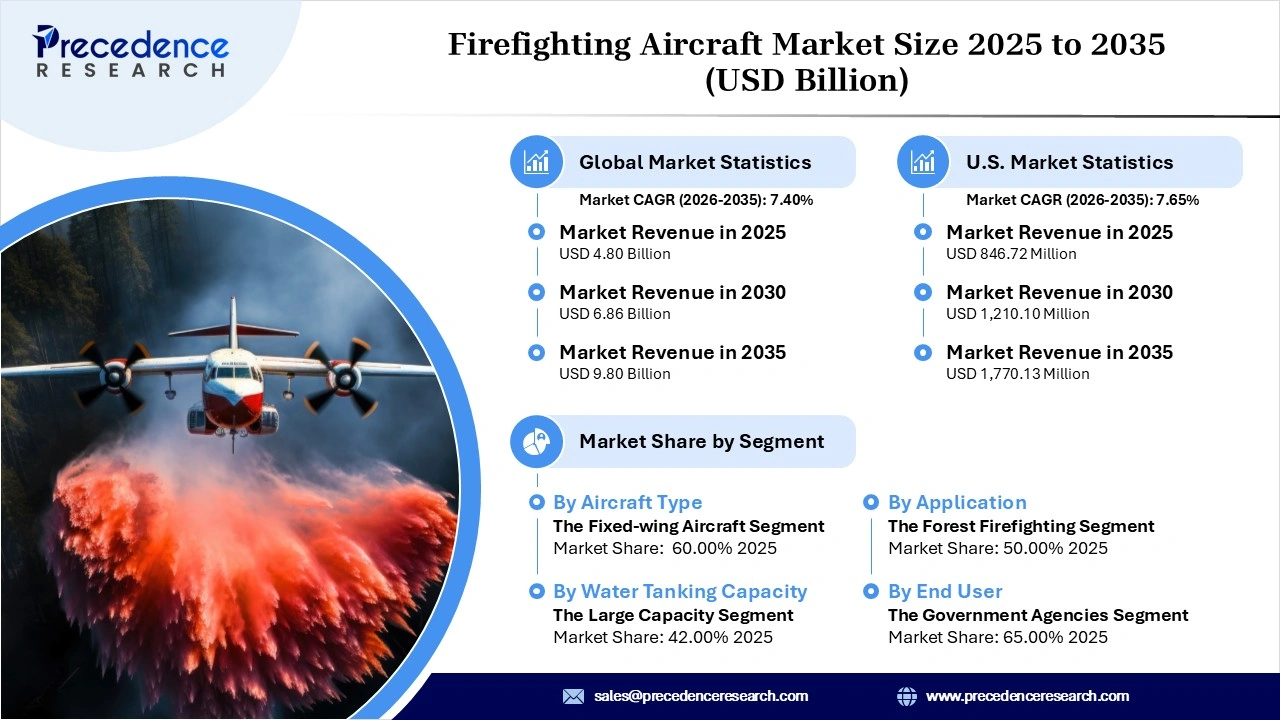
The global firefighting aircraft market revenue was valued at USD 4.80 billion in 2025 and is expected to attain around USD 9.80 billion by 2035, growing at a CAGR of 7.40% during forecast period. The firefighting aircraft market is growing rapidly as nations invest in aerial fleets and advanced technologies to combat increasingly frequent and intense wildfires efficiently and safely.
Market at a Glance
The firefighting aircraft market includes specialized fixed-wing planes and helicopters that are either purpose-built or modified to combat wildfires, capable of carrying and accurately deploying water, fire retardants, or foam over affected areas. In addition to these core functions, the market extends to services such as aerial reconnaissance, aircraft retrofitting, leasing, and ongoing maintenance, forming an integrated, fast-response system where timing, precision, and operational efficiency are critical to successful wildfire management. Government agencies often collaborate with private contractors in cross-border emergency responses, leveraging advanced technologies like real-time data systems and precision drop algorithms, which transform traditional reactive firefighting into strategic, foresighted, and highly adaptable operations.
What Drives the Firefighting Aircraft Market?
- Investment and Policy Support: Many nations are allocating substantial budgets for disaster management, providing grants for new aircraft acquisition, fleet modernization, and infrastructure upgrades. In 2026, Alberta awarded a $400 million contract for five new DHC-515 water bombers, aiming to boost water-dropping capacity by nearly 60%. Such large-scale government contracts not only expand aerial firefighting fleets but also improve operational efficiency, encouraging other regions facing wildfire risks to pursue similar initiatives.
- Demand for Rapid-Response in Hard-to-Reach Areas: Urban-wildland interfaces, remote forests, and rugged terrains are often inaccessible to ground-based firefighting methods. Aerial firefighting aircraft can quickly reach these areas, making them indispensable for protecting lives, property, and critical infrastructure.
- Climate Change: Wildfires are increasingly spreading beyond traditional seasons and regions, with over a million hectares affected in Europe in 2025 alone. As fire seasons lengthen, governments are compelled to invest in additional aircraft and more versatile, multi-functional aerial systems to meet growing operational demands.
Global Firefighting Aircraft Import Trends
According to Firefighting Aircraft import analytics, a total of 25 verified buyers worldwide sourced aircraft from 25 different global suppliers. Between January and December 2024, 10 of these buyers remained actively engaged, highlighting consistent procurement interest across the market. Among the high-volume buyers, Universal Alloy Corporation Europe SR led with 18% of global imports across two shipments, while Corporacion Favorita C.A. and PT AGATA PROMAR each contributed 9% with one shipment apiece, collectively representing the major share of international demand.
Market Segmentation Overview
- By aircraft type, the fixed-wing aircraft segment led the firefighting aircraft market with a 60% share in 2025. This is because their design enables them to carry larger payloads over extensive wildfire areas and quickly return for subsequent drops, making them indispensable for rapid-response operations where fires spread over wide regions.
- By aircraft type, the rotary-wing aircraft segment held the second-largest market share of 40% in 2025. These aircraft are excellent at precision drops, navigating narrow valleys and rugged terrain to deliver water or retardants accurately, which is critical in locations where fixed-wing aircraft cannot operate effectively.
- By water tanking capacity, the large capacity (above 10,000 liters) segment held a major market share of 42% in 2025. This is because these aircraft can deliver massive volumes of water or retardant in a single sortie, reducing the number of trips needed and shortening response times, making them ideal for tackling extensive wildfires where both speed and volume are critical for containment.
- By water tanking capacity, the medium capacity (3,000-10,000) segment was the second-largest shareholder, holding a 40% share in 2025. These aircraft offer operational flexibility, are easier to mobilize, and are well-suited for regional or moderately sized fires, providing a balance between payload and efficiency without the resource demands of larger aircraft.
- By application, the forest firefighter segment dominated the firefighting aircraft market, accounting for the largest share of 50% in 2025. The dominance of this segment is driven by the increasing spread of wildfires into remote and previously inaccessible areas, making aerial support essential for successive water or retardant drops across large regions, where ground teams alone cannot manage containment.
- By end user, the government agencies segment held a major revenue share of 65% in the market in 2025. This is because of their focus on large-scale preparedness and emergency response drives investment in long-term fleets, ensuring they have the capacity, coordination, and resources to manage seasonal and unpredictable wildfire events effectively.
- By end user, the private companies segment held a 35% market share in 2025 due to their growing partnerships with government agencies. These organizations enhance operational flexibility, develop rapid deployment strategies, and gradually integrate with public firefighting services to support peak demand and specialized missions.
Regional Insights
North America dominated the global firefighting aircraft market with a share of 42% in 2025, driven by frequent and intense wildfires that demanded extensive aerial deployment. The U.S. contributed through strong federal support and proactive fleet modernization, while Canada strengthened regional capacity via well-managed provincial programs and waterbomber initiatives. Combined, these efforts established rapid-response capabilities and positioned aircraft as strategic assets, ready well in advance of fire seasons.
Europe was the second-largest shareholder, holding a 28% market share in 2025, driven by increasingly severe and frequent wildfire seasons. Countries like Italy, Spain, France, and Greece have been prompted to reassess aging fleets and slow procurement practices, moving away from decades-old aerial units. The region is gradually shifting toward coordinated acquisitions and EU-supported joint programs, establishing more secure, sustainable, and future-ready aerial firefighting operations.
Asia Pacific is expected to grow at the fastest rate in the coming years, driven by rising wildfire incidences and increased government focus on disaster preparedness. Rapid urbanization, expansion of forested areas under protection, and investments in modern aerial firefighting fleets are accelerating demand. Additionally, the adoption of advanced technologies like GPS-guided drops and real-time aerial surveillance is further enhancing operational efficiency and market expansion in the region.
Firefighting Aircraft Market Coverage
| Report Attribute | Key Statistics |
| Market Revenue in 2025 | USD 4.80 Billion |
| Market Revenue by 2035 | USD 9.80 Billion |
| CAGR from 2026 to 2035 | 7.40% |
| Quantitative Units | Revenue in USD million/billion, Volume in units |
| Largest Market | North America |
| Base Year | 2025 |
| Regions Covered | North America, Europe, Asia-Pacific, Latin America, and the Middle East & Africa |
Top Companies in the Firefighting Aircraft Market
Bombardier Inc., Airbus SE, and Lockheed Martin Corporation play a pivotal role in the market due to their extensive engineering capabilities, frequently transforming military-grade platforms into effective firefighting aircraft. Textron Aviation Inc. and Embraer S.A. broaden the range with adaptable planes suited for various missions. De Havilland Aircraft of Canada Limited is influential in the amphibious segment through its DHC-515 program, while Viking Air Limited enhances legacy models with contemporary upgrades.
Segments Covered in the Report
By Aircraft Type
- Fixed-Wing Aircraft
- Large Fixed-Wing Aircraft
- Small & Medium Fixed-Wing Aircraft
- Rotary-Wing Aircraft
- Helicopters
- Light Aircraft
By Water Tanking Capacity
- Small Capacity (Up to 3,000 liters)
- Medium Capacity (3,000 - 10,000 liters)
- Large Capacity (Above 10,000 liters)
By Application
- Forest Firefighting
- Wildland Firefighting
- Aerial Firefighting Support
- Structural Firefighting
- Agricultural Firefighting
- Fire Suppression in Farmlands
- Others
- Emergency Rescue Operations
- Water Dropping for Flood Control
By End User
- Government Agencies
- Firefighting Authorities
- Military Agencies
- Private Companies
- Aircraft Operators
- Firefighting Service Providers
By Region
- North America
- Latin America
- Europe
- Asia-pacific
- Middle and East Africa
Get this report to explore global market size, share, CAGR, and trends, featuring detailed segmental analysis and an insightful competitive landscape overview @ https://www.precedenceresearch.com/sample/8287
You can place an order or ask any questions, please feel free to contact us at sales@precedenceresearch.com |+1 804 441 9344