



Firefighting Aircraft Market Trends, Companies, Contract Wins / Project Pipeline, Defense Contracts, Procurement Volume, Government Spending, Production Capacity, Competitive Positioning, and Growth Outlook
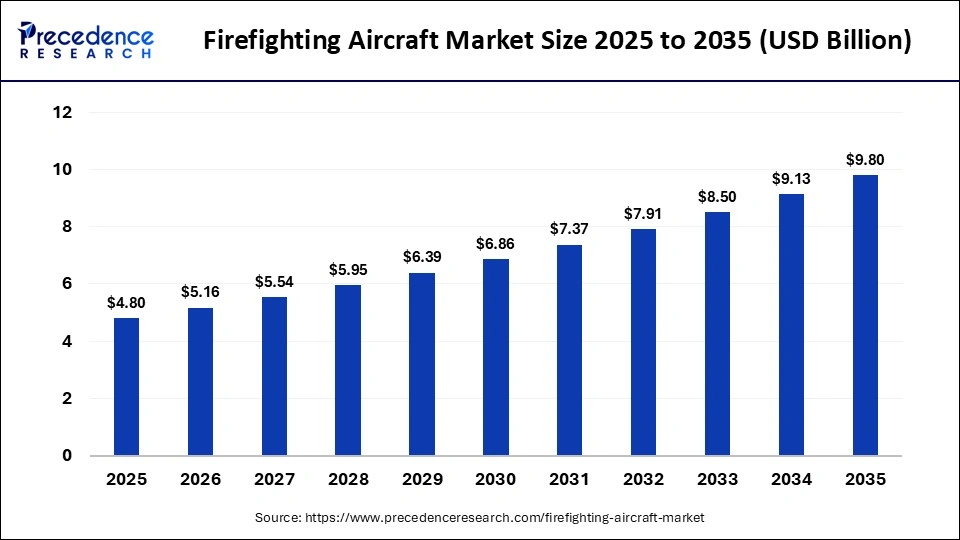
Gautam Mahajan, an Aerospace and Defence Industry Expert, identifies strong market momentum in the firefighting aircraft market, which reached USD 5.16 billion in 2026 and is projected to attain USD 9.80 billion by 2035 at a CAGR of 7.40%. Major firefighting aircraft market companies, including Bombardier Inc., Airbus SE, Lockheed Martin Corporation, Textron Aviation Inc., compete across critical segments such as By Aircraft Type, By Water Tanking Capacity, By Application, By End User.
Source: https://www.precedenceresearch.com/firefighting-aircraft-market
 Get a Sample
 Table Of Content


What is the Firefighting Aircraft Market Size in 2026?
The global firefighting aircraft market size accounted for USD 4.80 billion in 2025 and is predicted to increase from USD 5.16 billion in 2026 to approximately USD 9.80 billion by 2035, expanding at a CAGR of 7.40% from 2026 to 2035. The firefighting aircraft market is driven by the increasing frequency of wildfires and rising investments in aerial firefighting.
Key Takeaways
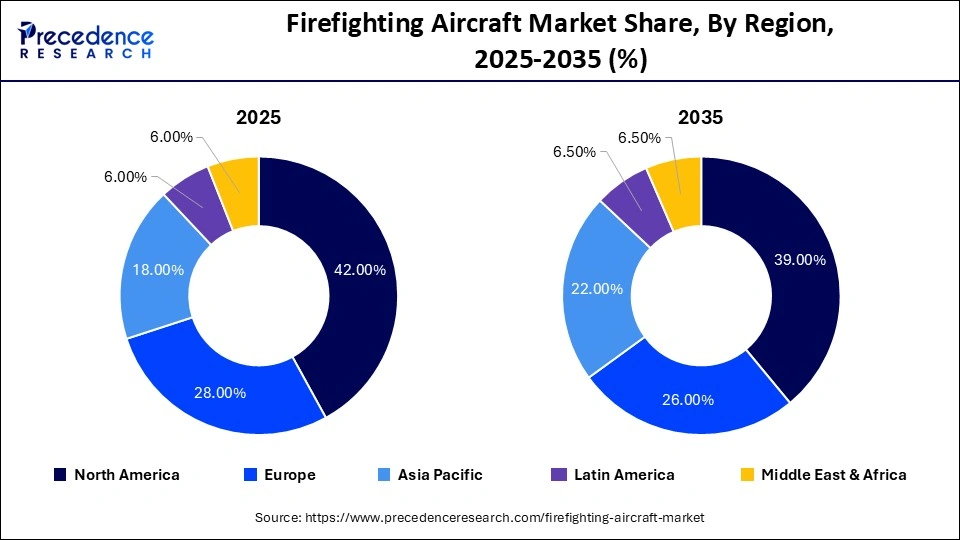
- North America dominated the firefighting aircraft market, accounting for 42.00% share in 2025.
- The Asia Pacific is expected to grow at a significant rate in the market during the forecast period.
- By aircraft type, the fixed-wing aircraft segment held a dominant position in the market with a share of 60.00% in 2025.
- By aircraft type, the rotary-wing aircraft segment is the second-largest shareholder and is expected to grow at a significant rate between 2026 and 2035.
- By water tanking capacity, the large capacity segment accounted for a major market share of 42.00% in 2025.
- By water tanking capacity, the medium capacity segment is the second-largest shareholder and is expected to grow at a significant rate between 2026 and 2035.
- By application, the forest firefighting segment led the global market with a share of 50.00% in 2025.
- By application, the structural firefighting segment is the second-largest shareholder and is expected to grow at a significant rate between 2026 and 2035.
- By end user, the government agencies segment dominated the global market with a share of 65.00% in 2025.
- By end user, the private companies segment is the second-largest shareholder and is expected to grow at a significant rate between 2026 and 2035.
Market Overview
Firefighting aircraft are planes designed or converted for aerial firefighting to fight wildfires and large blazes. They are also key in transporting water, fire retardants, or foam to hard-to-reach areas, helping to contain fires more quickly and prevent their spread. Firefighting aircraft include fixed-wing planes, air tankers, scooper airplanes, and helicopter rotors, often equipped with a Bambi Bucket or internal tank for precise drops. They are used by government agencies, private contractors, and military forces worldwide. As wildfires increase in frequency and severity, countries are investing in building their aerial firefighting fleets, adopting new technologies, and fostering international cooperation.
How is AI Influencing the Firefighting Aircraft Market?
The integration of artificial intelligence into firefighting aircraft is changing how wildfires are detected, tracked, and extinguished. High-level AI programs, which are utilized to process satellite imagery and other forms of real-time data collected by drones and manned aircraft, are already in place to detect the fire eruptions during their early stages and the direction that the fires take. This makes aircraft programs optimally programmed to deliver water and retardant and reduce resource wastage. Additionally, AI-powered systems monitor environmental factors such as wind speed, terrain, and vegetation density to support informed decision-making, enhancing both operational efficiency and safety.
Firefighting Aircraft Market Trends
- Artificial intelligence, satellite data, and predictive analytics are increasingly used in firefighting operations to detect wildfires at early stages, optimize flight routing, and enable more targeted water and retardant drops.
- Governments and private operators are investing in larger and more advanced fleets, including modern air tankers and multi-mission aircraft, to expand coverage, reduce response times, and address the growing frequency and severity of wildfires.
- Drones equipped with thermal cameras and advanced sensors are being deployed for reconnaissance and real-time fire monitoring, enhancing situational awareness and supporting manned aircraft operations.
- Next-generation firefighting aircraft are incorporating advanced water and retardant dispersal systems, precision delivery technologies, and hybrid tank designs to maximize coverage, reduce resource wastage, and improve operational efficiency across diverse terrains.
Market Scope
| Report Coverage | Details |
| Market Size in 2025 | USD 4.80 Billion |
| Market Size in 2026 | USD 5.16 Billion |
| Market Size by 2035 | USD 9.80 Billion |
| Market Growth Rate from 2026 to 2035 | CAGR of 7.40% |
| Dominating Region | North America |
| Fastest Growing Region | Asia-Pacific |
| Base Year | 2025 |
| Forecast Period | 2026 to 2035 |
| Segments Covered | Aircraft Type, Water Tanking Capacity, Application, End User, and Region |
| Regions Covered | North America, Europe, Asia-Pacific, Latin America, and Middle East & Africa |
Market Dynamics
Drivers
Rising Frequency of Wildfires
The rising frequency and severity of wildfires in most parts of the world are a major factor driving the firefighting aircraft market by significantly boosting the demand for firefighting aircraft. Conventional land-based techniques usually fail to contain huge fires, especially in remote or inaccessible locations. The special characteristic of firefighting aircraft is that they can reach the affected areas in the shortest time, supply significant amounts of water or firefighting substances, and decrease the fire propagation more effectively. The necessity to increase the response times has prompted governments and firefighting agencies to acquire and upgrade fleets of aerial combat vehicles, which are on the rise. Public-private alliances and cross-border partnerships are contributing to the growth of fleets.
Increase in Fire-Related Incidents in the Oil & Gas Industry
The market is also driven by the rising occurrence of fire incidents in the oil and gas plants. Refineries, offshore platforms, and storage sites have flammable material, and prompt containment of such fires becomes a very important issue in preventing catastrophic losses. These areas are prone to fire, and the traditional firefighting methods are not always sufficient. Therefore, special aerial firefighting aircraft are needed. This, in turn, boosts the demand for large-scale aircraft equipped with advanced retardant and water-dropping systems, which are either fixed-wing or rotary-wing.
Restraint
High Acquisition and Operational Costs
Specialized aircraft, such as amphibious planes and large air tankers, require significant capital investment, making them less accessible for small or developing economies. In addition to acquisition costs, high operational expenses, including fuel, maintenance, pilot training, and aircraft conversion, further increase the financial burden. Stringent aviation safety and environmental regulations also pose challenges, requiring extensive compliance and specialized training. Moreover, a global shortage of skilled pilots and technicians limits fleet expansion and affects overall operational readiness.
Opportunity
Technological Advancements and International Collaborations
Ongoing technological advances create immense opportunities in the firefighting aircraft market. Advancements in AI, predictive analytics, and real-time surveillance tools are enhancing the accuracy and effectiveness of wildfire suppression, reducing response times and improving crew safety. Innovations in water and fire retardant dispersal systems, along with the development of autonomous and semi-autonomous flight technologies, are strengthening operational capabilities across diverse terrains. Additionally, the adoption of unmanned aerial vehicles (UAVs) is increasing for reconnaissance and hazard assessment, complementing manned aircraft operations and improving overall mission efficiency.
Segment Insights
Aircraft Type Insights
Firefighting Aircraft Market Share, By Aircraft Type, 2025-2035 (%)
| Aircraft Type | 2025 | 2035 |
| Fixed-Wing Aircraft | 60.00% | 55.00% |
| Rotary-Wing Aircraft | 40.00% | 45.00% |
The Fixed-Wing Aircraft Segment Held a 60.00% Share of the Market in 2025
The fixed-wing aircraft segment held a dominant position in the market with a share of 60.00% in 2025, since it is quicker, has a longer range, and can carry more water. The fixed-wing planes have the capability of covering large territories that are exposed to fire, which means that quick response can be provided to wildfires that are distant or span a large area. These aircraft are also capable of carrying heavier water or fire retardant, which makes them efficient in battling fire. Moreover, the introduction of air-fighting systems like precision drop systems and upgraded airframes has made fixed-wing aircraft more reliable and less costly to perform activities on a massive level.
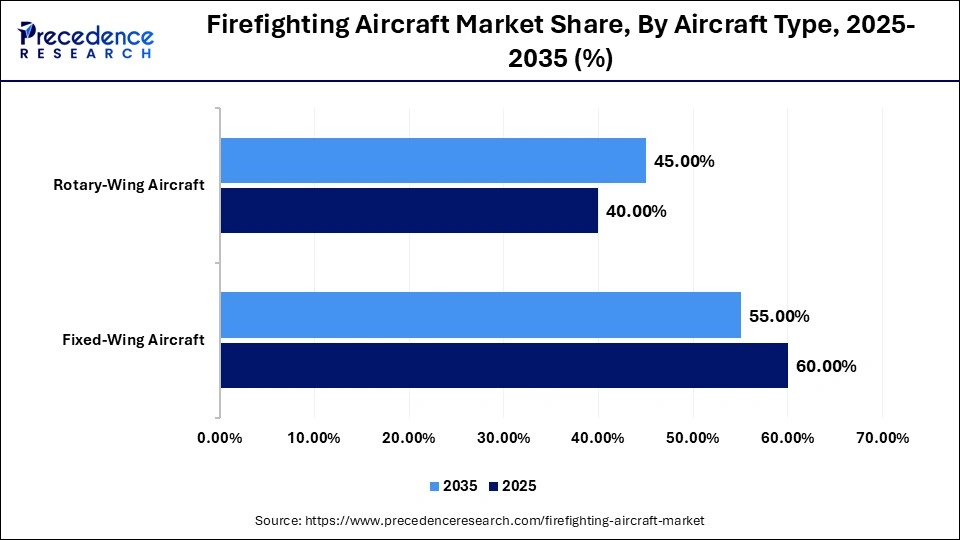
The rotary-wing aircraft segment held a 40.00% share of the market in 2025, since it is the only aircraft that can maneuver in slender or uneven spaces. These aircraft are able to maneuver around fire, drop water or retardant to the targeted points, and land at such places where fixed-wing planes are not able to reach. Their agility and capability of relocating at great speed to the cities, forests, and mountains make them the preferred choice. Moreover, rotary-wing planes are needed in case of rescue operations and also for transporting firefighting services and equipment to the areas in need.
Water Tanking Capacity Insights
Firefighting Aircraft Market Share, By Water Tanking Capacity, 2025-2035 (%)
| Water Tanking Capacity | 2025 | 2035 |
| Small Capacity (Up to 3,000 liters) | 18.00% | 16.00% |
| Medium Capacity (3,000 - 10,000 liters) | 40.00% | 38.00% |
| Large Capacity (Above 10,000 liters) | 42.00% | 46.00% |
The Large-Capacity Segment Held a 42.00% Share of the Firefighting Aircraft Market
The large capacity (above 10,000 liters) segment dominated the market while holding a major share of 42.00% in 2025. This is due to its ability to effectively fight a large wildfire. Aircraft equipped with large water tanks can carry huge amounts of water or fire retardant and decrease the number of trips and operation costs that are required to suppress a fire on a large scale. Ongoing technological advancements, such as improved drop accuracy systems, reinforced airframes, and enhanced fuel efficiency, further strengthen their performance and enable long-distance operations. As a result, large-capacity aircraft play a critical role in modern aerial firefighting, particularly in regions with extensive forests, vast grasslands, and high wildfire incidence.
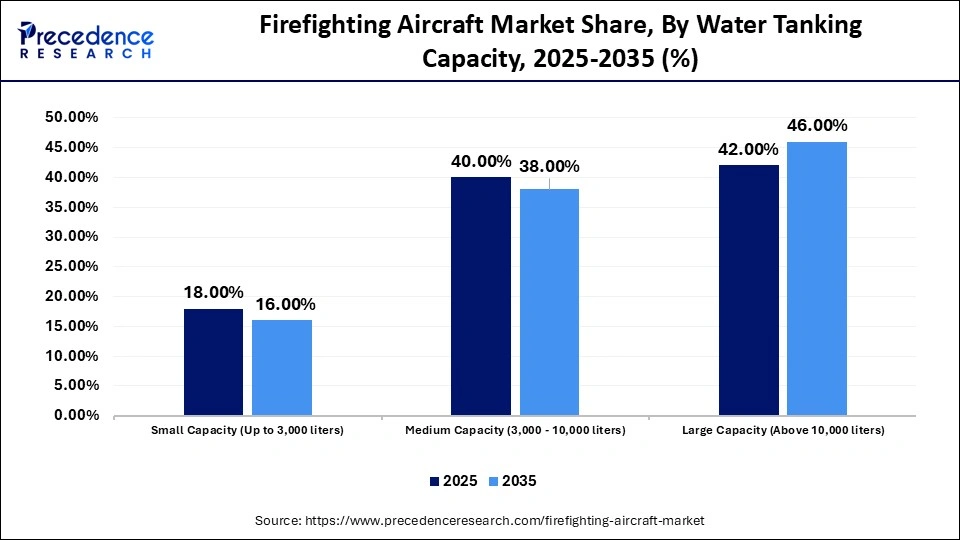
The medium capacity (3,000-10,000 liters) segment held a 40.00% share of the market in 2025 because of its operational flexibility and equal payload. Such aircraft can respond quickly to medium-sized fires and also cover multiple locations due to their maneuverability and shorter turnaround time. They are cost-effective because they use less fuel and less infrastructure than large-capacity aircraft. Medium-capacity aircraft are widely preferred in areas with a short runway or complex terrain due to their ability to do a turnaround and quell the fire.
The small capacity (up to 3,000 liters) segment held a 18.00% share of the market in 2025, driven by its precision, maneuverability, and versatility in confined or urban environments. These aircraft are ideal for targeting hot spots, assisting in rescues, and operating on short runways inaccessible to larger planes. Their quick turnaround times allow for multiple sorties per day, supporting larger aircraft during extensive firefighting operations. Small-capacity planes are particularly favored in rugged terrain or localized fires, where tactical, precise drops are essential for effective suppression.
Application Insights
Firefighting Aircraft Market Share, By Application, 2025-2035 (%)
| Application | 2025 | 2035 |
| Forest Firefighting | 50.00% | 45.00% |
| Structural Firefighting | 30.00% | 32.00% |
| Agricultural Firefighting | 15.00% | 18.00% |
| Others | 5.00% | 5.00% |
Why Did the Forest Firefighting Segment Lead the Firefighting Aircraft Market?
The forest firefighting segment registered dominance in the global market with a share of 50.00% in 2025. This is because of the increasing intensity and frequency of wildfires, caused by climate change and prolonged dry seasons. Fire in the forest is prevalent in remote or inaccessible areas, and therefore, aircraft are used to respond to fires quickly and cover the area. The dominance of the segment is also reinforced by the capability of the specialized fixed-wing and rotary-wing aircraft to deliver large quantities of water or retardant to the area.
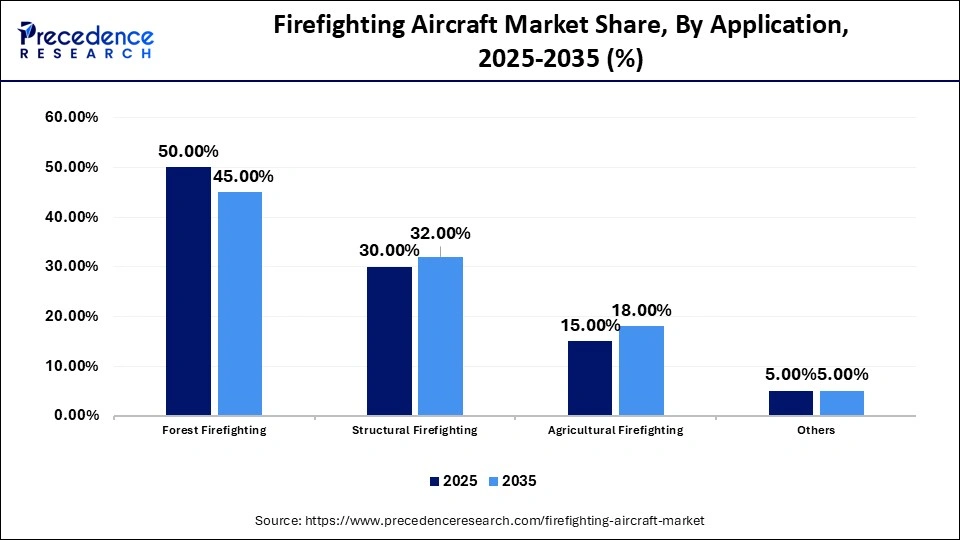
The structural firefighting segment held a 30.00% share of the market in 2025 due to the growing demand for aerial support during fire incidents in cities and industries. Aircraft are more responsive and have the capability of delivering water or foam to areas that are otherwise inaccessible by congested infrastructure or high-rise buildings. The integration of helicopters and small aircraft into municipal fire services has enabled precision drops during emergencies. Additionally, the growing need to protect residential, commercial, and critical infrastructure in rapidly expanding urban areas is driving segmental growth.
The agricultural firefighting segment held a 15.00% share of the market in 2025 because agricultural products, orchards, and rural farmlands need to be protected against fire, which poses a threat to food safety and livelihood. Aircraft are deployed to control small- to medium-sized fires across large agricultural areas, often in regions with limited land access. The growing focus on risk mitigation in agriculture, coupled with government subsidies and support for rural firefighting efforts, is further fueling demand in this segment.
End User Insights
The Government Agencies Segment Led the Firefighting Aircraft Market in 2025
The government agencies segment led the market with the largest share of 65.00% in 2025, as these agencies are primarily responsible for disaster control and wildfire suppression. Their dominance is driven by significant budget allocations, policy mandates, and the provision of essential infrastructure for aviation-based firefighting efforts. Government agencies are also leveraging advanced technologies, such as GPS-guided drops and integrated fire monitoring systems, which enhance their ability to operate effectively across large and diverse regions.
Firefighting Aircraft Market Share, By End User, 2025-2035 (%)
| End User | 2025 | 2035 |
| Government Agencies | 65.00% | 60.00% |
| Private Companies | 35.00% | 40.00% |
The private companies segment held a 35.00% share of the market in 2025 and is expected to grow at a significant rate in the coming years due to the increasing demand for specialized aerial firefighting services from industries, forestry contractors, and agricultural businesses. These private firms often operate smaller, more flexible fleets that can respond quickly to specific firefighting needs, especially in areas where large aircraft are impractical. Additionally, the need for fire hazard mitigation, property protection, and business continuity in sectors such as agriculture and real estate is driving more private stakeholders to invest in firefighting aircraft services, further fueling segmental growth.
Regional Insights
North America Firefighting Aircraft Market Size and Growth 2026 to 2035
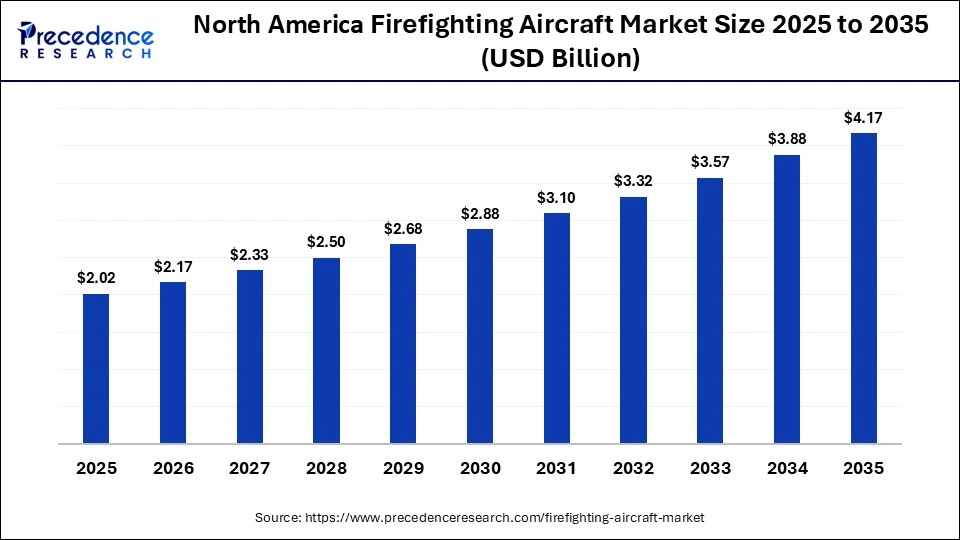
The North America firefighting aircraft market size is estimated at USD 2.02 billion in 2025 and is projected to reach approximately USD 4.17 billion by 2035, with a 7.52% CAGR from 2026 to 2035.
Why Did North America Lead the Global Firefighting Aircraft Market?
North America dominated the firefighting aircraft market with a share of 42.00% in 2025, driven by the rapid increase in the frequency of wildfires in the region, particularly in the western part of the U.S., and even in certain states of Canada. Government support through federal grants and state-level programs has facilitated the acquisition, modernization, and expansion of aerial firefighting fleets. There is also high adoption of advanced technologies, such as infrared mapping, GPS-guided retardant drops, and real-time aerial surveillance, to improve the efficiency and precision of fire suppression efforts. Additionally, strong coordination between agencies and a developed aerospace sector further enhances fleet preparedness and operational performance in North America.
U.S. Firefighting Aircraft Market Size and Growth 2026 to 2035
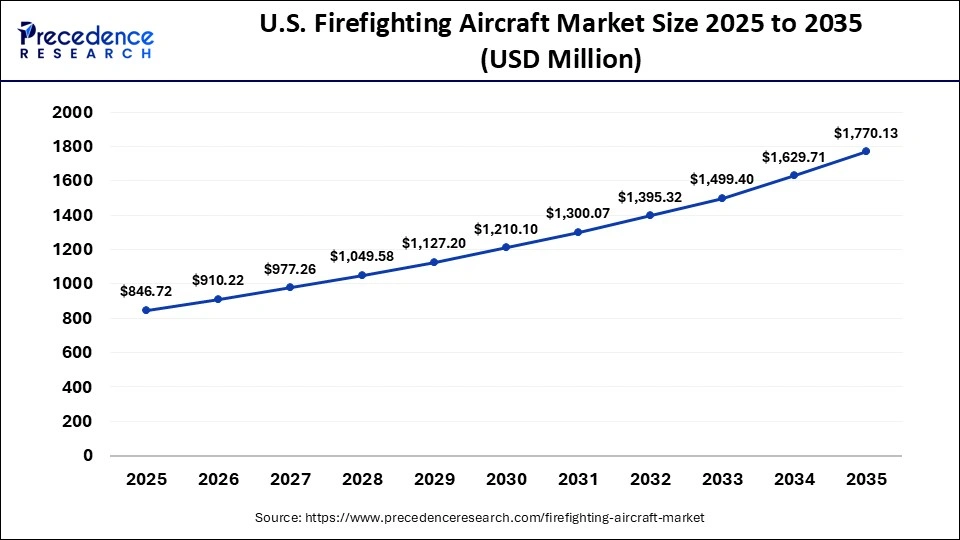
The U.S. firefighting aircraft market size is calculated at USD 846.72 million in 2025 and is expected to reach nearly USD 1,770.13 million in 2035, accelerating at a strong CAGR of 7.65% between 2026 and 2035.
U.S. Firefighting Aircraft Market Trends
The market in the U.S. is growing due to the increasing interest from federal and state governments in expanding and modernizing aerial firefighting fleets. Agencies like the U.S. Forest Service and the National Interagency Fire Center are driving growth through fleet upgrades and broader operational scopes. Government policies, disaster relief funding, and an increased focus on rapid responses to wildfires in remote and rugged areas are further boosting demand for aerial firefighting capabilities.
How is the Opportunistic Rise of Asia Pacific in the Firefighting Aircraft Market?
Asia Pacific held a 18.00% share of the market in 2025 and is expected to grow at a significant rate over the forecast period, driven by the increasing need to protect infrastructure, forests, and natural reserves. Governments in the region are investing heavily in firefighting aircraft to enhance disaster response capabilities, contributing to market growth. The growing emphasis on joint industrialized fire suppression initiatives and international collaboration in disaster management is further accelerating fleet acquisitions.
Japan Firefighting Aircraft Market Trends
The market in Japan is driven by a focus on disaster preparedness and rapid response to larger, more intense forest fires. Increased government spending on modern firefighting aircraft is aimed at protecting human settlements, agricultural lands, and forest habitats. The development and transformation of specialized firefighting aircraft are supported by Japan's established aerospace manufacturing capabilities and growing international partnerships in the field of disaster management.
Europe: The Second-Largest Market
Europe held a 28.00% share of the market in 2025 due to the increasing cases of massive wildfires, heat waves, and droughts related to climate change. This is prompting big expenditures in the acquisition of contemporary aerial firefighting apparatus, both fixed-wing and rotary-wing airplanes, as a result of the augmented disaster response frameworks of the European Union. European aerospace manufacturers and service providers are driving innovation in the firefighting aircraft market, spurred by the region's stringent safety, operational, and environmental standards. Modern technologies, including precision GPS-guided retardant drops, real-time monitoring, and aerial surveillance systems, are increasingly being adopted to enhance the efficiency and safety of firefighting operations.
UK Firefighting Aircraft Market Trends
The market in the UK is expanding as the government places greater emphasis on disaster preparedness and wildfire mitigation. This growth is further supported by the inclusion of aerial firefighting capabilities in the UK Fire and Rescue Services' modernization plans, enabling faster response times and broader coverage. Collaborative efforts between agencies, the Royal Air Force, and the Coastguard are increasing, driven by the need for joint emergency operations and the growing use of multi-role firefighting aircraft.
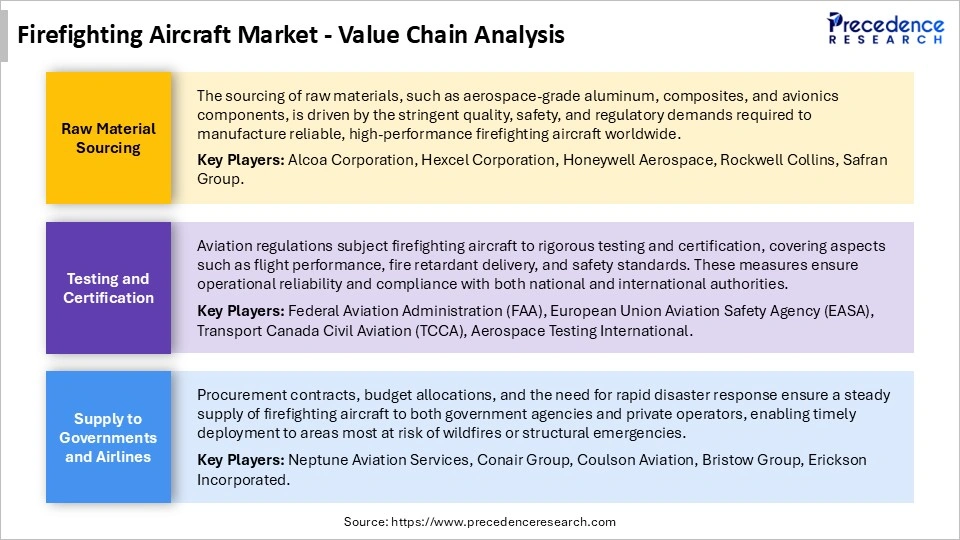
Firefighting Aircraft Market Value Chain Analysis
Firefighting Aircraft Market Companies
- Bombardier Inc.
- Airbus SE
- Lockheed Martin Corporation
- Textron Aviation Inc.
- Aviation Industry Corporation of China (AVIC)
- Erickson Inc.
- MHI (Mitsubishi Heavy Industries)
- Air Tractor, Inc.
- PZL Mielec (a Lockheed Martin Company)
- Conair Group Inc.
- BAE Systems plc
- Sky Aviation LLC
- De Havilland Aircraft of Canada Limited
- Embraer S.A.
- Viking Air Limited
Recent Developments
- In August 2025, Neptune Aviation Services proposed to build a new generation air tanker based on Airbus A319. The change is to enhance the capacity and effectiveness of firefighting, which will result in more efficient aerial wildfire suppression.(Source: https://aviationweek.com)
- In June 2025, AIRBUS and Space successfully finished test drops and demonstrations of the A400M firefighting demonstrator kit. Its capability to deliver and deploy large amounts of water was also pointed out in tests, which illustrated it to be flexible, quickly deployable, and efficient in operation.(Source: https://www.indiastrategic.in)
- In January 2025, Conair purchased the Daher TBM 960 to enhance the wildfire suppression efforts. The efficiency, rapid response to fire zones, and the speed of the aircraft are facilitated by its advanced avionics, which enhance the overall mitigation and containment.(Source: https://www.daher.com)
Segments Covered in the Report
By Aircraft Type
- Fixed-Wing Aircraft
- Large Fixed-Wing Aircraft
- Small & Medium Fixed-Wing Aircraft
- Rotary-Wing Aircraft
- Helicopters
- Light Aircraft
By Water Tanking Capacity
- Small Capacity (Up to 3,000 liters)
- Medium Capacity (3,000 - 10,000 liters)
- Large Capacity (Above 10,000 liters)
By Application
- Forest Firefighting
- Wildland Firefighting
- Aerial Firefighting Support
- Structural Firefighting
- Agricultural Firefighting
- Fire Suppression in Farmlands
- Others
- Emergency Rescue Operations
- Water Dropping for Flood Control
By End User
- Government Agencies
- Firefighting Authorities
- Military Agencies
- Private Companies
- Aircraft Operators
- Firefighting Service Providers
By Region
- North America
- Latin America
- Europe
- Asia-pacific
- Middle and East Africa
For inquiries regarding discounts, bulk purchases, or customization requests, please contact us at sales@precedenceresearch.com
Frequently Asked Questions





Ask For Sample
No cookie-cutter, only authentic analysis – take the 1st step to become a Precedence Research client
 Get a Sample




 sales@precedenceresearch.com
 Schedule a Meeting
