



Healthcare Cloud Computing Market Revenue to Attain USD 312.97 Bn by 2035
Published: 14 May 2026
Author: Precedence Research



Healthcare Cloud Computing Market Revenue and Trends 2026 to 2035
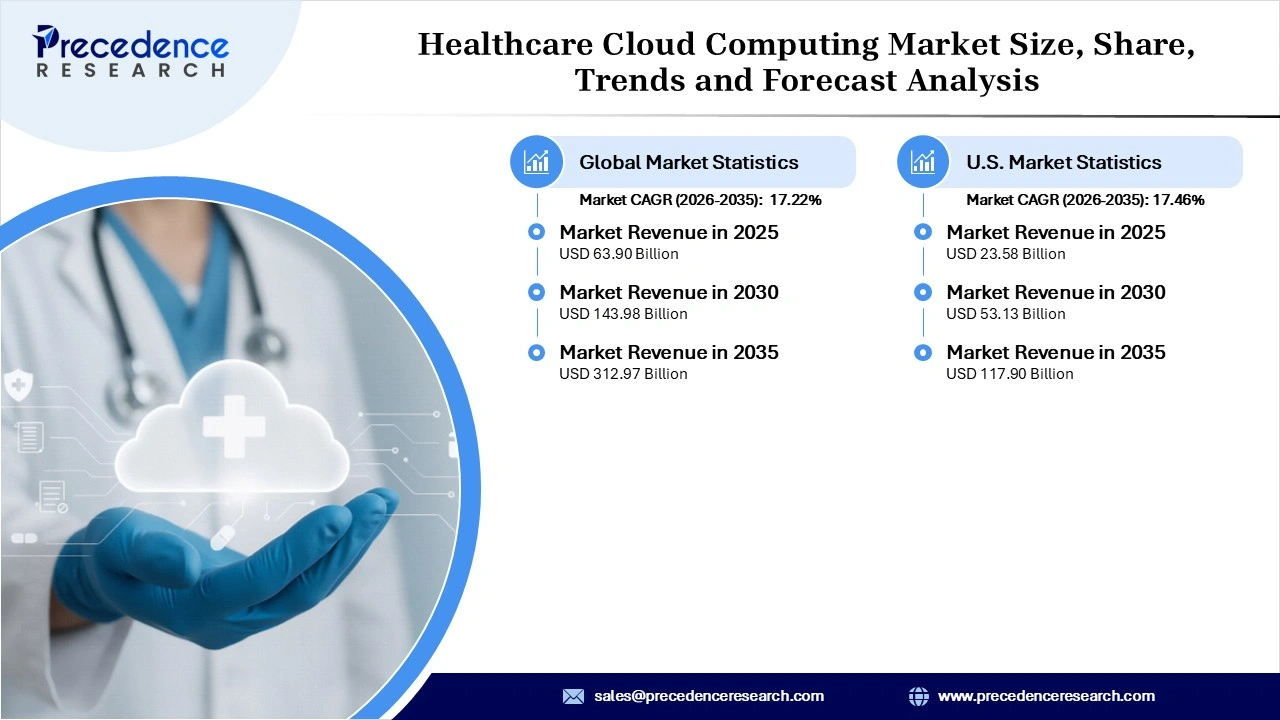
The global healthcare cloud computing market revenue accounted at USD 63.90 billion in 2025 and is expected to grow from USD 75.17 billion in 2026 to approximately USD 312.97 billion by 2035, expanding at a CAGR of 17.22% from 2026 to 2035. The market is also observed to be growing rapidly due to the digital transformation of healthcare systems, a surge in telehealth, and the integration of AI-driven analytics.
Market at a Glance
The healthcare cloud computing market involves delivering services, storing and managing data, and deploying applications with the help of the internet. The technology helps to enable remote access, enhance security, and offer scalable and cost-effective infrastructure for patient data storage, telemedicine, and analytics.
- Improving Technologies- Improving technologies in the form of AI, IoT, ML, and big data analytics integration for enhanced patient care and analysis is one of the major scopes for the growth of the market.
Microsoft Cloud for Healthcare- The platform offers a comprehensive suite integrating Azure AI services, Cognitive Services, and Power BI for clinical analytics, imaging, and predictive insights. - Hybrid and Multi Cloud Adoption- Inclination of the healthcare providers towards hybrid models for balancing data security with the scalability of public clouds, ensuring compliance with regulations like HIPAA.
Amazon Web Services (AWS)- The platform is widely used for scalable storage, hosting, and HIPAA-compliant, cost-efficient, public cloud services.
Market Forecast
- AI and ML Integration- Cloud-based AI for diagnostic assistance, predictive analytics for patient outcomes, and personalized medicine initiatives are some of the major opportunities fueling the growth of the market.
- Google Cloud Healthcare API and Vertex AI- The platform provides support for FHIR and DICOM data, along with integration of Vertex AI for building ML models.
- Rising Telehealth and Telecloud Services- Rising usage of virtual consultations and remote monitoring for managing chronic diseases and expanding care access to rural, underserved areas is another major opportunity for the market’s growth.
- Teladoc Health- It is a leading cloud-based telehealth platform using AWS to power its virtual care by connecting patients with healthcare providers via voice, video, and messaging.
- Blockchain for Data Security- Use of blockchain to enhance security and portability of electronic health records ensures compliance with regulatory standards, further propelling the growth of the market in the foreseen period.
- Decentralized EHR Management- Platforms such as ServBlock use distributed nodes to keep the patient data safe against breaches, moving away from vulnerable centralized servers.
Secondary Data
| End Users | Estimated Market Share |
| Hospitals | 35% |
| Pharmaceutical Companies | 15% |
| Diagnostic and Imaging Centers | 13% |
| Ambulatory Centers | 11% |
| Insurance Companies | 11% |
| Pharmacies | 10% |
| Others | 5% |
The table above represents various users of healthcare cloud computing platforms with the estimated market percentage in the year 2025. The hospital segment represents the major segment of the market due to the transition from physical paper records to electronic health records. Pharmaceutical companies are another major segment fueling the growth of the market due to the integration of AI and cloud computing in clinical trials and genomic research with massive computational power. Various other segments, such as diagnostic and imaging centers, ambulatory centers, and insurance companies, also have notable contributions to the growth of the market.
Market Segmentation Overview
- By Application, the clinical information system segment led the global healthcare cloud computing market in 2025. The segment majorly involves EMR, EHR, PACS, and telehealth. The segment’s growth is also driven by increasing adoption of cloud-based electronic health records and remote monitoring.
- By Application, the non-clinical information system segment is observed to be the highest growing region in the foreseen period, with the highest CAGR. The segment’s growth is driven by the need to reduce administrative costs and streamline operations.
- By Deployment, the public segment dominated the global market in 2025. Cost-effectiveness, scalability, and ease of access are some of the major factors that help fuel the market’s growth. Storing, managing, and analysing large datasets are also some of the major factors that help fuel the market’s growth.
- By Deployment, the hybrid segment is observed to be the fastest-growing segment with the highest CAGR in the studied years. The segment allows providers to combine the security of private clouds with the flexibility of public clouds.
- By Service, the Software as a Service (Saas) segment had a major dominance of the global market in 2025. Its ready-to-use nature for seamless management of applications helps to propel the market’s growth.
- By Service, the Platform as a Service segment (PaaS) is observed to be the fastest-growing segment with the highest CAGR in the upcoming years. The segment’s growth is majorly driven by the growing need for interoperable, scalable, and secure application development environments to manage high-volume data.
- By End users, the healthcare providers segment had a major market revenue share in 2025. The segment is inclusive of hospitals, labs, and clinics, driven by the need for EHR systems, PACS, and telemedicine.
- By End users, the healthcare payers segment is observed to be the fastest-growing segment with the highest CAGR in the forecast period. The segment includes insurance companies and private/public health insurance programs for claims processing, member management, and data analytics.
Regional Insights
North America led the global healthcare cloud computing market with a share of 41% in 2025. The presence of major market players in the region is one of the major factors fueling the growth of the market. Widespread adoption of EHRs and telehealth platforms, along with the need for data-driven analytics, are also some of the major factors fueling the growth of the market. The U.S. has a major contribution to the market’s growth, driven by higher adoption of AI, EHR, and telehealth. Other major factors fueling the market’s growth involve SaaS, non-clinical information systems, and accelerated remote care.
Asia Pacific is observed to be the fastest-growing region with the highest CAGR in the forecast period. Improving healthcare infrastructure, rising adoption of wearable devices, and increasing digital health investments in various countries such as India, China, and Japan are other major factors fueling the growth of the market. Major shifts in the industry towards hybrid cloud models, rising chronic diseases, and government initiatives also fuel the growth of the market. Japan has made a major contribution to the market’s growth with heavy investment in AI and cloud upgrades.
Top Companies of Healthcare Cloud Computing Market
- Cisco Systems Inc: The company offers various tools for healthcare, supporting telehealth, data management, and real-time patient monitoring.
- IBM Corp: The company provides cloud-based healthcare analytics, AI solutions, and secure data platforms to optimize clinical workflows, research, and patient care.
- Oracle Corp: The company provides cloud applications and data management for hospitals and providers for efficient health information exchange and analytics.
- EKC Corp: It offers cloud infrastructure, healthcare IT solutions, and secure data storage for hospitals and clinics to enhance operational efficiency, along with patient care.
- Dell Inc.: The company provides various options such as cloud servers, storage, and virtualization solutions for healthcare organizations, supporting data security, telemedicine, and scalable IT infrastructure.
Segments Covered in the Report
By Product
- Healthcare Provider Solutions
- Clinical Information Systems
- EHR/EMR
- Telehealth Solutions
- PACS/VNA
- PHM Solutions
- LIS
- PIS
- RIS
- Non-clinical Information Systems
- RCM Solutions
- HIE Solutions
- Financial Management Solutions
- SCM Solutions
- Billings and Account Management Solutions
- Clinical Information Systems
- Healthcare Payer Solutions
- Claims Management Solutions
- Payment Management Solutions
- Provider Network Management Solutions
- Fraud Management Solutions
- CMR Solutions
By Deployment
- Public
- Private
- Hybrid
By Application
- Clinical Information System
- Telehealth Solutions
- Computerized Physician Order Entry
- Population Health Management (PHM) Solutions
- Electronic Medical Records
- Pharmacy Information System
- Radiology Information System
- Others
- Non-clinical Information System
- Revenue Cycle Management (RCM)
- Billing & Accounts Management Solutions
- Claims Management
- Others
By Service
- Platform as a service (Paas)
- Infrastructure as a service (IaaS)
- Software as a service (Saas)
By End Users
- Healthcare Providers
- Healthcare Payers
By Region
- North America
- Europe
- Asia Pacific
- Latin America
- East & Africa
Get this report to explore global market size, share, CAGR, and trends, featuring detailed segmental analysis and an insightful competitive landscape overview @ https://www.precedenceresearch.com/sample/1081
You can place an order or ask any questions. Please feel free to contact us at sales@precedenceresearch.com |+1 804 441 9344