



Hemodialysis and Peritoneal Dialysis Market Revenue to Attain USD 219.05 Bn by 2035
Published: 03 Jul 2026
Author: Precedence Research



Hemodialysis and Peritoneal Dialysis Market Revenue and Trends 2026 to 2035
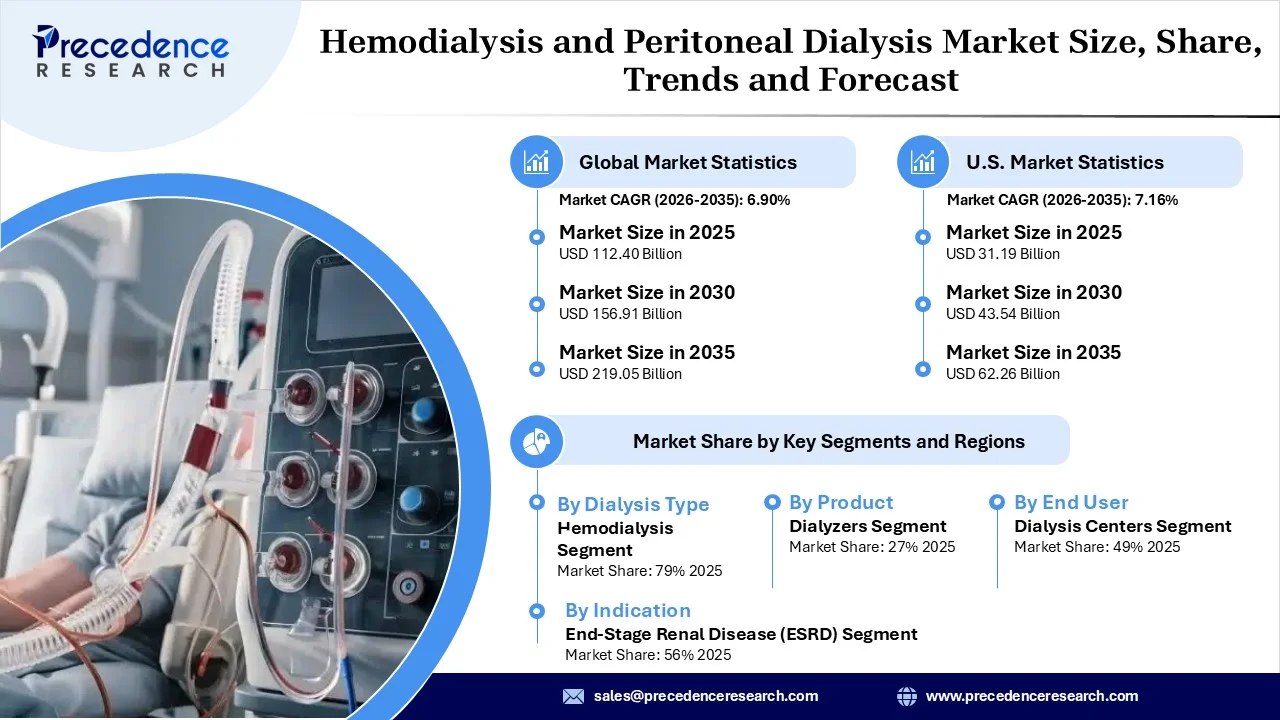
The global hemodialysis and peritoneal dialysis market revenue was valued at USD 112.40 billion in 2025 and is expected to attain around USD 219.05 billion by 2035, growing at a CAGR of 6.90% during forecast period. The market is driven by the increase in the incidence of end-stage renal disease (ESRD) due to higher cases of diabetes and hypertension, owing to the development of cheaper alternatives like home dialysis, alongside innovation in portable and wearable dialysis systems.
Life-Sustaining Therapies for Renal Replacement Therapy
The hemodialysis and peritoneal dialysis market includes all products, devices, and services that are utilized in two major renal replacement therapies used for treating patients suffering from ESRD and acute kidney injury (AKI). Hemodialysis is a process in which blood from the body is filtered outside the body using a dialyzer in a dialysis center or home setting.
Peritoneal dialysis is a method wherein the patient’s peritoneal membrane is used as a filter where dialysate fluid is infused and removed via a catheter, generally carried out in a home setting. The market includes hemodialysis machines, dialyzers, vascular access devices, and water treatment systems. This market has been adopted by hospitals, freestanding dialysis centers, home care facilities, and specialty clinics.
Next-Generation Dialysis Devices Moving Towards Implantable and Wearable Solutions
Dialysis is moving away from traditional, centralized treatment towards solutions that are implantable, wearable, and based on AI technologies, which ensure constant renal replacement therapy and provide patient flexibility. Some of the breakthroughs in this area are dialysate-free wearable artificial kidneys, implantable continuous dialysis devices, and mobility-enabled automated peritoneal dialysis devices. FDA granted Breakthrough Device Designation for Nephrodite’s Holly implantable continuous dialysis device in 2025, after conducting a 72-hour animal test, which showed that kidney function can be replaced by a fully mechanical implantable device. This device provides constant filtration and fluid balance of the system with an embedded smart sensor.
Growing Adoption of Home Dialysis Machines
The hemodialysis and peritoneal dialysis market witnesses the increasing adoption of home dialysis machines by patients as new FDA-cleared devices are now available in the U.S. market. These new machines have simplified interfaces, increased portability, and reduced noise. Such machines are gaining adoption as regulatory clearances are facilitating the commercial availability of the devices. Byonyks, based out of Chicago, obtained the FDA 510(k) clearance for its X1 APD Cycler in 2025, allowing its entry into the U.S. market. The company has already performed more than 10,000 treatments abroad via its license programs.
National Programs Improve Access to Dialysis Facilities
Governments across the globe have introduced programs to enhance dialysis access and create modern technological standards for devices. Such initiatives involve large-scale programs of public dialysis and industry standards. Such measures are crucial for determining the future market of dialysis products and services. In 2025, the Indian government announced the Pradhan Mantri National Dialysis Program (PMNDP). Hemodialysis and peritoneal dialysis services are supported by the National Health Mission in states. There is also a proposal to establish hemodialysis centers in all district hospitals.
Renalyx Invests USD 96 Million USD to Expand Production of AI Hemodialysis Machines
In 2025, Renalyx Health Systems, Bengaluru, India, announced an investment of USD 96 million for scaling production of its AI-enabled and cloud-computing hemodialysis systems. Renalyx intends to manufacture 5,000 units of the RxT 21 system by FY26 and an additional 1,500 units of the same by FY28, and is expected to be certified by the FDA by 2026. The product is a one-of-a-kind AI-enabled dialysis system with remote monitoring capability.
Market Segmentation Overview
- By dialysis type, the hemodialysis segment led the hemodialysis and peritoneal dialysis market with a 79% share in 2025 because it is the most researched and accessible form of therapy, with mature facilities at clinics, experienced physicians, and better reimbursement across the world. This form of treatment is considered the standard option for most new ESRD patients.
- By dialysis type, the peritoneal dialysis segment is expected to expand at the highest CAGR of 8.9% during the forecast period, due to its alignment with the worldwide trend towards home care that provides higher flexibility, renal function preservation, and reduced costs in comparison with in-center hemodialysis. The development of new automated cyclers, remote monitoring systems, and improved catheters has decreased infection risk in this segment.
- By product, the dialyzers segment dominated the market with a 27% share in 2025, owing to the fact that they are high-volume disposable consumables that need to be changed after each hemodialysis procedure, thereby producing recurrent sales revenues. The ongoing technological advancements in membranes used in catalysts, such as high flux, high efficiency, and biocompatible dialyzers, lead to replacement and premium prices.
- By product, the dialysis concentrates and solutions segment is expected to grow at the fastest CAGR of 7.6% from 2026 to 2035, due to its consumption-based nature that is utilized in each and every treatment of dialysis, whether it is hemodialysis or peritoneal dialysis. It provides an ongoing revenue that is directly proportional to the increase in dialysis patients around the world, and differs from capital equipment that is purchased only once.
- By end user, the dialysis centers segment led the hemodialysis and peritoneal dialysis market with a 49% share in 2025, because it is the main venue where dialysis patients receive treatment since conventional dialysis is needed for a majority of the end-stage renal disease patients. This segment benefits from well-established infrastructure and has been adopted by a lot of patients worldwide.
- By end user, the home care settings segment is expected to expand at the highest CAGR of 9.8% during the forecast period, owing to the emergence of new technologies such as automated peritoneal dialysis systems, simplified hemodialysis systems, and remote patient monitoring technologies that are enhancing the safety, ease-of-use, and clinical feasibility of home-based therapy. It also decreases caregiver and healthcare system burden.
- By indication, the end-stage renal disease (ESRD) segment dominated the market with a 56% share in 2025, due to the fact that it involves a big group of patients who need to undergo dialysis, with more than 2 million patients worldwide depending on life-saving treatments. ESRD demands repeated treatments, usually thrice weekly in the case of hemodialysis and every day in the case of peritoneal dialysis.
- By indication, the acute kidney injury (AKI) segment is expected to grow at the fastest CAGR of 8.4% from 2026 to 2035, because of an increase in admissions due to infections, surgeries, and chronic ailments such as diabetes and heart disease, which are the most common conditions causing sudden loss of kidney function. Further, as healthcare infrastructures enhance critical care and dialysis capabilities in developing economies, an increasing number of patients suffering from AKI are surviving and getting treated.
Regional Analysis
North America led the hemodialysis and peritoneal dialysis market with a 37% share in 2025, owing to the high rates of diabetes and hypertension prevalence in the region, leading to end-stage renal disease; the presence of mature systems of reimbursement, including the ESRD program under Medicare, and the early adoption of technological innovations in dialysis procedures. The U.S. dominated the market in North America because of high expenditure on dialysis technologies, government and private sector initiatives, which boost treatment accessibility to patients, and the significant presence of prominent dialysis providers and manufacturers in the world. Canada is a significant contributor to the market due to the national healthcare system that facilitates universal access to both hemodialysis and peritoneal dialysis, a significant focus on home care and patient-centered models, and government support for research projects aimed at promoting cost-efficient and innovative dialysis technologies.
Asia-Pacific is expected to expand at the highest CAGR of 8.4% during the forecast period because of its large and aging population, high incidence of diabetes and hypertension, which cause kidney failures, and rapidly developing healthcare access systems that are significantly improving the accessibility of various treatments. China led the market in Asia-Pacific due to the presence of a large number of patients, high government investments in dialysis equipment, and the fast-growing number of in-center and home-based dialysis programs initiated by the government. India witnessed notable market growth owing to its large unmet need for ESRD treatment, the Pradhan Mantri National Dialysis Program, which has established a large number of dialysis centers across the country, and the increasing popularity of cost-effective home dialysis treatments.
Europe held the second-largest market share of 27% in 2025, due to the high prevalence of diseases such as diabetes and hypertension leading to ESRD, the existence of well-developed universal healthcare systems ensuring wide availability of dialysis services, and the early uptake of home dialysis and advanced dialysis technologies. Germany dominated the market in Europe owing to the presence of global healthcare players such as Fresenius Medical Care, its status as the manufacturing center for dialysis devices and supplies, and its well-developed statutory health insurance system that covers both hemodialysis and peritoneal dialysis. The UK is a significant contributor to the market because of the emphasis placed by the government on economic treatment through the adoption of home dialysis therapies, resulting in extensive penetration of both peritoneal dialysis and hemodialysis.
Hemodialysis and Peritoneal Dialysis Market Coverage
| Report Attribute | Key Statistics |
| Market Revenue in 2025 | USD 112.40 Billion |
| Market Revenue by 2035 | USD 219.05 Billion |
| CAGR from 2026 to 2035 | 6.90% |
| Quantitative Units | Revenue in USD million/billion, Volume in units |
| Largest Market | North America |
| Base Year | 2025 |
| Regions Covered | North America, Europe, Asia-Pacific, Latin America, and the Middle East & Africa |
Top Companies in the Hemodialysis and Peritoneal Dialysis Market
Fresenius Medical Care, B. Braun, Baxter, and Nipro are some of the key players that manufacture dialysis machines, dialyzers, and related products. Nikkiso, Asahi Kasei, Toray, and Medtronic manufacture hemodialysis machines and dialyzers. Weigao Group, JMS, and SB-KAWASUMI are some of the regional players, especially in the Asian market. Huaren Pharmaceutical, China Resources Double Crane, and Chengdu Qingshan Likang are some of the leading Chinese manufacturers of dialysis equipment.
The market can be characterized as a concentrated oligopoly, where global market leaders such as Fresenius, Baxter, and B. Braun operate vertically integrated product lines that include machines, dialyzers, solutions, and other components. The competition comes from Asian players such as Nikkiso, Asahi Kasei, Weigao, and Toray due to cost-effective products.
Segments Covered in This Report
By Dialysis Type
- Hemodialysis
- In-center Hemodialysis
- Home Hemodialysis
- Conventional Home HD
- Short Daily Home HD
- Nocturnal Home HD
- Peritoneal Dialysis
- Continuous Ambulatory Peritoneal Dialysis (CAPD)
- Automated Peritoneal Dialysis (APD)
By Product
- Dialysis Machines
- Hemodialysis Machines
- Peritoneal Dialysis Cyclers
- Dialyzers
- High-Flux Dialyzers
- Low-Flux Dialyzers
- Dialysis Catheters
- Bloodline Systems
- Dialysis Concentrates & Solutions
- Consumables & Accessories
By Modality
- Conventional Hemodialysis
- High-Flux Hemodialysis
- Hemodiafiltration (HDF)
- Continuous Renal Replacement Therapy (CRRT)
- Continuous Ambulatory Peritoneal Dialysis
- Automated Peritoneal Dialysis
By End User
- Hospitals
- Dialysis Centers
- Home Care Settings
- Ambulatory Surgical Centers
- Specialty Kidney Clinics
By Age Group
- Pediatric
- Adult
- Geriatric
By Indication
- Chronic Kidney Disease (CKD)
- End-Stage Renal Disease (ESRD)
- Acute Kidney Injury (AKI)
By Treatment Setting
- In-center Treatment
- Home-based Treatment
By Payer
- Public Healthcare
- Private Insurance
- Out-of-Pocket
By Region
- North America
- Latin America
- Europe
- Asia-pacific
- Middle and East Africa
Get this report to explore global market size, share, CAGR, and trends, featuring detailed segmental analysis and an insightful competitive landscape overview @ https://www.precedenceresearch.com/sample/8532
You can place an order or ask any questions. Please feel free to contact us at sales@precedenceresearch.com |+1 804 441 9344