



Hip Reconstruction Devices Market Revenue to Attain USD 17.29 Bn by 2035
Published: 23 Apr 2026
Author: Precedence Research



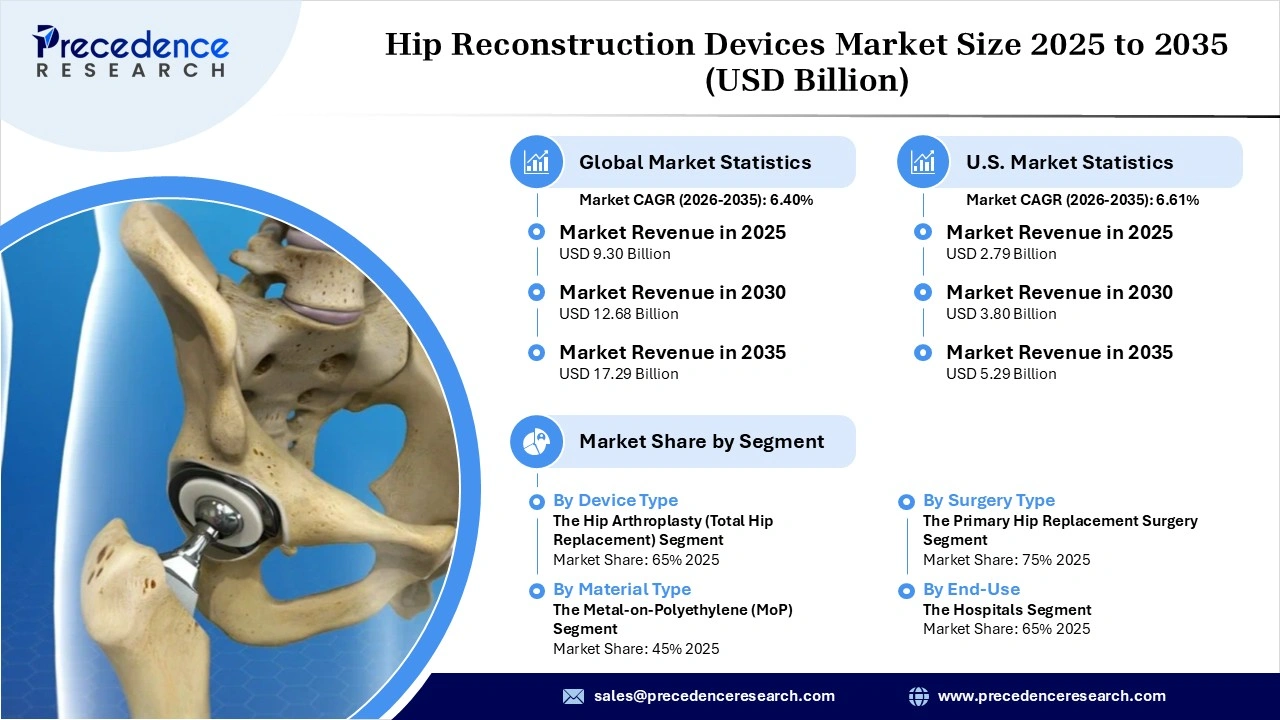
The global hip reconstruction devices market revenue surpassed USD 9.30 billion in 2025 and is predicted to attain around USD 17.29 billion by 2035, growing at a CAGR of 6.40% from 2026 to 2035. The market is gaining significant momentum due to increasing life expectancy, rising prevalence of joint degeneration, and a growing preference for mobility-preserving surgical interventions.
Market at a Glance
The hip reconstruction devices market comprises implants, surgical instruments, and enabling technologies used to repair or replace damaged hip joints caused by conditions such as osteoarthritis, fractures, and congenital abnormalities. It includes procedures such as total and partial hip replacement, resurfacing, and fixation, along with the use of advanced biomaterials. The market is also increasingly integrating robotic-assisted surgical systems and navigation technologies, marking a shift from conventional joint replacement toward precision-guided interventions aimed at improving implant durability, surgical accuracy, and post-operative mobility.
In addition, the hip reconstruction devices market extends beyond core implant technologies to encompass the broader surgical ecosystem, including fixation techniques, biomaterials, and supportive surgical instruments used during procedures. The market covers both primary and revision surgeries performed in hospitals and outpatient settings. The growing adoption of technology-driven solutions such as robotic-assisted systems and surgical navigation tools is further enhancing procedural accuracy and has the potential to improve long-term patient outcomes.
What Drives the Hip Reconstruction Devices Market?
- Aging Population: The market’s growth is primarily driven by demographic trends, as the expanding global elderly population continues to increase the incidence of degenerative hip conditions. This results in a steady rise in both primary and revision hip reconstruction procedures year after year.
- Revision Surgeries Emerging as a Second Wave of Demand: As hip implants typically have a lifespan of 15 to 25 years, healthcare systems are increasingly witnessing a rise in implant wear and failure, particularly from procedures performed in earlier decades. This is driving demand for complex revision surgeries, thereby increasing the need for advanced hip reconstruction devices and technologies.
Trends in Knee and Hip Replacement
- Large-scale datasets covering approximately 1.45 million primary hip and knee procedures indicate that hip reconstruction is not a niche intervention but a high-volume, system-level surgical category.
- Registry evidence tracking over 1.68 million primary hip replacements further highlights both the clinical maturity of the procedure and its sustained long-term demand.
- Patient demographics consistently show a strong concentration in the 65–75 age group, firmly linking demand to aging populations worldwide.
- Historical trends demonstrate a 69.5% increase in total hip arthroplasty volumes over less than a decade, reflecting how rapidly procedural adoption scales once clinical outcomes stabilize.
- The procedures are clinically complex, with complication rates of around 27% for primary surgeries and approximately 39% for revision surgeries, underscoring the need for advanced reconstruction solutions.
- At the same time, implant durability has improved significantly, with long-term revision rates remaining below 5% after 15 years, indicating that technological advancements are extending implant lifespan while sustaining long-term market growth.
Market Segmentation Overview
- By device type, the hip arthroplasty segment accounted for the largest share of 65% in the hip reconstruction devices market in 2025, because of its effectiveness in treating advanced hip joint arthritis. Its widespread clinical acceptance stemmed from a clear value proposition restoring mobility while materially improving quality of life, particularly across an aging patient pool that required definitive, long-term solutions.
- By device type, the hip revision surgery devices segment is expected to grow at the fastest CAGR of 7.5% in the market between 2026 and 2035, driven by the increasing incidence of aging and worn-out primary hip implants entering clinical revision pathways. As the number of failed or deteriorated hip replacements rises, the demand for complex revision procedures is expected to expand, thereby increasing the adoption of advanced revision-specific devices.
- By material, the metal-on-polyethylene segment held a major revenue share of 45% in the hip reconstruction devices market in 2025, due to its balance of durability, cost-effectiveness, and clinical performance, making it the preferred choice across a broad spectrum of patients where cost sensitivity and proven outcomes quietly dictated decision-making.
- By material, the ceramic-on-ceramic segment is expected to grow at a CAGR of 8.5% in the market between 2026 and 2035, as it is gaining traction, particularly for younger, active patients needing long-term durability. The low wear rates of CoC implants position them as a preferred option, especially in cases where implant lifespan needs to stretch well beyond conventional expectations.
- By surgery type, the primary hip replacement surgery segment accounted for the highest share of 75% in 2025, due to its widespread usage in treating hip arthritis and a myriad of joint disorders.
- By surgery type, the robotic-assisted hip surgery segment is expected to expand rapidly with a CAGR of 15% in the coming years, due to improvements in accuracy and precision, with better patient outcomes. Moreover, there is a rapid shift from traditional surgical procedures to technology-driven procedures, which further contributes to segmental growth.
- By end-use, the hospitals segment held a share of 65% in the hip reconstruction devices market in 2025, driven by their capability to perform complex surgical procedures supported by advanced operating infrastructure and high-end surgical technologies. These settings also enable the integration of multidisciplinary teams and specialized orthopedic departments, which are essential for managing high-risk and technically demanding hip reconstruction surgeries.
- By end-use, the specialty orthopedic clinics segment is expected to grow at the fastest CAGR of 7.2% in the market between 2026 and 2035, driven by increasing demand for personalized orthopedic care and minimally invasive surgical approaches. Their focused clinical expertise, combined with more accessible and patient-centric care models, is gradually shifting select procedures away from large hospital systems toward specialized outpatient orthopedic facilities.
Regional Analysis
North America registered dominance in the hip reconstruction devices market with a major share of 40% in 2025, driven by a highly advanced healthcare infrastructure that enables consistent execution of complex hip procedures. Early adoption of technologies such as robotic-assisted surgery has further enhanced surgical precision and outcomes. In addition, high healthcare expenditure supports broad access to premium implants and advanced treatment options. The U.S. leads the market, supported by favorable reimbursement systems and rapid technology adoption.
Asia Pacific held a market share of 20% in 2025 and is expected to grow at the fastest CAGR of 9% in the market during the forecast period, driven by expanding healthcare infrastructure, increasing access to surgical procedures, and a rising aging population contributing to higher demand for hip reconstruction surgeries. Growing patient awareness of treatment options, along with increasing the affordability of procedures, is also encouraging greater adoption of elective surgeries. China is expected to remain a key growth driver due to large-scale hospital expansion, while India is supporting the market through cost-effective treatment availability and expanding healthcare access.
Hip Reconstruction Devices Market Coverage
| Report Attribute | Key Statistics |
| Market Revenue in 2025 | USD 9.30 Billion |
| Market Revenue by 2035 | USD 17.29 Billion |
| CAGR from 2026 to 2035 | 6.40% |
| Quantitative Units | Revenue in USD million/billion, Volume in units |
| Largest Market | North America |
| Base Year | 2025 |
| Regions Covered | North America, Europe, Asia-Pacific, Latin America, and the Middle East & Africa |
Top Companies in the Hip Reconstruction Devices Market
Zimmer Biomet and Stryker Corporation are among the leading players in the market, supported by broad product portfolios and growing adoption of robotic-assisted surgical technologies. DePuy Synthes (part of Johnson & Johnson) maintains its competitive position through a strong focus on procedure-specific solutions, while Smith & Nephew emphasizes material innovation and improvements in surgical efficiency. A significant competitive development in the market was Stryker Corporation’s acquisition of Wright Medical Group, which strengthened its portfolio by integrating specialized orthopedic expertise into a broader musculoskeletal ecosystem.
Segments Covered in the Report
By Device Type
- Hip Arthroplasty (Total Hip Replacement)
- Hip Resurfacing Devices
- Partial Hip Replacement Devices
- Hip Revision Surgery Devices
- Others (Impingement Devices, etc.)
By Material
- Metal-on-Polyethylene (MoP)
- Metal-on-Metal (MoM)
- Ceramic-on-Polyethylene (CoP)
- Ceramic-on-Ceramic (CoC)
- Hybrid (Ceramic on Metal, etc.)
By Surgery Type
- Primary Hip Replacement Surgery
- Hip Revision Surgery
- Minimally Invasive Hip Surgery
- Robotic-assisted Hip Surgery
By End-Use
- Hospitals
- Ambulatory Surgical Centers (ASCs)
- Specialty Orthopedic Clinics
By Region
- North America
- Latin America
- Europe
- Asia-pacific
- Middle and East Africa
Get this report to explore global market size, share, CAGR, and trends, featuring detailed segmental analysis and an insightful competitive landscape overview @ https://www.precedenceresearch.com/sample/8331
You can place an order or ask any questions, please feel free to contact us at sales@precedenceresearch.com |+1 804 441 9344