



Household Induction Cooktops Market Revenue to Attain USD 10.78 Bn by 2035
Published: 10 Apr 2026
Author: Precedence Research



Household Induction Cooktops Market Revenue and Trends 2026 to 2035
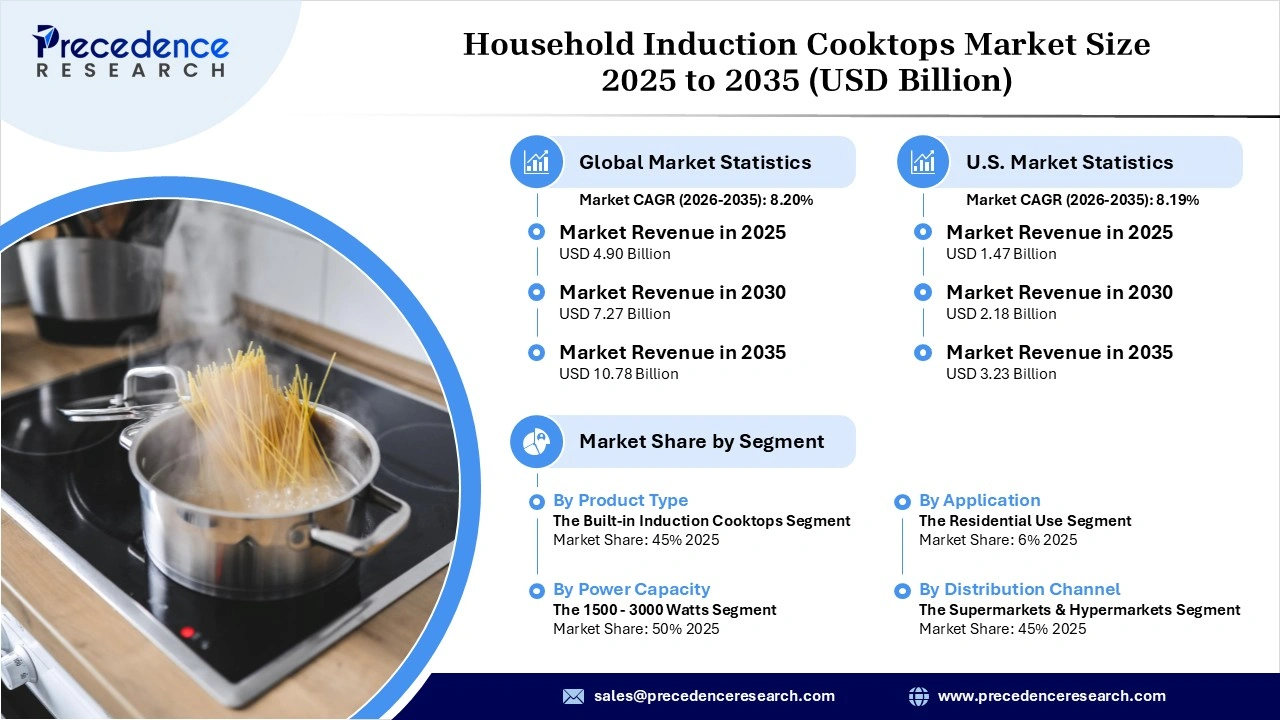
The global household induction cooktops market revenue surpassed USD 4.90 billion in 2025 and is predicted to attain around USD 10.78 billion by 2035, growing at a CAGR of 8.20%. The market is driven by the rise in consumer demand for energy-efficient, time-saving, and safe cooking equipment.
Market at a Glance
The household induction cooktops market involves production, distribution, and sales of electrical cooktops that employ the principle of electromagnetic induction in heating food through the pot. Induction cooktops are more efficient, safer, and quicker than conventional gas and electric stoves. These cooktops have been widely adopted in households, whether portable or fixed, with various capacities and technological advancements.
The market also includes other related products such as cookware and safety equipment for the cooktops. The market covers multi-wattage platforms, sensor-controlled units, power inversion systems, and optimized design frameworks tailored for home kitchen needs.
What Drives the Household Induction Cooktops Market?
- Adoption of Inverter and Sensor Technologies: With an increase in demand for high-end induction cooktops in household settings, manufacturers are adopting various technological innovations. These innovations include inverters to regulate the rate at which energy is converted into heat and sensor technologies that allow for accurate temperature regulation.
- Use of IoT and Wireless Features: There has been an increase in the integration of household induction cooktops with smart connected technologies. At CES 2026, Hisense revealed a brand-new series of induction cookers equipped with ConnectLife AI and accurate automatic temperature control technology. IoT and wireless connectivity facilitate remote monitoring, voice-commanded operation, and other advanced functionalities such as IoT-based real-time diagnostics and software upgrades.
Energy Efficiency and Electrification Policies
Efforts from the governments to encourage efficiency, electrification, and the use of non fossil fuel based sources of energy are making it easier for induction cooktops to be adopted in residential settings. Many government and regional programs are promoting the use of energy-efficient devices by providing guidelines on how to reduce carbon emissions and improve energy utilization efficiency. The Indian government intends to ramp up production of induction cooktops, thereby encouraging the use of electric cooking devices in an attempt to decrease dependence on cooking gas.
Market Segmentation Overview
- By Product Type: The built-in induction cooktops segment led the household induction cooktops market with a 45% share in 2025. The dominance of this segment is attributed to the rising preferences for kitchens designed on modular bases. This design provides a sleek integration into countertops, high-end aesthetics, and higher power output with multi-cooking zone support.
- By Product Type: The portable induction cooktops segment held the second-largest market share of 38% in 2025. This is mainly due to their low costs, small size, and easy installation. Portable induction cooktops are feasible for small families, rented spaces, and even for short-term cooking needs.
- By Power Capacity: The 1500-3000 watts segment dominated the market with a major share of 50% in 2025. This is because it provides the best balance between the efficiency of heating and suitability for domestic electrical systems.
- By Power Capacity: The above 3000 watts segment held the second-largest market share of 30% in 2025. This is mainly due to its ability to generate immense amounts of heat energy, thereby allowing intense cooking activities such as quick boiling, frying, and simultaneous heating of various zones.
- By Application: The residential use segment led the market with the largest share of 60% in 2025. The segment’s dominance is mainly driven by the growing popularity of induction cooktops within households for regular cooking activities. The extensive prevalence of induction cooktops in urban residences, along with the rising demand for efficient appliances, led to the market growth of this segment.
- By Application: The commercial use segment is expected to grow at the highest CAGR during the forecast period. The market growth of this segment can be attributed to its increasing adoption in restaurants, hotels, and energy-saving solutions. Induction cooking technology’s ability to offer continuous and precise heating, along with its compatibility with professional cookware, makes it suitable for commercial settings.
- By Distribution Channel: The supermarkets & hypermarkets segment dominated the market with a 45% share in 2025. The segment dominance is driven by the wide range of products on display, the presence of several different brands, and the possibility of consumers comparing products directly in supermarkets and hypermarkets.
- By Distribution Channel: The online retailers segment is expected to expand at the fastest rate from 2026 to 2035. The market growth of this segment is due to developments in e-commerce technology, higher accessibility of products, and the presence of precise specifications, customer feedback, and lower prices.
Regional Analysis
North America led the household induction cooktops market with a 40% share in 2025. The region’s dominance is attributed to the widespread presence of advanced kitchen appliances and modular kitchen systems. High consumer spending power, coupled with well-established distribution networks for premium appliances, further fueled growth. The U.S. led the regional market with strong adoption of smart cooking technologies and built-in induction systems, while Canada contributed through increased investments in energy-efficient household appliances.
Asia Pacific is projected to grow at the fastest CAGR in the market during the forecast period, driven by rapid urbanization and expansion in residential construction. The region’s growth is further supported by increasing adoption of energy-efficient cooking appliances and improved household electrification infrastructure. China leads this expansion due to its high manufacturing capacity and widespread use of energy-efficient cooktops, while India sees rising adoption driven by increasing middle-class income levels.
Household Induction Cooktops Market Coverage
| Report Attribute | Key Statistics |
| Market Revenue in 2025 | USD 4.90 Billion |
| Market Revenue by 2035 | USD 10.78 Billion |
| CAGR from 2026 to 2035 | 8.20% |
| Quantitative Units | Revenue in USD million/billion, Volume in units |
| Largest Market | North America |
| Base Year | 2025 |
| Regions Covered | North America, Europe, Asia-Pacific, Latin America, and the Middle East & Africa |
Top Companies in the Market
Key players in the household induction cooktops market focus on different competitive strategies. Philips Electronics, Whirlpool Corporation, Panasonic Corporation, and GE Appliances emphasize developing cost-effective and user-friendly induction cooktops. Bosch Home Appliances, Electrolux AB, Siemens AG, and Samsung Electronics Co. Ltd. prioritize precision manufacturing and intelligent cooking features. Meanwhile, LG Electronics, Sharp Corporation, Midea Group, and Kenmore (Sears) leverage economies of scale and strong distribution networks to expand market reach.
Segments Covered in This Report
By Product Type
- Portable Induction Cooktops
- Built-in Induction Cooktops
- Modular Induction Cooktops
- Commercial Induction Cooktops
By Power Capacity
- Up to 1500 Watts
- 1500-3000 Watts
- Above 3000 Watts
By Application
- Residential Use
- Commercial Use
- Hotels
- Restaurants
- Catering Services
- Others
- Industrial Applications
By Distribution Channel
- Online Retailers
- Supermarkets & Hypermarkets
- Specialty Stores
- Others
- Direct Sales
- Electronics Retail Stores
By Region
- North America
- Latin America
- Europe
- Asia-pacific
- Middle and East Africa
Get this report to explore global market size, share, CAGR, and trends, featuring detailed segmental analysis and an insightful competitive landscape overview @ https://www.precedenceresearch.com/sample/8286
You can place an order or ask any questions, please feel free to contact us at sales@precedenceresearch.com |+1 804 441 9344