



Oat Milk Market Revenue to Attain USD 17.99 Bn by 2035
Published: 01 Jun 2026
Author: Precedence Research



Oat Milk Market Revenue and Trends 2026 to 2035
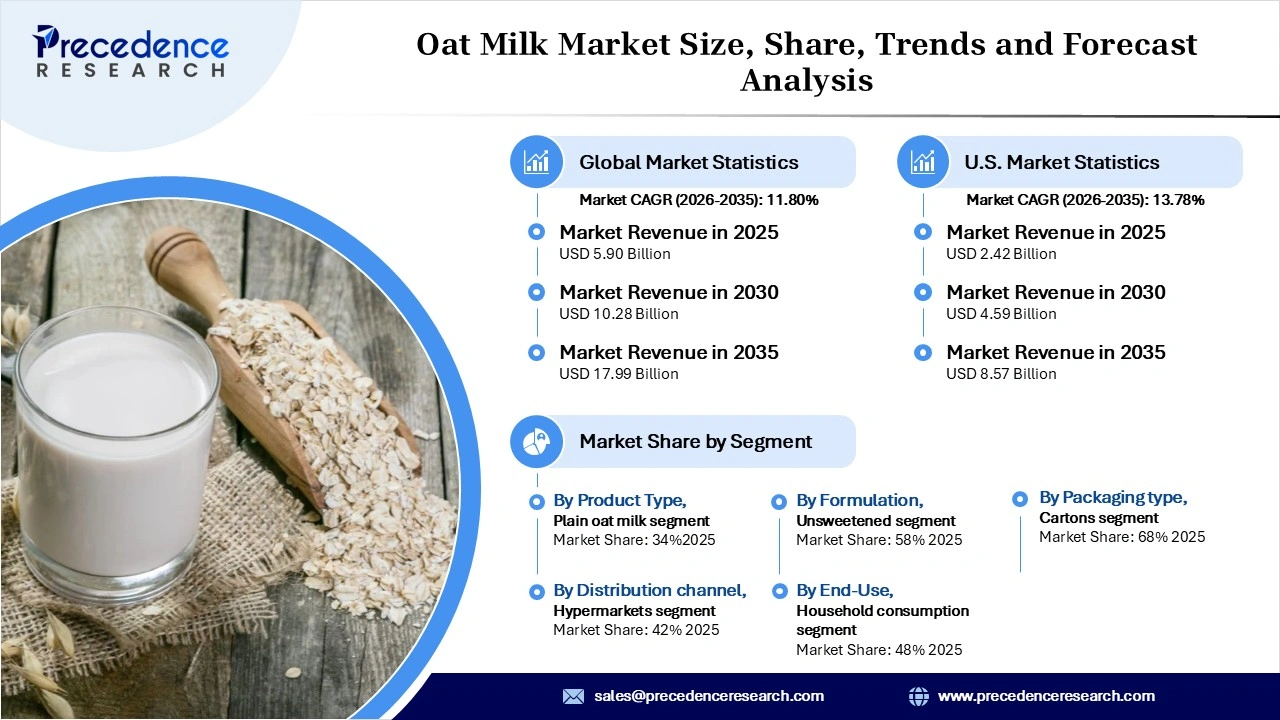
The global oat milk market revenue surpassed USD 5.90 billion in 2025 and is predicted to attain around USD 17.99 billion by 2035, growing at a CAGR of 11.80%. The market is expanding quickly as so many people love dairy-free foods, or at least the taste and texture that they associate with them. Driven by the increasing rate of lactose intolerance, the rise in cafe-type acceptance, the increasing trend for clean-label products, and overall sustainability concerns, there is a demand that transcends fashion.
Market at a Glance
The oat milk market constitutes the worldwide industry responsible for producing, selling, and distributing liquid beverages made from processed oats to substitute for dairy products. In this category are presented many different choices, including plain and flavored alternatives, fortified formulations that are meant to be nutritious, and also the barista preparation that supermarkets, coffee shops, websites, and foodservice companies offer. It also covers raw material sourcing (oats), packaging solutions, private-label production, and nutrition-focused developments. Growing numbers of consumers are choosing lactose-free plant-based options that suit their needs and that contribute to the environment, and this category is only growing.
The scope of the market includes retail beverage sales, applications in coffee bars, ready-to-drink formats, flavored oat, nutritionally modified oat, and raw materials for desserts or baked products. Its jurisdiction will also include supply chain control for oats sourcing; packaging process management; contract manufacturing with e-commerce distribution, and in emerging markets where alternative dairy products have been increasingly becoming a popular choice on the shelves.
Market Forecast for the Oat Milk Market
- Coffee Chains are Driving the Market: When global cafe brands add oat milk to permanent menus, demand scales fast because consumers trial the product in drinks before buying cartons at retail. Starbucks rolled out oatmilk across markets and continues launching oatmilk-based beverages such as shaken espresso and seasonal drinks, showing sustained menu confidence. That matters because foodservice often acts as a sampling channel for retail conversion.
- Rising Demand for Premium Products: The market is moving towards premium formats (barista blends, cold foam, flavored variety, cafe style) over standard packaging. While discussing 2026, Oatly highlighted new flavored barista drinks and the presence of more cold foam products. This implies that profit margins can be improved with premiumization as opposed to only price competition.
Consumer Interest Returns to Non-Dairy Drinks Market
- Plant-based beverage volumes were up a solid 2.1% in the calendar year ending February 2025
- Signs of consumer interest are back in non-dairy beverages beyond last year’s flat figures. Oat milk is poised to profit from any such rebound.
- This sector had a significantly stronger base of sales than most other plant-based drinks by a considerable 7.2% on this basis, so it could not be too surprising.
- 35% of UK households are introducing plant drinks into their eating patterns to illustrate that oat milk has now become part of the mainstream kitchen beyond its niche status in wellness.
- A quarter of purchased coffees are plant-based milk products, with oat being the most popular among large coffee chains, demonstrating a movement to expand this area in line with foodservice trends.
- Sales of oat milk in the UK now account for £275 million per annum (up from £155 million five years ago), signifying sustained value growth in the sector.
Market Segmentation Overview
- By product type, the plain oat milk segment accounted for a considerable revenue share of 34.0% in the oat milk market in 2025, due to consumers who wanted easy dairy substitutes that made sense and integrated seamlessly into their daily habits. That steadily increasing percentage was fueled by a burgeoning demand for natural ingredients, which were routinely used in cereals, coffee, tea, and blended drinks to maintain constant volumes.
- By product type, the barista oat milk segment is expected to grow at the fastest CAGR of 15.2% in the market between 2026 and 2035, due to the ongoing expansion of plant-based offerings at specialty cafes and coffee chains. Increasing consumer focus on drinks such as oat milk lattes and cappuccinos, as well as improved foam quality and greater café-like texture, are expected to increase the chance that they will be sold in the future.
- By formulation, the unsweetened segment dominated the market with a 58.0% market share in 2025 and is expected to maintain its leading position with a CAGR of 14.2% in the coming years, due to growing demand for low-sugar and clean-label products. There has been an increase in the demand for beverages featuring straightforward nutritional profiles, especially when it comes to managing diabetes or achieving some sort of fitness goal.
- By packaging type, the cartons segment held a major revenue share of 68.0% in the market in 2025, due to consumers' deep liking for shelf-stable alternatives to packaging. Cartons, therefore, did well in retail as they can be stacked efficiently and are easily seen on the shelves. The wider acceptance of this format was also encouraged through actions towards sustainability, which included lightweight packaging measures.
- By packaging type, the bottles segment is steadily growing with a CAGR of 14.0% in the market between 2026 and 2035, due to the growing demand for ready-to-drink oat milk drinks in the beverage category. This demand is anticipated to grow as consumers want convenience in their purchases and are attracted to the trend of portable beverage formats, especially in chilled, ready-to-consume beverages.
- By distribution channel, the supermarkets and hypermarkets segment accounted for a considerable revenue share of 42.0% in the oat milk market in 2025, as many products were available, and enhanced visibility in the retail environment helped create consumers' propensity for repetitive purchases. This channel was also able to maintain its first place due to the expansion in volume of shelf space dedicated to plant-based drinks, and the consumer preference for a one-stop shopping experience.
- By distribution channel, the online retail segment is expected to expand rapidly in the market with a CAGR of 18.5% in the coming years, due to the increasing convenience provided by digital grocery platforms. In addition, the expanding preference for home delivery services, recurring subscription purchases, and wider availability of specialized oat milk brands are expected to contribute to sustained progress in this area.
- By end-use, the household consumption segment accounted for a considerable revenue share of 48.0% in the market in 2025, as this change of position comes on account of many more consumers at home opting for plant-based alternatives to dairy products. Reasons behind this trend are a rising vegan demographic, increased awareness of lactose intolerance, and the rising trend of sustainability that leads to consistent daily usage.
- By end-use, the cafes and coffee chains segment is expected to grow at the fastest CAGR of 15.8% in the market between 2026 and 2035, due to the swift proliferation of specialty coffee chains worldwide. The rising demand for plant-based milk products among these organizations, as well as the growing popularity of oat milk lattes and cappuccinos, is likely to drive fast adoption in this segment.
Regional Analysis
Europe dominated the global oat milk market with a market share of 36.0% in 2025, due to strong consumer preference for plant-based dairy alternatives and widespread adoption of vegan and flexitarian diets. Growing concerns about the sustainability of traditional dairy farming have also paved the way for this move from consumers. Nordic countries with large oat milk producers drove innovation closer to consumer bases. With established oat drink brands, Sweden played a key role; Germany’s supermarkets, cafes, and health-oriented retail channels had strong demand.
Asia-Pacific held a market share of 22.0% in 2025 and is expected to grow at the fastest CAGR of 16.5% in the market during the forecast period, as rapid urbanization is bringing into the picture the changes to the way people eat, with a growing cohort of socially and ecologically literate consumers now searching for lighter alternatives to conventional dairy products. In urban areas, veganism and plant-based diets are on the rise alongside continuing investment that expands choices in dairy alternatives. Moreover, growing e-commerce platforms and modern retail infrastructures should improve accessibility for consumers. The digital grocery landscape is likely to favor China; in the meantime, Australia enjoys a well-established wellness consumption trend.
Oat Milk Market Coverage
| Report Attribute | Key Statistics |
| Market Revenue in 2025 | USD 5.90 Billion |
| Market Revenue by 2035 | USD 17.99 Billion |
| CAGR from 2026 to 2035 | 11.80% |
| Quantitative Units | Revenue in USD million/billion, Volume in units |
| Largest Market | North America |
| Base Year | 2025 |
| Regions Covered | North America, Europe, Asia-Pacific, Latin America, and the Middle East & Africa |
Top Companies in the Oat Milk Market
Through aggressive market positioning and a market expansion fueled by baristas, Oatly AB, the most prominent brand focused solely on oat milk, has successfully moved this product from niche markets to mainstream availability. Danone S.A. has become very competitive with plant-based product lines, taking advantage of its extensive global distribution network, whilst Nestlé S.A. is expanding dairy alternatives around the world, utilizing the clout of the largest company on earth. The Hain Celestial Group leverages its natural product background, and SunOpta Inc. is also strong with its manufacturing capabilities and private-label services that broaden this category.
Segments Covered in the Report
By Product Type
- Plain Oat Milk
- Flavoured Oat Milk
- Chocolate
- Vanilla
- Coffee
- Others
- Organic Oat Milk
- Fortified Oat Milk
- Barista Oat Milk
By Formulation
- Sweetened
- Unsweetened
By Packaging Type
- Cartons
- Bottles
- Cans
By Distribution Channel
- Supermarkets & Hypermarkets
- Convenience Stores
- Specialty Stores
- Online Retail
- Foodservice Channels
By End-Use
- Household Consumption
- Cafés & Coffee Chains
- Bakery & Confectionery
- Smoothies & Beverage
- Food Processing Industry
By Region
- North America
- Latin America
- Europe
- Asia-pacific
- Middle and East Africa
Get this report to explore global market size, share, CAGR, and trends, featuring detailed segmental analysis and an insightful competitive landscape overview @ https://www.precedenceresearch.com/sample/8437
You can place an order or ask any questions. Please feel free to contact us at sales@precedenceresearch.com |+1 804 441 9344