



Space Semiconductor Market Revenue to Attain USD 6.98 Bn by 2035
Published: 18 May 2026
Author: Precedence Research



Space Semiconductor Market Revenue and Trends 2026 to 2035
The global space semiconductor market revenue reached at USD 4.11 billion in 2025 and is projected to grow from USD 4.34 billion in 2026 to approximately USD 6.98 billion by 2035, at a CAGR of 5.44% from 2026 to 2035. Space semiconductors are used in various space-related systems and equipment, such as scientific instruments, communication satellites, space probes, and spacecraft avionics. These semiconductors are able to resist the risky conditions of outer space, including a high degree of radiation, extreme temperatures, and vacuum environments.
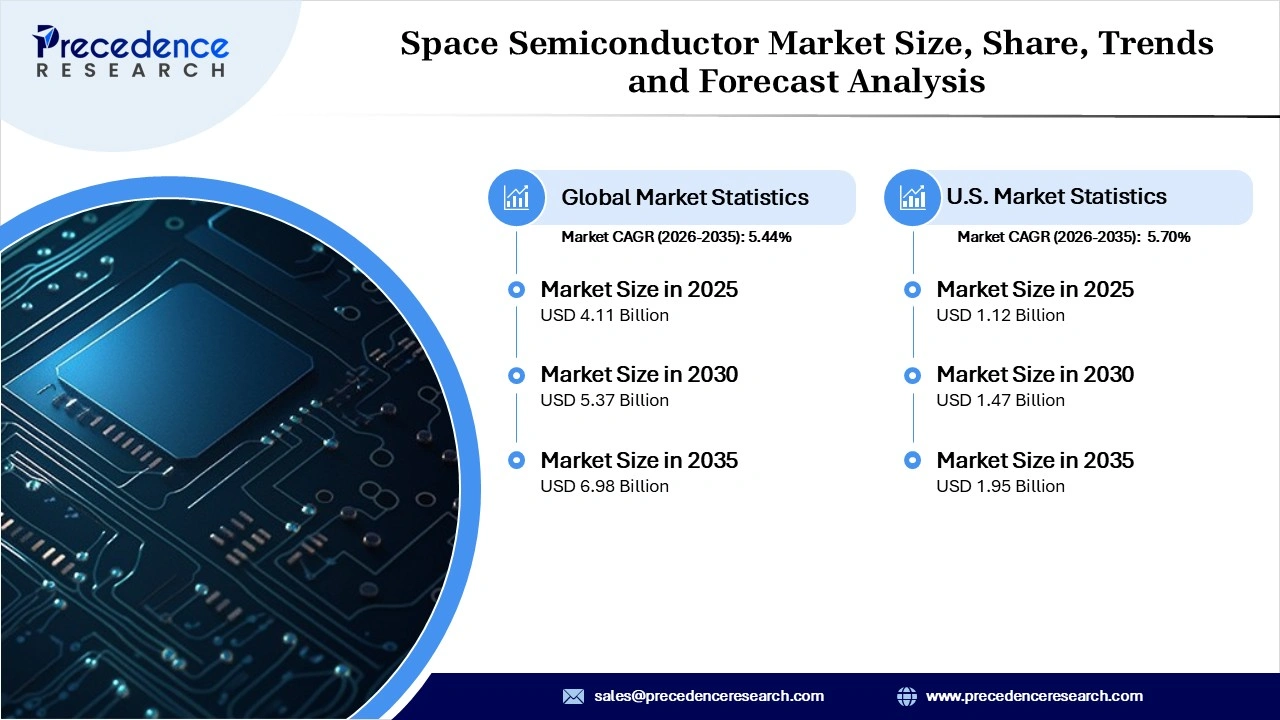
Market at Glance
The space semiconductor market is rapidly gaining momentum owing to the rising number of satellite launches, growing space exploration programs, and rising investments in commercial space activities. Space semiconductors are essential for guaranteeing operational reliability for satellites, launch vehicles, communication systems, and deep space programs in extreme space conditions. Miniaturization, radiation-resistant technology, and high-performance electronic components developed for the aerospace industry are helping to benefit the market. Moreover, the market is being expanded by the increasing involvement of the private sector in the space industry and Government funding for defense modernization.
Market Forecast
The growth in space electronics and next-generation satellite systems will drive the space semiconductor market to significant growth during the forecast period. As low Earth orbit (LEO) satellite constellations for communication, navigation, and Earth observation continue to expand, semiconductors can be expected to see many opportunities for their manufacturers. Long-term market development is likely to be stimulated by continuous innovation in radiation-hardened chips, on-board processing systems with AI capabilities, and high-speed communications technology. In addition, the increased spending on lunar exploration, interplanetary missions, and reusable launch vehicle technologies will boost the demand for highly reliable semiconductor components.
Segmental Insights
Type Insights
According to the type, the radiation-hardened type has held the highest revenue share in 2025, as it offered high resistance to radiation and environmental conditions faced in space missions. They are semiconductors that are specifically developed to keep operating stably and reliably in satellites, spacecraft, and defense systems that are subjected to cosmic radiation. In the case of mission-critical applications with long operational lives, government space agencies and defense organizations heavily depend on radiation-hardened components. Increasing deployment of advanced communication satellites and deep-space exploration missions is further supporting the demand for radiation-hardened semiconductors.
The radiation-tolerant grade segment is expected to be the fastest-growing in the market over the studied period, owing to the growing requirement for cost-effective semiconductor solutions for commercial space applications. These components offer some radiation protection and are less expensive to manufacture than fully radiation-hardened components. Small satellites, CubeSats, and low-cost commercial space missions are experiencing rapid growth, which greatly contributes to the use of radiation-tolerant semiconductor technologies. Private space companies are increasingly turning to these semiconductors to provide a balance of performance, reliability, and price for their satellites. Additionally, the development of semiconductor materials and system-level shielding technologies will be expected to help drive growth in this segment.
Component Insights
The optical device segment dominated the market in 2025, as optical communication systems, imaging technology, and remote sensing equipment were gaining in use in space applications. In the satellite industry, optical semiconductors are used extensively in high-speed data communication, Earth observation, and navigation. Optical devices are being used in military and civilian space missions because of the growing demand for advanced imaging and real-time communications requirements. The introduction of technological innovations in photonics, laser communication systems, and infrared sensing technologies is further bolstering the growth of these segments.
The integrated circuits segment is expected to be the fastest growing in the market during the forecast period, driven by onboarding computing, signal processing, power control, and communication are examples of functions that are crucial in modern spacecraft and satellites and rely on the use of integrated circuits. As autonomous space systems require high-performance processors, memory chips and AI capabilities, they are driving the use of complex integrated circuits. Space agencies and private aerospace firms are spending vast resources on developing next-generation semiconductors that can enhance mission efficiency and decrease payload mass. In addition, the low-power and radiation-resistant IC technology will continue to progress and contribute to the rapid growth of this segment.
Application Insights
The satellite segment dominated the market by holding a major share in the year 2025, due to increased launches of communication, navigation, weather monitoring, and earth observation satellites around the world dominated the space semiconductor market, as the number of satellites in orbit continues to grow. Semiconductors must be very reliable, capable of functioning continuously for long periods of time in extreme space environments. Satellite deployment has been greatly accelerated in the world due to the growing demand for broadband connectivity, remote sensing, and defense surveillance systems. In-satellite processing, high-speed data transmission, and power-saving systems are some of the many areas where semiconductor technologies are making a critical contribution.
The launch vehicles segment is expected to be the fastest-growing in the market, due to the growing number of space launches and development of reusable rocket technologies. The navigation, propulsion control, telemetry, and flight safety systems used in launch vehicles are highly demanding of semiconductor systems. Governments and private space companies are betting big on next-generation launch systems for their ability to decrease costs and increase the efficiency of space missions. Semiconductor integration of launch vehicles is further speeding up due to the increasing commercialization of space transportation services and the increasing demand for launching satellites. Furthermore, the segment is projected to witness robust growth owing to the developments in the autonomous flight systems and real-time monitoring technologies.
Regional Insights
North America dominated the space semiconductor market due to the strong presence of leading aerospace companies, advanced semiconductor manufacturers, and major government space agencies in the region. The United States continues to invest heavily in satellite programs, deep-space exploration missions, defense modernization, and space research initiatives. Increasing collaboration between public and private space organizations is accelerating innovation in radiation-resistant semiconductor technologies. The region also benefits from a well-established space infrastructure and the growing commercialization of space activities led by private aerospace firms. Rising investments in satellite communication networks, missile defense systems, and autonomous space technologies are further supporting market growth in North America. Additionally, continuous advancements in semiconductor research and high government funding for space exploration programs contribute significantly to regional dominance.
Asia Pacific is expected to witness the fastest growth in the space semiconductor market during the forecast period due to increasing investments in national space programs and the rapid expansion of the regional aerospace industry. Countries such as China, India, Japan, and South Korea are actively developing advanced satellite systems, launch vehicles, and space exploration missions. Growing government support for domestic semiconductor manufacturing and space technology innovation is strengthening regional market development. Rising deployment of communication and Earth observation satellites is significantly increasing demand for reliable semiconductor components across the region. Private sector participation in commercial space activities and satellite manufacturing is also contributing to rapid market expansion. Furthermore, increasing focus on technological self-reliance and defense modernization is expected to create strong growth opportunities for the Asia Pacific space semiconductor market.
Space Semiconductor Market Companies
- Teledyne Technologies Incorporated: The company supplies high-tech electronic parts, such as military electronics, as well as the whole electronic systems used by satellites for communication, sensing, and other important space applications.
- Infineon Technologies AG: The company provides power semiconductor devices, microcontrollers, and security components for space electronics that are characterized by their reliability, energy efficiency, and high performance throughout the harshest aerospace environments.
- Texas Instruments Incorporated: It produces the analog chip and the embedded processor that, when combined, make it possible to manage the power consumption very well and at the same time ensure reliable data transmission for different space systems and mission applications.
Other Major Key Players
- Microchip Technology Inc.
- Cobham Advanced Electronic Solutions Inc.
- STMicroelectronics International N.V.
- Solid State Devices Inc.
- Honeywell International Inc.
- Xilinx Inc.
- BAE System Plc
- TE Connectivity
Segments Covered in the Report
By Type
- Radiation Hardened Grade
- Radiation Tolerant Grade
- Others
By Component
- Integrated Circuits
- Discrete semiconductors Devices
- Optical Device
- Microprocessor
- Memory
- Sensors
- Others
By Application
- Satellite
- Launch Vehicles
- Deep Space Probe
- Rovers and Landers
By Region
- North America
- Europe
- Asia-Pacific
- Latin America
- Middle East and Africa
Get this report to explore global market size, share, CAGR, and trends, featuring detailed segmental analysis and an insightful competitive landscape overview @ https://www.precedenceresearch.com/sample/3308
You can place an order or ask any questions. Please feel free to contact us at sales@precedenceresearch.com |+1 804 441 9344