



Psychological Distress Market Size, Companies, Share, Patient Volume, Treatment Adoption Rates, Pricing Analysis, Regulatory Landscape, Competitive Positioning, and Demand Forecast
Psychological Distress Market (By Disorder Type Anxiety Disorders Depression Stress-Related Disorders Post-Traumatic Stress Disorder (PTSD) Adjustment Disorders By Treatment Type Pharmacological Treatment Psychotherapy Digital Mental Health Solutions Lifestyle and Wellness Programs By Therapy Type Cognitive Behavioral Therapy (CBT) Counseling and Talk Therapy Mindfulness-Based Therapy Group Therapy) - Global Industry Analysis, Size, Trends, Leading Companies, Regional Outlook, and Forecast 2026 to 2035
Source: https://www.precedenceresearch.com/psychological-distress-market
 Get a Sample
 Table Of Content


What is the Psychological Distress Market Size in 2026?
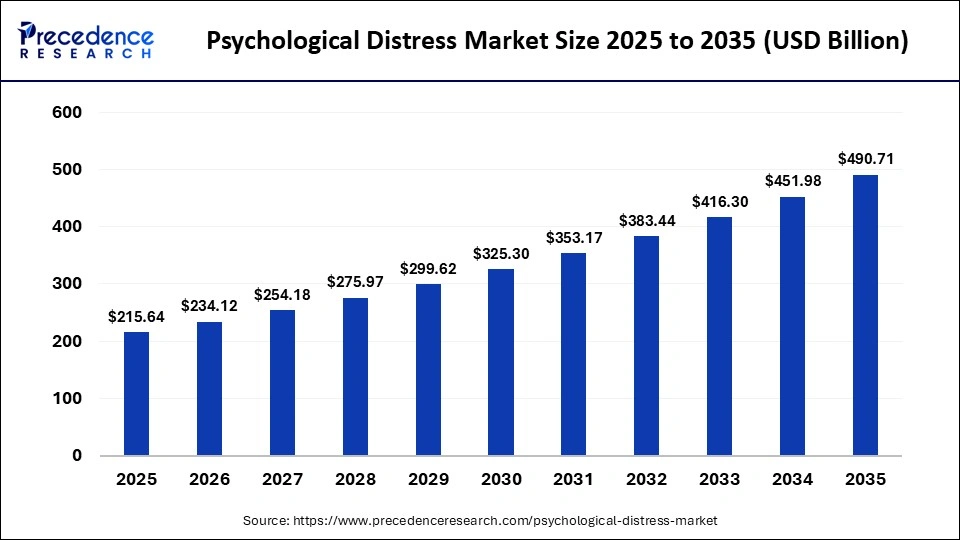
The global psychological distress market size was calculated at USD 215.64 billion in 2025 and is predicted to increase from USD 234.12 billion in 2026 to approximately USD 490.71 billion by 2035, expanding at a CAGR of 8.57% from 2026 to 2035. The market witnesses a rapidly expanding landscape of mental healthcare where rising global stress, the rise of digital therapeutic solutions, AI-driven assessment tools, and investments in workplace well-being continue to coalesce to transform identifying, diagnosing, and treating anxiety, depression, and emotional disorders on a much larger scale.
Key Takeaways
- North America held a dominant revenue share of the psychological distress market in 2025.
- Asia-Pacific is expected to grow at the fastest CAGR in the market during the forecast period.
- By disorder type, the anxiety disorders segment accounted for a considerable revenue share in the market in 2025.
- By disorder type, the stress-related disorders segment is expected to grow at the fastest CAGR in the market between 2026 and 2035.
- By treatment type, the pharmacological treatment segment registered its dominance over the global market with a share in 2025.
- By treatment type, the digital mental health solutions segment is expected to grow with the highest CAGR in the market during the studied years.
- By therapy type, the cognitive behavioral therapy (CBT) segment accounted for the highest revenue share in the market in 2025.
- By therapy type, the mindfulness-based therapy segment is expected to witness the fastest growth in the market over the forecast period.
What is the Psychological Distress Market?
The psychological distress industry is not merely one single, narrowly defined industry but, rather, an integrated and responsive system that responds to the growing global problems of anxiety, depression, trauma-related conditions, burnout, and stress-associated issues. It includes traditional psychiatry, clinical psychology, and counseling centers, and digital mental health platforms that include apps that can provide teletherapy with AI-based screening tools, as well as corporate wellness offerings.
Urbanization trends, economic instability, social isolation, and information overload have led to changes in the patterns of emotional health globally as well, and they also influence how this is done. Furthermore, the market represents this shift not only in the face of widespread social and healthcare systems and societal transformation in general, where mental well-being is shifting from somewhere on the margins to the center within healthcare investment strategies and public policy frameworks.
Impact of AI in the Psychological Distress Market
Artificial intelligence (AI) is slowly changing the landscape of mental healthcare; however, not to become the provider of care, but to expand its domain. AI-based chat interfaces, predictive analytics, and behavior patterns algorithms have been increasingly used to spot anxiety, depression, and stress-related disorders early, and are sometimes able to highlight potential hazards before any human consultation is arranged.
Digital triage systems direct patients to the best possible interventions and take some pressure off a mental health system already stretched thin. Moreover, AI further enables continuous mood monitoring (using wearable devices and applications), which transforms episodic therapy into a data-driven model. But that presents a double problem; although the scalability and accessibility do make immense advancement, the ethical implications, clinical accuracy, and the complexity of emotions will remain key factors in both the regulatory approach and the choice of investment throughout the industry.
Trends Influencing the Psychological Distress Market
- Digital-First Mental Healthcare Adoption: Therapy has moved out of traditional clinic settings. Video consultations, app-based counseling services, and subscription mental health platforms are making it easier for clients to continually rely on emotional support that they may not find in real-life settings. This move to a more convenient, more private, and cheaper route is especially enticing for the younger population, revolutionizing the way companies should engage with their patients and prompting the classical providers to implement hybrid services.
- Integrating Mental Health as a Workplace Aspect: Organizations are working past superficial wellness programs, like occasional webinars. Corporate endeavors include comprehensive employee assistance programs, resilience training sessions, burnout levels tracking tools, and AI-driven assessments for stress. Mental health service is increasingly viewed as a vital infrastructure for productivity, not just an added perk.
- Orientation to Youth and Adolescent Mental Health: An increase in stress and psychological distress experienced by young people is resulting in specific services being formulated in schools, universities, and online platforms. Investors and policymakers have long urged interventions in early life stages because of the recognition that long-term impact is felt and that neglecting psychological distress among young people can lead to rising costs for health care services and social support services.
Market Scope
| Report Coverage | Details |
| Market Size in 2025 | USD 215.64 Billion |
| Market Size in 2026 | USD 234.12 Billion |
| Market Size by 2035 | USD 490.71 Billion |
| Market Growth Rate from 2026 to 2035 | CAGR of 8.57% |
| Dominating Region | North America |
| Fastest Growing Region | Asia Pacific |
| Base Year | 2025 |
| Forecast Period | 2026 to 2035 |
| Segments Covered | Disorder Type, Treatment Type, Therapy Type, and region |
| Regions Covered | North America, Europe, Asia-Pacific, Latin America, and Middle East & Africa |
Segmental Insights
Disorder Type Insights
Why Did the Anxiety Disorders Segment Dominate the Psychological Distress Market?
The anxiety disorders segment held a dominant position in the market in 2025, as anxiety disorders are the most commonly reported mental health issue in both developed and emerging nations. The high prevalence rates, along with early onset trends and recurring symptoms, contributed to ongoing demand for treatment. Screening tools commonly employed in primary care settings prioritize evaluation of anxiety disorders, boosting their clinical prominence. Workplace mental health initiatives have also recently turned further toward anxiety management interventions.
The stress-related disorders segment is expected to grow with the highest CAGR in the market during the studied years, due to increasing psychological pressures from work environments today, prevailing economic circumstances, and the ubiquity of online connectivity. Unlike long-lasting, sustained forms, stress disorders develop in reaction to an event and are therefore susceptible to early intervention via early support programs, self-regulation apps, and digital platforms.
Treatment Type Insights
Why did the Pharmacological Treatment Segment Dominate the Psychological Distress Market?
The pharmacological treatment segment accounted for the highest revenue share in the market in 2025. This prominence arises from its clear clinical acceptance and recognized reimbursement mechanisms. For cases of moderate to severe psychological distress, antidepressants, anxiolytics, and mood stabilizers remain essential. Doctors generally rely on a medication regimen for symptom management, especially when prompt intervention is vital.
Long-term prescriptions create steady revenue streams for healthcare systems and pharmaceutical companies alike. This makes medication a cornerstone of psychiatric work, particularly in hospitals and specialized clinics, while there is increasing interest in non-pharmacological alternatives.
The digital mental health solutions segment is expected to gain the highest market share between 2026 and 2035, as it offers accessibility, cost-effectiveness, and privacy considerations. Mobile app-based counseling services are likely to fill treatment gaps among underserved individuals, along with AI-enhanced cognitive therapy modules and telepsychiatry platforms. Younger age demographics are expected to want mobile-centric models of care more than older demographics. Once regulatory landscapes get clearer and insurers work to slowly incorporate digital therapeutics into their coverage plans, it is likely that uptake will increase rapidly.
Therapy Type Insights
Which Therapy Type Segment Led the Psychological Distress Market?
The cognitive behavioral therapy (CBT) segment held the largest revenue share in the market in 2025, based on its reliable and systematic methodology combined with the ease of use in treating anxiety, depression, and stress-related disorders. Clinicians would rather use CBT due to its measurable utility and for the use of either face-to-face or digital formats. Moreover, CBT sessions are also covered by insurance companies, making it more appealing to healthcare institutions. Also, many digital mental health applications are structured around the central tenets of CBT.
The mindfulness-based therapy segment is expected to expand rapidly in the market in the coming years as prevention-centered mental health efforts around the world gain popularity. Practices that are meditation-oriented, breath controlling, and present moment awareness are becoming more integrated into corporate wellness and app platforms. Mindfulness approaches lend themselves to scale and adaptation, unlike more structured types of psychotherapy, well into group settings, putting them in a commercial interest.
Regional Insights
Why North America Dominated the Psychological Distress Market?
North America held a major revenue share of the market in 2025. That is due to greater attention around mental well-being, improved clinical systems, and widespread insurance that have cumulatively helped make it one of the world's biggest demand centers. The United States has a vast majority of mental health services, channeling significant research investments into this field, and adopting digital care solutions. The region benefited from well-established treatment pathways, effective reimbursement systems, and considerable collaborations between public entities and the private sector.
U.S. Market Trends
The U.S. dominated North America, driven by factors like high prevalence rates of mental health conditions such as anxiety disorders; depression levels rising sharply over time, as well as various problems from stress. Additionally, due to heavy investments in innovative methods for delivering mental health care. These features, in turn, led to regular attendance at therapy sessions and to the introduction of additional pharmacologic treatments of these conditions. In addition, the U.S. has led the sector in deploying digital solutions, everything from teletherapy platforms to app-based CBT.
Why is Asia-Pacific Experiencing the Fastest Growth in the Psychological Distress Market?
Asia-Pacific is expected to host the fastest-growing market in the coming years, driven by rapid socioeconomic changes, an increased awareness of mental health issues, and a growing use of telehealth services. Both government and private industry are expected to help improve infrastructure and facilitate digital care solutions, specifically in historically underserved areas. Cultural change, wider insurance coverage possibilities, and mobile app-based solutions together make it very possible to see increased demand for care in this region.
India Market Trends
India is expected to lead growth within the Asia-Pacific. Digital mental health platforms are especially attractive as a result of rising stress levels in the younger workforce and working professionals, high mobile device use, and high broadband connectivity.
It is likely that as social stigma slowly disappears and as employers focus on psychological health in their human resource approaches, the market in India alone can grow faster than that in other markets in the region. Government-led campaigns, NGO-led awareness campaigns, and private teletherapy companies will also help expand market coverage and extend sustainable development, as well as contribute to sustained expansion.
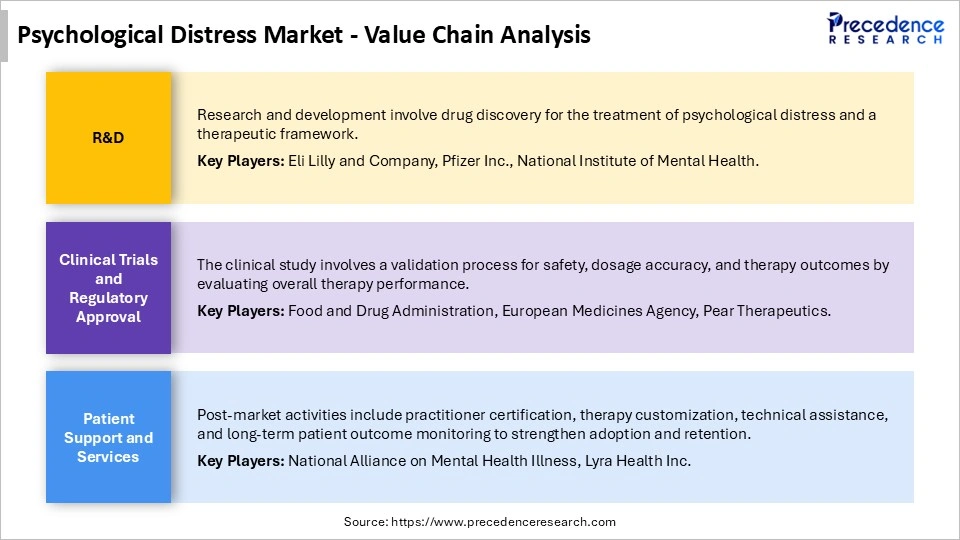
Psychological Distress Market Value Chain Analysis
Psychological Distress Market Companies
- Acadia Healthcare
- Ascension Seton
- Behavioral Health Network Inc.
- CareTech Holdings PLC
- North Range Behavioral Health
- Promises Behavioral Health
- Pyramid Healthcare
- Strategic Behavioral Health LLC
- Sevita (The MENTOR Network)
- Universal Health Services Inc.
- Crestwood Behavioral Health Inc.
- Vita Health Group
- The Cigna Group
- TEAMCare Behavioral Health LLC
- Unison Behavioral Health
Recent Developments
- In February 2026, Talkiatry Holdings raised $210 million in a funding round led by Perceptive Advisors for telepsychiatry tools designed using AI. This is a vote of confidence that investors and sector leaders have in technology for providing mental healthcare.(Source: https://www.wsj.com)
- In November 2025, Infosys and the National Institute of Mental Health and Neurosciences (NIMHANS) launched “Wellness Matters: Mental Health First Aider Training Manual”, a practical guide designed to help employees recognize early signs of mental distress, offer peer support, and connect individuals with professional help. (Source: https://health.economictimes.indiatimes.com)
- In May 2025, the Sri Lankan Ministry of Education announced the launch of a special nationwide program to support students facing psychological distress. The initiative involves the active participation of professional psychiatrists and mental health experts. This addresses several suicide cases and other critical mental health emergencies reported recently. (Source: https://srilankamirror.com)
Segments Covered in the Report
By Disorder Type
- Anxiety Disorders
- Depression
- Stress-Related Disorders
- Post-Traumatic Stress Disorder (PTSD)
- Adjustment Disorders
By Treatment Type
- Pharmacological Treatment
- Psychotherapy
- Digital Mental Health Solutions
- Lifestyle and Wellness Programs
By Therapy Type
- Cognitive Behavioral Therapy (CBT)
- Counseling and Talk Therapy
- Mindfulness-Based Therapy
- Group Therapy
By Region
- North America
- Latin America
- Europe
- Asia-pacific
- Middle and East Africa
For inquiries regarding discounts, bulk purchases, or customization requests, please contact us at sales@precedenceresearch.com
Frequently Asked Questions





Ask For Sample
No cookie-cutter, only authentic analysis – take the 1st step to become a Precedence Research client
 Get a Sample




 sales@precedenceresearch.com
 Schedule a Meeting
