



Rare Earth Magnets Market Trends, Leading Companies, Company Revenue / Sales Performance, Plant Utilization, Production Volume, Pricing Dynamics, Supply Chain Performance, Competitive Landscape, and Industry Growth
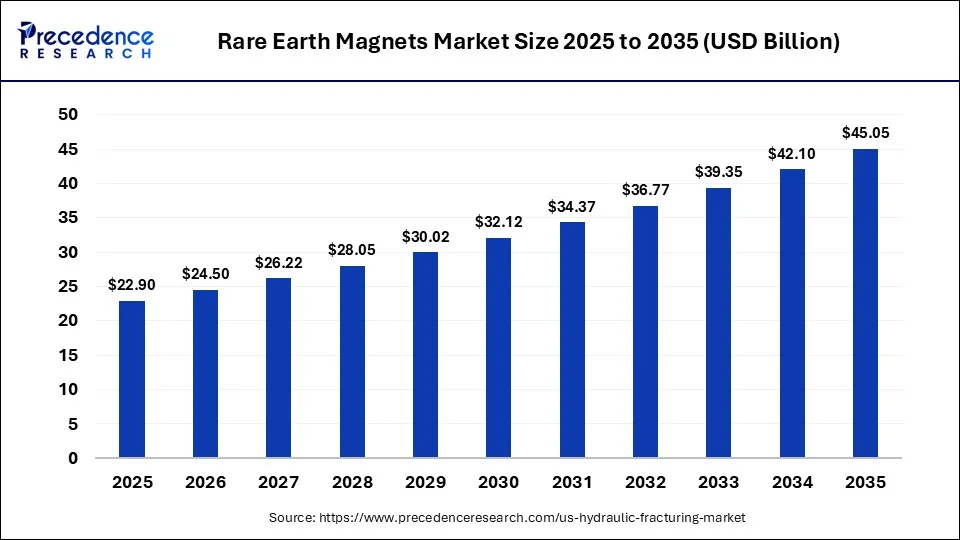
The rare earth magnets market accounted for USD 24.50 billion in 2026. The market growth is being driven by magnet manufacturing capacity expansion in non-China regions, the development of advanced manufacturing and magnet technologies, and the growing adoption of EVs to curb carbon emissions and meet sustainability goals. These trends were evaluated by our Senior Research Analyst, Vidyesh Swar, to curate this well-researched report. His analysis benefits chemical manufacturers, distributors, industry researchers, and stakeholders in conducting competitive analysis and making well-informed decisions.
Source: https://www.precedenceresearch.com/rare-earth-magnets-market
 Get a Sample
 Table Of Content


Rare Earth Magnets Market Trends, Share, and Growth Analysis 2035
The rare earth magnets market is forecasted to expand from USD 24.50 billion in 2026 to USD 45.05 billion by 2035, growing at a CAGR of 7% from 2026 to 2035. Investment by various governments to localize their supply chains, growing demand from electric vehicle traction motors and industrial motors, and rapid adoption in next-generation applications are benefiting the market. Vidyesh Swar, our Senior Research Analyst, has over 5 years of experience in the chemical and materials industry. According to him, the ability to develop indigenous end-to-end supply chains and manufacturing competitive products in terms of cost and performance will be a significant factor alongside the availability of ore.
Key Takeaways
- By magnet type, the Neodymium-iron-boron (NdFeB) segment led the market with a 90.80% share in 2025.
- By application, the automotive and EV traction motors segment dominated the market with a 29.85% share in 2025.
- By region, Asia Pacific accounted for the major revenue share of 74.85% in 2025.
- By application, the robotics and automation segment is expected to grow at the fastest CAGR of 10.55% from 2026 to 2035.
- By region, North America is expected to expand at the highest CAGR of 8.97% during the forecast period.
- China held 60% of the global magnet rare-earth mining share and contributed to 91% of refined magnet rare-earth output in 2024.
- MP Materials produced 2,599 metric tons of NdPr oxide in 2025 and MP Independence facility is intended to have initial production capacity of 1,000 metric tons per year.
- MP Materials announced the planned 10X magnet production site in Northlake, Texas, U.S., which involves an investment of over USD 1.25 billion.
- Noveon Magnetics and Kangwon Energy unveiled plans in November 2025 to develop a sintered NdFeB magnet facility in South Korea with 2,000 metric tons of annual production capacity.
- Noveon Magnetics completed a USD 215 million Series C funding round in January 2026 to expand rare-earth magnet manufacturing capacity in the U.S.
What was the Size of the Rare Earth Magnets Market in 2025?
The global rare earth magnets market accounted for USD 22.90 billion in 2025 and is expected to expand at a CAGR of 7.00% during the forecast period. The market growth is being driven by electric vehicle traction motors, wind-power generators, industrial motors, robotics, automation, consumer electronics, aerospace, and defense systems. The most strategically crucial products are NdFeB magnets, owing to the fact that they offer high magnetic energy density in compact motor and generator configurations. The IEA recognizes permanent magnets as a crucial driver of demand for rare earths, especially from EVs and wind power.
Expert Analyst Insights
The critical issue is not just the growth of the demand for magnets, but the locations of magnet manufacturing. China contributed around 94% of the worldwide sintered permanent-magnet production in 2024, and the country also accounted for 60% of mined magnet rare earths and 91% of the refined yield. This presents a significant opportunity for manufacturers in various countries such as the U.S., Japan, Europe, South Korea, Vietnam, and Australia to diversify the global supply chains.
Which Rare Earth Magnet Technologies are Propelling the Market Growth?
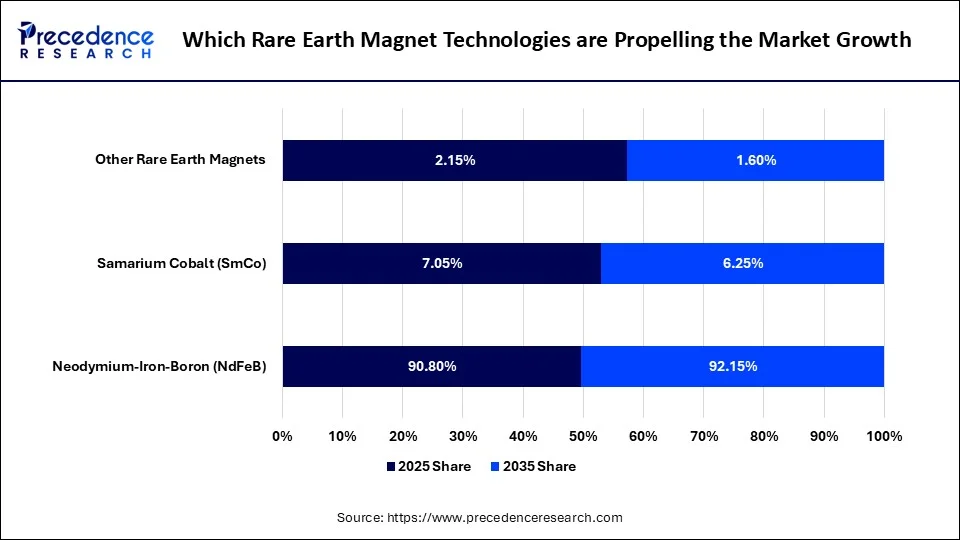
The Neodymium-iron-boron (NdFeB) segment led the market with a 90.80% share in 2025 and is expected to grow at the highest CAGR of 7.16% from 2026 to 2035, increasing its market share to 92.15% by 2035. NdFeB technology provides high-energy products, compact size, and compatibility with high-efficiency motors. Proterial recognizes NdFeB as a high-performance permanent-magnet material that finds applications in high-performance motors, actuators, speakers, hard-disk drives, and sensors. The Samarium Cobalt (SmCo) segment held the second-largest share of 7.05% in 2025 and is crucial for high-temperature and demanding applications. VAC manufactures NdFeB as well as SmCo permanent magnets by making use of Nd, Pr, Tb, and Dy for its NdFeB products and Sm/Gd for SmCo products.
Expert Analyst Insights
According to our Senior Researcher Aditi Shivarkar, NdFeB market share would continue to increase due to the fact that EV traction motors, robotics, industrial servo motors, drones, and wind generators need high magnetic performance along with low weight and compact motor configuration. An especially crucial technology trend is reduction or elimination of heavy rare earths such as dysprosium and terbium, along with the maintenance of coercivity at high temperatures.
Which Rare Earth Magnet Application Held the Largest Market Share in 2025?
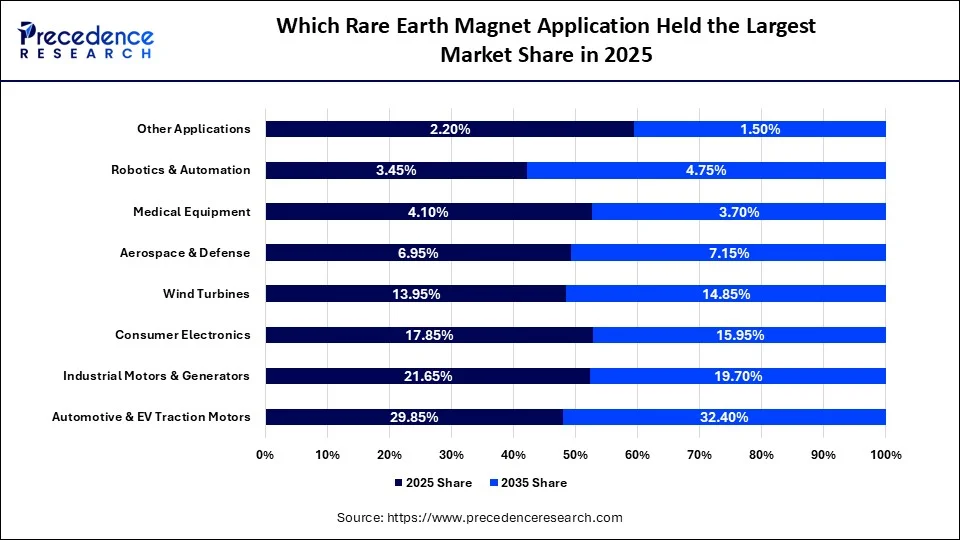
The automotive and EV traction motors segment accounted for the major revenue share of 29.85% in 2025 and is expected to grow at a CAGR of 7.86% during the forecast period. The robotics and automation segment is expected to expand at the highest CAGR of 10.55% from 2026 to 2035. EVs and wind power are especially crucial due to the fact that both utilize high-performance permanent magnets in electric machines. The IEA explicitly recognizes EV deployment as the largest driver of the demand for rare earths outside China during the forecast period.
Rare Earth Magnet Application Insights By Expert Analysts
According to our Senior Researcher Aman Singh, automotive/EV and industrial applications presently offer the widest demand landscape, while robotics is emerging as a high-growth specialized field. The combination of electric drives, compact actuators, autonomous systems, and humanoid robotics boosts the demand for high-performance magnets. This is creating a presence of the market beyond just conventional automotive and electronics applications.
How Crucial are Electric Vehicles to Rare Earth Magnet Demand?
Permanent-magnet synchronous motors can provide high torque density and efficiency while retaining a relatively compact motor configuration. NdFeB magnets have been widely adopted in traction motors and various other automotive electric-drive systems. The strategic significance can be seen across the supply chain. MP Materials says that NdFeB magnets are crucial components for vehicles, drones, robotics, electronics, and aerospace and defense systems.
What are Some of the Demand Indicators in EV-based Applications?
| Indicator | Latest documented figure |
| Global magnet rare-earth mining share held by China, 2024 | 60% |
| Global refined magnet rare-earth output share held by China, 2024 | 91% |
| Global sintered permanent-magnet production share held by China, 2024 | 94% |
| MP Materials 2025 NdPr oxide production | 2,599 metric tons |
| MP Materials planned total U.S. NdFeB capacity after 10X | ~10,000 metric tons/year |
| MP Independence planned/initial magnet capacity | ~1,000 metric tons/year |
| eVAC South Carolina nameplate capacity | ~2,000 metric tons/year |
China accounted for around 60% of the worldwide magnet rare-earth mining, 91% of the refined magnet rare-earth yield, and 94% of the sintered permanent-magnet production in 2024. MP Materials manufactured 2,599 metric tons of NdPr oxide in 2025, and the production capacity of the eVAC South Carolina, U.S., site is 2,000 metric tons/year.
Expert Analyst Insights
According to our Senior Researcher Aditi Shivarkar, the EV sector is emerging as an important driver of demand and a booster for the localization of the supply chain. Automakers are increasingly requiring qualified magnet vendors outside China because magnet availability can influence vehicle manufacturing. The 2025 Chinese export-control saga showed that disruption can shift from the raw-material stage to the automotive production stage.
Which Region Held the Largest Market Share in 2025?
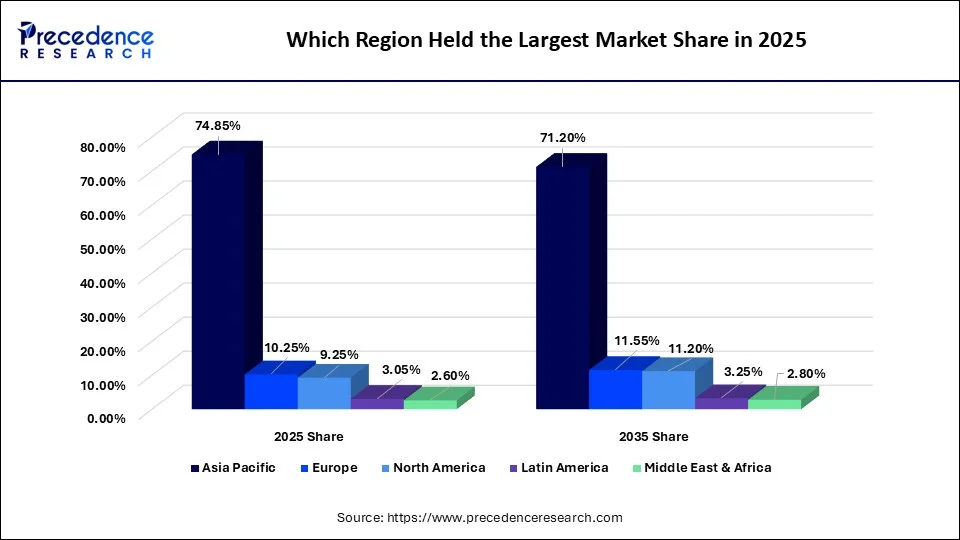
Asia Pacific dominated the market with a 74.85% share in 2025 and is expected to expand at a CAGR of 6.48% from 2026 to 2035. North America is expected to grow at the fastest CAGR of 8.97% during the forecast period, increasing its share from 9.25% in 2025 to 11.20% in 2035. Europe is also expected to expand at a healthy CAGR of 8.19% from 2026 to 2035, propelling its share from 10.25% in 2025 to 11.55% in 2035.
Regional Insights By Expert Analysts
According to our Senior Researcher Aman Singh, Asia Pacific continues to be the most prominent regional market owing to the fact that it brings together magnet manufacturing, electronics production, automotive manufacturing, and renewable-energy deployment. North America and Europe are emerging as strategically vital production regions, and the reason is not just their capability to compete with the scale of production of China, but also because of heavy investments by governments and industrial companies towards the development of localized supply chains.
Which Countries Hold Significant Importance in the Rare Earth Magnets Sector?
| China | Global manufacturing leader | Mining, refining, alloying, and NdFeB magnet manufacturing |
| Japan | Advanced technology hub | High-performance magnets, automotive/electronics applications |
| South Korea | Emerging manufacturing hub | Automotive, electronics and new magnet capacity |
| United States | Major emerging supply-chain hub | Mining, refining, magnet manufacturing and recycling |
| Germany | European industrial hub | Automotive, industrial motors and magnet technology |
| Vietnam | Emerging manufacturing base | Integrated rare-earth magnet production and recycling |
| Australia | Upstream growth market | Rare-earth mining and emerging downstream processing |
| France | European technology/supply-chain market | Automotive, aerospace and strategic materials |
| United Kingdom | Emerging circular-supply-chain market | Recycling and permanent-magnet initiatives |
| India | Emerging demand/manufacturing market | EVs, electronics, renewable energy and rare-earth development |
China leads the global production of rare earth magnets and has a significant presence in mining, refining, alloying, and NdFeB magnet manufacturing segments. Japan is an advanced manufacturing hub that excels in high-performance magnets and automotive/electronics applications. The significance of South Korea in manufacturing is growing due to rapidly expanding automotive, electronics, and novel magnet capacity. The U.S. is an important emerging supply chain hub, and Germany represents an important center for European industrial manufacturing capacity.
Country Insights By Expert Analysts
China is still the central manufacturing country; however, the most strategically crucial emerging nations are the U.S., Vietnam, South Korea, Australia, and specific European countries. The IEA expects the demand for magnet rare earths outside China to grow by approximately 50% by 2035. The currently existing and announced capacity outside China is expected to cater to only 50% of the mining needs, 25% of the refining needs, and less than 20% of the magnet demand by 2035.
Why Does China Lead the Production of Rare Earth Magnets?
China has a significant presence in almost the entire supply chain:
Mining → separation → refining → metal → alloy → powder → magnet → component
The IEA gave the following approximate figures:
- 60% of global mined magnet rare earth production in 2024
- 91% of refined magnet rare earth output
- 94% of global sintered permanent-magnet production
USGS data also points out that the rare earth sector in China is governed via production quotas and that the country contributed to over 70% of the worldwide rare earth extraction and 87% of processing in the cited USGS evaluation.
China Production Insights by Expert Analysts
According to our Senior Researcher Aman Singh, the best competitive potential is not just accessibility to ore, but vertical integration and manufacturing scale. This is why just the development of new mines outside China does not automatically create an alternative magnet supply chain
Which Countries are Emerging as Alternative Rare Earth Magnet Production Hubs?
United States
The U.S. is swiftly developing a comprehensive mine-to-magnet landscape. MP Materials manufactured its first NdFeB magnets on commercial machinery in 2025. The company's Independence facility in Texas, U.S., is intended to achieve manufacturing capacity of 1,000 metric tons of finished NdFeB magnets per year. In February 2026, MP unveiled the planned 10X magnet production campus in Northlake, Texas, U.S., which involves an investment of over USD 1.25 billion and is expected to increase the company's net U.S. NdFeB magnet production capacity to around 10,000 metric tons per year when its operations commence.
Expert Analyst Insights
The U.S. is expanding its market ecosystem from just mining to comprehensive indigenous magnet production, with automotive, defense, robotics, AI infrastructure, and electrification generating potential downstream demand.
Japan
Japan holds significance in advanced magnet technology, automotive applications, electronics, and manufacturing prowess. Shin-Etsu Chemical operates rare-earth manufacturing in Japan as well as in various other countries. The company's operations in Vietnam bring together refining, recycling, and finished neodymium magnet production, and the company reported its plans to expand capacity in Vietnam and Japan. Proterial is also working on the development of high-performance NdFeB materials that do not use heavy rare earths. In 2025, the company unveiled a heavy-rare-earth-free neodymium sintered magnet intended for EV driving motors, with its mass-production site already offering pre-production samples.
Japanese Market Insights by Expert Analysts
The market growth potential in Japan is being increasingly influenced by high-performance magnet formulations, heavy-rare-earth reduction, grain-boundary technologies, automotive qualification and precision manufacturing than just being competitive in commodity-scale production.
South Korea
South Korea is becoming increasingly significant owing to its automotive, electronics, and battery/energy production environment. Noveon Magnetics and Kangwon Energy unveiled in November 2025 that it intends to develop a 2,000-metric-ton annual sintered NdFeB magnet facility in South Korea, targeting automotive, industrial, defense, electronics and energy applications.
Expert Analyst Insights
South Korea has the potential to become a significant regional magnet production center owing to the fact that indigenous magnet manufacturing can be integrated with its massive automotive and electronics production ecosystem.
Vietnam
Vietnam is especially vital as an upcoming Asian alternative to China. The operations of Shin-Etsu in Vietnam bring together recycling, raw-material processing, and neodymium magnet manufacturing. The company's 2025 report said that Vietnam is a hub for integrated production and indicated more investments to expand manufacturing capacity and supply consistency.
Expert Analyst Insights
The strongest growth potential for Vietnam is its status as a production diversification location, especially for companies that want an Asian manufacturing base outside mainland China.
Which Companies are Influencing the Rare Earth Magnets Market?
| Company | Country/Region | Key Market Position |
| JL MAG Rare-Earth | China | NdFeB permanent magnets and rare-earth materials |
| Shin-Etsu Chemical | Japan/Vietnam | NdFeB magnets, recycling and integrated materials |
| TDK | Japan | Electronic components and permanent magnet technologies |
| Proterial | Japan | NEOMAX NdFeB magnets and advanced motor magnets |
| VACUUMSCHMELZE / eVAC | Germany/U.S. | NdFeB and SmCo; new U.S. production |
| MP Materials | U.S. | Mine-to-magnet NdFeB supply chain |
| Noveon Magnetics | U.S. | Sintered NdFeB and magnet recycling |
| Daido Steel | Japan | High-performance permanent magnets |
| Ningbo Yunsheng | China | NdFeB permanent magnets |
| Neo Performance Materials | Canada/Asia | Rare-earth materials and magnetic materials |
| Arnold Magnetic Technologies | U.S. | Permanent magnets and magnetic assemblies |
| TDK | Japan | Advanced magnet and electronic-component applications |
JL MAG Rare-Earth is an important Chinese company that manufactures NdFeB permanent magnets and rare-earth materials. Shin-Etsu Chemical has a significant presence in Japan and China and has a robust ecosystem of NdFeB magnets, recycling, and integrated materials. MP Materials, Noveon Magnetics, and Arnold Magnetic Technologies are some of the crucial market-relevant companies in the U.S.
Companies Insights by Expert Analysts
The competitive environment is diverging into 2 broad categories: mature Asian manufacturers with well-developed manufacturing ecosystems and upcoming Western manufacturers attempting to develop local mine-to-magnet or recycled-material supply chains.
Which Companies are Investing Most Actively in New Rare Earth Magnet Capacity?
| Company | Development | Scale / Value |
| MP Materials | 10X Northlake magnet campus | >USD 1.25B investment |
| MP Materials | Planned U.S. NdFeB capacity | ~10,000 metric tons/year |
| MP Materials | Independence facility | ~1,000 metric tons/year |
| eVAC/VAC | Sumter, South Carolina facility | ~2,000 metric tons/year |
| Noveon/Kangwon Energy | South Korea facility | 2,000 metric tons/year planned |
| Noveon Magnetics | Series C financing | USD 215M |
| Shin-Etsu | Vietnam integrated production | Expansion of recycling/refining/magnet capacity |
MP Materials noted its first commercial-equipment NdFeB magnet manufacturing in 2025 and also announced the expansion of its Northlake, U.S. center. eVAC commenced commercial manufacturing of rare earth magnets in South Carolina in 2025 and has a facility nameplate capacity of around 2,000 metric tons per year. Noveon completed a Series C financing amounting to USD 215 million in January 2026 as part of its efforts to expand U.S. rare earth manufacturing.
Companies Insights by Expert Analysts
Capacity investment is increasingly shifting downstream. The best strategic opportunity is mine-to-magnet localization, where companies have excellent control over rare-earth feedstock, refining, metal/alloy production, magnet manufacturing, and recycling.
How Are Export Controls Influencing the Rare Earth Magnet Market?
China unveiled export controls that cover 7 rare-earth elements and related compounds and magnets in April 2025. The IEA noted that export volumes decreased significantly in April and May, creating obstacles for automakers and other downstream producers. The European Commission has explicitly documented disruption issues for the EU industry, and the EU policy is increasingly emphasizing the development of alternative rare-earth and permanent-magnet supply chains.
Expert Analyst Insights
Export restrictions have changed rare earth magnets from a traditional raw-material procurement issue to a strategic sourcing and industrial-resilience issue. Buyers are increasingly assessing:
- country of origin
- guaranteed supply
- dual sourcing
- recycled content
- heavy-rare-earth exposure
- long-term offtake agreements
- domestic production
- traceability
- geopolitical threat
Rare Earth Magnet Recycling Becoming Commercially Vital?
Recycling is transitioning from a sustainability initiative to a supply safeguarding strategy. Noveon uses a Magnet-to-Magnet approach for recovering rare earth magnets from end-of-life processes. In January 2025, Noveon, Kangwon Energy, and LG Electronics unveiled a closed-loop recycling initiative by making use of end-of-life LG products to manufacture new high-performance magnets. MP Materials also unveiled a long-term contract with Apple in 2025 to supply rare-earth magnets manufactured in the U.S. entirely using recycled rare-earth materials. VAC and Cyclic Materials expanded a 10-year contract to cover recycling of magnet-manufacturing by-products from the South Carolina facility of VAC.
Expert Analyst Insights
Recycling is expected to be the fastest-growing component of the supply chain due to the fact that it can decrease reliance on primary mining while offering an indigenous feedstock for magnet production.
What are the Most Important Technology Trends in Rare Earth Magnets?
| Technology Trend | Market Impact |
| Heavy-rare-earth-free NdFeB | Reduces Dy/Tb dependence |
| Grain Boundary Diffusion | Improves coercivity while reducing heavy REE usage |
| Magnet recycling | Creates secondary rare-earth feedstock |
| High-temperature NdFeB | Supports EV and industrial motors |
| Smaller high-energy magnets | Enables compact motors and actuators |
| Automated magnet manufacturing | Improves consistency and production economics |
| Integrated mine-to-magnet production | Reduces supply-chain exposure |
| Advanced magnet coatings | Improves corrosion resistance and operating life |
| High-efficiency motor designs | Increases value of high-performance magnets |
| Alternative magnet materials | Reduces dependence on NdFeB in selected applications |
The 2025 heavy-rare-earth-free magnet development of Proterial shows the direction of technology advancement, while MP Materials is adopting grain-boundary diffusion technology in its well-planned U.S. magnet platform.
Expert Analyst Insights
The development and adoption of next-generation technologies is helping manufacturers increase supply chain resilience and produce highly efficient systems for modern applications.
What are the Biggest Restraints Faced by Rare Earth Magnet Manufacturers?
| Challenge | Market Implication |
| China supply concentration | High geographic dependency |
| NdPr price volatility | Magnet cost uncertainty |
| Dy/Tb availability | Limits high-temperature magnet production |
| Export controls | Creates procurement disruption |
| Qualification requirements | Slows new supplier adoption |
| High manufacturing complexity | Raises barriers to entry |
| Environmental footprint | Increases compliance requirements |
| Recycling infrastructure | Still developing at scale |
| Technology know-how | Limits rapid capacity replication |
| Long automotive qualification cycles | Delays new supplier commercialization |
The supply dominance of China creates significant geographical reliance, and the price fluctuations in NdPr create uncertainty in magnet costs. The limited availability of Dy/Tb throttles the expansion of high-temperature magnet manufacturing capacity, and export controls disturb the procurement landscape. There are significant intricacies involved in manufacturing, which create a high skill barrier for new players to enter the market.
Expert Analyst Insights
The major obstacle is not just the availability of resources, but also involves separation technology, metallization, alloying, powder production, sintering, grain-boundary treatment, machining, coating, quality control, and customer qualification. This is the reason why the announcement of new mining projects does not automatically transition into magnet production capacity.
What are the Strongest Market Growth Opportunities By 2035?
| Opportunity | Growth Potential | Strategic Importance |
| EV traction magnets | Very High | Very High |
| Robotics and humanoid systems | Very High | High |
| U.S. domestic magnet manufacturing | High | Very High |
| European magnet localization | High | Very High |
| Wind-turbine magnets | High | High |
| Heavy-rare-earth-free NdFeB | Very High | Very High |
| Magnet recycling | Very High | Very High |
| AI/data-center hardware | High | High |
| Aerospace and defense | High | Very High |
| High-temperature magnets | High | High |
| Vietnam/South Korea production | High | High |
| Magnet supply-chain software/traceability | Moderate–High | High |
EV traction magnets, robotics and humanoid systems, heavy-rare-earth-free NdFeB magnets, and magnet recycling present very high market growth potential. The most recent analytics by the IEA show that planned capacity outside China is still not sufficient when compared to the predicted 2035 demand, especially at the magnet production phase.
Market Growth Opportunities Insights by Expert Analysts
The development of localized supply chains outside mainland China and growing demand from AI, aerospace, and defense present high-growth potential areas for players to gain an edge.
What Should Buyers Focus on When Sourcing Rare Earth Magnets?
| Buyer Requirement | Importance in Procurement |
| Magnetic performance | Core technical specification |
| Temperature resistance | Critical for EV and industrial motors |
| Coercivity | Important for high-performance applications |
| NdPr/Dy/Tb composition | Directly affects cost and supply risk |
| Dimensional precision | Important for motor assemblies |
| Corrosion resistance | Required for long operating life |
| Country of origin | Increasingly important |
| Supply continuity | Strategic requirement |
| Recycling content | Increasing sustainability requirement |
| Automotive qualification | Essential for vehicle applications |
| Traceability | Increasingly required |
| Long-term pricing agreements | Helps manage rare-earth volatility |
EVs and industrial motor buyers focus on the temperature resistance capability of the magnets, and coercivity is crucial for customers who need high performance. Dimensional accuracy is crucial for motor assemblies, and corrosion resistance ensures a long operational lifecycle.
Expert Analyst Insights
The buyer scenario is transitioning from price-per-kilogram procurement to performance-and-security procurement. Automotive, aerospace, defense, and industrial buyers increasingly require vendors who can demonstrate reliable magnetic properties, consistent supply, material traceability, and long-term capacity commitments.
What is the Rare Earth Magnets Market Expected to Look Like by 2035?
The geographical fragmentation in the market is increasing, but it is still a very concentrated structure. China is expected to hold its leading position in terms of manufacturing, while the U.S., Japan, Europe, South Korea, and Vietnam expand their production capacity. The most crucial structural changes are expected to be:
- NdFeB holds its dominance in terms of rare-earth magnet technologies.
- EV traction motors will continue to be an important driver of demand in the market.
- Wind power will continue to propel the demand for high-performance magnets.
- Robotics and automation create a novel high-growth application base.
- Heavy-rare-earth-free magnet technologies gain significance.
- The U.S. and Europe's magnet manufacturing capacity expands rapidly from a relatively small ecosystem.
- Recycling becomes an increasingly vital source of magnetic feedstock.
- OEMs increasingly utilize long-term offtake agreements to secure supply.
- Vietnam and South Korea bolster their status as Asian manufacturing locations outside mainland China.
- Supply chain resilience becomes an important buying criterion along with price and magnetic performance.
Expert Analyst Insights
The importance of supply chain resilience is increasing, and various economies in the world intend to decrease their reliance on China by developing their own manufacturing capacity.
Rare Earth Magnets Market Key Companies
- JL MAG Rare-Earth
- Shin-Etsu Chemical
- TDK
- Proterial
- VACUUMSCHMELZE
- eVAC Magnetics
- MP Materials
- Noveon Magnetics
- Daido Steel
- Ningbo Yunsheng
- Neo Performance Material
- Arnold Magnetic Technologies
Experts Insights
The fragmentation in the global supply chain is increasing as various economies other than China are placing a significant emphasis on developing integrated indigenous ecosystems. Asia Pacific still holds the largest market share, but North America and Europe are high-growth regions that are expected to gain a significant number of percentage points through 2035.
Our Experts
- The primary market research process was carried out by Vidyesh Swar, Senior Research Associate, who also designed the methodology and did market segmentation, regional trend analysis, buyer intelligence, competitive analysis, and forecasts, laying the foundation for the analytical part of the report.
- Aman Singh, Head of Research, has gathered and checked regulatory policies, company financial information, rare earth magnet applications information, production information, commodity price information, and various other quantitative information sources, which were obtained independently, thereby increasing the quality of evidence supporting the calculations of the market values.
- Aditi Shivarkar, VP Research, has validated and refined the research material, verified facts, corrected inconsistencies, and completed the research document, making it accurate and to the point.
Rare Earth Magnets Market Segments Covered in This Report
By Magnet Type
- Neodymium-Iron-Boron (NdFeB)
- Samarium Cobalt (SmCo)
- Other Rare Earth Magnets
By NdFeB Product Type
- Sintered NdFeB
- Bonded NdFeB
- High-Temperature NdFeB
- Heavy-Rare-Earth-Free NdFeB
- Grain Boundary Diffusion NdFeB
By Application
- Automotive & EV Traction Motors
- Industrial Motors & Generators
- Consumer Electronics
- Wind Turbines
- Aerospace & Defense
- Medical Equipment
- Robotics & Automation
- Data Storage
- Audio & Speakers
- Other Applications
By End User
- Automotive
- Renewable Energy
- Industrial
- Electronics
- Aerospace & Defense
- Healthcare
- Robotics
- Consumer Products
- Other Industries
By Manufacturing Process
- Powder Metallurgy
- Sintering
- Bonding
- Grain Boundary Diffusion
- Machining & Finishing
- Coating & Surface Treatment
Recycling / Magnet-to-Magnet
By Supply Chain Stage
- Rare-Earth Mining
- Separation & Refining
- Rare-Earth Metals
- Alloy Production
- Magnet Powder
- Magnet Manufacturing
- Magnet Assemblies
- Recycling
By Region
- North America
- Europe
- Asia Pacific
- Latin America
- Middle East & Africa
Key Countries
- China
- Japan
- South Korea
- United States
- Germany
- Vietnam
- Australia
- France
- United Kingdom
- India
- Canada
- Brazil
For inquiries regarding discounts, bulk purchases, or customization requests, please contact us at sales@precedenceresearch.com
Frequently Asked Questions





Ask For Sample
No cookie-cutter, only authentic analysis – take the 1st step to become a Precedence Research client
 Get a Sample




 sales@precedenceresearch.com
 Schedule a Meeting
