



Residential Real Estate Market Size, Key Companies, Company Market Share, Sales Volume, Consumer Demand, Pricing Trends, Distribution Performance, Competitive Positioning, and Growth Forecast
Residential Real Estate Market (By Type of Property: Single-family homes, Condominiums, Apartments, Townhouses, Luxury villas; By Buyer Demographics: Baby Boomer Generation, Millennial Generation) - Global Industry Analysis, Size, Trends, Leading Companies, Regional Outlook, and Forecast 2026 to 2035
Source: https://www.precedenceresearch.com/residential-real-estate-market
 Get a Sample
 Table Of Content


What is the Residential Real Estate Market Size?
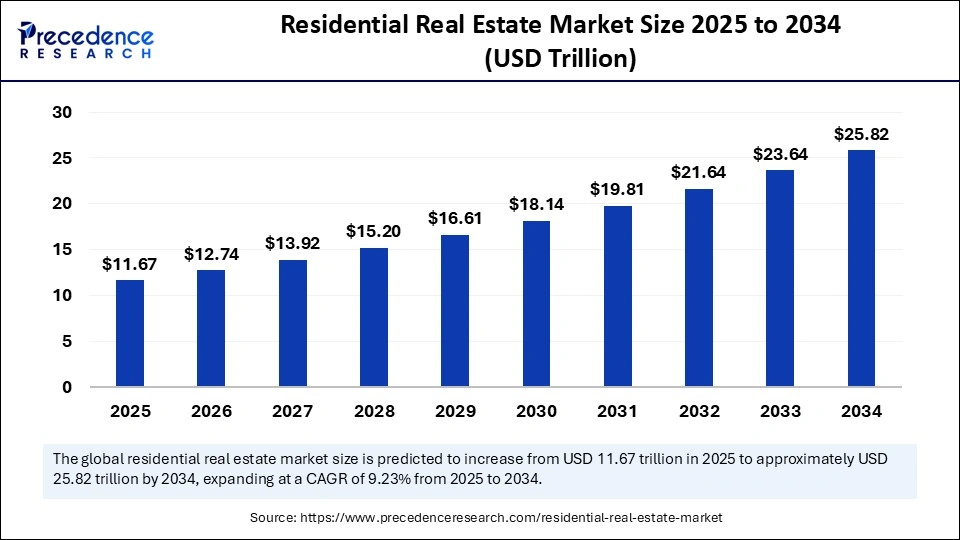
The global residential real estate market size is accounted at USD 11.67 trillion in 2025 and predicted to increase from USD 12.74 trillion in 2026 to approximately USD 27.88 trillion by 2035, expanding at a CAGR of 9.10% from 2026 to 2035. The market is expanding due to urban population growth, home ownership preference, sustainable housing investments, and the need for smart home technologies and integrated living spaces, aligning with modern lifestyle preferences and technological advancement.
Residential Real Estate Market Key Takeaways
- North America dominated the residential real estate market in 2025.
- Asia Pacific is anticipated to grow at the fastest CAGR during the forecast period.
- The European market is expected to witness significant growth in the foreseeable future.
- By type of property, the single-family homes segment held a dominant presence in 2025.
- By type of property, the condominium segment is expected to grow at the fastest CAGR in the upcoming years.
- By buyer demographic, the baby boomers dominated the market with the highest share in 2025.
- By buyer demographic, the millennials segment is expected to witness the fastest CAGR during the predicted timeframe.
Market Overview
Residential real estate relates to properties intended for personal dwelling, including single-family houses, apartments, condominiums, townhomes, and villas. It constitutes the foundation of the housing industry, catering to individuals, families, investors, and developers in search of residences. The residential real estate market refers to that part of the real estate sector that purchases, sells, leases, and develops properties intended for residential use. This market plays a crucial role in the economy, affecting financial stability, consumer trust, and the general economic well-being of a region or nation.
What are the Government initiatives in the Residential Real Estate Market
- The US government encourages the residential real estate industry by offering affordable housing programs via the Department of Housing and Urban Development (HUD) and providing low-cost mortgages via the Federal Housing Administration (FHA).
- The German government uses the KfW Energy-Efficient Housing Program to encourage sustainability and innovation in the residential real estate market.
- The Chinese government used affordable housing development strategies and smart city programs to boost affordable housing and sustainable urban residential developments.
- The Indian government established a new program, Pradhan Mantri Awas Yojana (PMAY), to enhance affordable housing provision using affordable housing strategies and subsidies.
- The UAE government has been providing long-term visas and promoting foreign ownership of properties and sustainable residential real estate projects through smart cities.
Trade Analysis on the Residential Real Estate Market
- There were 10 global shipments of residential real estate from March 2023 to February 2024, growing by 900% annually.
- Russian Federation and Mexico were the main receivers of residential real estate shipments.
- China was the highest exporter country, exporting 10 shipments followed by Russian Federation with 2 shipments.
- Volza's trade tools aid companies in locating buyers, monitoring industry trends, and increasing their profitability in global trade for residential real estate.
- There were 10 global shipments of residential real estate from March 2023 to February 2024, with annual growth.
- Russian Federation and Mexico were the main receivers in global residential real estate shipments.
- China was the leading exporter with 10 shipments and Russian Federation followed.
- Volza's trade tools assist companies in identifying buyers and market trends.
Artificial Intelligence Improving Marketability for Technology-Inclined Buyers
Artificial Intelligence (AI) is transforming the residential real estate market by simplifying processes, boosting customer interactions, and refining decision-making. Important uses include real estate assessment, forecasting analytics, client interaction, virtual walkthroughs, smart home connectivity, and property administration. Tools powered by AI examine past sales data, predict housing requirements, and offer assistance at all times. AI further improves marketing and content development, making properties more appealing to technology-inclined buyers.
- In April 2025, RealPage, a property management software firm from Texas, initiated legal action against Berkeley, California, contesting a law that bans AI-driven rent pricing tools, underscoring increasing regulatory oversight in real estate.
Residential Real Estate Market Growth Factors
- Rapid urbanization and increasing population: Rapid urbanization and increasing population drive the demand for housing, particularly in metropolitan and urban areas. As people migrate from rural to urban areas for better opportunities, it enhances the need for residential infrastructure.
- Changing demographics and household preferences: Shifts toward nuclear families, co-living spaces, and eco-friendly housing significantly influence market trends. Additionally, millennial buyers and renters are reshaping market demands with preferences for urban living and convenience.
- Low-interest rates and infrastructure development: Lower mortgage interest rates make home loans more accessible, encouraging homeownership. Coupled with the Development of transportation, healthcare, and educational infrastructure near residential areas, enhances property values and drives market growth.
- Technological advancements: Technology enables inventive construction practices and the development of sustainable and eco-friendly housing by using digital platforms, virtual tours, and data analytics are altering how properties are marketed and sold, framing transactions as more efficient and accessible.
- Government incentives and policies: Policies such as affordable housing schemes, tax benefits, subsidies on home loans, and reduced interest rates stimulate market growth by enhancing transparency and buyer confidence.
Market Scope
| Report Coverage | Details |
| Market Size by 2035 | USD 27.88 Trillion |
| Market Size in 2025 | USD 11.67 Trillion |
| Market Size in 2026 | USD 12.74 Trillion |
| Market Growth Rate from 2026 to 2035 | CAGR of 9.10% |
| Dominated Region | North America |
| Fastest Growing Market | Asia Pacific |
| Base Year | 2025 |
| Forecast Period | 2026 to 2035 |
| Segments Covered | Type of Property, Buyer Demographics, and Regions |
| Regions Covered | North America, Europe, Asia-Pacific, Latin America and Middle East & Africa |
Market Dynamics
Drivers
Rapid urbanization
Rapid urbanization is fueling the residential real estate market globally. As individuals move to cities seeking improved jobs and living conditions, the need for housing in urban and suburban regions increases. This trend is especially evident in developing countries, straining the current housing infrastructure and prompting developers to launch new projects. This demand is driven by wealthy individuals and prosperous local purchasers.
- In January 2025, DLF, the top real estate developer in India, revealed its USD 4 billion project, The Dahlias, located in Gurugram, close to New Delhi. The project consists of 420 units valued at USD 8 million, and offers features such as cascading lakes and private theaters.
Restraint
Affordability barrier
The residential real estate market is experiencing a restraint in affordability caused by increasing property costs, elevated mortgage rates, and stagnant growth in incomes. This has rendered homeownership inaccessible for a significant portion of the population, especially for first-time and moderate-income purchasers. Essential elements leading to this restraint consist of increasing real estate prices, soaring building expenses, high interest rates, and a restricted availability of affordable housing. Developers have decreased the availability of affordable housing units because of diminished profit margins and regulatory hurdles.
Opportunity
Increasing requirement of smart homes and sustainable living
The residential real estate market is witnessing growth in eco-friendly and intelligent housing projects. This expansion is fueled by an emphasis on sustainable design, energy-saving structures, and LEED-accredited initiatives. Smart homes and the integration of technology are boosting the attractiveness of contemporary residential properties, especially in the high-end market. The growth of integrated townships, driven by increasing disposable incomes and urbanization, is generating new growth areas. The efforts of the government, including the Smart Cities Mission, are encouraging the creation of intelligent and eco-friendly housing developments.
- In March 2025, Palava City, a 5,000-acre smart city located in Maharashtra, stood as the top smart city in India, emphasizing sustainability, contemporary infrastructure, and community-oriented living. It includes advanced water preservation, solar energy systems, and effective waste disposal.
Segment Insights
Type of Property Insights
The single-family homes segment held a dominant presence in 2025 because of strong demand for homeownership, the desire for personal space and privacy, and the plead of owning a property that can be customized and inherited, offering a long-term investment opportunity and a sense of legacy. Recent advancements and collaborations in the sector emphasize technological innovation, such as smart home technologies and AI-driven construction, and strategic partnerships between developers and technology companies to enhance the home-buying and living experience.
The condominium segment is expected to grow at the fastest rate in the upcoming years because of low maintenance, which offers ease of ownership, increasing urban populations, and the rise of smart living concepts, coupled with increasingly integrated technology such as smart home systems and integrated conveniences to appeal to modern homebuyers. Moreover, with the demand for remote work and flexible lifestyles, individuals are mostly focusing on having a comfortable and commodious living space, further propelling the need for single-family homes. The collaboration between government and private developers on affordable housing initiatives is being addressed by imposing government schemes like Pradhan Mantri Awas Yojana to address the growing housing demand.
Buyer Demographic Insights
The baby boomers dominated the residential real estate market with the highest share in 2025 due to their significant wealth accumulation, large population, representing a significant portion of the population, and evolving needs and preferences. They are also a prime demographic for investment properties, downsizing, and retirement living, influencing demand for certain types of home features and locations, coupled with seeking a balance of value, purchasing decisions, and reliability.
The millennials segment is expected to witness the fastest rate of growth during the predicted timeframe because of their demand for financial security and asset building, the rise of remote work and flexible lifestyles, low interest rates, and the increasing availability of tech-driven real estate platforms. Their preferences and priorities, like focus on affordable housing, technology-based transactions, and sustainable living driving the market. This is apparent in the rise of co-living spaces, shared accommodations, and rental options, as well as developers incorporating smart technologies and sustainable practices that are becoming increasingly popular in new construction and renovations.
Regional Insights
Development of New Residential Projects Supporting North American Dominance
North America dominated the residential real estate market in 2025 owing to its powerfully economic strength, high population density in urban areas, and robust construction industry. Therefore, by providing a strong and stable foundation for real estate investment, employment opportunities, and well-developed infrastructure, including transportation networks, utilities, and communication systems, along with strong construction industry support, the rapid development of new residential projects, and government support and funding, drove the market in North America.
- In May 2023, the Future Housing Initiative of New York City launched a USD 15 million partnership with the State to construct 3,000 energy-efficient, all-electric affordable homes. The initiative aims to accelerate the creation of these homes, promoting both affordability and sustainability.
The U.S. dominates the North American market due to its large and diverse economy, favorable financing options, and a strong culture of homeownership. The U.S. market also has a well-established mortgage market with various loan options and competitive interest rates, making properties more accessible and thus benefiting from a diverse landscape offering various housing options, from suburban homes to urban apartments and major cities known for high-end properties.
Government Initiatives Drive the Asia Pacific Market
Asia Pacific is anticipated to grow at the fastest rate during the forecast period due to a combination of rapid urbanization, sustained economic growth, leading to increased disposable incomes for middle-class families. Large and rapidly growing population countries like China and India are experiencing a surge in housing demand. This is further driven by government initiatives, such as public-private partnerships and investments in infrastructure and collaborations between industry and academia, along with the utilization of technology, such as online property portals and digital platforms attract investors and stimulate growth in the market.
- In December 2024, Godrej Properties obtained rupees 6000 crore through QIP to facilitate growth and expansion strategies in the residential real estate market of India.
India plays a crucial role in the residential real estate market. This is due to rapid urbanization in India, infrastructure advancement, government support, and affordable housing programs that have boosted connectivity and the need for residential properties. Initiatives such as the Prime Minister Awas Yojana and tax incentives have made it easier to own a home. The support of the Reserve Bank's monetary policy has boosted economic growth, making home loans more accessible. Innovations in technology have simplified the home-buying experience and drawn in tech-oriented audiences.
China is enacting policy initiatives to boost the housing market, such as reducing the minimum down payment and abolishing mortgage interest rate caps. Efforts consist of affordable rental homes and city development. Increasing population, government initiatives, and urban development are propelling a possible stabilization of the market.
What are the Advancements in the Residential Real Estate Industry in Europe?
The European residential real estate market is expected to witness significant growth in the foreseeable future. It is characterized by its economic stability, strong infrastructure, and elevated housing demand. Large cities such as London, Paris, Berlin, and Amsterdam draw global investments and talented workers, boosting the need for housing in urban regions. Europe is at the forefront of implementing sustainable housing solutions, as numerous nations concentrate on carbon-neutral structures and energy-efficient designs. Government programs and housing assistance, including affordable housing projects and advantageous mortgage regulations, enhance the accessibility of homeownership.
Germany Residential Real Estate Market Trends
Regulatory frameworks in the country are evolving to support sustainable housing initiatives, which are becoming increasingly important. The regional market is also benefiting from low interest rates, making home financing more accessible to a broader population.
What are the Key Trends in the Residential Real Estate Industry in Latin America?
Latin America is expected to witness substantial growth in the market. This growth is driven by various factors such as rapid urbanization, rising incomes, and a burgeoning middle class. Countries like Brazil and Mexico are leading players in the region, due to an increasing demand for housing and infrastructure development. Regulatory initiatives aimed at improving housing affordability and sustainability are also playing a vital role in market expansion and adoption.
Brazil Residential Real Estate Market Trends
The region is witnessing a shift towards digital platforms, which helps in enhancing the buying and selling experience. As urban centers continue to grow, the demand for residential properties is expected to rise even more.
MEA's Growing Residential Real Estate Industry
The Middle East and Africa region is expected to witness steady growth over the forecast years, driven by urbanization, population growth, and increasing foreign investment. Countries like the UAE and South Africa are leading players in the region, with government initiatives aimed at boosting housing supply and affordability. Regulatory frameworks also seem to be evolving to attract international investors, further propelling market growth.
Saudi Arabia Residential Real Estate Market Trends
Key players in the region are increasingly focusing on innovative housing solutions and sustainable development practices. As the region continues to develop, the demand for residential properties is expected to grow even more, opening up significant opportunities for investors and developers.
Value Chain Analysis on the Residential Real Estate Market
- Marketing & Promotions - Developers leverage digital marketing techniques, property websites, and virtual property tours to target potential buyers.
- Key Players: Zillow, RE/MAX, Keller Williams.
- Customer Service & Customer Feedback Cycle - Property management organizations offer post-purchase support, management services, and customer engagement.
- Key Players: CBRE, Compass, Redfin.
- End of Life Stage of Property - Organizations emphasize property renewal, reuse of building materials, and proper disposal.
- Key Players: Lennar Corporation, D.R. Horton, Brookfield Properties.
Residential Real Estate Market Companies
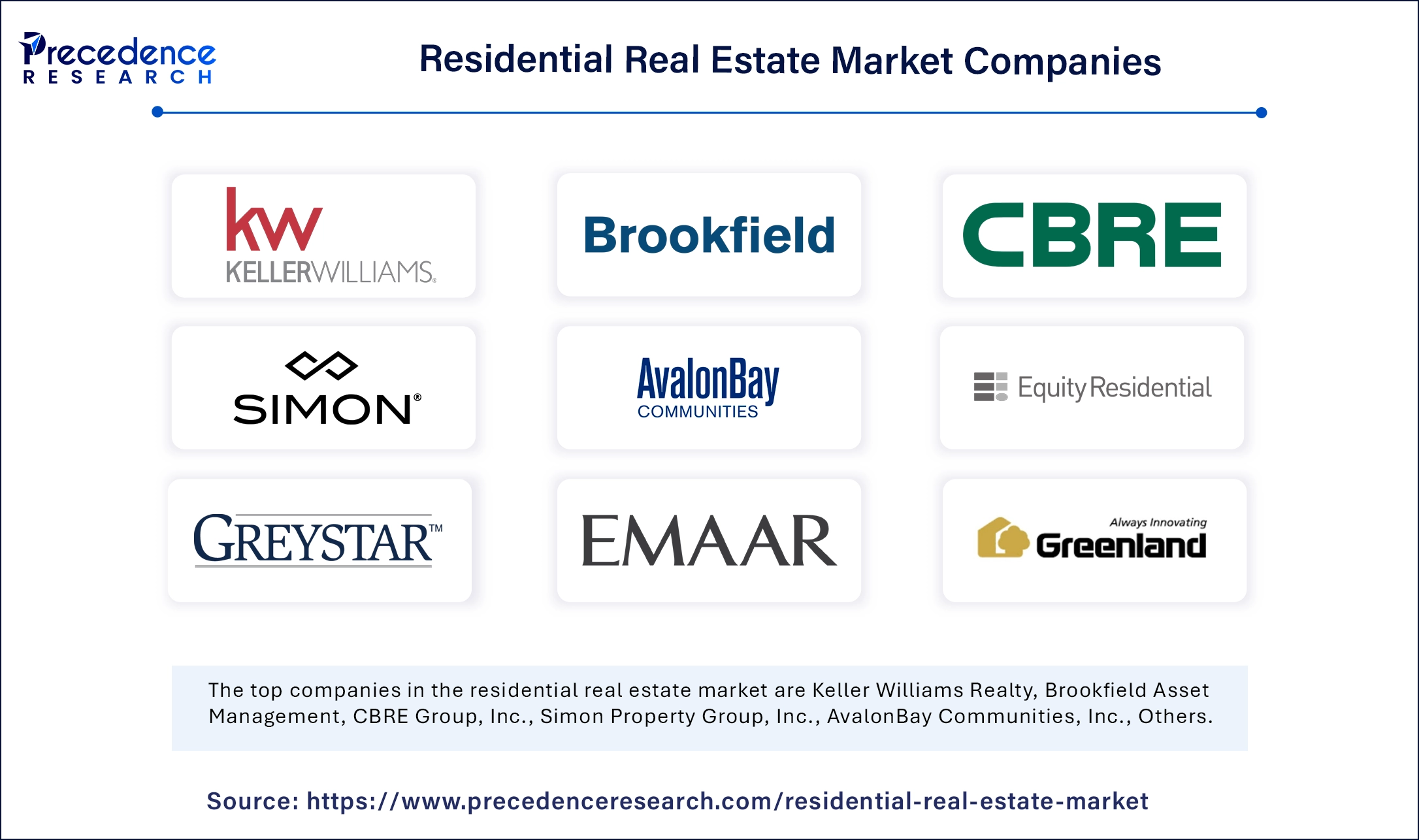
- Keller Williams Realty – Provides residential property brokerage services, including buying, selling, and renting homes, supported by technology-driven tools and agent networks.
- Brookfield Asset Management – Invests in and manages residential real estate assets, including rental communities and mixed-use developments, with a focus on long-term value creation.
- CBRE Group, Inc. – Offers residential property sales, leasing, investment management, and advisory services through a global platform of agents and consultants.
- Simon Property Group, Inc. – Primarily focused on commercial real estate, but also invests in mixed-use residential developments within retail and lifestyle centers.
- AvalonBay Communities, Inc. – Develops, redevelops, and manages apartment communities across the United States, focusing on high-quality, upscale residential living.
- Equity Residential – Owns, develops, and manages apartment buildings and rental communities, emphasizing urban and high-demand metropolitan markets.
- Greystar Real Estate Partners – Provides development, investment, and management of rental apartment communities and student housing globally.
- Emaar Properties – Develops large-scale residential communities, luxury apartments, and mixed-use projects, including integrated urban lifestyles in Dubai and international markets.
- Greenland Holdings – Engages in the development of residential apartments, condominiums, and large-scale urban residential projects across China and overseas.
- Frasers Property – Develops, manages, and invests in residential properties, including apartments, condominiums, and integrated mixed-use communities in multiple countries.
- Harcourts International – Provides residential property sales, rentals, and consultancy services, with a focus on local and regional housing markets.
- Engel & Völkers – Specializes in brokerage of high-end residential properties, offering personalized services for buying, selling, and renting luxury homes worldwide.
- Prologis, Inc. – Primarily focuses on industrial and logistics properties, but selectively invests in mixed-use developments that include residential components near key distribution hubs.
- American Tower Corporation – Specializes in telecommunications infrastructure, with minimal direct involvement in residential real estate.
- Welltower Inc. – Develops and invests in senior housing and healthcare-related residential communities, including assisted living and independent living facilities.
- Digital Realty Trust, Inc. – Focuses on data centers and technology infrastructure, with no primary residential real estate offerings.
- Public Storage – Operates self-storage facilities and does not directly invest in traditional residential real estate.
- Realty Income Corporation – Primarily invests in retail and commercial properties, with limited exposure to residential real estate through select mixed-use developments.
- Goodman Group – Focuses mainly on industrial and logistics properties, but has expanded into residential-led mixed-use developments in urban areas.
- Vonovia SE – Owns, manages, and develops a large portfolio of rental apartments and residential communities across Germany and other European countries.
Leaders' Announcements
- In March 2025, Onewo, the residential property management division of Vanke, intends to purchase the final 55% share in Shanghai Xiangda for 870.3 million yuan (USD 119.99 million), in line with Vanke's strategy to concentrate on lucrative projects in a tough market.
Recent Developments
- In May 2026, Ganesh Housing Limited launched the ₹15,000 crore Million Minds Tech City project in Ahmedabad to support the growing demand for Global Capability Centers (GCCs) and technology businesses. (Source: https://www.moneycontrol.com)
- In July 2024, according to JLL, the total number of residential units introduced in the first half of 2024 hit a record peak of 159,455. This equates to around 55% of all units introduced over the course of the year 2023. The availability of new housing developments has demonstrated steady growth this year.
In December 2019, International professional services companies JLL and Miebach Consulting introduced their global Partnership into the Indian market. Based in the United States, JLL ranks among the largest real estate brokers and consultancies globally. The firm earns USD 21 billion in revenue and has a workforce exceeding 103,000 employees.
Segments Covered in the Report
By Type of Property
- Single-family homes
- Condominiums
- Apartments
- Townhouses
- Luxury villas
By Buyer Demographics
- Baby Boomer Generation
- Millennial Generation
By Geography
- North America
- Europe
- Asia Pacific
- Latin America
- Middle East and Africa
For inquiries regarding discounts, bulk purchases, or customization requests, please contact us at sales@precedenceresearch.com
Frequently Asked Questions





Ask For Sample
No cookie-cutter, only authentic analysis – take the 1st step to become a Precedence Research client
 Get a Sample




 sales@precedenceresearch.com
 Schedule a Meeting
