



RF Power Semiconductor Market Trends, Companies, Revenue / Sales Performance, Manufacturing Yield, Fab Capacity, Export & Import Dynamics, Supply Chain Analysis, Competitive Landscape, and Growth Forecast
RF Power Semiconductor Market (By Technology: LDMOS (Laterally Diffused Metal Oxide Semiconductor), GaN (Gallium Nitride, SiC (Silicon Carbide), GaAs (Gallium Arsenide); By Device Type: RF Transistors, RF Diodes, RF MOSFETs, RF IGBTs; By Frequency Range: Below 1 GHz, 1–3 GHz, 3–6 GHz, Above 6 GHz; By Application: Telecommunications & 5G Infrastructure, Defense & Aerospace, Industrial RF, Broadcasting, Consumer Electronics; By End-User: Network Equipment Manufacturers, Defense & Aerospace Contractors, Industrial Equipment Manufacturers, Consumer Electronics Manufacturers, Others) - Global Industry Analysis, Size, Trends, Leading Companies, Regional Outlook, and Forecast 2026 to 2035
Source: https://www.precedenceresearch.com/rf-power-semiconductor-market
 Get a Sample
 Table Of Content


What is the RF Power Semiconductor Market Size in 2026?
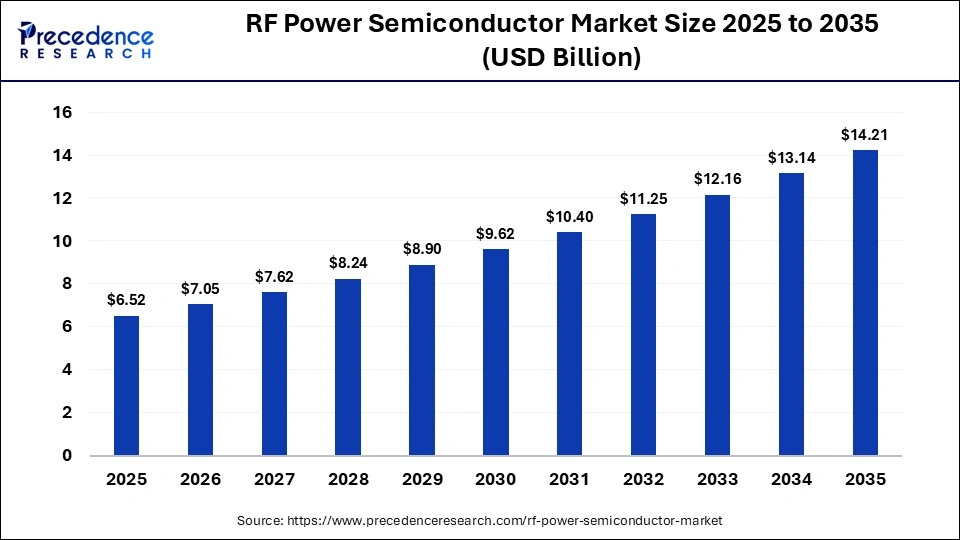
The global RF power semiconductor market size was calculated at USD 6.52 billion in 2025 and is predicted to increase from USD 7.05 billion in 2026 to approximately USD 14.21 billion by 2035, expanding at a CAGR of 8.10% from 2026 to 2035. The RF power semiconductor market is driven by the growing deployment of 5G and increasing demand for wireless communication devices.
Key Takeaways
- North America held a 35% share of the RF power semiconductor market in 2025.
- The Asia Pacific is expected to grow at the fastest CAGR of 8.5% in the market during the forecast period.
- By technology, the LDMOS segment held a dominant position in the market, holding a 48% share of the market in 2025.
- By technology, the GaN segment is expected to grow at a robust CAGR of 6.5% over 2026-2035.
- By device type, the RF transistors segment held a 55% share of the market in 2025.
- By device type, the RF MOSFET segment is expected to grow at a CAGR of 6.3% in the market over the studied period.
- By frequency range, the 1–3 GHz segment led the global market, accounting for 28% share in 2025.
- By frequency range, the 3–6 GHz segment is expected to grow rapidly, with a CAGR of 6.8% in the coming years.
- By application, the telecommunications & 5G infrastructure segment held a 40% share of the global market in 2025.
- By application, the defense & aerospace segment is expected to experience notable growth over the forecast period.
- By end-user, the network equipment manufacturers segment dominated the global market, holding a 38% share in 2025.
- By end-user, the industrial equipment manufacturers segment is expected to grow at the fastest CAGR of 7.3% between 2026 and 2035.
Market Overview
RF (Radio Frequency) power semiconductors are electronic devices that amplify, switch, and control high-frequency signals, such as those used in wireless communications, radar, broadcasting, and other industrial applications. They include devices such as GaN, LDMOS, and SiC transistors, which provide high efficiency, high power density, and reliability for RF applications. These semiconductors are critical in 5G infrastructure, satellite communication, defense systems, and industrial RF heating, enabling faster, more efficient signal transmission while reducing power loss and improving overall system performance. The 5G base stations, satellite communication systems, aerospace, defense equipment, and industrial RF heating and plasma generation are the most common applications of these semiconductors. Increasing investments in defense electronics, satellite communications, and advanced radar systems are driving adoption, as industries seek more efficient and reliable power solutions at high frequencies.
How is AI Influencing the RF Power Semiconductor Market?
RF power semiconductor technologies are increasingly leveraging AI to enhance performance, effectiveness, and reliability. AI-powered computer-aided design tools are currently being developed to optimize semiconductor architecture, allowing the development of high-frequency devices, such as GaN, LDMOS, and SiC transistors, much faster. Engineers are using AI for power, thermal, and signal integrity improvements through advanced simulation and predictive modeling. Combining RF with AI also enables smart power management, active signal optimization, and real-time monitoring of communication networks, enhancing the overall functionality of RF systems.
RF Power Semiconductor Market Trends
- There is a rising demand for high-performance RF power semiconductors due to the rapid rollout of 5G networks, which require efficient signal amplification and high-frequency performance for next-generation wireless systems and advanced base stations.
- The adoption of Gallium nitride (GaN) semiconductors is increasing because of their high power density, efficiency, and thermal stability. In telecommunications, aerospace, and defense applications, these GaN semiconductors are widely used to meet the demand for reliable, high-frequency, and high-power operation.
- With the rising defense budgets and global military communication, the adoption of RF power semiconductors is rising in radar systems, electronic warfare, and satellite communications.
- The growth of satellite networks and satellite internet is boosting demand for these devices, enabling long-range signal transmission and effective on-board and ground-station communications.
- Growing preference for highly integrated RF front‑end modules, including power amplifiers and transceivers, to reduce size, cost, and complexity for mobile and IoT devices.
Market Scope
| Report Coverage | Details |
| Market Size in 2025 | USD 6.52 Billion |
| Market Size in 2026 | USD 7.05 Billion |
| Market Size by 2035 | USD 14.21 Billion |
| Market Growth Rate from 2026 to 2035 | CAGR of 8.10% |
| Dominating Region | North America |
| Fastest Growing Region | Asia Pacific |
| Base Year | 2025 |
| Forecast Period | 2026 to 2035 |
| Segments Covered | Technology, Device Type, Frequency Range, Application, End-User, and Region |
| Regions Covered | North America, Europe, Asia-Pacific, Latin America, and Middle East & Africa |
Segment Insights
Technology Insights
Why Did the LDMOS Segment Dominate the RF Power Semiconductor Market?
The LDMOS (Laterally Diffused Metal Oxide Semiconductor) segment held a dominant position in the market while holding a 48% share in 2025. This is mainly due to its ability to offer reliability, affordability, and high-power RF performance. LDMOS technology has been used extensively in the wireless communication infrastructure, especially in cellular base stations and broadcast transmitters, where high linearity and stable power amplification are major concerns. It is mostly used in the production of telecom equipment because it amplifies frequency ranges used in cellular networks. The growing development of 4G and 5G networks highlighted the necessity of LDMOS in base-station amplifiers.
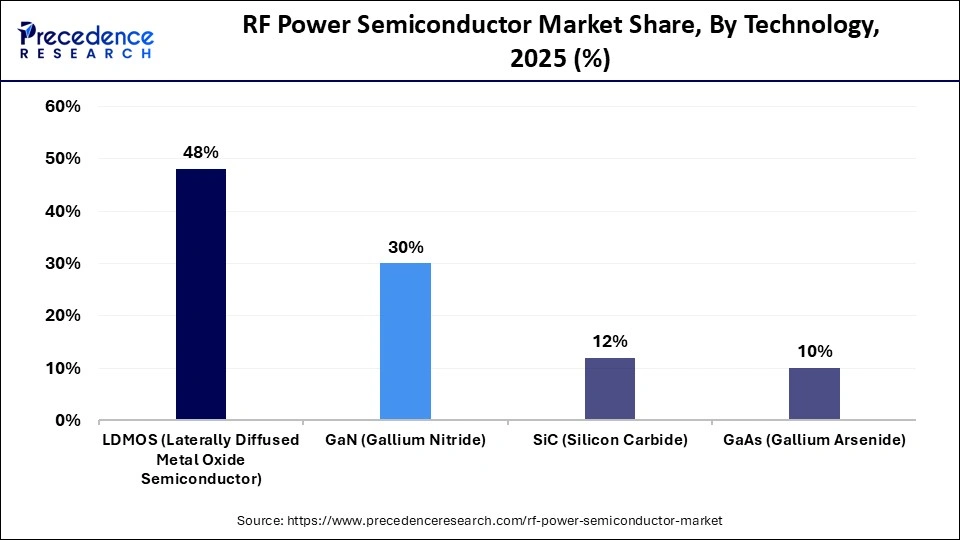
The GaN (Gallium Nitride) segment is expected to grow at a robust CAGR of 6.5% in the upcoming period, owing to its high efficiency, power density, and the fact that it has the ability to perform at higher frequencies than traditional semiconductor technologies. GaN technology has the capability to run at high voltages, making it suitable for compact, energy-efficient RF systems. The GaN is especially suitable for 5G infrastructure, satellite communications, radar systems, and aerospace and defense systems. The use of GaN is becoming very common as telecom networks are being run at higher frequencies, which demand higher power efficiency.
Device Type Insights
Why Did the RF Transistors Segment Lead the RF Power Semiconductor Market?
The RF transistors segment led the RF power semiconductor market, accounting for a 55% share in 2025. This is mainly due to their crucial role in amplification of high frequencies within wireless communication systems. Cellular base stations, broadcast transmitters, radar systems, and satellite communication devices are major applications where RF transistors have been employed. They are able to sustain high voltages, perform well thermally, and are very reliable, which makes them applicable in highly demanding telecom applications or for use in defense applications. The rapid growth of 4G and 5G networks has triggered the demand for RF transistors in the base-station power amplifier.
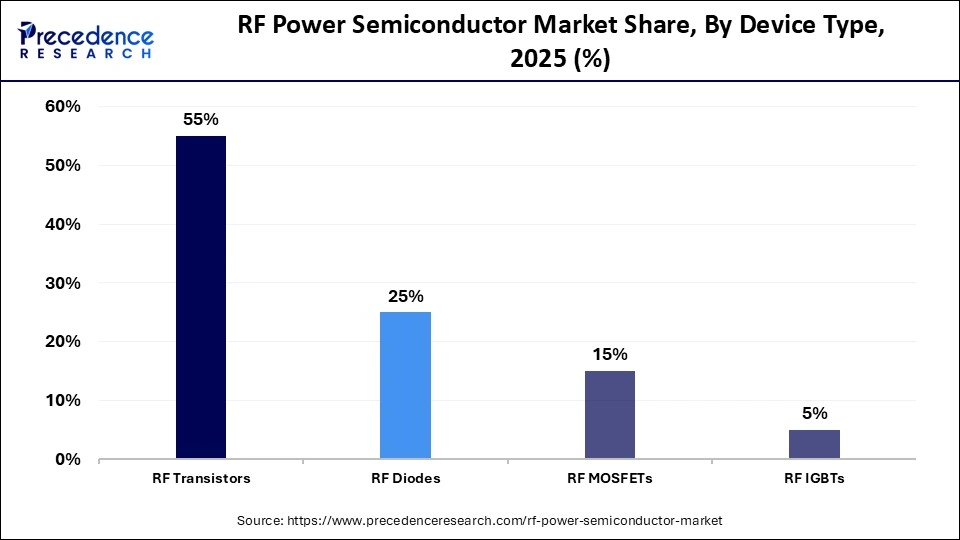
The RF MOSFET segment is expected to expand at a CAGR of 6.3% between 2026 and 2035 because of the increasing demand for efficient and compact semiconductor devices in high-frequency applications. Known for their fast switching, thermal efficiency, and reliability, RF MOSFETs are increasingly used in next-generation wireless communications, including 5G and satellite networks. Their ability to support higher-frequency, energy-efficient telecommunications makes them a critical component in evolving communication technologies.
Frequency Range Insights
What Made 1-3 GHz the Dominant Segment in the RF Power Semiconductor Market?
The 1-3 GHz segment dominated the market with a 28% share in 2025, owing to the widespread use of this frequency range in mobile communication, broadcast, and wireless networking systems. This frequency range is suitable for major cellular bands such as 2G, 3G, and early 4G LTE, which are integral to telecommunications infrastructure. RF power semiconductors in this band are reliable, cost-effective, and efficient for signal amplification in base stations, repeaters, and broadcast transmitters. Additionally, the rising deployment of network devices and communication equipment in this frequency band is driving demand for components such as RF transistors, LDMOS, and GaN-based semiconductors.
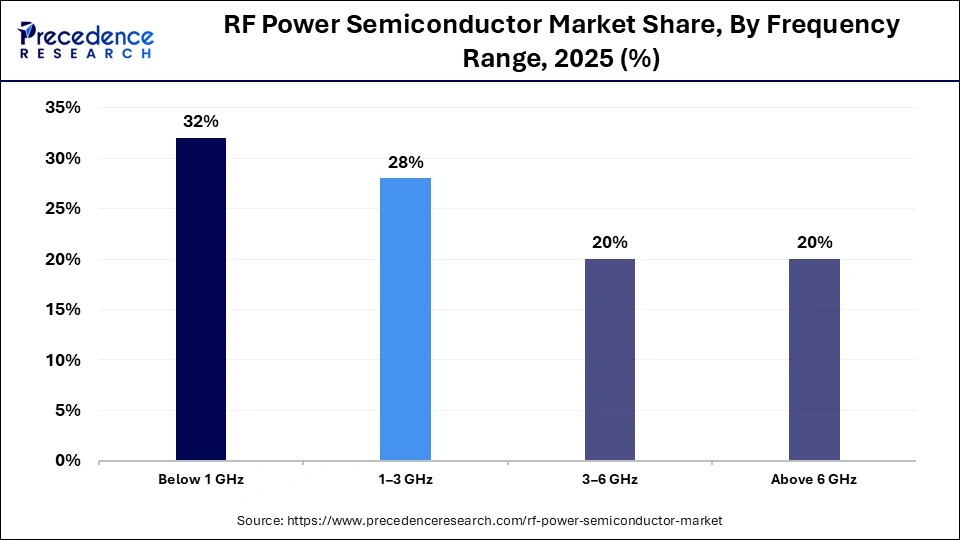
The 3-6 GHz segment is expected to grow at a healthy CAGR of 6.8% over the forecast period due to the rapid expansion of 5G networks around the world, where the mid-band frequency is used to provide high-speed data and low latency. This range plays a critical role in enabling 5G networks and high-speed wireless communications, which demand higher frequency bands for greater data throughput. Additionally, this frequency range supports emerging applications such as radar systems, satellite communications, and advanced IoT devices, driving increased semiconductor adoption. The combination of rising demand for high-performance connectivity and technological advancements in RF devices is accelerating growth in this segment.
Application Insights
Why Did the Telecommunications & 5G Infrastructure Segment Lead the Market?
The telecommunications & 5G infrastructure segment led the RF power semiconductor market, holding a 40% share in 2025, and is expected to grow at the fastest rate in the coming years. This is because RF power semiconductors are critical in amplifying and regulating signals in base stations, repeaters, and mini-cells. The rapid deployment of 4G LTE and 5G networks has boosted demand for high-performance LDMOS, GaN, and SiC semiconductors, which offer higher efficiency, thermal stability, and operation at elevated frequencies. As mobile data traffic continues to surge, RF power semiconductors remain essential for enhancing network coverage, data rates, and reliability, supporting the global expansion of next-generation communication technologies.
RF Power Semiconductor Market Share, By Application, 2025 (%)
| Application | Market Share (%) |
| Telecommunications & 5G Infrastructure | 40% |
| Defense & Aerospace | 25% |
| Industrial RF | 20% |
| Broadcasting | 10% |
| Consumer Electronics | 5% |
The defense & aerospace segment is expected to expand at a significant rate in the upcoming period, owing to the rising military expenditure and modernization of defense infrastructure. RF power semiconductors are critical in radar, electronic warfare, satellite communications, and avionics, where high-frequency signal amplification and exceptional reliability are essential. Advanced GaN and SiC devices, offering high power density, thermal stability, and efficiency, are increasingly adopted to meet the demands of satellites, UAVs, and next-generation radar systems requiring compact, energy-efficient, high-performance RF components.
End-User Insights
Why Did the Network Equipment Manufacturers Segment Lead the RF Power Semiconductor Market?
The network equipment manufacturers segment held a 38% share of the market in 2025 because these manufacturers integrate high-performance RF devices into base stations, repeaters, and small cells to ensure reliable mobile connectivity. The rapid rollout of 4G LTE and 5G networks has increased demand for LDMOS, GaN, and SiC semiconductors, which offer higher efficiency, thermal stability, and high-frequency operation essential for modern network infrastructure. Additionally, as mobile data traffic and network complexity grow, RF power semiconductors become critical for improving coverage, data rates, and overall network performance, giving equipment manufacturers a dominant role in the market.
RF Power Semiconductor Market Share, By End-User, 2025 (%)
| End-User | Market Share (%) |
| Network Equipment Manufacturers | 38% |
| Defense & Aerospace Contractors | 25% |
| Industrial Equipment Manufacturers | 20% |
| Consumer Electronics Manufacturers | 12% |
| Others | 5% |
The industrial equipment manufacturers segment is expected to grow at the fastest CAGR of 7.3% over the forecast period. This is mainly due to the rising adoption of RF power semiconductors in industrial applications, such as industrial heating, plasma generation, semiconductor manufacturing, and cutting tools, where high-frequency power amplification and efficiency are important. These applications require semiconductors like GaN and SiC that offer high efficiency, thermal stability, and the ability to operate at high frequencies under demanding conditions. As industries increasingly rely on automation, IoT, and precision RF-based processes, the demand for reliable, high-performance RF power devices from industrial equipment manufacturers continues to expand.
Regional Insights
North America RF Power Semiconductor Market Size and Growth 2026 to 2035
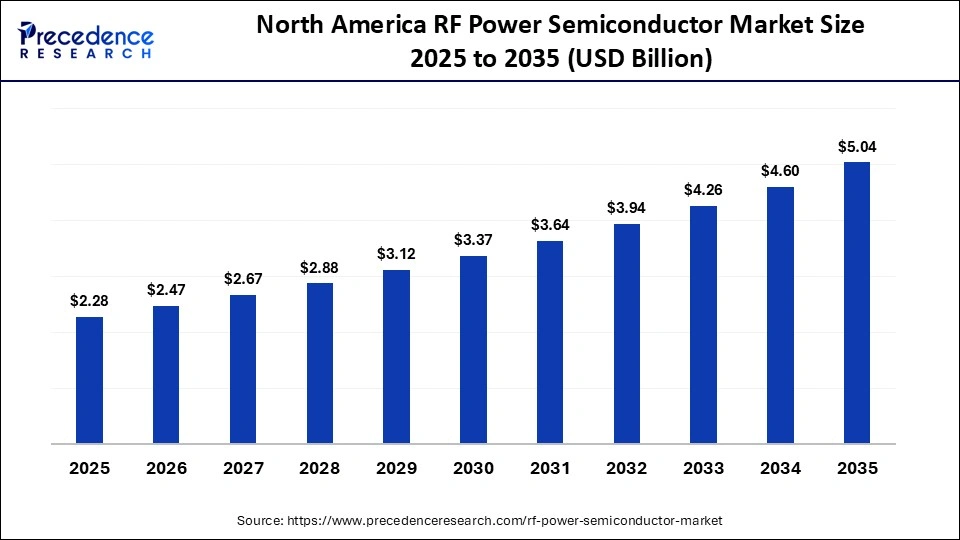
The North America RF power semiconductor market size is estimated at USD 2.28 billion in 2025 and is projected to reach approximately USD 5.04 billion by 2035, with a 8.26% CAGR from 2026 to 2035.
Why Did North America Lead the Global RF Power Semiconductor Market?
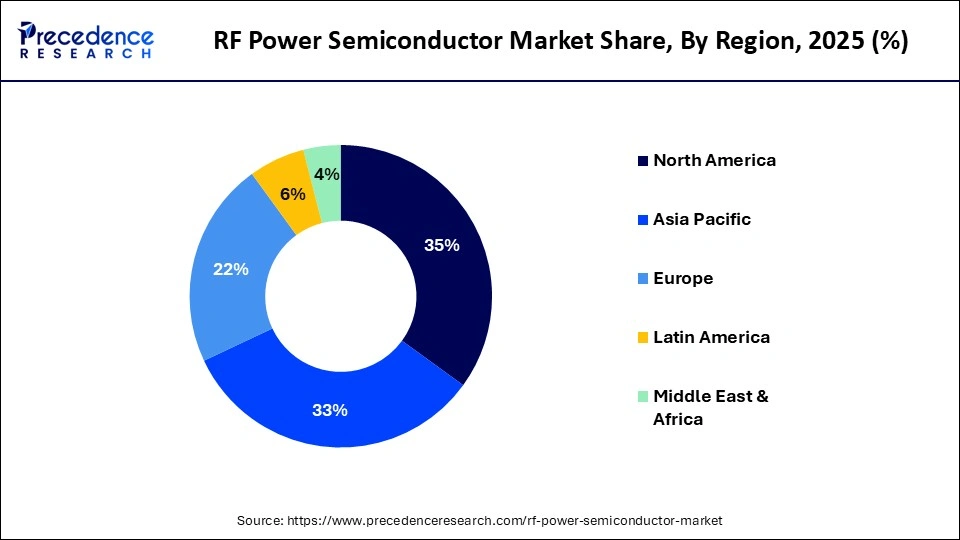
North America led the RF power semiconductor market with a 35% share in 2025. This is because of its strong R&D infrastructure, advanced technology ecosystem, and presence of major semiconductor manufacturers. The region produces a significant portion of high-performance LDMOS, GaN, and SiC RF power devices, which are widely used across telecommunications, defense, aerospace, and industrial applications. Rapid 5G deployment, along with government initiatives and defense modernization programs, has further increased demand for RF semiconductors in high-frequency applications such as radar, electronic warfare, and satellite communications.
U.S. RF Power Semiconductor Market Size and Growth 2026 to 2035
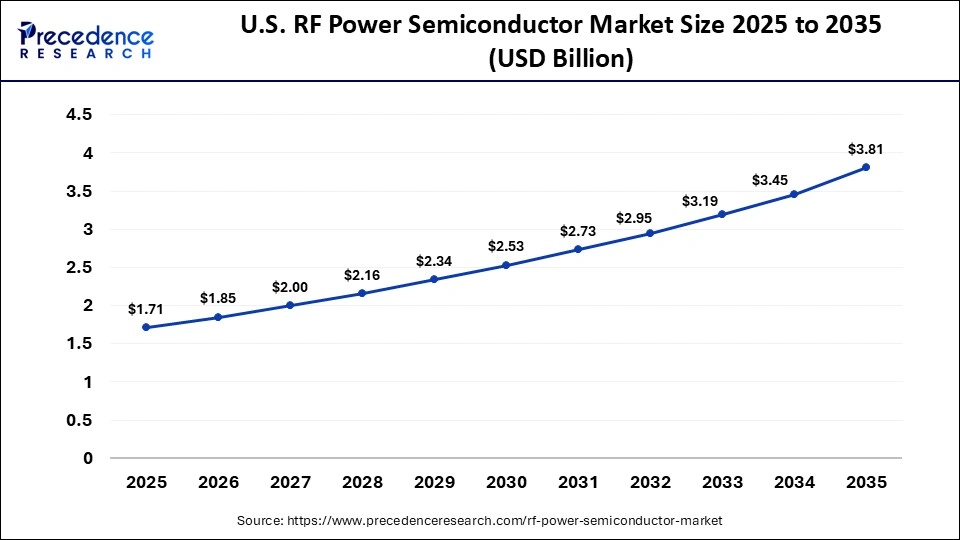
The U.S. RF power semiconductor market size is calculated at USD 1.71 billion in 2025 and is expected to reach nearly USD 3.81 billion in 2035, accelerating at a strong CAGR of 8.34% between 2026 and 2035.
Why is Asia Pacific Experiencing the Fastest Growth in the RF Power Semiconductor Market?
Asia Pacific is expected to grow at the fastest CAGR in the market during the forecast period due to the high rate of urbanization, industrialization, and implementation of next-generation wireless communication networks. Significant investments in 5G, satellite communications, and smart industrial applications in China, Japan, South Korea, and India are creating strong demand for high-frequency RF semiconductors. Additionally, rising defense and aerospace expenditures are boosting the need for RF power devices used in radar, satellites, and electronic warfare systems. As industries adopt automation and IoT-based smart factories, the demand for high-performance RF components is expected to increase further.
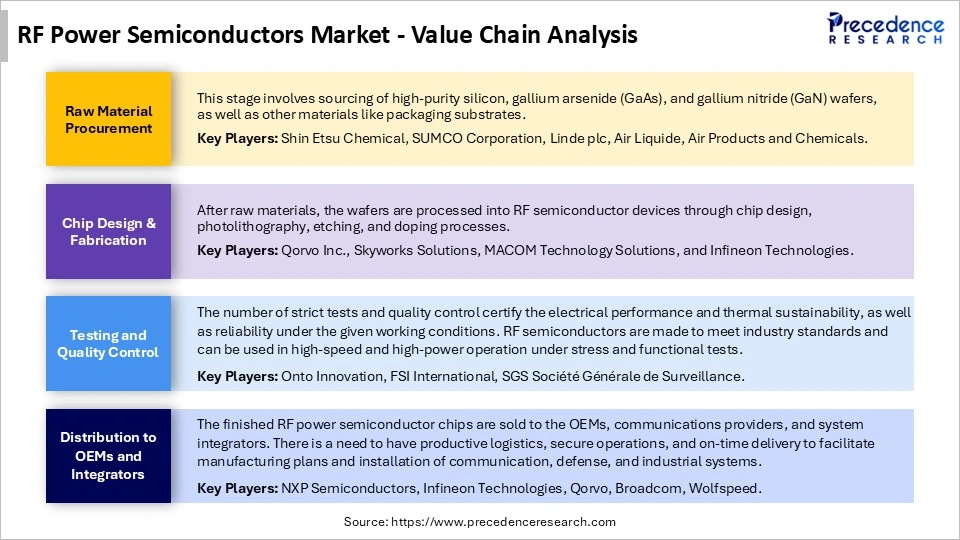
RF Power Semiconductors Market Supply Chain Analysis
RF Power Semiconductor Market Companies
- Qorvo, Inc.
- Skyworks Solutions, Inc.
- Broadcom Inc.
- NXP Semiconductors
- Infineon Technologies AG
- MACOM Technology Solutions
- STMicroelectronics
- Cree, Inc. (Wolfspeed)
- ON Semiconductor
- Toshiba Corporation
- Mitsubishi Electric Corporation
- Panasonic Corporation
- Analog Devices, Inc.
- Rohde & Schwarz (RF Modules)
- Wolfspeed, a Cree Company
Recent Developments
- In April 2025, Infineon unveiled CoolGaN G5 transistors with an integrated diode, the Schottky diode, to be used in server and telecom power systems to achieve high efficiency and reliability. With this introduction, Infineon will be well-positioned in high-performance GaN RF.(Source: https://www.infineon.com)
- In February 2025, Infineon shipped the first shipments of 200 mm SiC to Austria and Malaysia, which are used in high-voltage systems and automobile power systems. (Source: https://www.infineon.com)
- In June 2024, Qorvo presented three new advanced RF multi-chip modules that are applied in the most recent radar systems that are power-efficient, compact, and high-performing. These are used in defense and aerospace applications, in which phased array and multifunction radar systems are improved.(Source: https://www.qorvo.com)
Segments Covered in the Report
By Technology
- LDMOS (Laterally Diffused Metal Oxide Semiconductor)
- GaN (Gallium Nitride
- SiC (Silicon Carbide)
- GaAs (Gallium Arsenide)
By Device Type
- RF Transistors
- RF Diodes
- RF MOSFETs
- RF IGBTs
By Frequency Range
- Below 1 GHz
- 1-3 GHz
- 3-6 GHz
- Above 6 GHz
By Application
- Telecommunications & 5G Infrastructure
- Defense & Aerospace
- Industrial RF
- Broadcasting
- Consumer Electronics
By End-User
- Network Equipment Manufacturers
- Defense & Aerospace Contractors
- Industrial Equipment Manufacturers
- Consumer Electronics Manufacturers
- Others
By Region
- North America
- Latin America
- Europe
- Asia-pacific
- Middle and East Africa
For inquiries regarding discounts, bulk purchases, or customization requests, please contact us at sales@precedenceresearch.com
Frequently Asked Questions





Ask For Sample
No cookie-cutter, only authentic analysis – take the 1st step to become a Precedence Research client
 Get a Sample




 sales@precedenceresearch.com
 Schedule a Meeting
