



Semiconductor Memory Market Size, Key Companies, Company Market Share, Chip Production Volume, Wafer Capacity, Technology Adoption, Pricing Trends, Competitive Positioning, and Demand Analysis
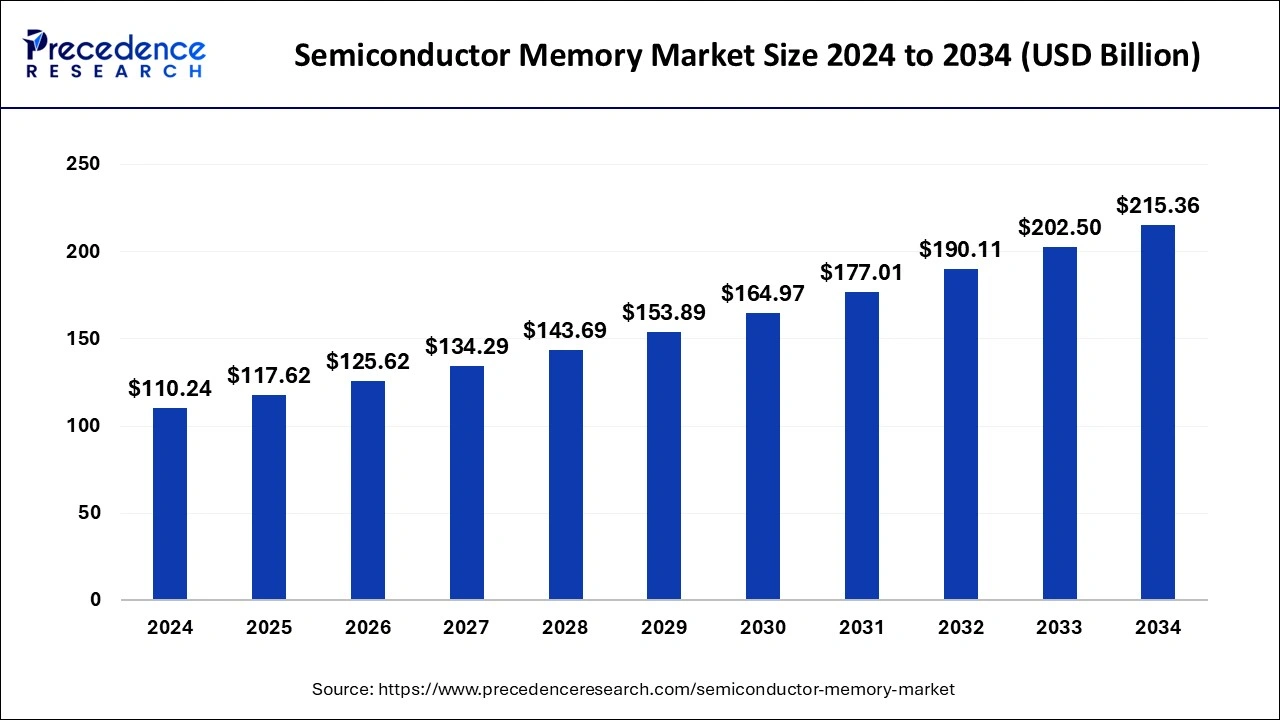
The global semiconductor memory market is projected to grow from USD 125.62 billion in 2026 to USD 227.91 billion by 2035, expanding at a CAGR of 6.84% from 2026 to 2035. Market growth is driven by rising adoption of artificial intelligence (AI), cloud computing, data centers, high-performance computing (HPC), 5G networks, and connected devices. Increasing demand for high-speed, high-capacity, and energy-efficient memory solutions across consumer electronics, automotive, industrial automation, and enterprise applications is accelerating innovation in DRAM, NAND flash, and next-generation memory technologies.
Source: https://www.precedenceresearch.com/semiconductor-memory-market
 Get a Sample
 Table Of Content


What is the Semiconductor Memory Market Size?
The global semiconductor memory market size is calculated at USD 117.62 billion in 2025 and is predicted to increase from USD 125.62 billion in 2026 to approximately USD 227.91 billion by 2035, expanding at a CAGR of 6.84% from 2026 to 2035. The semiconductor memory market is driven by rising AI adoption, expanding data centers, growing consumer electronics demand, automotive electronics, and high-performance computing applications.
Semiconductor Memory Market Key Takeaways
- In terms of revenue, the market is valued at $ 117.62 billion in 2025.
- It is projected to reach $ 227.91 billion by 2035.
- The market is expected to grow at a CAGR of 6.92% from 2026 to 2035.
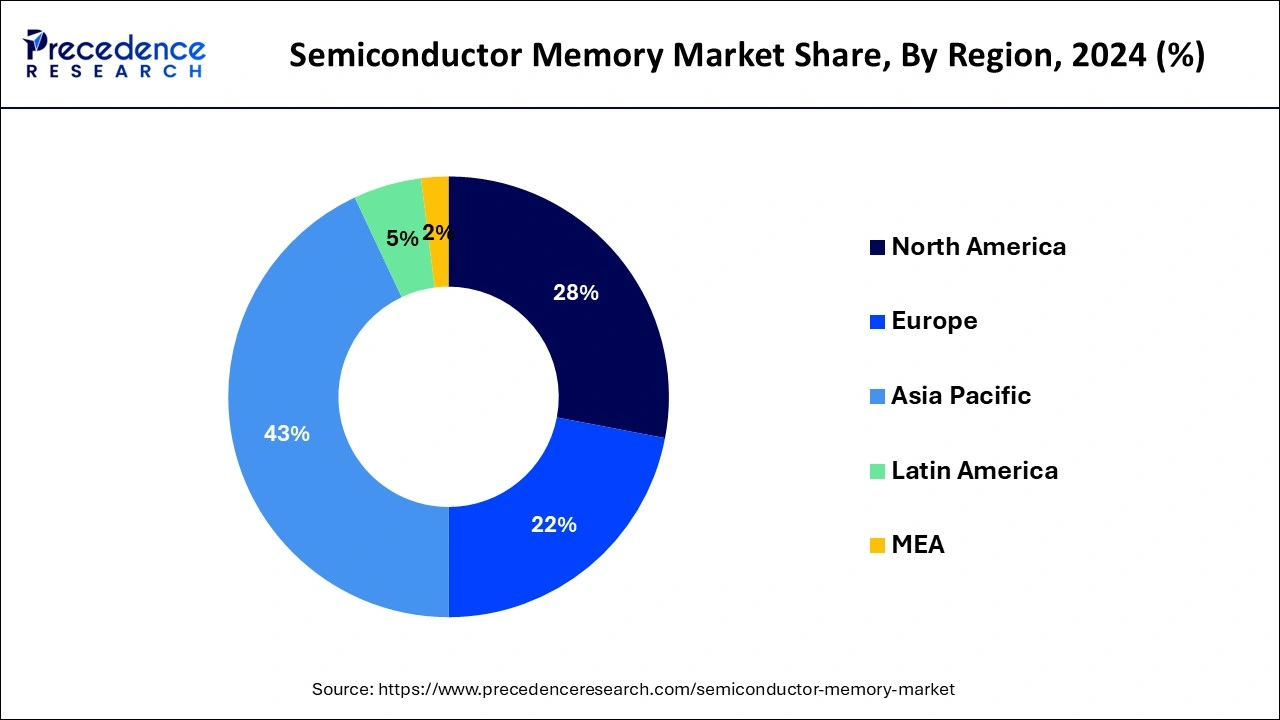
- Asia Pacific contributed more than 45% of revenue share of 43% in 2025.
- North America is estimated to expand the fastest CAGR between 2026 and 2035.
- By Type, the Dynamic Random Access Memory (DRAM) segment has held the largest market share of 45% in 2025.
- By Application, the consumer electronics segment had the largest market share of 35% in 2025.
- By Application, the automotive segment is expected to expand at the fastest CAGR over the projected period.
Market Overview
Semiconductor Memory Market Fuels Intelligent Digital Infrastructure
The semiconductor memory market includes electronic memory devices for data storage and retrieval in computing, communication, automotive, industrial and consumer electronics. This market includes volatile memory such as DRAM and SRAM as well as non-volatile memory such as NAND flash, NOR flash, and various emerging memory technologies. The market is expanding rapidly because artificial intelligence, cloud computing, edge computing, and high-performance computing continuously require new solutions in terms of faster, higher-capacity, and energy-efficient memory.
The increasing trend of 5G networks, connected cars, IoT devices, and advanced mobile phones leads to the need for high-speed data storage and processing. Manufacturers of memory devices are working on new technologies of production, three-dimensional memory architectures, and new types of packaging to enhance performance. The growing digital transformation in different industries, increased infrastructure of data centers, and increased share of semiconductor components in today's electronics are continuing to enhance demand for semiconductor memory on the global market.
How Artificial Intelligence is Changing the Semiconductor Memory Market?
Artificial Intelligence is shaping the semiconductor memory landscape as it generates substantial demand for memory solutions that are fast, energy efficient, and have a high capacity to support various complex artificial intelligence workloads. Some examples of artificial intelligence applications, such as generative artificial intelligence, machine learning, autonomous systems, and edge computing, create the need for fast processing of data and low latency memory solutions, fast tracking the implementation of the advanced memory solution, including High Bandwidth Memory (HBM), DDR4, and advanced NAND flash memory. Artificial Intelligence can also help the semiconductor production process to improve in terms of predictive maintenance, defects detection, improving yield, and intelligent process control. Therefore, it is essential to have higher efficiency of production and decrease operational costs. Moreover, Artificial Intelligence-powered memory management help in better access to data, power saving, and system performance improvement.
Semiconductor Memory Market Growth Factors
Increasing application of semiconductor components in different industries, such as consumer electronics, automotive, and IT & Telecom expected to fuel the market growth for semiconductor memory. Rapid development in the form of automation and digitalization in the electronics industry coupled with the implementation of memory-based elements in the advanced products such as wearable devices, smartphones, and electronic gadgets propels the market growth across the globe. Increasing application of semiconductor devices in the electronics systems and automobile such as DRAM and Flash ROM is a key factor that drives the demand for chips and integrated gadgets. Flash ROM and DRAM used in ADAS and lighting control systems offer better connectivity and increased speed to vehicle systems.
On the other hand, high manufacturing cost, other costs associated with the operation and maintenance of the existing and new fabrication plants, and increased amount of capital investment required are the prime factors that pose challenge to the global semiconductor memory industry over the forecast period.
In February 2025, the Semiconductor Industry Association (SIA) announced that global semiconductor sales hit USD 627.6 billion in 2024, an increase of 19.1% compared to the 2023 total of USD 526.8 billion. Additionally, fourth-quarter sales of USD 170.9 billion were 17.1% more than the fourth quarter of 2023, and 3.0% higher than the third quarter of 2024. Regionally, yearly sales were up in the Americas (44.8%), China (18.3%), and Asia Pacific/All Others (12.5%).
Market Scope
| Report Highlights | Details |
| Market Size by 2035 | USD 227.91 Billion |
| Market Size in 2025 | USD 117.62 Billion |
| Market Size in 2026 | USD 125.62 Billion |
| Market Growth Rate from 2026 to 2035 | CAGR of 6.84% |
| Largest Market | Asia Pacific |
| Base Year | 2025 |
| Forecast Period | 2026 to 2035 |
| Segments Covered | Type, Application, and Region |
| Regions Covered | North America, Europe, Asia-Pacific, Latin America, and Middle East & Africa |
Market Dynamics
Driver
Increase in Demand for AI Technology and High-Performance Computing
The adoption of technologies, including artificial intelligence and cloud infrastructure, has raised the demand for higher-speed and more significant storage memory semiconductors. In this regard, various technologies, such as high bandwidth memory (HBM), Direct Dynamic Access memory (DDR5), and enterprise Solid State Drives (SSD), have gained much importance and, thus, pushed companies toward investing in expanding their capabilities and improving their memory technologies.
Restraint
High Complexity of Manufacturing Process and High Costs of Production
The production of memory semiconductors and chips entails sophisticated manufacturing technology, complex equipment, and high-cost investment. In addition, the production process involves continuous technological transitions, high standards, and increasing wafer production costs, thus increasing the operational costs. Thus, all these factors create a great barrier for newcomers and impact production capacity.
Opportunity
Growth of Automotive Sector and Edge AI Market
With the rise in the deployment of autonomous vehicles and other related technologies, there is an increasing opportunity for companies providing memory semiconductors. These applications require reliable, low-latency, and power-efficient storage, contributing to innovations in memory devices and DRAM.
Segment Insights
Type Insights
In 2025, the Dynamic Random Access Memory (DRAM) segment captured the major market revenue share of more than 45%. The growth is attributed to the increasing computing capabilities with the implementation of Artificial Intelligence (AI) in laptops, smartwatches, and smartphones that require compatible memory solutions. Further, increasing integration of electronic components in automotive sector expected to offer significant growth opportunities for the DRAM semiconductor memory industry players. DRAM memory that is used in lighting control and Advanced Driver-Assistance Systems (ADAS) offer high-speed and improved connectivity to the vehicle systems. Moreover, several market players offer automotive semiconductor memory chips pertaining to cater to the increasing demand of electronic devices in the automotive industry.
Application Insights
Consumer electronics dominated the global semiconductor memory market and accounted for nearly 35% of market value share in the year 2025, The segment anticipated to offer alluring growth opportunities for all the market players involved in the value chain on the account of rising application of semiconductor memory in wearable devices, smartphones, and tablets across the globe. Semiconductor memory provides numerous advantages that include improved volatile memory, increased storage, low power consumption, and high endurance that leads to the rising adoption of semiconductor components in the consumer electronics industry.
The automotive segment anticipated to register considerable growth rate over the analysis period. The growth of the segment is attributed to the rising adoption of advanced safety systems in automobiles such as advanced driver-assistance systems (ADAS), lighting, airbags, and braking that use large amount of sensors and Engine Control Units (ECUs). These ECUs and sensors require highly efficient memory components. Subsequently, automotive manufacturers are significantly adopting semiconductor memory chips in the vehicle safety systems due to their improved performance and low power consumption advantages.
Consumer Electronics
- In June 2024, China's electronics manufacturing industry posted a strong performance in the first four months of this year. The combined profits of major companies in the sector soared 75.8 percent year on year to 144.2 billion yuan (about 20.3 billion U.S. dollars) in the January to April period, according to the Ministry of Industry and Information Technology.
Regional Insights
What is the Asia Pacific Semiconductor Memory Market Size?
The Asia Pacific semiconductor memory market size was exhibited at USD 51.06 billion in 2025 and is projected to be worth around USD 101.90 billion by 2035, growing at a CAGR of 7.15% from 2026 to 2035.
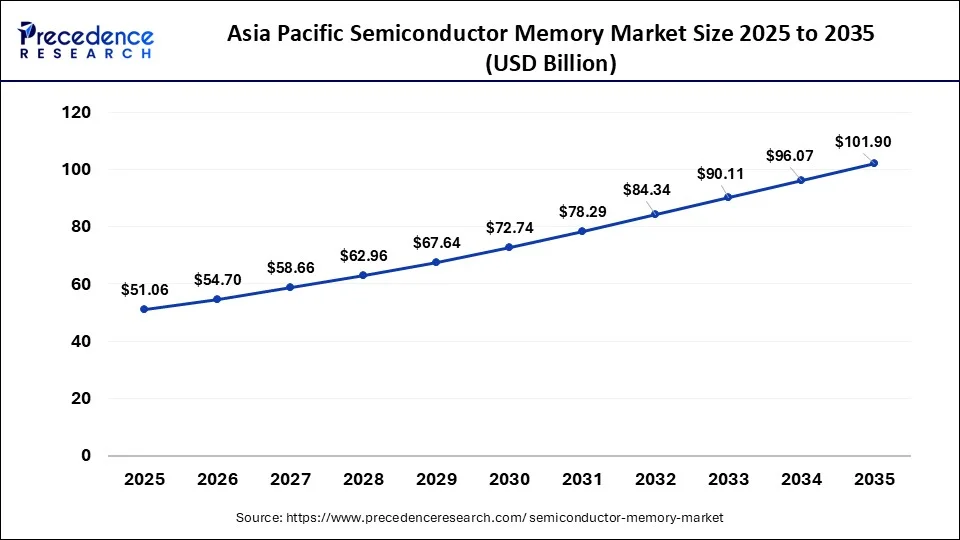
The Asia Pacific led the global semiconductor memory market with more than 45% of market value share in the year 2025. This is attributed to the increasing data center investments in countries such as Singapore, India, and Indonesia, thus create prominent demand for semiconductor memory in the region. Moreover, the developing countries in the region such as China, India, and Japan are supporting the market growth owing to several factors including increasing production of consumer electronics products and memory chips, increasing penetration of high technology gadgets, and growing digitization. In addition, easy availability of raw materials at lower cost attracts various prominent market participants that include Toshiba Corporation and Samsung Electronics to expand their offering and presence in the region, thereby fuels the market growth.
According to the data published by the Japan Electronics and Information Technology Industries Association (JEITA), the total production by the Japanese Electronics Industry in December 2024 stood at 1,006,407 million yen. This represents a significant increase from the previous month, where production was at 940,652 million yen. The production includes industrial electronics, consumer electronics, and electronic components and devices.
In Japan, the electronics and IT industries are experiencing greater semiconductor demand fueled by computer replacement demand due to the end of support for Windows 10, rising AI demand, and rapid growth in mirrorless and other fixed-lens cameras. Production by Japanese electronics and IT companies (including offshore production) is consequently expected to rise 6% year on year in 2024 to ¥41,181.3 billion, within which electronics production should also climb 6% year on year to ¥32,182.3 billion.
The rapid expansion of the automotive sector in the region is expected to accelerate the market's revenue in the region. For instance, according to the IEA, A total of 17.3 million electric cars were produced worldwide in 2024, about one-quarter more than in 2023, largely as a result of increased production in China, which reached 12.4 million electric cars.
China remains the world's electric car manufacturing hub, accounting for more than 70% of global production in 2024. Production in China has been increasingly shaped by the expansion of domestic manufacturers. In 2024, Chinese OEMs accounted for more than 80% of domestic production, up from roughly two-thirds in 2021.
- In March 2025, Mitsubishi Chemical Group, one of Japan's largest integrated chemical companies, announced plans to expand its footprint in India by entering the country's semiconductor and electric vehicle (EV) supply chains. The company aims to collaborate with local partners to capitalize on India's rapidly growing demand in these sectors.
North America and Europe Drive Growth in the Semiconductor Memory Market
North America seeks to be the most opportunistic region during the forecast period, followed by Europe. Rising investment for research & development activities by the companies along with the significant presence of major market players that are dedicated towards the development of new technologies propel the growth of the region significantly. Increasing adoption of smart and advanced technologies in the automotive sector accounts for the other prominent factor that triggers the growth for semiconductor memory market during the forthcoming years. Both North America and Europe registered significant growth in advanced mobility infrastructure coupled with favorable policies from regulatory bodies of the region positively influence the market growth.
- In March 2025, Taiwan Semiconductor Manufacturing (TSMC) announced its plan to invest USD 100 billion into bolstering chip manufacturing in the U.S.
What are the Advancements in the Semiconductor Memory Market in Europe?
Europe is expected to witness significant growth in the market. This is because the region has a high focus on Industry 4.0 initiatives, automotive electronics, and is also witnessing increased adoption of advanced technologies in various sectors, thus driving demand for semiconductor memory solutions. The region also benefits from a mature consumer electronics market, which further fosters innovation and competition.
Germany Semiconductor Memory Market Trends: The expansion of IoT (Internet of Things) devices and the integration of advanced technologies in vehicles are contributing to the country's market growth. The growing demand for cloud services and data storage has further influenced the need for advanced memory solutions in data centers.
What are the Key Trends in the Semiconductor Memory Market in Latin America?
Latin America is expected to witness substantial growth throughout the forecast years. The region boasts a large consumer electronics market, driven by a vast population and increasing disposable incomes. The region also has a growing demand for smartphones, tablets, and wearables has fueled the need for semiconductor memory solutions. Moreover, the rapid industrialization and digitization across sectors in countries like Brazil and Mexico have boosted market adoption in automotive, healthcare, and manufacturing.
Brazil Semiconductor Memory Market Trends: The increasing demand for consumer electronics, continuous advancements in automotive technology and electric vehicles, expanding 5G network deployment, and growing investments in data centers are some of the factors that are boosting the country's market landscape.
How is the Middle East and Africa Region Growing in the Semiconductor Memory Market?
The Middle East and Africa are expected to have a steady growth rate in the upcoming years. This growth is due to the increasing concerns about data security, which creates an emphasis on developing advanced memory solutions and security features. The market ecosystem is evolving, particularly in countries like the UAE and Saudi Arabia. Various initiatives are also being taken to enhance the overall market.
Saudi Arabia Semiconductor Memory Market Trends: Saudi Arabia has been making various strategic investments in technology infrastructure. These investments aim to promote technological advancement and reduce dependence on imported semiconductor components, thus boosting the regional market landscape.
Supply Chain Analysis
- Supply of Raw Materials and Wafers: The production process starts with obtaining wafers made of pure silicon, specialty gases, positive photoresist, rare chemicals, and other essential materials used in semiconductor memory production. As there is a steady supply of quality materials, production efficiency and device effectiveness remain intact.
Key Players: Shin-Etsu Chemical, SUMCO Corporation, GlobalWafers, JSR Corporation, Entegris - Chip Design and Production: The chipmaking companies create different DRAM, NAND, and other types of memory designs. There are advanced facilities where wafers undergo treatment in accordance with the used lithographic, deposition, and etching technologies.
Key Players: Samsung Electronics, SK hynix, Micron Technology, Kioxia, Yangtze Memory Technologies - Packaging, Assembly, and Testing: Memory chips produced first undergo packaging and assembly before they can be tested for various properties such as speed and reliability.
Key Players: Amkor Technology, ASE Technology Holding, Powertech Technology, JCET Group, ChipMOS Technologies - Distribution and End-Use Integration: The ready-made memory chips are sold through OEM, different distributors, and technology-related companies.
Key Players: Arrow Electronics, Avnet, Dell Technologies, Lenovo, Hewlett Packard Enterprise
Competitive Landscape
The semiconductor memory market is highly consolidated, dominated by a few global corporations that possess broad expertise in production capabilities, intellectual property, and manufacturing skills. Therefore, significant capital investments and fast-paced technological innovations create high entry barriers and competition in the marketplace facilitating growth among existing players.
Technology giants such as Samsung Electronics, SK Hynix, Micron Technology, Kioxia and Western Digital have powerful positions in the industry owing to cutting-edge memory technology, wider variety of products, widespread networks of manufacturing facilities across the globe, and powerful partnerships with their customers.
The fierce competition in the industry comes from ongoing R&D, and endless launches of cutting-edge DRAMs and NANDs, expansion of production capacities, and formation of partnerships and contracts with the suppliers. In the future, competition will be influenced by the demand for memory that is driven by AI technologies, innovations in production processes, and overall efficiency of manufacturing operations and investments into semiconductor manufacturing.
Semiconductor Memory Market Companies
- Micron Technology
- Integrated Silicon Solution Inc.
- Cypress Semiconductor Corporation
- Samsung Electronics
- Macronix International Co., Ltd.
- Taiwan Semiconductor
- SK Hynix
- Toshiba Corp.
- Texas Instruments
- IBM Corporation
Rencent Developement
- In May 2025, NEO Semiconductor, a leading developer of innovative technologies for 3D NAND flash memory and 3D DRAM, announced the latest advancement in its groundbreaking 3D X-DRAM technology family, the industry-first 1T1C- and 3T0C-based 3D X-DRAM cell, a transformative solution designed to deliver unprecedented density, power efficiency, and scalability for the most demanding data applications.
- In January 2025, Indichip Semiconductors announced a joint venture (JV) with Japan's Yitoa Micro Technology, signed an MoU with the Andhra Pradesh government to set up India's first private semiconductor manufacturing facility with an investment of over ?14,000 crores. Focused on Silicon Carbide chips, the facility aims to boost India's technological and sustainability goals and create thousands of jobs in the region. This cutting-edge facility will focus on manufacturing Silicon Carbide (SiC) chips, contributing to India's technological advancement and sustainability goals.
- In February 2025, Everspin Technologies, Inc., announced that its PERSYST MRAM is validated for configuration across all Lattice Semiconductor Field Programmable Gate Arrays (FPGA). Enabled through the Lattice Radiant software suite, this validation highlights MRAM's role as a robust and reliable configuration memory device for a wide range of applications in industries such as industrial, aerospace, military, and automotive.
Segments Covered in the Report
By Type
- Flash ROM
- MRAM
- SRAM
- DRAM
- Others
By Application
- IT & Telecommunication
- Medical
- Consumer Electronics
- Industrial
- Automotive
- Aerospace & Defense
- Others
By Region
- North America
- Europe
- Asia Pacific
- Latin America
- Middle East and Africa
For inquiries regarding discounts, bulk purchases, or customization requests, please contact us at sales@precedenceresearch.com
Frequently Asked Questions
Tags





Ask For Sample
No cookie-cutter, only authentic analysis – take the 1st step to become a Precedence Research client
 Get a Sample




 sales@precedenceresearch.com
 Schedule a Meeting
