



Shipping Software Market Trends, Companies, Revenue / Sales Performance, Subscriber Growth, Pricing Strategies, Cloud Adoption, Infrastructure Expansion, Competitive Landscape, and Industry Outlook
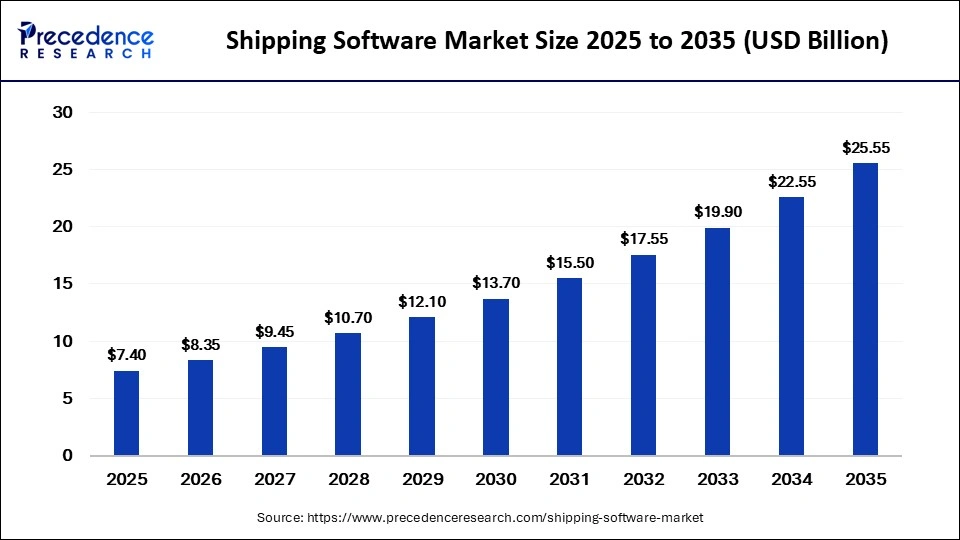
ICT industry specialist Gautam Mahajan estimates the shipping software market at USD 8.35 billion in 2026, with continued technology adoption expected to take the market to USD 25.55 billion by 2035 at a CAGR of 13.19%. Leading shipping software market providers such as Oracle, SAP, Descartes Systems Group, Trimble, Manhattan Associates are expanding their capabilities across segments including By Deployment Model, By Component, By Functionality, By Transportation Mode, By End-Use Industry.
Source: https://www.precedenceresearch.com/shipping-software-market
 Get a Sample
 Table Of Content


What is the Shipping Software Market Size in 2026?
The global shipping software market size accounted for USD 7.40 billion in 2025 and is predicted to increase from USD 8.35 billion in 2026 to approximately USD 25.55 billion by 2035, expanding at a CAGR of 13.19% from 2026 to 2035. The market growth is attributed to increasing digitalization of global maritime trade, rising demand for real-time visibility, and regulatory push for automated shipping operations.
Key Takeaways
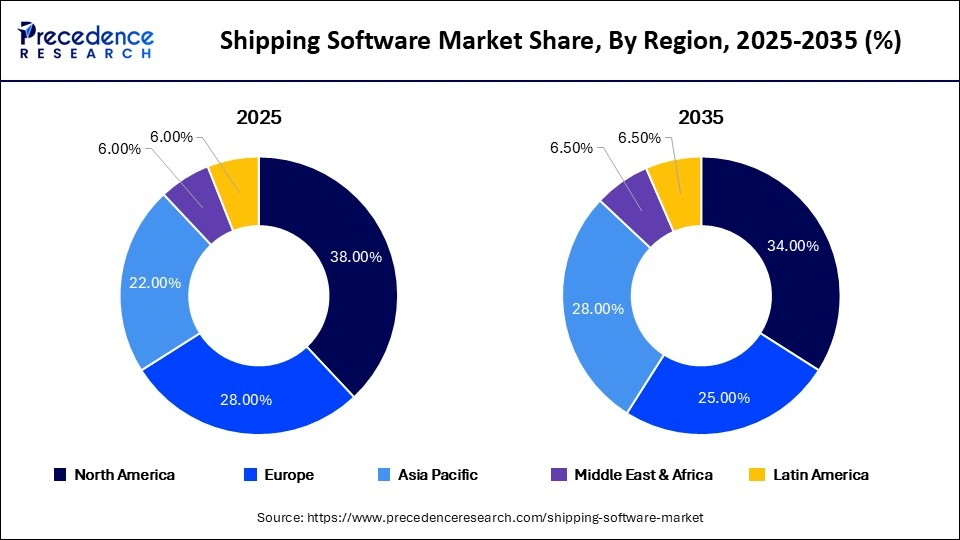
- North America dominated the shipping software market with a 38% share in 2025.
- Asia Pacific is expected to grow at the fastest CAGR of 17.5% between 2026 and 2035.
- By deployment mode, the cloud-based segment contributed the highest market share of 72% in 2025.
- By deployment mode, the on-premises segment held a 28% share of the market in 2025 and is expected to grow at a significant rate of CAGR of 7.5% between 2026 and 2035.
- By component, the software segment held a major market share of 78% in 2025.
- By component, the services segment held a 22% market share in 2025 and is expected to grow at a 10.5% CAGR during 2026 and 2035.
- By functionality, the shipment tracking & visibility segment held a market share of 28% in 2025.
- By functionality, the order management segment held the second-largest market share of 22% in 2025 and is expected to grow at a strong CAGR of 11.5% over the projected period.
- By transportation mode, the road freight segment contributed the highest market share of 40% in 2025.
- By transportation mode, the sea freight segment held a 25% share of the market in 2025 and is expected to grow at the fastest CAGR of 13.5% between 2026 and 2035.
- By end-use industry, the retail & e-commerce segment held a major market share of 30% in 2025.
- By end-use industry, the logistics & transportation segment held the second-largest market share of 28% in 2025 and is expected to grow at a significant CAGR of 12% between 2026 and 2035.
Market Overview
Rising volume of global trade, digitalization of the shipping industry, and the need to improve operational efficiency are boosting the growth of the shipping software market. The United Nations Conference on Trade and Development states that maritime transport manages a volume of over 80% of the global volume of trade.
The market encompasses software platforms to manage the fleets, track cargo, port operations, electronic documentation, and compliance automation. These systems lessen the delays in ports, enhance data exchange, and enrich coordination among shipping stakeholders and regulatory authorities. The growing intricacy of international shipping networks is accelerating the uptake of real-time visibility solutions.
Impact of Artificial Intelligence on the Shipping Software Market
Artificial intelligence is transforming the shipping software market by enabling advanced automation and intelligent decision-making across maritime operations. AI-based systems analyze the performance of vessels and weather forecasts, and port congestion. AI-powered software is used to increase the efficiency of container handling, enhance the efficiency of berth allocation, and reduce the turnaround rates of a vessel by relying on automated planning systems.
Major Market Trends
- Increasing Adoption of API-Driven Data Exchange: Growing demand for standardized APIs is driving seamless integration between carriers, ports, and logistics platforms.
- Rising Demand for End-to-End Supply Chain Visibility: Increasing need for real-time cargo tracking and transparency is boosting adoption of advanced shipping software solutions.
- Real-Time Monitoring and Control Platforms Becoming Standard: Real-time monitoring systems are moving beyond optional systems and becoming a core part of infrastructure. These systems facilitate proactive decisions throughout the fleets to enhance safety, efficiency, and operational responsiveness in the complex maritime environment.
Market Scope
| Report Coverage | Details |
| Market Size in 2025 | USD 7.40 Billion |
| Market Size in 2026 | USD 8.35 Billion |
| Market Size by 2035 | USD 25.55 Billion |
| Market Growth Rate from 2026 to 2035 | CAGR of 13.19% |
| Dominating Region | North America |
| Fastest Growing Region | Asia Pacific |
| Base Year | 2025 |
| Forecast Period | 2026 to 2035 |
| Segments Covered | Deployment Model, Component, Functionality, Transportation Mode, End-Use Industry, and Region |
| Regions Covered | North America, Europe, Asia-Pacific, Latin America, and Middle East & Africa |
Market Dynamics
Drivers
Increasing Adoption of API-Driven Data Exchange
Increasing adoption of standardized APIs across maritime stakeholders is expected to drive the shipping software market in the coming years. APIs are standardized, which allows real-time exchange of cargo, vessel, and compliance data, improving operational coordination and reducing errors in manual interventions. The increased use of interoperable systems underpins modern analytics, automation, and predictive capabilities in the shipping software platforms.
Restraint
High Implementation Costs
High upfront costs are expected to restrict software deployment across small and mid-sized shipping operators, thus hindering the market. Budgets lead to the postponement of the ROI timelines, thereby discouraging speedy digital transformation among cost-sensitive maritime operators. The obstacle of this financial cost restrains large-scale adoption and prevents penetration of advanced shipping software solutions globally.
Opportunity
Growing Emphasis on Maritime Cybersecurity Systems
Growing emphasis on cybersecurity in maritime operations is projected to increase investments in secure software systems, further creating immense opportunities for the market. International regulatory authorities are emphasizing cybersecurity structures to safeguard the connected shipping infrastructure and data exchange systems. This cybersecurity emphasis is enhancing confidence in online shipping platforms and enabling increased uptake of software internationally.
Segment Insights
Deployment Model Insights
The Cloud-based Segment Dominated the Market with a 72% Share in 2025
The cloud-based segment dominated the shipping software market while holding the largest share of 72% in 2025. This is mainly due to the high reliance of the shipping industry on cloud-based SaaS models that reduce infrastructure complexity and support rapid deployment cycles. Cloud-based systems are further consolidating their niche with further innovation in AI, analytics, and cybersecurity integration.
Shipping Software Market Share, By Deployment Model, 2025-2035 (%)
| Deployment Model | 2025 | 2035 | CAGR (%) |
| Cloud-based | 72.00% | 80.00% | 16.50% |
| On-premise | 28.00% | 20.00% | 7.50% |
The on-premise segment held the second-largest market share of 28% in 2025 and is expected to grow at a significant CAGR of 7.5% in the upcoming period, driven by the need for organizations to have strict data control and data regulatory compliance in maritime operations. On-premise solutions are adopted by businesses to be able to comply with internal IT policies and ensure that they are able to comply with regional data regulations.
Component Insights
Shipping Software Market Share, By Component, 2025-2035 (%)
| Component | 2025 | 2035 | CAGR (%) |
| Cloud-based | 72.00% | 80.00% | 18.5% |
| On-premise | 28.00% | 20.00% | 8.5% |
The Software Segment Held a 78% Market Share in 2025
The software segment dominated the shipping software market with the highest share of 78% in 2025, owing to a strong demand for digital platforms that support end-to-end maritime logistics management. Shipping companies are increasingly adopting software solutions to improve decision-making speed, reduce operational disruptions, and enhance transparency across global supply chains.
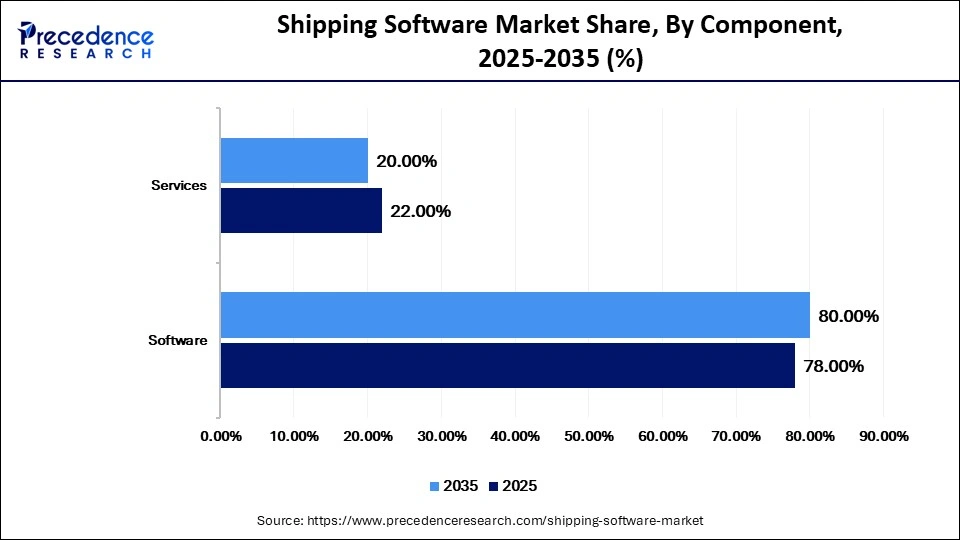
The services segment held a 22% share of the market in 2025 and is expected to grow at a CAGR of 10.5% during the forecast period, driven by rising demand for system integration, consulting, and ongoing technical support. Service providers are expanding their offerings to include specialized consulting, software upgrades, and lifecycle management solutions tailored to the specific needs of the maritime industry.
Functionality Insights
Why Did the Shipment Tracking & Visibility Segment Dominate the Market in 2025?
The shipment tracking & visibility segment dominated the shipping software market with a share of 28% in 2025, owing to the increasing need for predictive visibility and disruption management across interconnected supply chains. An announcement in 2025 by the World Shipping Council stated that large shipholders are installing a standard global tracking system in their entire fleets. Furthermore, the rapid shift toward data-centric logistics ecosystems and real-time operational intelligence is expected to facilitate the segment's growth in the coming years.
The order management segment held the second-largest market share of 22% in 2025 and is expected to grow at a CAGR of 11.5% between 2026 and 2035, as companies are implementing smart order orchestration systems that real-time harmonize bookings and financial workflows. Shipping companies such as Mediterranean Shipping Company are increasingly adopting digital booking and documentation systems, supporting market growth.
Shipping Software Market Share, By Functionality, 2025-2035 (%)
| Functionality | 2025 | 2035 | CAGR (%) |
| Shipment Tracking & Visibility | 28.00% | 30.00% | 14.50% |
| Order Management | 22.00% | 20.00% | 11.50% |
| Rate & Route Optimization | 20.00% | 22.00% | 14.00% |
| Warehouse Integration | 15.00% | 14.00% | 11.00% |
| Analytics & Reporting | 15.00% | 14.00% | 12.50% |
The rate & route optimization segment held a 20% share of the market in 2025 and is expected to expand at a significant CAGR of 14% during the projection period. This is mainly due to the growing need to reduce the amount of fuel used and increase the accuracy of schedules. These tools are being combined by companies with emissions tracking technologies in order to achieve cost optimization and sustainability objectives.
The warehouse integration segment held a 15% share of the market in 2025 and is estimated to grow at a strong CAGR of 11% over the projected period. The segment's growth is driven by the increasing need for seamless coordination between storage, handling, and transportation systems. Integration of shipping platforms with warehouse management systems enables synchronized inventory control and efficient shipment execution.
The analytics & reporting segment held a 15% share of the market in 2025 and is expected to grow at a CAGR of 12.5% in between 2026 and 2035, supported by the rising availability of real-time data, enhancing analytical capabilities across maritime operations. These tools enable better strategic planning by identifying inefficiencies and optimizing resource utilization in shipping processes.
Transportation Mode Insights
Shipping Software Market Share, By Transportation Mode, 2025-2035 (%)
| Transportation Mode | 2025 | 2035 | CAGR (%) |
| Road Freight | 40.00% | 38.00% | 12.00% |
| Sea Freight | 25.00% | 27.00% | 13.50% |
| Air Freight | 20.00% | 21.00% | 13.00% |
| Rail Freight | 15.00% | 14.00% | 11.50% |
The Road Freight Segment Dominated the Market with a 40% Share in 2025
The road freight segment dominated the shipping software market with a share of 40% in 2025, due to its extensive use of road transport for last-mile connectivity and regional distribution networks. These complex software systems combine GPS tracking, telematics, and real-time route optimizations to maximize the delivery time and minimize slots and delays.
The sea freight segment held a 25% share of the market in 2025 and is expected to grow at the fastest CAGR of 13.5% in between 2026 and 2035, facilitated by rising global trade volumes and increasing reliance on maritime transportation. This advanced software is used to coordinate the activities of the vessels, manage the shipments, and finalize the operations at the ports.
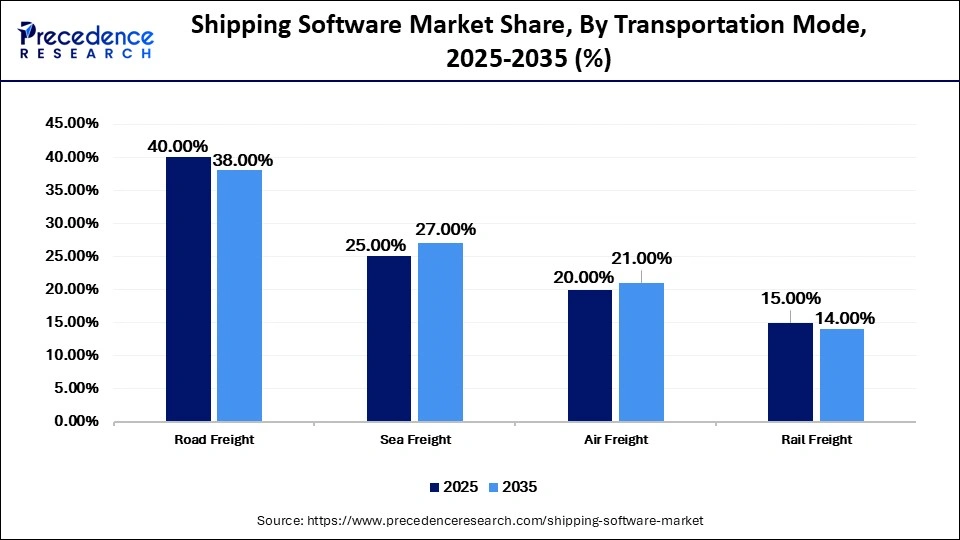
The air freight segment held a 20% share of the market in 2025 and is expected to grow at a 13% CAGR during the forecast period, due to its rising popularity in time-sensitive freight delivery and in delivering high-value cargo expressly. Firms are implementing enhanced software platforms that provide cargo scheduling, tracking, and capacity optimization functions of air transport networks.
The rail freight segment contributed 15% to the market in 2025 and is estimated to grow at a strong CAGR of 11.5% over the projected period, owing to its advantages in costs and appropriateness in transporting bulk transportation over long distances. Shipping software solutions are facilitating improved scheduling, cargo tracking, and network-wide coordination of rail logistics systems.
End-Use Industry Insights
What Made Retail & E-commerce the Leading Segment in the Shipping Software Market?
The retail & E-commerce segment led the market while holding a major share of 30% in 2025. This is mainly due to the rapid growth in online orders and increasing customer expectations for faster delivery. Digital shipping systems integrate inventory, warehouse, and transportation data to ensure seamless order fulfillment and efficient logistics operations.
The logistics & transportation segment held a 28% share of the market in 2025 and is expected to grow at a significant CAGR of 12% in between 2026 and 2035. This growth is supported by the rising need to manage complex, high-volume freight networks. Shipping software enables real-time data exchange among carriers, ports, and freight forwarders, improving operational efficiency and coordination.
Shipping Software Market Share, By End-Use Industry, 2025-2035 (%)
| End-Use Industry | 2025 | 2035 | CAGR (%) |
| Retail & E-commerce | 30.00% | 34.00% | 16.50% |
| Logistics & Transportation | 28.00% | 27.00% | 12.00% |
| Manufacturing | 15.00% | 14.00% | 11.50% |
| Healthcare | 10.00% | 9.00% | 11.00% |
| BFSI | 9.00% | 8.00% | 10.50% |
| Government | 8.00% | 8.00% | 11.00% |
The manufacturing segment held a 15% share of the market in 2025 and is expected to grow at a 11.5% CAGR during the projection period. This growth is driven by the need for efficient supply chain coordination and just-in-time production systems. Organizations use shipping software to manage inbound raw materials, outbound finished goods, and inventory flows across global operations.
The healthcare segment held a 10% share of the market in 2025 and is expected to expand at a strong CAGR of 11% over the forecast period, driven by the need for precise, secure, and timely delivery of medical supplies and pharmaceuticals. These systems enable real-time monitoring of temperature-sensitive shipments, ensuring reliability and compliance with healthcare standards.
The BFSI segment held a 9% share of the market in 2025 and is expected to grow at a 10.5% CAGR between 2026 and 2035. The segment growth is driven by logistics requirements related to document handling, asset movement, and secure transportation. Financial institutions are adopting shipping software to enhance tracking, security, and coordination of logistics operations.
Regional Insights
North America Shipping Software Market Size and Growth 2026 to 2035
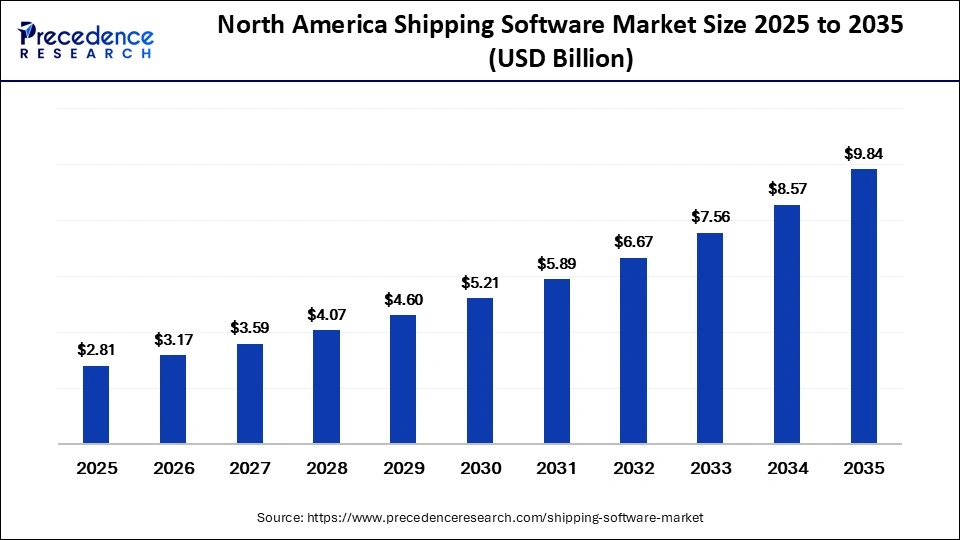
The North America shipping software market size is estimated at USD 2.81 billion in 2025 and is projected to reach approximately USD 9.84 billion by 2035, with a 13.35% CAGR from 2026 to 2035.
North America Dominated the Market With a 40% Share in 2025
North America led the shipping software market, capturing the largest revenue share 38% in 2025, due to its strong digital infrastructure and early adoption of technology across maritime logistics. The region boasts major ports and carriers, which actively deploy shipping software systems to improve operational efficiency.
The American Association of Port Authorities noted that over 70% of major U.S. ports in 2025 are advancing digital and smart port initiatives, supporting software deployment. Furthermore, the Available technology providers, such as Amazon Web Services and Microsoft, are fortifying maritime cloud portions in the area, further facilitating the market growth.
U.S. Shipping Software Market Size and Growth 2026 to 2035
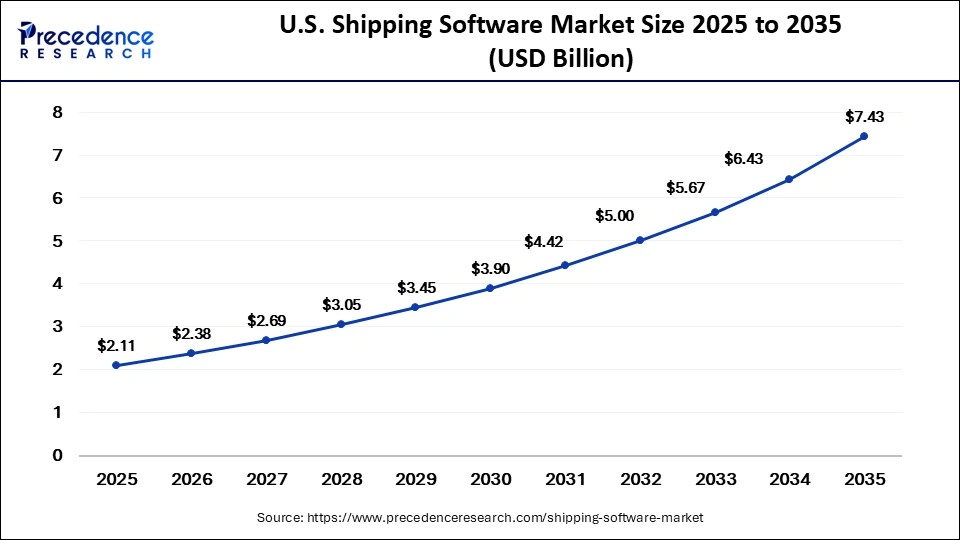
The U.S. shipping software market size is calculated at USD 2.11 billion in 2025 and is expected to reach nearly USD 7.43 billion in 2035, accelerating at a strong CAGR of 13.34% between 2026 and 2035.
U.S. Shipping Software Market Analysis
The U.S. leads the market within North America, driven by advanced port infrastructure and strong digital transformation across logistics networks. In 2025, the U.S. Maritime Administration reported more investment in the systems of port digitization and freight data systems. The pace of the use of the latest systems shipping software technologies is rising due to continuous investment in smart ports, automation, and data-driven systems.
Europe: The Second-Largest Market
Europe held the second-largest market share of 28% in 2025 and is estimated to grow at a CAGR of 11% over the projected period, owing to the high levels of cross-border trade and sound regulatory oversight. The area has very tight-knit logistics chains, and the use of proper software solutions is essential to manage and match them. Shipping companies are on the move to use digital platforms to oversee complex trade flows within and between countries.
Germany Shipping Software Market Analysis
Germany is a major contributor to the market, due to its robust export-led trade and well-developed logistics infrastructure. Firms in this region are deploying AI-powered shipping software for route planning and optimization, live tracking, and sustainability monitoring systems.
Asia Pacific: The Fastest-Growing Region
Asia Pacific held a 22% share of the market in 2025 and is expected to grow at a 17.5% CAGR between 2026 and 2035, driven by the rapid e-commerce and manufacturing growth, which compels the need to implement effective shipping and logistics software solutions.
The United Nations Conference on Trade and Development in 2025 further recorded that Asia manages more than 63% of worldwide container traffic, boosting the high demand for digital systems. Shipping firms are moving towards software solutions to handle large volumes of cargo, plan efficient routes, and improve trucking schedules.
China Shipping Software Market Analysis
In China, the market is growing due to strong government initiatives promoting smart ports and digital trade systems. The sustained investment in technology, infrastructure, and innovation is enhancing the leadership of China with regard to the adoption of shipping software in the region.
Shipping Software Market Companies
- Oracle
- SAP
- Descartes Systems Group
- Trimble
- Manhattan Associates
- MercuryGate
- ShipStation
- Shippo
- Easyship
- Pitney Bowes
- Stamps.com
- MetaPack
- FreightPOP
- ShipBob
- Infor
Recent Developments
- In April 2026, Shadowfax Technologies launched Shadowfax 360, a unified digital shipping platform targeting SMEs and D2C brands across India. The platform enables rapid onboarding and nationwide shipping activation within minutes, reducing traditional logistics barriers. The launch, disclosed under SEBI Regulation 30 on April 21, 2026, strengthens digital logistics access for small businesses.(Source: https://scanx.trade)
- In April 2026, Freight Technologies Inc. launched DODA Smart, an AI-driven platform for managing digital customs documentation lifecycle processes. The system enables automated verification, monitoring, and real-time tracking of customs documents across the U.S.–Mexico trade corridor. The platform integrates with Mexico's tax authority systems to deliver real-time compliance intelligence for logistics stakeholders.(Source: https://finance.yahoo.com)
Segments Covered in the Report
By Deployment Model
- Cloud-based
- On-premise
By Component
- Software
- Services
By Functionality
- Order Management
- Shipment Tracking & Visibility
- Rate & Route Optimization
- Warehouse Integration
- Analytics & Reporting
By Transportation Mode
- Road Freight
- Air Freight
- Sea Freight
- Rail Freight
By End-Use Industry
- Retail & E-commerce
- Logistics & Transportation
- Manufacturing
- Healthcare
- BFSI
- Government
By Region
- North America
- Latin America
- Europe
- Asia-pacific
- Middle and East Africa
For inquiries regarding discounts, bulk purchases, or customization requests, please contact us at sales@precedenceresearch.com
Frequently Asked Questions
Tags





Ask For Sample
No cookie-cutter, only authentic analysis – take the 1st step to become a Precedence Research client
 Get a Sample




 sales@precedenceresearch.com
 Schedule a Meeting
