



Smart EV Charging Networks Market Size, Companies, Share, Vehicle Production Volume, Sales Performance, Export & Import Analysis, Technology Adoption, Competitive Positioning, and Demand Trends
Smart EV Charging Networks Market (By Charging Level: Level 1 (Low Power AC), Level 2 (Medium Power AC), DC Fast Charging (High Power), By Deployment: Residential, Commercial; By Grid Interaction Capability: Unidirectional Smart Charging, Bidirectional Charging Enabled Networks; By Connectivity Technology: Cellular (4G/5G), Wi-Fi/Ethernet, Power Line Communication (PLC), RF/IoT-based Networks) - Global Industry Analysis, Size, Trends, Leading Companies, Regional Outlook, and Forecast 2026 to 2035
Source: https://www.precedenceresearch.com/smart-ev-charging-networks-market
 Get a Sample
 Table Of Content


What is the Smart EV Charging Networks Market Size in 2026?
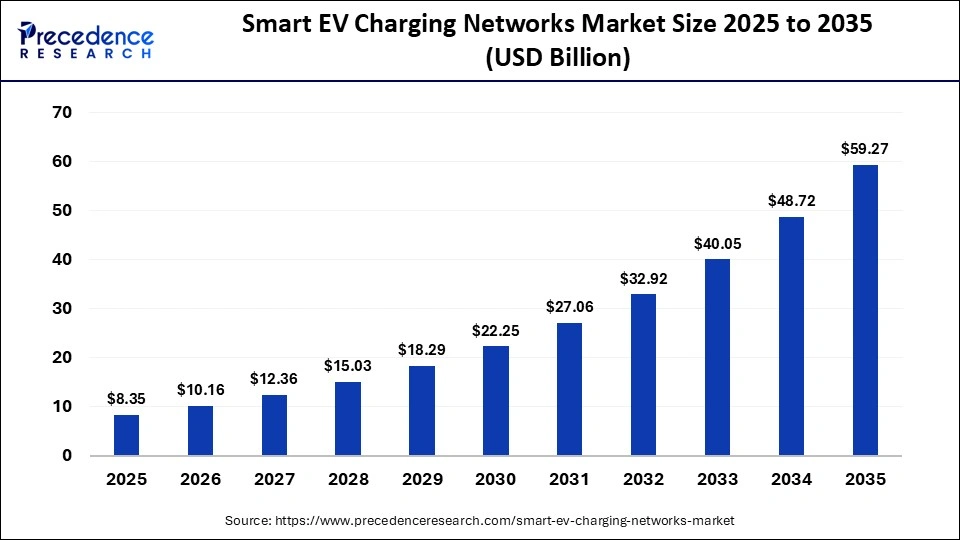
The global smart EV charging networks market size accounted for USD 8.35 billion in 2025 and is predicted to increase from USD 10.16 billion in 2026 to approximately USD 59.27 billion by 2035, expanding at a CAGR of 21.65% from 2026 to 2035. The market is rapidly growing due to the rising electric vehicle adoption, growing investments in connected charging infrastructure, increasing demand for intelligent energy management solutions, and collaboration among automakers and energy providers.
Key Takeaways
- Asia Pacific held the largest market share in 2025.
- Europe is projected to grow at the fastest CAGR during the foreseeable period.
- By charging level, the DC fast charging segment held the largest market share in 2025.
- By charging level, the level 2 charging segment is projected to grow at the fastest CAGR during the foreseeable period.
- By deployment, the commercial deployment segment held the largest market share in 2025.
- By deployment, the residential deployment segment is projected to grow at the fastest CAGR during the foreseeable period.
- By grid interaction capability, the unidirectional smart charging segment held the largest market share in 2025.
- By grid interaction capability, the bidirectional charging enabled networks segment is projected to grow at the fastest CAGR during the foreseeable period.
- By connectivity technology, the cellular (4G/5G) segment held the largest market share in 2025.
- By connectivity technology, the Wi-Fi/Ethernet segment is projected to grow at the fastest CAGR during the foreseeable period.
Market Overview
A smart EV charging network is a cloud-based infrastructure that intelligently optimizes electricity usage to charge electric vehicles by balancing grid stability in real time with the help of the internet. The market refers to the ecosystem of software enabled, connected charging stations that assist energy usage dynamically. These systems use data to manage charging speeds, minimize costs, and avoid grid overload for commercial, public, and fleet operators. The market growth is majorly driven by the increasing adoption of EVs, strict carbon emission rules, and the need for efficient infrastructure to handle the heavy loads of electricity.
How is AI Impacting the Smart EV Charging Networks Market?
The integration of artificial intelligence is rapidly changing the market dynamics from hardware-centric infrastructure to intelligent software-defined networks that predict and automate charging. AI algorithms manage vehicle-to-grid technology by managing energy flow as per demand. ML models monitor charger efficiency and predict failure before it manifests, which reduces downtime and maintenance costs of EV charging infrastructure. AI further expands plug and charge capabilities that reduce the need for card authentication, which in turn enables smart, personalized, and RITE-based charging to reduce unnecessary loads on the grid and keep it working for a longer run.
Smart EV Charging Networks Market Trends
- The market is witnessing a rapid shift toward cloud-based and software-defined platforms that enable real-time monitoring, dynamic pricing, and automated load balancing across distributed charging networks.
- Smart charging networks are increasingly adopting vehicle-to-home (V2H) technologies, transforming EV chargers into energy storage assets that can support households and stabilize the grid during peak demand periods.
- Wireless charging is gaining traction as a convenient and efficient power transfer solution for stationary vehicles and, increasingly, for dynamic on-road charging applications.
- Integration of renewable energy sources with charging infrastructure is becoming a key trend, with companies deploying solar-powered charging stations and hybrid systems to reduce grid dependency and enhance sustainability.
Market Scope
| Report Coverage | Details |
| Market Size in 2025 | USD 8.35 Billion |
| Market Size in 2026 | USD 10.16 Billion |
| Market Size by 2035 | USD 59.27 Billion |
| Market Growth Rate from 2026 to 2035 | CAGR of 21.65% |
| Dominating Region | Asia Pacific |
| Fastest Growing Region | Europe |
| Base Year | 2025 |
| Forecast Period | 2026 to 2035 |
| Segments Covered | Charging Level, Deployment, Grid Interaction Capability, Connectivity Technology, and Region |
| Regions Covered | North America, Europe, Asia-Pacific, Latin America, and Middle East & Africa |
Segment Insights
Charging Level Insights
Why Did the DC Fast Charging Segment Lead the Smart EV Charging Networks Market?
The DC fast charging segment led the market with the largest share in 2025 as it reduces charging time by up to 80-90% and allows vehicles to run for a longer period with fast charging, which supports long-distance travel. DC fast charging directly provides power to the battery and bypasses the limitations of on-board chargers. Faster turnover rates directly affect the maximum number of vehicles serving per day, which increases profitability for businesses. DC fast charging handles load balancing, dynamic pricing, and managing peak demand with utility grid management systems, which is highly crucial for densely populated regions.
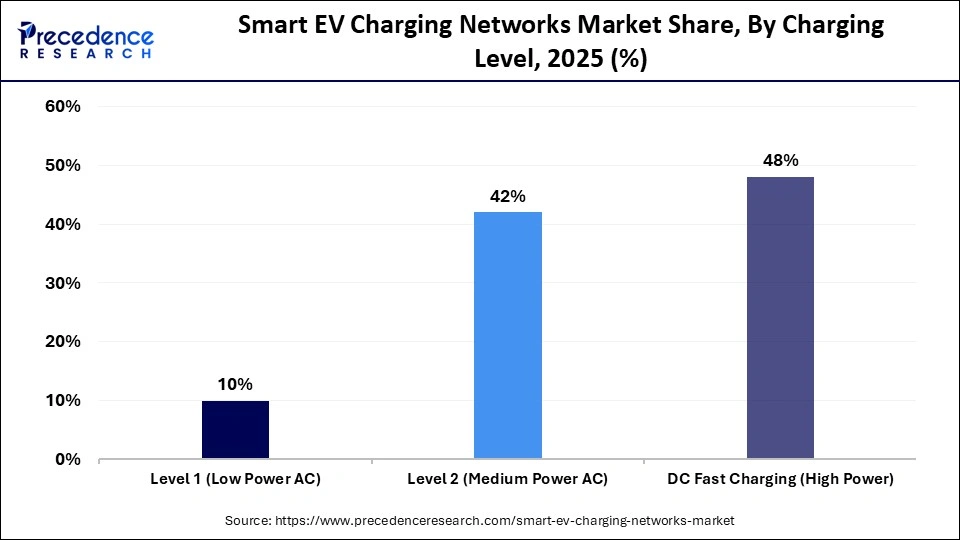
The level 2 charging segment is projected to grow at the fastest CAGR during the foreseeable period due to its offerings like cost-effective installation, wide compatibility, and faster charging speed, which is ideal for destination charging, where a car can be parked for long hours. Level 2 charging systems are equipped with connectivity and smart management software that enable load balancing and proper scheduling to minimize energy costs during peak periods.
Deployment Insights
Why Does the Commercial Deployment Segment Dominate the Smart EV Charging Networks Market?
The commercial deployment segment dominated the market with the largest share in 2025 due to the increased utilization and strong demand supported by government initiatives, advanced functional requirements, high revenue potential, and rapid expansion of public and fleet infrastructure, resulting in faster return on investment (ROI). Commercial charging sites require intelligent networked chargers equipped with advanced features such as dynamic pricing and energy load management to efficiently manage large public fleets, including buses, taxis, and logistics vehicles. Additionally, substantial financial backing and supportive regional government policies for charging infrastructure development continue to be key drivers fueling the growth of this segment.
The residential deployment segment is projected to grow at the fastest CAGR during the foreseeable period due to its capability of overnight charging, convenience for users, high installation base, and lower electricity needs. Many EV users are shifting toward a charging at home approach, which is more cost-effective than public charging rates, and they also offer remote monitoring, software updates, and load management. Governments of various nations are providing subsidies and tax benefits to residential charging point deployment, supporting the segment's growth.
Grid Interaction Capability Insights
What Made Unidirectional Smart Charging the Leading Segment in the Smart EV Charging Networks Market?
The unidirectional smart charging segment led the market, holding the largest share in 2025. This is mainly due to its compatibility with most existing EV models, which allows controlled one-way power flow for load balancing. This charging is highly beneficial for residential and commercial applications. The unidirectional smart charging enables operators to modulate charging speed and time that minimizes load on the grids. Such grid interaction is highly supportive of leveraging renewable energy at its highest capability, supports environmental goals, and increases adoption rates across commercial, residential, and public infrastructure.
The bidirectional charging enabled networks segment is projected to grow at the fastest CAGR during the foreseeable period, as bidirectional chargers work as a distributed energy source and store excessive energy generation during low demand and feed it back when demand is higher. It further transforms vehicles into high-capacity energy storage units. This technology supports market expansion by extending grid resilience and renewable energy integration and offers high revenue generation for consumers through energy arbitrage, fueling the segment growth.
Connectivity Technology Insights
Why Did the Cellular (4G/5G) Connectivity Segment Hold the Highest Share in the Market?
The cellular (4G/5G) segment held the largest share of the market in 2025, as it offers low latency that allows instant communication between vehicle and charger to start charging, dynamic pricing, and handling billing quickly. It further provides high-speed data capabilities, extensive coverage, secure payments, and remote diagnostics of sudden issues. Cellular IoT allows operators to handle station health remotely, perform remote firmware updates, and reduce the need for on-site visits for maintenance, ensuring higher uptime. LTE and NB-IoT offer widespread coverage and make them the first choice for highway charging and rural locations.
The Wi-Fi/Ethernet segment is projected to grow at the fastest CAGR during the foreseeable period due to its unmatched offerings like high bandwidth, reliability, cost-effectiveness, plus secure data transmission capabilities, which are highly crucial for real-time monitoring and smart grid maintenance. Ethernet offers stable and high-speed charging, and wi-fi offers flexible connectivity, making them authentic connectivity technologies for residential and public sites.
Regional Insights
What Made Asia Pacific the Dominant Region in the Smart EV Charging Networks Market?
Asia Pacific dominated the market while holding the largest share in 2025, driven by aggressive government policies and subsidies for EV charging stations, substantial investments in smart EV charging infrastructure, a robust manufacturing base, rapid urbanization, and increasing EV adoption in leading countries. Technological advancements in EVs and charging points further fueled growth in the region. Additionally, the integration of EV charging stations with renewable energy sources such as solar power, along with developments like ultra-fast DC charging, is being increasingly adopted to meet the growing demand, supported by strong government policies and financial incentives.
China Smart EV Charging Networks Market Analysis
China is a major contributor to the Asia Pacific smart EV charging networks market, owing to substantial government investments in infrastructure to achieve carbon neutrality under its “dual carbon” initiative, along with supportive policies aimed at maximizing EV sales. The country hosts the world's largest charging network, supported by a combination of state-owned enterprises and private companies, with a strong focus on fast charging and cost efficiency. Furthermore, China accounts for nearly 70% of global lithium battery production, which indirectly bolsters the growth of the regional EV charging industry and reinforces its position in the market.
How is Europe Rapidly Growing in the Smart EV Charging Networks Market?
Europe is projected to grow at the fastest CAGR during the foreseeable period due to the increasing EV adoption, regulatory mandate for fast charging, and its projection to reach 4 million public charging infrastructure with high-power charging expansion. The region is increasingly adopting AI-powered, software-based, and grid-balanced systems. According to data from March 2025, roads in Europe host 9.3 km of battery EVs and 5.2 m plug-in hybrid electric vehicles. By 2030, the combined EV fleet across countries in Europe is anticipated to reach 50m. Also, the original equipment manufacturers in Europe, like Kia and Shell, have covered 80% of public charging points in Europe, highlighting the rapid growth rate of the market in the region.
Germany Smart EV Charging Networks Market Trends
Germany is spearheading Europe's growth in the smart EV charging networks market, supported by substantial government investment of €3 billion to expand public and private charging stations, with a target of deploying over 1 million public chargers by 2030. Strong collaborations between leading German automakers and energy companies are accelerating the deployment of smart EV charging infrastructure, often integrated with renewable energy sources. The rise of public fast-charging solutions, expansion into rural areas, enhanced focus on convenience and user experience, and rapid adoption of renewable energy generation are all driving market growth.
Smart EV Charging Networks Market Value Chain Analysis
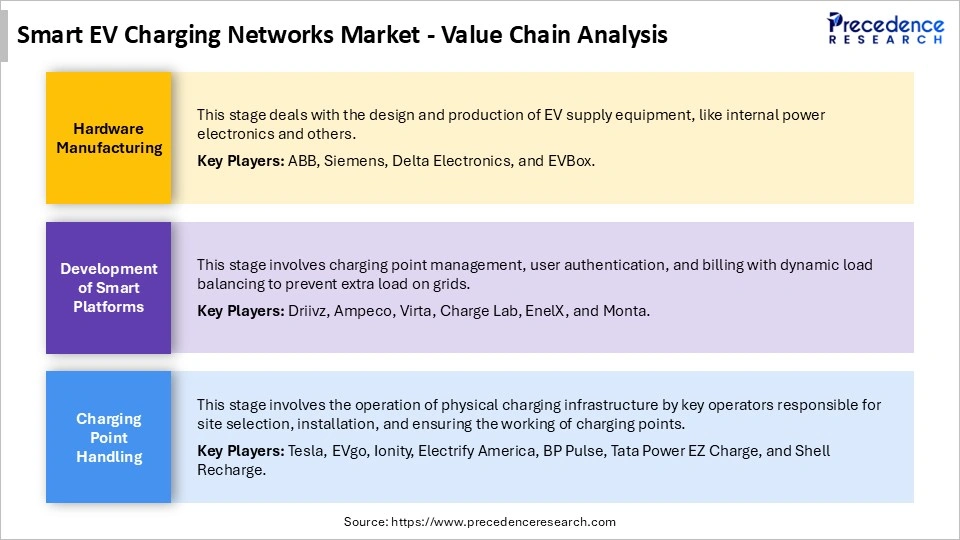
Smart EV Charging Networks Market Companies
- ChargePoint Holdings, Inc (U.S.)
- Tesla, Inc
- ABB Ltd. (Switzerland)
- Siemens AG (Germany)
- Schneider Electric (France)
- EVgo Inc. (U.S.)
- BP Pulse (U.K.)
- EVBox Group (Netherlands)
- Shell Recharge (Netherlands)
- Electrify America, LLC (U.S.)
- Blink Charging Co (U.S.)
- Tritium (Australia)
- Wallbox Chargers Inc. (Spain)
Recent Developments
- In February 2026, Uber Technologies announced a plan to invest a whopping amount of USD 100 million to establish fast charging hubs for autonomous vehicles in the U.S. to meet robotaxi and driverless mobility targets.(Source: https://mexicobusiness.news)
- In July 2025, Guangzhou XPENG Smart Charging Technology Co., Ltd., a subsidiary of Chinese EV maker XPENG, has signed a strategic cooperation agreement with Hubei Changtou Smart Parking Co., Ltd., marking a new phase in the expansion of XPENG's nationwide charging network.(Source: https://autonews.gasgoo.com)
Segments Covered in the Report
By Charging Level
- Level 1 (Low Power AC)
- Level 2 (Medium Power AC)
- DC Fast Charging (High Power)
By Deployment
- Residential
- Commercial
By Grid Interaction Capability
- Unidirectional Smart Charging
- Bidirectional Charging Enabled Networks
By Connectivity Technology
- Cellular (4G/5G)
- Wi-Fi/Ethernet
- Power Line Communication (PLC)
- RF/IoT-based Networks
By Region
- North America
- Europe
- Asia-Pacific
- Latin America
- Middle East & Africa
For inquiries regarding discounts, bulk purchases, or customization requests, please contact us at sales@precedenceresearch.com
Frequently Asked Questions





Ask For Sample
No cookie-cutter, only authentic analysis – take the 1st step to become a Precedence Research client
 Get a Sample




 sales@precedenceresearch.com
 Schedule a Meeting
