



Smart Grid Data Analytics Market Revenue, Leading Companies, Company Technology / Innovation, Service Utilization, Infrastructure Capacity, Sales Performance, Pricing Metrics, Competitive Positioning, and Growth Opportunities
ICT industry specialist Shivani Zoting estimates the smart grid data analytics market at USD 7.69 billion in 2026, with continued technology adoption expected to take the market to USD 20.98 billion by 2035 at a CAGR of 11.84%. Leading smart grid data analytics market providers such as Amdocs Ltd., Auto Grid Systems Inc., are expanding their capabilities across segments including Tata Consultancy Service Ltd., Siemens AG, Capgemini SE.
Source: https://www.precedenceresearch.com/smart-grid-data-analytics-market
 Get a Sample
 Table Of Content


What is the Smart Grid Data Analytics Market Size?
The global smart grid data analytics market size is calculated at USD 6.85 billion in 2025 and is predicted to increase from USD 7.69 billion in 2026 to approximately USD 20.98 billion by 2035, expanding at a CAGR of 11.84% from 2026 to 2035.
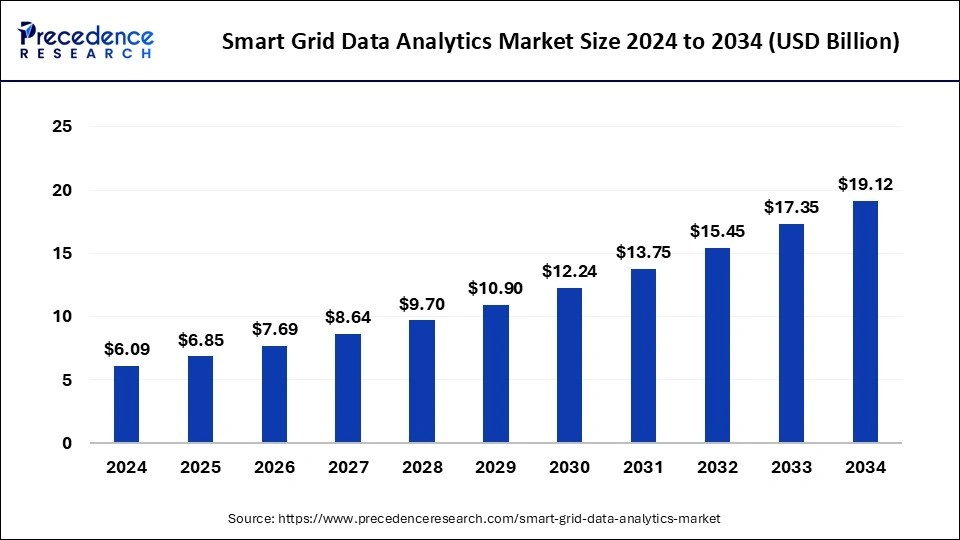
Smart Grid Data Analytics Market Key Takeaways
- The global smart grid data analytics market was valued at USD 6.85 billion in 2025.
- It is projected to reach USD 20.98 billion by 2035.
- The smart grid data analytics market is expected to grow at a CAGR of 11.84% from 2026 to 2035.
- North America dominated the smart grid data analytics market in 2025.
- Asia Pacific is poised to be the fastest-growing market in the coming years.
- By component, the solution segment held the largest share of the market in 2025.
- By deployment, the cloud-based segment is expected to grow at the fastest rate in the market during the forecast period.
- By application, the advanced metering segment is expected to grow at a significant rate in the market in the upcoming period.
- By end user, the large enterprise segment dominated the market in 2025
- By end users, the small & medium enterprise segment is projected to register the fastest growth in the market during the forecast period 2026 to 2035.
Market Overview
The smart grid data analytics market is experiencing substantial growth due to the rising adoption of smart grid technologies and the growing demand for energy efficiency and reliability. With the integration of advanced metering structures, utilities are generating vast amounts of data, which further needs sophisticated analytics to derive actionable plans and insights. The market is propelled due to the government's initiatives and regulatory mandates aimed to modernize electric grids, reduce carbon emissions to enhance energy management.
Smart grid data analytics market has some key trends which includes deployment of AI machine learning particularly for predictive analytics enabling proactive maintenance and real-time decision making. Utilities are leveraging these technologies to optimize operations of grids, to reduce wastages helps in improving consumer service and experience as well. The rise of renewable energy sources and distributed energy sources needs advanced predictive analytics for overall integration and management.
Region-wise, North America currently leads the smart grid data analytics market due to the early adoption of cutting-edge technologies and significant advancements in smart grid projects, followed by Europe and the Asia Pacific. Major players in the market are aiming to make strategic partnerships, mergers, and acquisitions to expand their portfolio on a global scale.
Smart Grid Data Analytics Market Growth Factors
- Enhanced grid reliability and efficiency
- Regulatory mandates for energy efficiency and carbon reduction.
- Development of advanced data analytics tools and platforms.
- Rising emphasis on optimizing the use of stored energy.
- Enhanced data collection and analysis capabilities.
Market Scope
| Report Coverage | Details |
| Market Size by 2035 | USD 20.98 Billion |
| Market Size in 2025 | USD 6.85 Billion |
| Market Size in 2026 | USD 7.69 Billion |
| Market Growth Rate from 2026 to 2035 | CAGR of 11.84% |
| Largest Market | North America |
| Base Year | 2025 |
| Forecast Period | 2026 to 2035 |
| Segments Covered | Component, Deployment, and Regions |
| Regions Covered | North America, Europe, Asia-Pacific, Latin America, and Middle East & Africa |
Market Dynamics
Driver
Advancement in metering infrastructure
A significant driver for the smart grid data analytics market is advancements in smart metering infrastructure (AMI). Smart meters are equipped with digital communication technology to provide real-time data on electricity consumption, power quality, and voltage level with time, which enables both providers and consumers to manage and monitor energy usage effectively. Such real-time data collection is critical for the deployment of smart grid analytics, which transforms raw data into useful insights to improve grid reliability, efficiency, and sustainability.
AMI system extends beyond smart meters and facilitates robust infrastructure support for remote meter reading, data collection and analysis, peak in demand, and its management without failure in provision. The precise data provided by AMI allows utilities to actively address issues before they arise, reducing downtime and saving the overall operational cost.
Additionally, the continuous evolvement in AMI systems incorporated with advanced technologies like IoT and cloud computing again boosts the capabilities of smart grid analytics. These advancements drive the smart grid data analytics market exponentially on a larger scale.
Restraint
Lack of awareness
Despite the significant advancements in smart meters and advanced metering infrastructure, a major restraint for the smart grid data analytics market is the lack of awareness among consumers and some utility companies. Many consumers are not fully aware of the benefits that smart grid technologies can offer, such as improved energy efficiency, cost savings, and enhanced reliability of electricity supply. This lack of awareness can lead to resistance or reluctance to adopt smart meters and participate in demand response programs.
Similarly, smaller utility companies, especially in developing regions, may lack the knowledge and resources to implement and utilize advanced metering infrastructure and data analytics effectively. These utilities might be unaware of the potential return on investment or the long-term operational benefits that smart grid analytics can provide. Additionally, the perceived complexity and cost of deploying AMI systems and integrating sophisticated analytics tools can be a hindrance for utilities with limited budgets and technical expertise. This gap in awareness and understanding hampers the widespread adoption of smart grid technologies, slowing down market growth.
Addressing this challenge requires concerted efforts in education and outreach by industry stakeholders, including governments, utility companies, and technology providers, to demonstrate the value proposition and benefits of smart grid data analytics to both consumers and utilities.
Opportunity
Hybrid deployment model
The hybrid deployment model presents a significant opportunity for the smart grid data analytics market. This approach combines the best aspects of on-premises and cloud-based solutions, offering a flexible and scalable option for utilities seeking to optimize their grid operations without compromising on security and control. With a hybrid model, utilities can manage sensitive data and critical infrastructure on-premises, ensuring compliance with regulatory requirements and maintaining high levels of security. At the same time, they can leverage the cloud for processing large volumes of data and advanced analytics, benefiting from the cloud's scalability, cost-effectiveness, and ease of access to the latest technological advancements.
This model also supports utilities in managing peak loads and enhancing disaster recovery capabilities. During normal operations, utilities can rely on their on-premises infrastructure, but during peak demand or unforeseen events, they can seamlessly shift some of their data processing and analytics workloads to the cloud. This flexibility helps maintain continuous operations and minimize downtime.
Hybrid models facilitate a gradual transition to cloud technologies, enabling utilities to modernize their infrastructure incrementally without significant upfront investments. This reduces the financial and operational risks associated with full-scale cloud adoption. As utilities increasingly recognize the benefits of a hybrid deployment model, the demand for smart grid data analytics solutions that support this flexible approach is expected to grow, driving innovation and expansion in the market.
Segment Insights
[[segment_insights]]
Regional Insights
[[regional_insights]]
Value Chain Analysis
- Input and Raw Material Sourcing
Smart grid analytics begins with raw data that is sourced from smart meters, IoT sensors, phosphate transformers and automation devices. Utilities rely on high accuracy smart meters that are capable of capturing real time energy flow, voltage fluctuations, load patterns, and outage data, thus forming the very backbone of analytics. Major investments are being made recently in edge computing hardware and 5G based connectivity modules.
Key Players: Honeywell, Cisco, Siemens - Manufacturing and Processing
This stage includes the development of analytics platforms that process massive amounts of data sets from various sources like meters, DERs, and EV charging networks, thus turning them into an actionable form of intelligence. Vendors are seen increasingly integrating AI for better optimization, digital twins and better predictive outage management.
Key Players: IBM, Oracle, Hitachi Energy - Distribution Process
Smart grid analytics are distributed or delivered through cloud platforms, hybrid on premise set ups and managed service models where vendors are able to provide continuous monitoring for utilities. Its deployment involves configuring analytics engines to fit various regional rules, tariff structures, thus making it a major value driver. Utilities are expected to shift towards SaaS based analytics, enabling faster roll out of demand forecasting, fraud detection as well as renewable balancing solutions.
Key Players: AWS Energy, Google Cloud, Accenture
Smart Grid Data Analytics Market Companies
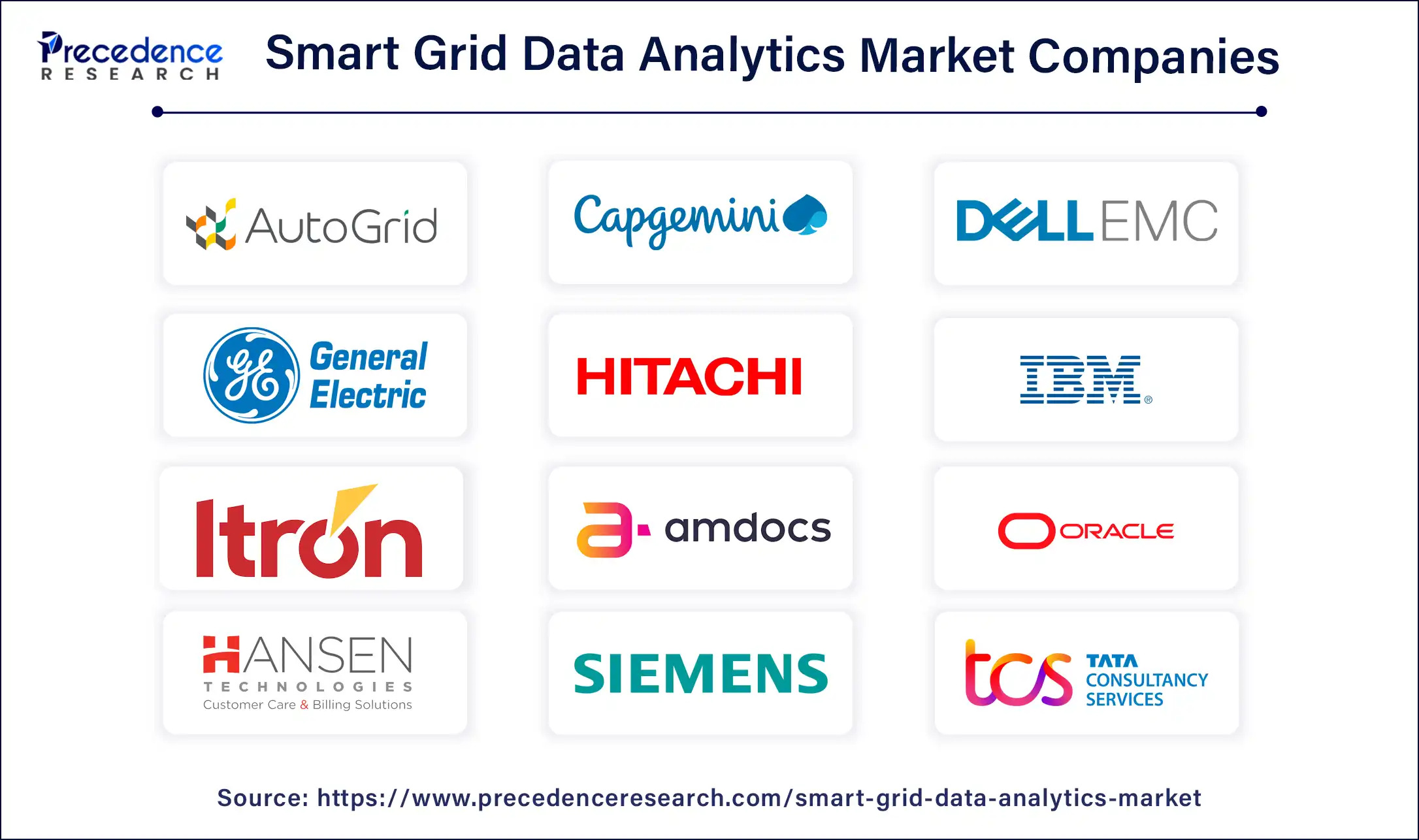
- Amdocs Ltd.
- Auto Grid Systems Inc.
- Tata Consultancy Service Ltd.
- Siemens AG
- Capgemini SE
- Dell EMC
- General Electric
- Hansen Technologies
- L.P.
- Hitachi Ltd
- Oracle Corp.
- IBM Corp.
- Itron Inc.
Recent Development
- In July 2024, AES Ohio chose Landis+Gyr as its technology provider for a grid upgrade project aimed at improving the efficiency of the power distribution system and customer services. AES Ohio will use Landis+Gyr cloud solutions for network management, installation support, and system operating software. The utility will install approximately 500,000 smart meters and a Gridstream Connect IoT platform using RF Mesh IP and cellular networks.
(Source: www.landisgyr.com ) - In June 2024, Schneider Electric, the leader in the digital transformation of energy management and automation, announced the launch of its microgrid solution Villaya Flex. Villaya Flex is a packaged microgrid solution that maximizes clean energy while reducing pollution from genset usage. It was specially designed for communities, facilitating the journey toward decarbonized, independent electricity while meeting today's energy challenges. The solution can be sized, ordered, commissioned, operated, and maintained easily with high levels of battery storage scalability.
(Source: www.se.com ) - In June 2024, 360factors announced the launch of Lumify360, a cutting-edge predictive data analytics platform designed to capture, integrate, and enrich key performance indicators (KPIs) and key risk indicators (KRIs) data with strategic goals, business objectives, and risk appetites. This is further helpful in the smart grid data analytics applications that propel the growth of the market.
Segments Covered in the Report
[[segment_covered]]
For inquiries regarding discounts, bulk purchases, or customization requests, please contact us at sales@precedenceresearch.com
Frequently Asked Questions





Ask For Sample
No cookie-cutter, only authentic analysis – take the 1st step to become a Precedence Research client
 Get a Sample




 sales@precedenceresearch.com
 Schedule a Meeting
