



Smart Tourism Market Size, Share and Trends 2026 to 2035
Smart Tourism Market (By Solution/Service: Smart Ticketing, Smart Engagement, Smart Parking, Smart Guide, Smart City Bots, Others (Smart Security, etc.); By Component: Software, Services, Hardware; By Technology: IoT, AI, Big Data, AR/VR, Cloud Computing Others; By Application: Travel Booking/Reservations, Navigation/Direction Guidance, Virtual Tours, Smart Hospitality, Others; By End-User: Traveler, Governments/Destinations, Hospitality Providers, Tour Operators/Agencies, Others; By Traveler Type: Individual/Family, Business/Corporate, Group/Others) - Global Industry Analysis, Size, Trends, Leading Companies, Regional Outlook, and Forecast 2026 to 2035
Source: https://www.precedenceresearch.com/smart-tourism-market
 Get a Sample
 Table Of Content


What is the Smart Tourism Market Size?
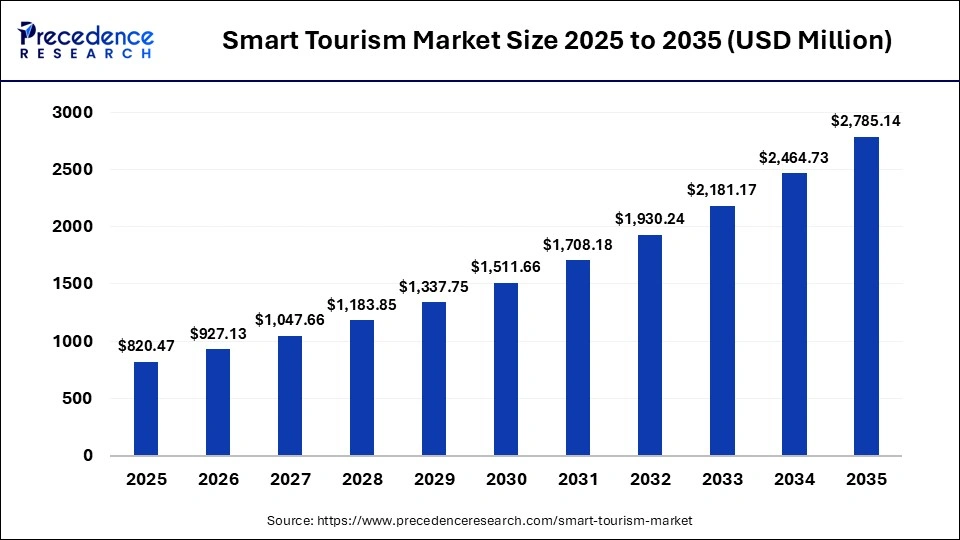
The global smart tourism market size was calculated at USD 820.47 million in 2025 and is predicted to increase from USD 927.13 million in 2026 to approximately USD 2,785.14 million by 2035, expanding at a CAGR of 13.00% from 2026 to 2035. The tourism market is driven by rising smartphone adoption and demand for personalized, tech-enabled travel experiences.
Market Highlights
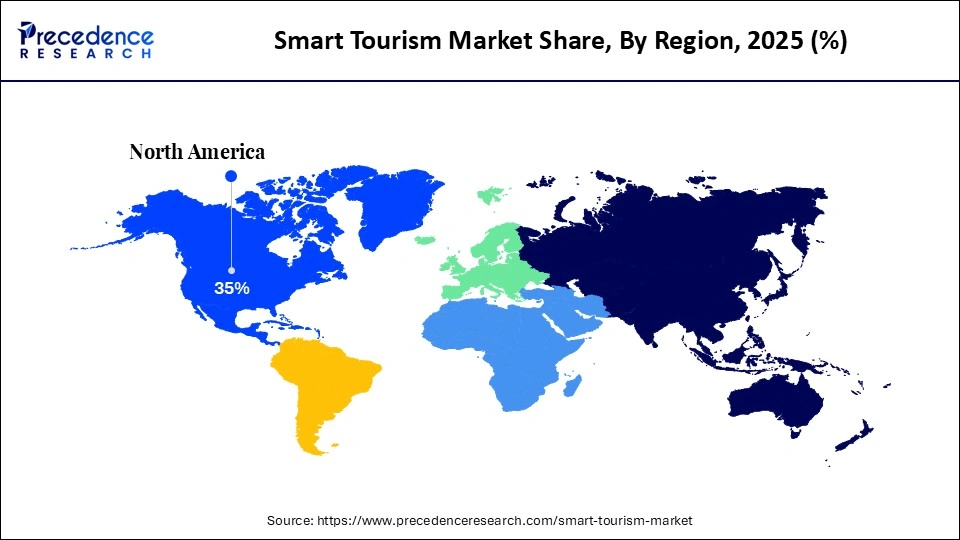
- By region, North America dominated the market with a share of 35% in 2025.
- By region, Asia Pacific is expected to grow at the fastest CAGR of 13.5% during the forecast period.
- By solution/service, the smart ticketing segment held a dominant share of 35% in the market in 2025.
- By solution/service, the smart city bots segment is expected to grow at the fastest CAGR of 11.8% in the market between 2026 and 2035.
- By component, the software segment held a major revenue share of 45% in 2025.
- By component, the services segment is expected to grow at a notable rate during the studied years.
- By technology, the IoT segment led the global market with a share of 28% in 2025.
- By technology, the AR/VR segment is expected to expand at a CAGR of 11.5% in the coming years.
- By application, the travel booking/reservations segment registered its dominance in the market with a share of 35% in 2025.
- By application, the virtual tours segment is expected to grow at the fastest CAGR of 11.6% over the forecast period.
- By end-user, the travelers segment dominated the market with a share of 40% in 2025.
- By end-user, the governments/destinations segment is expected to grow at the highest CAGR of 11.9% between 2026 and 2035.
- By traveler type, the individual/family segment held a major revenue share of 55% in the market in 2025.
- By traveler type, the business / corporate segment is expected to expand at the fastest CAGR of 12.2% over the forecast period.
Market Outlook
The smart tourism market consists of digital and technology-driven solutions that are used to improve the experiences of a traveler, as well as streamline the management of a destination and increase the efficiency of tourism services. The market involves information and communication technologies, mobile application, Internet of Things (IoT), artificial intelligence, cloud computing, AR/VR, and big data analytics to develop connected and smart tourism ecosystems. These technologies connect tourists, service providers, governments, and infrastructure to deliver seamless booking, navigation, personalized engagement, and real-time information. The market is driven by the increased smart city initiatives, demand for contactless services, and investments in digital travel platforms globally.
How Does AI Integration Transform the Smart Tourism Market?
The smart tourism market is being transformed by artificial intelligence, which enables more personalized experiences, operational efficiency, and customer engagement. AI is integrated into smart airports, hotels, and attractions through security monitoring, energy management, and predictive maintenance, enhancing safety and efficiency. Additionally, AI-powered image recognition and AR applications offer immersive experiences such as virtual tours, cultural narration, and real-time translation, enriching the traveler's journey
Smart Tourism Market Trends
- There is increasing adoption of contact-free technologies such as mobile payments, online tickets, face recognition, and QR-based services to shorten wait times, upgrade the level of hygiene, and ensure end-to-end travel experiences.
- Expanding the use of IoT-powered applications like smart hotels, smart luggage tracking, and sensors to optimize operations, conserve energy, and improve the comfort and safety of the guest.
- The growing use of AR and VR applications allows travelers to take virtual previews of destinations, explore museums, and enjoy immersive cultural experiences, helping them plan trips more effectively and enhancing tourism marketing worldwide.
- There is a high usage of big data analytics to promote sustainable tourism by managing visitor flows, minimizing environmental impact, maximizing resource use, and supporting responsible growth at popular destinations.
Market Scope
| Report Coverage | Details |
| Market Size in 2025 | USD 820.47 Million |
| Market Size in 2026 | USD 927.13 Million |
| Market Size by 2035 | USD 2,785.14 Million |
| Market Growth Rate from 2026 to 2035 | CAGR of 13.00% |
| Dominating Region | North America |
| Fastest Growing Region | Asia Pacific |
| Base Year | 2025 |
| Forecast Period | 2026 to 2035 |
| Segments Covered | Solution/Service, Component, Technology, Application, End User, Traveler Type, and Region |
| Regions Covered | North America, Europe, Asia-Pacific, Latin America, and Middle East & Africa |
Segment Insights
Solution/Service Insights
Why Did the Smart Ticketing Segment Lead the Smart Tourism Market?
The smart ticketing segment led the market with a major share of 35% in 2025. This is because smart ticketing helps to provide a fast, secure, and smooth entry of travelers by combining mobile apps, QR codes, NFC, and contactless payments to decrease waiting time and enhance the overall visitor experience. The adoption of smart ticketing solutions has increased over the years, driven by growing penetration of smartphones, preference for convenience by travelers, and good collaboration between tourism authorities, transport operators, and organizers of various events. These solutions enable real-time data analysis to control visitor flows, predict demand tendencies, and make more personalized offers.
The smart city bots segment is expected to grow at the fastest CAGR of 11.8% in the market during the forecast period, driven by their ability to provide real-time assistance to tourists, including navigation, itinerary suggestions, local event notifications, and multilingual services. These bots help governments and city authorities enhance visitor management, reduce reliance on human staff, and offer 24/7 support at key tourist destinations. Their adoption is accelerating alongside investments in smart cities and digital tourism infrastructure, particularly in cities across Asia Pacific and Europe.
Component Insights
Why Did the Software Segment Dominate the Smart Tourism Market?
The software segment dominated the market by holding a major revenue share of 45% in 2025 and is expected to grow at the fastest CAGR of 11.3% throughout the forecast period. This dominance is driven by the widespread use of mobile apps, AI-based recommendation engines, smart ticketing systems, and AR/VR experiences, all of which rely on robust software platforms to integrate transport and destination management systems into unified ecosystems. Cloud-based software and big data analytics enable personalized services, real-time insights, and operational efficiency for tourism stakeholders. Additionally, software facilitates seamless connectivity among tourists, travel agencies, hotels, transport systems, and government bodies, driving higher adoption and revenue share.
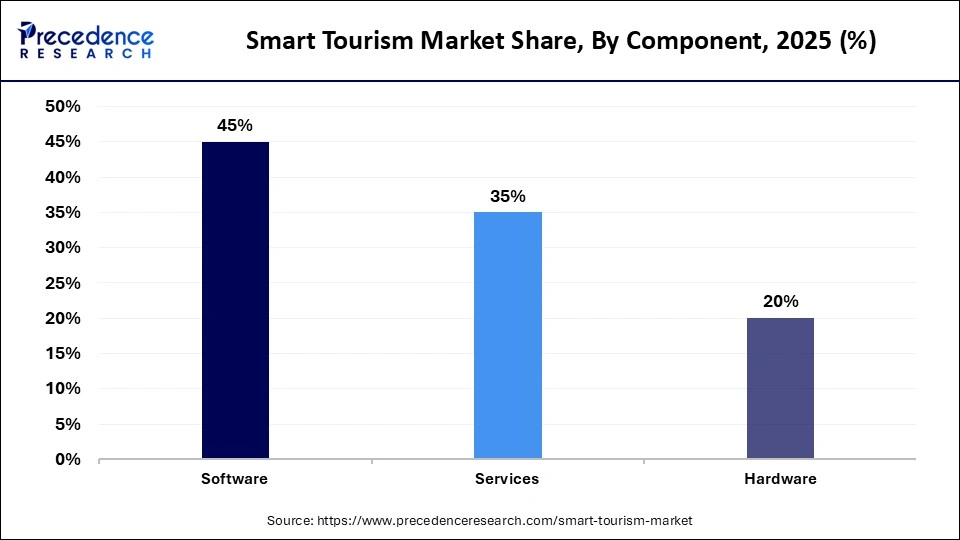
The services segment is expected to grow at the fastest CAGR over the forecast period. This is due to the rising need for seamless integration of AI, IoT, and AR/VR technologies into existing tourism infrastructure. Service providers play a crucial role in system customization, maintenance, data management, and user experience optimization for hotels, airports, attractions, and city platforms as the industry becomes more digital. Their technical expertise, ongoing operational support, and scalable deployment capabilities are key drivers accelerating growth in this segment.
Technology Insights
What Made IoT the Leading Segment in the Smart Tourism Market?
The IoT segment led the global market with a share of 28% in 2025, driven by widespread use of smart sensors, connected devices, wearables, and smart kiosks for real-time monitoring, data collection, and automation. These technologies enhance visitor experiences through personalized guidance, crowd tracking, environmental monitoring, and efficient energy management in smart hotels and attractions. When integrated with mobile applications and AI analytics, IoT enables data-driven decision-making, customized offerings, and supports the development of sustainable tourism practices.
The AR/VR segment is expected to grow at the highest CAGR of 11.5% between 2026 and 2035, driven by its ability to offer immersive and interactive experiences such as virtual destination previews, cultural site exploration, museum tours, and gamified sightseeing. Tourism boards, travel agencies, and hospitality providers are increasingly adopting AR/VR to differentiate their offerings, attract digital-savvy travelers, and deliver personalized experiences. Additionally, AR/VR provides a competitive advantage in crowded tourist locations by enabling virtual access and supporting sustainable visitor management.
Application Insights
Why Did the Travel Booking / Reservations Segment Lead the Smart Tourism Market?
The travel booking/reservations segment registered dominance in the market by holding a share of 35% in 2025, driven by the convenience of booking flights, hotels, transport, and attractions through digital platforms. Real-time availability, dynamic pricing, instant confirmations, secure payments, and easy itinerary management have made these solutions highly popular among individual and family travelers. Additionally, the integration of AI and big data analytics enables personalized recommendations, predictive offers, and loyalty programs, further enhancing customer satisfaction and adoption.
The virtual tours segment is expected to expand at the fastest CAGR of 11.6% over the forecast period. The growth of the segment is driven by VR and AR technologies that allow tourists to explore attractions, museums, historical sites, and cultural landmarks remotely. These solutions provide highly interactive experiences while helping reduce physical congestion at popular destinations, supporting sustainable tourism. Additionally, AI integration enables personalized and tailored experiences based on user interests and past interactions, increasing their value for international travelers, students, and individuals with limited mobility.
End-User Insights
Why Did the Travelers Segment Hold a Major Share in the Smart Tourism Market?
The travelers segment held a major market share of 40% in 2025 because of the widespread adoption of smartphones, mobile apps, and digital services that deliver convenient and personalized travel experiences. Smart tourism solutions support reservations, itinerary planning, real-time updates, and safety notifications, making them highly attractive to individual and family travelers. Additionally, AI-driven recommendations, smart ticketing, and AR/VR experiences, along with increased awareness of contactless and health-focused services post-pandemic, have significantly boosted adoption in this segment.
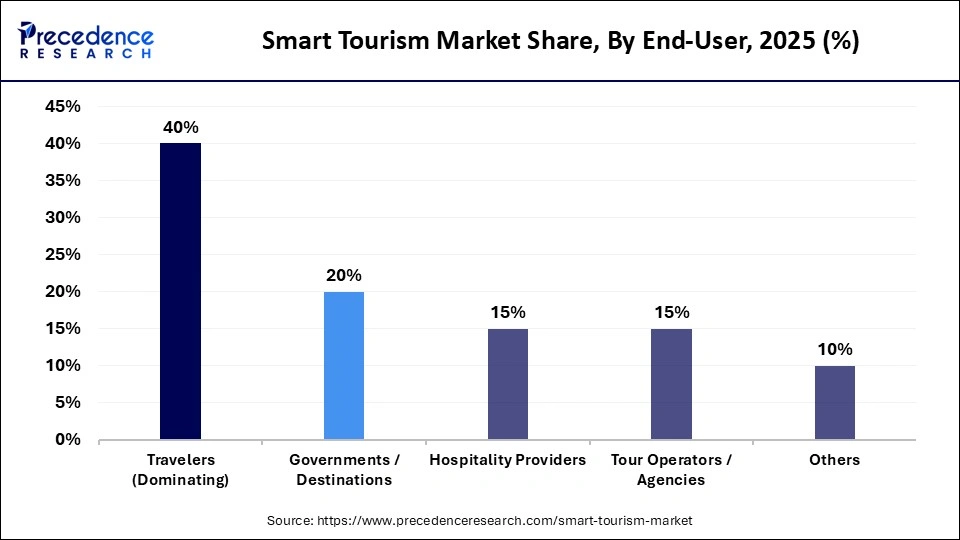
The governments/destinations segment is expected to expand at a CAGR of 11.9% in the coming years, driven by the expanding implementation of smart city initiatives and digital tourism infrastructure. Governments are leveraging AI, IoT, and big data analytics to enable real-time monitoring, crowd management, tourism flow prediction, resource allocation, and effective event planning. Additionally, the adoption of smart ticketing, navigation systems, and interactive platforms is helping authorities enhance visitor safety while preserving cultural heritage and tourism assets.
Traveler Type Insights
Why Did the Individual/Family Segment Lead the Smart Tourism Market?
The individual/family segment led the market, holding a major revenue share of 55% in 2025. This is because travelers increasingly prefer personalized and convenient experiences, including smart ticketing, live navigation, and AR/VR-based immersive activities. High smartphone adoption, rising disposable incomes, and greater travel awareness have driven the uptake of digital tourism solutions in this group. Moreover, integrated platforms connecting transport, accommodation, and attractions allow efficient planning and a seamless travel experience, making this segment the largest contributor to the market.
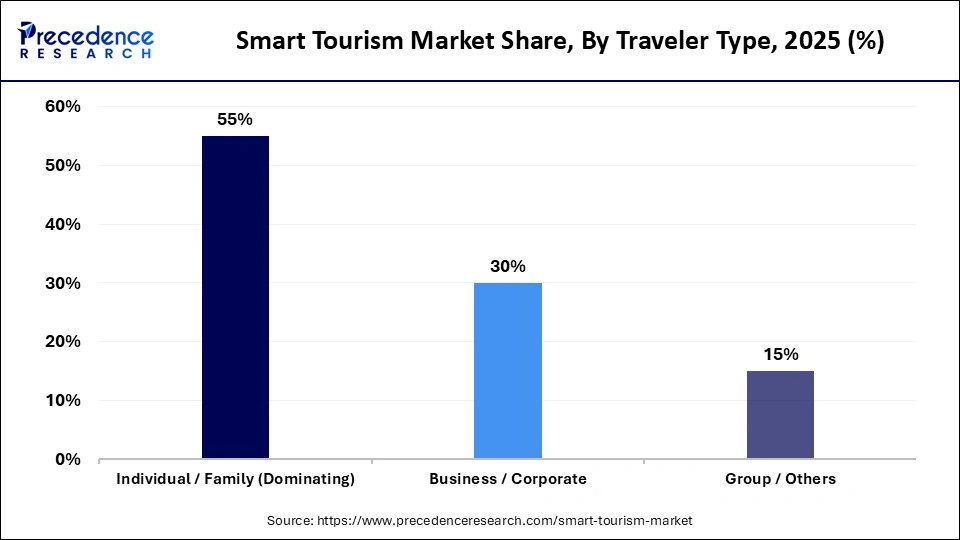
The business / corporate segment is expected to grow at the fastest CAGR of 12.2% over the forecast period, driven by the increasing use of smart tourism solutions for corporate travel, conferences, events, and incentive programs. Companies are leveraging AI, mobile apps, and IoT-based solutions for efficient trip planning, booking management, cost reduction, and employee engagement. Additionally, virtual tours and AR/VR applications enhance productivity and satisfaction for business travelers, while digital tools for corporate sustainability and carbon tracking are further driving adoption in this segment.
Regional Insights
How Big is the North America Smart Tourism Market Size?
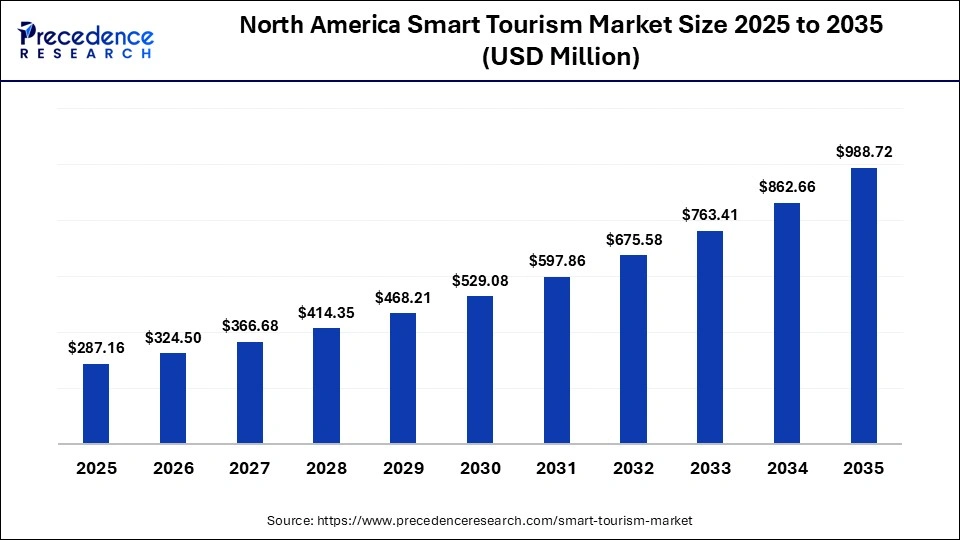
The North America smart tourism market size is estimated at USD 287.16 million in 2025 and is projected to reach approximately USD 988.72 million by 2035, with a 13.16% CAGR from 2026 to 2035.
What Made North America the Dominant Region in the Smart Tourism Market?
North America dominated the smart tourism market by capturing a 35% share in 2025. This is because of a high level of digital adoption and advanced tourism infrastructure. The region's well-developed travel and hospitality industry, including smart airports, connected hotels, and integrated destination management systems, supports the use of AI, IoT, and cloud-based solutions. Additionally, government initiatives promoting smart cities, digital tourism platforms, and sustainable tourism practices have further strengthened market growth in the region.
What is the Size of the U.S. Smart Tourism Market?
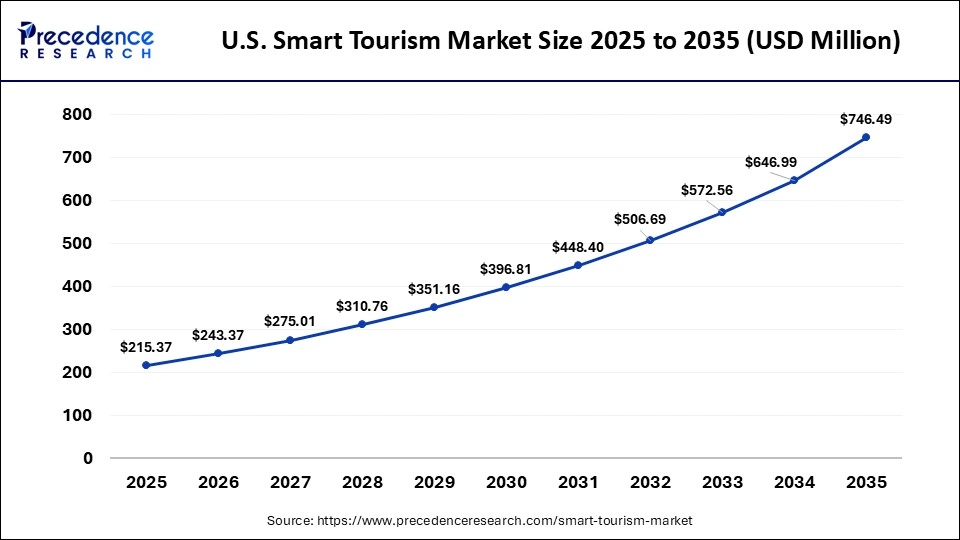
The U.S. smart tourism market size is calculated at USD 215.37 million in 2025 and is expected to reach nearly USD 746.49 million in 2035, accelerating at a strong CAGR of 13.24% between 2026 and 2035.
U.S. Market Analysis
The U.S. is the major contributor to the North American smart tourism market due to widespread mobile device and high-speed internet access, enabling travelers to use apps for bookings, navigation, and virtual experiences. The large volume of domestic and international tourists visiting cities, national parks, and cultural sites increases demand for smart solutions for crowd management and personalized experiences. Additionally, advanced public transit, ride-sharing, and airport systems support real-time tracking, smart ticketing, and seamless mobility, further strengthening the adoption of smart tourism technologies.
Why is Asia Pacific Considered the Fastest-Growing Region in the Smart Tourism Market?
Asia Pacific is expected to grow at the fastest CAGR of 13.5% during the forecast period due to rapid urbanization, rising middle-income populations, and increasing smartphone penetration in countries like China, India, Japan, and those in Southeast Asia. There is strong demand for digital tourism solutions such as AI-based personalization, smart ticketing, AR/VR experiences, and IoT-enabled infrastructure. Additionally, government and tourism board initiatives promoting smart cities, integrated travel management systems, and digital solutions are enhancing visitor interaction, security, and operational efficiency, driving market growth.
India Market Analysis
The smart tourism market in India is growing due to rising smartphone and internet penetration, which enables travelers to access apps for bookings, navigation, and virtual experiences. Increasing domestic and international tourism, along with government initiatives like smart city projects, is driving the adoption of AI, IoT, and AR/VR technologies in hotels, airports, and attractions. Additionally, a growing middle class with higher disposable incomes is fueling demand for personalized, convenient, and technology-driven travel experiences.
Why Europe is Growing in the Smart Tourism Market?
Europe is expected to expand significantly in the market during the forecast period. The focus on monitoring visitor flows and transitioning to eco-friendly travel increases smart tourism adoption. The creation of authentic travel experiences and the focus on easier travel require smart tourism. The rise in green infrastructure and the digital platform expansion increases the use of smart tourism, driving the overall market growth.
Spain Market Trends
Spain is rapidly growing in the market. The emphasis on optimizing travel services and the robust growth in international tourists increase the adoption of smart tourism. The well-developed technological infrastructure and focus on optimizing travel experience increase the adoption of smart tourism. The presence of smart tourism initiatives in over 80 municipalities supports the market growth.
How Latin America is Growing in the Smart Tourism Market?
Latin America is expected to show lucrative growth in the coming years. The simplification of travel booking and the surge in eco-tourism create demand for smart tourism. The customization of travel experiences and the expansion of new technologies increase smart tourism adoption. The surge in app-based services and the expansion of airport infrastructure increase the use of smart tourism, driving the market growth.
Argentina Market Trends
The market in Argentina is growing due to the growing ICT integration in the tourism sector. The rising air capacity and the focus on providing a personalized travel experience increase demand for smart tourism. The well-established transport links and rise in airport modernization support the market growth.
Who are the Major Players in the Global Smart Tourism Market?
The major players in the smart tourism market include Booking Holdings Inc., Expedia Group, Amadeus IT Group, Sabre Corporation, Trip.com Group, Airbnb Inc., Google Travel (Google LLC), Microsoft Corporation (Travel tech), Siemens AG, NEC Corporation, Cisco Systems, Inc., Huawei Technologies, Accenture PLC, Travelport Worldwide Ltd., and Cubic Transportation Systems, Inc.
Recent Developments
- In February 2026, Hoi An launched a smart ticketing system with multilingual support. The system includes 20 languages, and users can easily pay using QR codes. The ticketing system enhances convenience and improves service quality.
(Source: https://news.tuoitre.vn) - In January 2026, China Daily launched an English-language smart-tourism service platform, China Bound, for international travelers. The new website is available on mobile devices and desktops. The platform offers convenient ticket booking and develops personalized itineraries. The diverse sections of platforms are Itinerary Planning, Must-try-Foods, Travel Destinations, and Must-buy Items.
(Source: https://www.chinadaily.com.cn) - In November 2025, MGTO collaborated with Gaode Maps to launch a smart tourism platform, Amap. The platform improves the experience of visitors and offers greater ease. The platform includes accommodations, dining, itinerary planning, entertainment, and attractions.
(Source: https://macaudailytimes.com.mo)
Segments Covered in the Report
By Solution/Service
- Smart Ticketing
- Smart Engagement
- Smart Parking
- Smart Guide
- Smart City Bots
- Others (Smart Security, etc.)
By Component
- Software
- Services
- Hardware
By Technology
- IoT
- AI
- Big Data
- AR/VR
- Cloud Computing
- Others
By Application
- Travel Booking/Reservations
- Navigation/Direction Guidance
- Virtual Tours
- Smart Hospitality
- Others
By End-User
- Travelers
- Governments/Destinations
- Hospitality Providers
- Tour Operators/Agencies
- Others
By Traveler Type
- Individual/Family
- Business/Corporate
- Group/Others
By Region
- North America
- Europe
- Asia-Pacific
- Latin America
- Middle East & Africa
For inquiries regarding discounts, bulk purchases, or customization requests, please contact us at sales@precedenceresearch.com
Frequently Asked Questions
Tags





Ask For Sample
No cookie-cutter, only authentic analysis – take the 1st step to become a Precedence Research client
 Get a Sample




 sales@precedenceresearch.com
 Schedule a Meeting
