



Supplemental Health Market Size, Companies, Share, Patient Volume, Treatment Adoption Rates, Pricing Analysis, Regulatory Landscape, Competitive Positioning, and Demand Forecast
Supplemental Health Market (By Product Type: Critical Illness Insurance, Hospital Indemnity, Accident Insurance, Dental and Vision; By End-User (Demography): Working Adults (Age 21-64), Seniors (65+), Under-65 with Disabilities; By Coverage Type: Individual Plans, Group Plans (Employer-Sponsored); By Distribution Channel: Brokers and Agents, Employer/Workplace Programs, Direct-to-Consumer (DTC)/Online) - Global Industry Analysis, Size, Trends, Leading Companies, Regional Outlook, and Forecast 2026 to 2035
Source: https://www.precedenceresearch.com/supplemental-health-market
 Get a Sample
 Table Of Content


What is Supplemental Health Market Size in 2026?
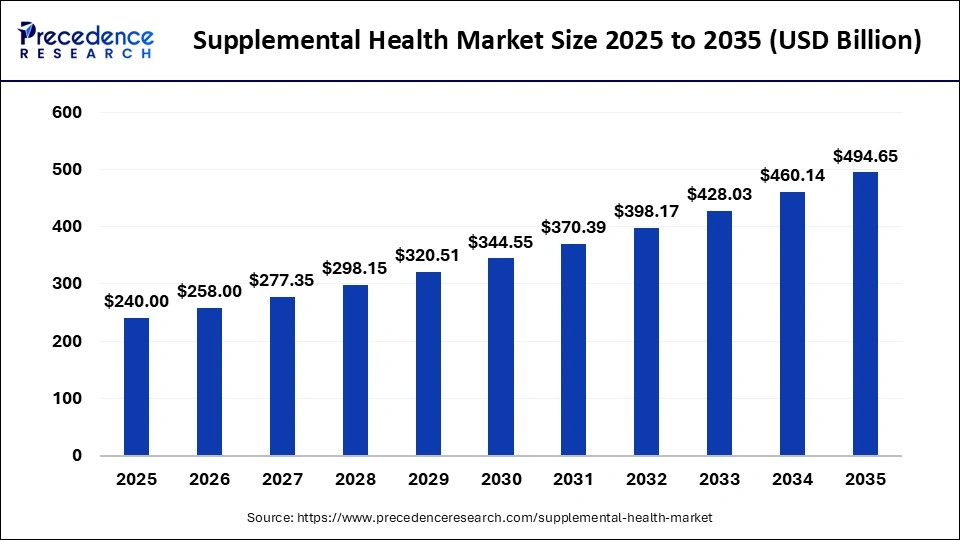
The global supplemental health market size was calculated at USD 240.00 billion in 2025 and is predicted to increase from USD 258.00 billion in 2026 to approximately USD 494.65 billion by 2035, expanding at a CAGR of 7.50% from 2026 to 2035. This market is growing due to the rapid growth in high-deductible health plans (HDHPs), increasing healthcare costs, and the rising prevalence of chronic disorders.
Key Takeaways
- North America dominated the global supplemental health market in 2025.
- Asia-Pacific is expected to grow at the fastest CAGR between 2026 and 2035.
- By product type, the critical illness insurance segment held the largest revenue share of the market in 2025.
- By product type, the accident insurance segment is expected to expand at the fastest CAGR between 2026 and 2035.
- By end-user (demography), the working adults (age 21-64) segment accounted for the highest market share in 2025.
- By end-user (demography), the seniors (65+) segment is expected to expand at the fastest CAGR between 2026 and 2035.
- By coverage type, the individual plans segment led the market in 2025.
- By coverage type, the group plans (employer-sponsored) segment is expected to expand at the fastest CAGR between 2026 and 2035.
- By distribution channel, the brokers and agents segment contributed the biggest revenue share of the market in 2025.
- By distribution channel, the employer/workplace programs segment is expected to expand at the fastest CAGR between 2026 and 2035.
What Drives the Supplemental Health Market?
The supplemental health industry is mainly driven by growing healthcare expenses, increasing out-of-pocket costs, and a growing aging population with chronic disorders. The prevalence of chronic illnesses such as heart disease and hypertension drives up the requirement for specialized coverage, like hospital indemnity. There is growing consumer knowledge regarding health risks, which has boosted the need for supplemental products. Supplemental health insurance enhances the accessibility and affordability of advanced healthcare through deductibles, copayments, and coinsurance.
How is AI Influencing the Supplemental Health Market?
Artificial Intelligence is revolutionizing the market by driving personalization in insurance products, automating underwriting processes, enhancing claims efficiency, and improving customer engagement via predictive analytics. AI-powered systems are decreasing the time and cost associated with processing, with few tools capable of predicting fraudulent claims and streamlining payouts, thus sometimes before a claim is formally filed. Insurers are utilizing AI to track health data and forecast potential complications, allowing preventive measures that decrease long-term costs and enhance policyholder health.
What are the Key Trends Influencing the Supplemental Health Market?
- Expansion of Digital Services & Telehealth: The post-COVID era has cemented telehealth as a staple in supplemental plans, improving access to care and convenience.
- Technology-Led Personalization (AI & Wearables): Insurers are using AI and data analytics to create personalized health plans, while wearables (smartwatches) are being integrated to provoke proactive health management and even monitor real-time data.
- Rising Medical Costs: Due to high inflation in healthcare expenses, there is an increased consumer need for supplemental insurance to cover gaps in primary, mainly in covering high-deductible plans.
- Focus on Preventive Care & Wellness: Supplemental products now usually include wellness-focused benefits, like fitness program incentives, nutrition counseling, and even mental health support, to decrease long-term risk.
Future Market Insights
- Expansion in Emerging Markets: It is driven by rising incomes, growing health knowledge, and even underpenetrated systems in Asia, Africa, and Latin America. Increased need for coverage against rising out-of-pocket expenses, coupled with aging populations and higher non-communicable disease rates, fuels significant expansion opportunities for private insurers.
- Infrastructure Development: In India, this initiative is establishing a digital backbone for the entire healthcare ecosystem, thus creating a repository for health records and allowing digital, interoperable services. Infrastructure projects are aiming to establish critical care blocks along with laboratories in underserved areas to tackle regional imbalances in tertiary care.
Marekt Scope
| Report Coverage | Details |
| Market Size in 2025 | USD 240.00 Billion |
| Market Size in 2026 | USD 258.00 Billion |
| Market Size by 2035 | USD 494.65 Billion |
| Market Growth Rate from 2026 to 2035 | CAGR of 7.50% |
| Dominating Region | North America |
| Base Year | 2025 |
| Forecast Period | 2026 to 2035 |
| Segments Covered | Product Type, End User, Coverage Type, Distribution Channel, and Region |
| Regions Covered | North America, Europe, Asia-Pacific, Latin America, and Middle East & Africa |
Market Dynamics
Driver
Rising Healthcare Costs and Coverage Gaps
Rising medical costs, coupled with expensive health insurance, are forcing many Americans to seek health insurance that goes above their primary insurance coverage. Many people are opting to buy supplementary insurance coverages such as accident, critical illness, dental, and hospital plans.
Restraint
High Premium Costs and Complex Policy Terms
Premiums might be relatively high, and the policy itself could be quite complex, thus preventing market expansion. Supplemental insurance policies tend to confuse consumers because of their various exceptions and claims procedures, especially for those from lower economic backgrounds.
Opportunity
Growth of Digital Health and Personalized Insurance Plans
Increasing usage of digital healthcare platforms and telemedicine services, and the use of claims processes based on AI technology, present many possibilities within the industry. There has been a marked trend toward personalized and health-centric insurance plans by insurance companies.
Segment Insights
Product Type Insights
Which Product Type Segment Dominated the Supplemental Health Market?
The critical illness insurance segment led the market in 2025, due to its ability to offer a lump-sum payment upon diagnosis, which thus covers non-medical expenses such as mortgage payments, rehabilitation, and living expenses. It bridges gaps in standard health plans that usually have high deductibles. Critical illness insurance covers medical costs against severe and life-threatening diseases, such as cancer and cardiovascular diseases.
The accident insurance segment is expected to grow at the fastest CAGR throughout the forecast period. This is due to rising knowledge of safety, increasing out-of-pocket costs, and the demand for financial protection against unexpected injuries. There is an increased acceptance of digital platforms that permit easy purchase, while many policies are portable, thus maintaining coverage even if employment changes. The increasing number of road accidents globally encourages people to opt for accident insurance.
End-User (Demography) Insights
Why Did the Working Adults (age 21-64) Segment Dominate the Supplemental Health Market?
The working adults (age 21-64) segment dominated the market in 2025. This is because of demographic shifts, rising health consciousness among senior populations, and even advancements in nutritional science. As global populations age, the need for targeted supplements that support mobility, cognitive health, and even overall wellness continues to rise.
The seniors (65+) segment is expected to witness the fastest growth in the market over the forecast period, due to rising expenses of chronic disease management and hospitalization, which standard, primary, or government-provided health plans usually fail to cover adequately. As the population ages, these demographics demand a more frequent medical attention, thus making supplemental coverage a necessity rather than a luxury.
Coverage Type Insights
How the Individual Plans Segment Dominated the Supplemental Health Market?
The individual plans segment held the largest market share in 2025. This is because of the rising healthcare expenses and high out-of-pocket costs; consumers are increasingly seeking supplemental policies to cover gaps in their main insurance, such as critical illness, hospital indemnity, or specialized in-hospital dental coverage. A decline in fully insured group plans has spurred a shift toward individual coverage arrangements, where employers offer funds for employees to buy their own individual plans, further boosting the segment's growth.
The group plans (employer-sponsored) segment is expected to gain the highest market share between 2026 and 2035, due to significant cost advantages of risk pooling, tax efficiencies for both employers and employees, and the ease of administration and enrollment. By leveraging large group sizes, insurers can provide comprehensive coverage, such as dental and vision, along with critical illness, at lower premiums than individual policies.
Distribution Channel Insights
Which Distribution Channel Segment Dominated the Supplemental Health Market?
The brokers and agents segment registered its dominance over the global market in 2025 because brokers are deemed vital for understanding, comparing, and selecting appropriate, usually complex, supplemental plans. Brokers and agents together command across 50% of the total health insurance premiums. In the non-life segment, they generate a significant portion of new business. They provide value-added services, including managing claims, providing employee benefits for firms, and offering wellness programs.
The employer/workplace programs segment is expected to grow at the fastest CAGR in the market between 2026 and 2035, as these plans are vital for recruiting and retaining talent in a competitive market while offsetting growing, high-deductible healthcare expenses for employees. Employers use these advantages to differentiate their compensation packages and enhance workforce productivity, with 90% of privately insured Americans, thus, under 65, obtaining coverage through employers.
Regional Insights
What Made North America the Dominant Region in the Supplemental Health Market?
North America held a major market share in 2025. The region's dominance in the market is attributed to being driven by the increasing healthcare expenses, evolving consumer needs, and an emphasis on personalized health coverage. As healthcare expenditures continue to rise, anticipated to reach over $4 trillion in the U.S. alone by 2025, individuals and employers are seeking innovative solutions to bridge gaps in conventional health insurance plans.
The U.S. leads the market in North America due to the fact that high-deductible health plans are becoming common, thus leaving employees with high out-of-pocket costs for critical illnesses or accidents. Supplemental plans assist bridge these financial gaps. Workers are seeking more flexible, tailored benefits, which include mental health services, telemedicine, and even financial wellness products. About 70% of employers find that these plans assist in recruiting and retaining talent.
What Makes Asia-Pacific the Fastest-Growing Region in the Supplemental Health Market?
Asia-Pacific is expected to grow at the fastest CAGR throughout the forecast period, due to a convergence of rapid, large-scale demographic shifts, growing economic prosperity, and a fundamental change in user attitudes toward health. Significant economic expansion has increased disposable incomes, enabling a rapidly expanding middle-class population in countries such as India and China to spend more on health-related products and even private insurance to bridge gaps in public coverage.
China Market Trends
The Chinese market is driven by a blend of cultural influences along with contemporary health consciousness. Government and private insurers provide customized offers to Chinese people, helping them benefit from the rising healthcare expenditure. The growing geriatric population, sedentary lifestyles, and the increasing number of hospitalizations promote the need for supplemental health among the Chinese population.
What Makes Europe a Significant Region in the Supplemental Health Market?
Europe is expected to grow at a significant CAGR throughout the forecast period, driven by the increasing healthcare expenses of individuals, aging populations, and a growing preference for personalized health coverage. Increasing out-of-pocket expenses and gaps in standard insurance coverage compel users to seek supplementary plans that offer financial protection and access to a wider range of healthcare services.
UK Market Trends
The UK market is driven by the high prevalence of conditions such as diabetes and obesity, which has increased the use of nutritional supplements as a complementary measure. This is due to high inflation and even cost-of-living concerns, businesses are re-evaluating conventional private medical insurance (PMI) in favor of more targeted, cost-effective, and accessible group health plans.
What Makes Latin America a Notable Region in the Supplemental Health Market?
Latin America is expected to grow at a notable CAGR in the coming years. With a population exceeding 650 million, a remarkable shift toward an older demographic is driving, or creating, a high need for chronic disease management and age-associated supplements for orthopedic, cognitive, and cardiovascular health. The rapid acceptance of e-commerce, AI-driven personalized nutrition, and even health apps, which 81% of users are willing to pay for, is expanding access to supplements in urban areas.
Brazil Market Trends
Brazil's market is driven by a shift toward preventative health, a high need for sports nutrition, leading to rapid digital transformation in insurance, with key players such as Amil and Unimed expanding via mergers. The Supplementary Health System (SHS) in Brazil has more than 700 Health Maintenance Organizations (HMOs) and offers health plans to more than 26% of the Brazilian population.
Which Factors Drive the Supplemental Health Market in the Middle East and Africa?
The Middle East and Africa are expected to grow at a considerable CAGR in the upcoming period. The MEA region faces high rates of lifestyle-related diseases, which include obesity, diabetes, and cardiovascular conditions, which have fueled the need for preventive and management solutions. Policies demanding insurance for expats, visitors, and residents, mainly in Saudi Arabia and the UAE, have driven the overall health insurance market.
UAE Market Trends
The healthcare ecosystem in the UAE is expanding at a rapid pace, with several insurance policies offered by government organizations. Employers are also becoming aware of employees' physical and mental health, thereby providing enhanced access to treatment. The UAE citizens get a “Thiqa” card, which gives them full access to many private and public healthcare providers registered with semi-government insurers.
Supplemental Health Market Companies
- American International Group, Inc.: Accident insurance, critical illness insurance, travel insurance, and supplemental employee health insurance services.
- Anthem, Inc.: Supplemental health insurance plans, dental insurance, vision insurance, and employer health insurance plans.
- MetLife, Inc: Disability insurance, accident insurance, dental insurance, and employee wellness benefits.
- Zurich Insurance Group AG: Supplemental accident insurance, corporate health insurance, and employer assistance health insurance plans.
- Assurant, Inc.: Supplemental health products, specialty insurance, and consumer health insurance plans.
Other Major Key Players
- UnitedHealthcare
- Humana Inc
- Prudential Financial
- Guardian Life Insurance
- Allstate Benefits
- Colonial Life
- Aetna (CVS Health)
- Mutual of Omaha
- Ameritas Life Insurance Corp.
Recent Developments
- In May 2026, Chubb launched new cancer coverage solutions in Canada under its supplemental health insurance portfolio, helping customers manage treatment costs and improve financial protection during cancer care. (Source: https://simplywall.st)
- In February 2026, Securian Financial launched AI-enabled instant decision and payment capabilities for supplemental health insurance claims, enabling real-time claim approvals and payments within minutes for eligible customers. (Source: https://www.businesswire.com)
- In December 2025, USDA launched the Regenerative Agriculture Pilot Program to help farmers lower production costs, improve soil health, and support sustainable farming practices across the U.S. (Source: https://www.usda.gov)
- In February 2026, Securian Financial announced the launch of AI-enabled instant claims decision and benefit payment capabilities for its supplemental health insurance products. The platform enhances decision-making through real-time results. It offers benefits across accident, critical illness, and hospital indemnity. (Source: https://www.businesswire.com)
- In May 2025, the Guardian Life Insurance Company declared the addition of over 20 benefits to its hospital indemnity insurance to support holistic workforce well-being. As part of these additions, Guardian thus becomes the first carrier to include family-building, fertility health, and caregiving wellness solutions directly in hospital indemnity insurance.(Source: https://www.prnewswire.com)
Segments Covered in the Report
By Product Type
- Critical Illness Insurance
- Hospital Indemnity
- Accident Insurance
- Dental and Vision
By End-User (Demography)
- Working Adults (Age 21-64)
- Seniors (65+)
- Under-65 with Disabilities
By Coverage Type
- Individual Plans
- Group Plans (Employer-Sponsored)
By Distribution Channel
- Brokers and Agents
- Employer/Workplace Programs
- Direct-to-Consumer (DTC)/Online
By Region
- North America
- Asia Pacific
- Europe
- Latin America
- Middle East & Africa
For inquiries regarding discounts, bulk purchases, or customization requests, please contact us at sales@precedenceresearch.com
Frequently Asked Questions
Tags





Ask For Sample
No cookie-cutter, only authentic analysis – take the 1st step to become a Precedence Research client
 Get a Sample
.webp)



 sales@precedenceresearch.com
 Schedule a Meeting
