



Third Party Payment Market Trends, Companies, Revenue / Sales Performance, Subscriber Growth, Pricing Strategies, Cloud Adoption, Infrastructure Expansion, Competitive Landscape, and Industry Outlook
Third Party Payment Market (By User Type: Individuals, Small Businesses, Large Enterprises; By Service Type: Payment Processing, Fraud Detection, Risk Management, Compliance Solutions; By Payment Method: Credit/Debit Cards, E-Wallets, Bank Transfers, Cryptocurrencies; By Transaction Type: Online Transactions, In-store Transactions, Mobile Transactions; By Technology Adoption: Emerging Technologies, Legacy Systems, Integrated Solutions) - Global Industry Analysis, Size, Trends, Leading Companies, Regional Outlook, and Forecast 2026 to 2035
Source: https://www.precedenceresearch.com/third-party-payment-market
 Get a Sample
 Table Of Content


What is the Third Party Payment Market Size in 2026?
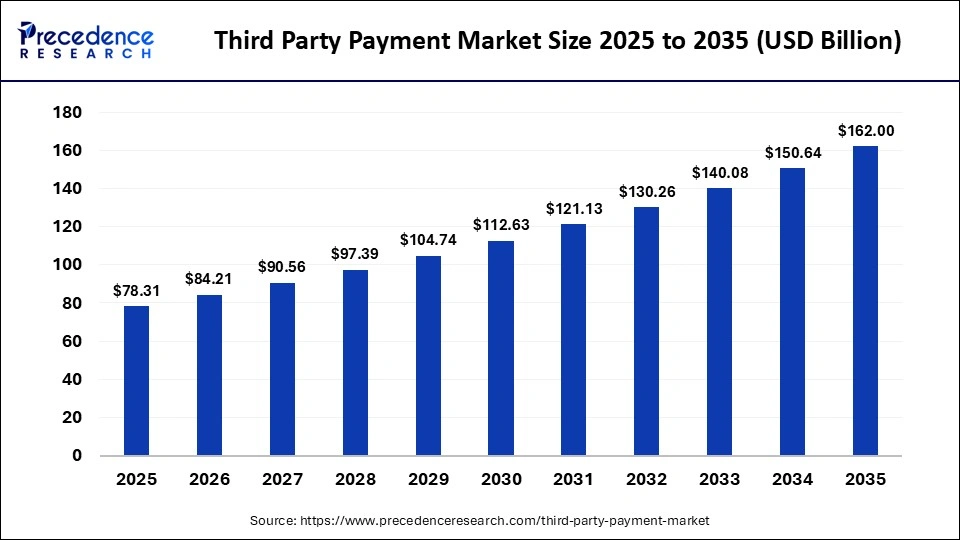
The global third party payment market size was calculated at USD 78.31 billion in 2025 and is predicted to increase from USD 84.21 billion in 2026 to approximately USD 162.00 billion by 2035, expanding at a CAGR of 7.54% from 2026 to 2035.The market is driven by rising digital payment adoption, expanding e-commerce, and increasing demand for secure cashless transactions.
Key Takeaways
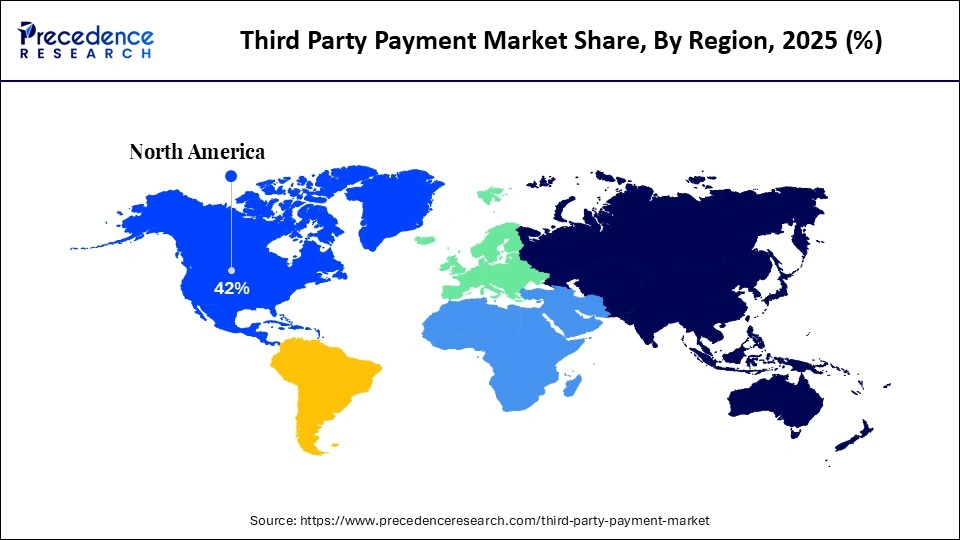
- North America accounted for the largest share of 42% in 2025.
- The Asia Pacific is expected to witness the fastest growth over the forecast period.
- By payment method, the credit/debit cards segment held the largest market share in 2025.
- By payment method, the e-wallets segment is expected to grow at the fastest rate in the market over the forecast period.
- By transaction type, the online transactions segment held a significant share of the market in 2025.
- By transaction type, the mobile transactions segment is expected to show the fastest growth in the market over the forecast period.
- By user type, the individuals segment held a significant market share in 2025.
- By user type, the small businesses segment is expected to show considerable growth in the market over the forecast period.
- By service type, the payment processing segment dominated the market in 2025.
- By service type, the fraud detection segment is anticipated to expand at the fastest CAGR in the market over the forecast period.
- By technology adoption, the integrated solutions segment held a significant share of the market in 2025.
- By technology adoption, the emerging technologies segment is anticipated to show considerable growth in the market over the
- forecast period.
Market Overview
The trend toward digital commerce and the expansion of the cashless financial ecosystems are driving the third party payment market. Third-party payment serves as the mediator in facilitating electronic transactions between businesses and preventing them from opening specific merchant accounts, making it easier to onboard and handle payments. Technology applications such as PayPal and Stripe have transformed the way payment processes are conducted by offering secure, scalable, and easy-to-use services to both small and large business owners. Consumers are increasingly demanding fast methods of payment, contactless payment, and secure payment, and this forces companies to introduce third-party payment systems into their operations to enhance customer experience and operational performance. In addition, the accelerating cybersecurity has raised the rate at which these providers invest in encrypted payment gateways, fraud detection systems, and compliance systems.
How is AI Influencing the Third Party Payment Market?
The use of artificial intelligence is revolutionizing the third party payment market by enhancing transaction security, operational efficiency, and the overall customer experience. AI-based algorithms can detect fraudulent activities in real time by analyzing transaction patterns, user behavior, and risk indicators, preventing unauthorized actions before they occur. Leading payment systems such as PayPal and Stripe leverage machine learning to automate payment processing, optimize transaction routing, and minimize financial losses. Additionally, AI enhances customer interaction through intelligent chatbots, personalized payment suggestions, and predictive analytics that anticipate consumer buying trends.
Third Party Payment Market Trends
- There is a rising popularity of mobile wallets, which are transforming the way in which payments are made in the global world. Quick and contactless payments are provided by Apple Pay, Google Pay, and other technologies, and people have begun to change their preference to make payments through their mobile devices, and merchants have begun to introduce efficient digital checkout systems.
- The growth of e-commerce at the global level has increased the pace of demand in cross-border payments. Third-party payment systems help in making it easier to convert currencies, comply, and settle, enabling companies to access overseas clients and minimize the complexity of business operations and transactional friction in cross-national online purchases.
- Increasing cyber threats have forced payment providers to spend millions of dollars on artificial intelligence-based fraud detection, biometric authentication, tokenization, and encryption solutions. Advanced security systems are boosting consumer trust and increasing transactions in digital payment systems on a global scale.
- Advanced APIs are enabling businesses to add payment features to apps, marketplaces, and digital platforms. Firms such as Stripe make it possible to integrate financial services, and merchants can process payments, subscriptions, lending, and financial analytics using the same ecosystem.
Market Scope
| Report Coverage | Details |
| Market Size in 2025 | USD 78.31 Billion |
| Market Size in 2026 | USD 84.21 Billion |
| Market Size by 2035 | USD 162.00 Billion |
| Market Growth Rate from 2026 to 2035 | CAGR of 7.54% |
| Dominating Region | North America |
| Fastest Growing Region | Asia Pacific |
| Base Year | 2025 |
| Forecast Period | 2026 to 2035 |
| Segments Covered | User Type, Service Type, Payment Method,T ransaction Type, Technology Adoption ,and Region |
| Regions Covered | North America, Europe, Asia-Pacific, Latin America, and Middle East & Africa |
Segment Insights
Payment Method Insights
Why Does the Credit/Debit Cards Segment Lead the Third Party Payment Market?
The credit/debit cards segment led the market with the largest revenue share in 2025 because of their high market penetration, consumer trust, and acceptance in all online and offline merchant networks. Cards are likely to continue to be the favorite means of payment by a wide range of people with a good banking system and good regulatory support. Their predominance is supported by the improved mechanisms of security, including tokenization, EMV authentication, and multi-factor validation, which increase consumer trust in digital payments. Additionally, loyalty programs, rewards, and flexible payment options further encourage adoption, making credit and debit cards the preferred choice for third-party payment platforms globally.
The e-wallets segment is expected to grow at a significant CAGR over the forecast period due to the accelerated digitalization, the growth of smartphone usage, and the shift in consumer payment preferences. E-wallets provide real-time payments, simpler onboarding, and compatibility with mobile applications, which is a benefit that attracts tech-savvy consumers who need convenient and efficient services more. The reality is that they enable consumers to save on different payment options, peer-to-peer transactions, and enable them to use QR-code services. Governments and fintech companies are motivating the use of digital wallets by promoting financial inclusion programs and cashless economy programs to facilitate the usage of digital wallets, primarily in emerging markets.
Transaction Type Insights
Why Did the Online Transactions Segment Contribute the Most Revenue in the Third-Party Payment?
The online transactions segment held the largest share of the market in 2025 due to the growth of e-commerce, subscription services, and digital service ecosystems. Consumers increasingly prefer online purchases due to convenience, product variety, competitive pricing, and ease of comparison. Third-party payment providers enhance this experience by ensuring secure checkouts, providing instant payment confirmations, and supporting multiple currencies. The widespread integration of payment gateways across retail websites, streaming platforms, travel booking portals, and educational services has further reinforced the reliance on web-based transactions as a primary mode of payment.
The mobile transactions segment is expected to grow at a rapid pace in the market, driven by the increasing adoption of smartphones and improved mobile internet connectivity. Consumers are increasingly using mobile devices for everyday financial activities, including bill payments, ticket purchases, peer-to-peer transfers, and in-app purchases. Payment providers are optimizing mobile interfaces with features such as one-click checkout, biometric authentication, and digital wallet integration to enhance user convenience. Additionally, the rise of super apps and app-based ecosystems has accelerated mobile payment adoption, particularly among younger users who prioritize speed and accessibility.
User Type Insights
Why Did the Individuals Segment Lead the Third Party Payment Market?
The individual segment led the third party payment market while holding the largest share in 2025 because of the increased adoption of digital payment systems among consumers. Third-party platforms have become increasingly popular for daily activities such as online shopping, bill payments, remittances, and peer-to-peer fund transfers. The growth of digital wallets, mobile banking apps, and instant payment systems has made financial transactions easier, faster, and more convenient, encouraging frequent use. The simplicity of managing accounts, transaction speed, and user-friendly interfaces have driven adoption across various age groups and income levels.
The small businesses segment is expected to grow at a significant CAGR over the forecast period, driven by the ongoing digital transformation of small and medium enterprises. Third-party payment solutions have become a preferred choice for small businesses to facilitate online sales, streamline operations, and reach a broader customer base beyond physical storefronts. These platforms offer low-cost payment acceptance, simple onboarding, and scalable alternatives to traditional banking systems. Additionally, integrated analytics and transaction tracking help businesses understand customer behavior and optimize revenue, while enhanced payment security, faster settlements, and support for multiple currencies and payment methods strengthen confidence in digital transactions.
Service Type Insights
Why Did the Payment Processing Segment Dominate the Third-Party Payment?
The payment processing segment dominated the market, holding the largest share in 2025 because it serves as the core function of all digital transactions, enabling secure, fast, and reliable movement of funds between buyers, sellers, and financial institutions. Payment processors are the foundation of online business to guarantee the linkage between merchants, financial institutions, and consumers with effective transaction authorization and settlement mechanisms. Continual advances in cloud infrastructure and API based integrations serve to support multiple sources of payments, multiple currencies, and multiple international standards of compliance by the payment processing companies. There are innovations such as contactless payments, real-time settlement options, automated reconciliation systems, etc, making the process of operations more efficient.
The fraud detection segment is expected to grow at the fastest CAGR in the upcoming period due to the escalating vulnerability to cyberattacks and the increasing volume of digital transactions. As online payments grow, financial institutions and merchants face greater risks such as identity theft, account takeovers, and payment fraud. Advanced fraud detection tools leverage artificial intelligence, machine learning, and behavioral analytics to monitor transactions in real time and identify suspicious activity. By minimizing financial risks and ensuring secure and efficient transactions, these systems strengthen trust between consumers and businesses, driving rapid adoption in the market.
Technology Adoption Insights
Why Did the Integrated Solutions Segment Lead the Third Party Payment Market?
The integrated solutions segment led the third-party payment market in 2025, capturing the largest revenue share due to its ability to combine multiple payment functionalities on a single platform. Businesses are increasingly adopting unified systems that integrate payment processing, fraud prevention, analytics, and customer management into a cohesive ecosystem. These solutions simplify operations, reduce integration costs, and improve overall efficiency by centralizing transaction management. The seamless flow of information across departments enhances decision-making and delivers a better customer experience, driving the dominance of integrated solutions in the market.
The emerging technologies segment is expected to grow at a significant CAGR over the forecast period, driven by innovations such as blockchain, artificial intelligence, machine learning, and decentralized finance. These technologies set new standards for transaction transparency, automation, and security. Blockchain enables more efficient cross-border settlements and lower operational costs by eliminating intermediaries and increasing payment traceability. Artificial intelligence supports intelligent fraud detection, predictive analytics, and personalized payment experiences based on user behavior. Additionally, fintech innovators and startups are investing in next-generation payment solutions that are disruptive and accelerate the pace of innovation in the market.
Regional Insights
North America Third Party Payment Market Size and Growth 2026 to 2035
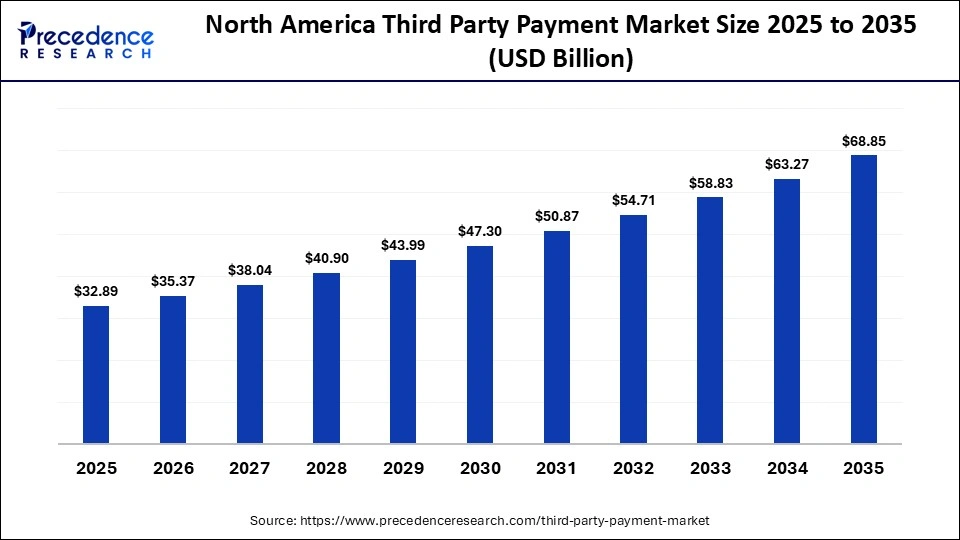
The North America third party payment market size is estimated at USD 32.89 billion in 2025 and is projected to reach approximately USD 68.85 billion by 2035, with a 7.67% CAGR from 2026 to 2035.
Why Did North America Lead the Global Third Party Payment Market?
North America led the third party payment market by holding the largest share in 2025. This is mainly due to widespread internet connectivity, high smartphone penetration, and rapid adoption of cashless payment solutions across retail, e-commerce, and service sectors. Regulatory initiatives, such as programs by the Consumer Financial Protection Bureau, have strengthened consumer protection and transparency in digital payments. The U.S. is the major contributor, supported by a well-developed fintech infrastructure, while Canada continues to expand contactless and mobile payment adoption. The market is highly competitive, with leading technology-based payment providers like PayPal, Square, and Stripe offering secure, real-time, and merchant-friendly services.
U.S. Third Party Payment Market Size and Growth 2026 to 2035
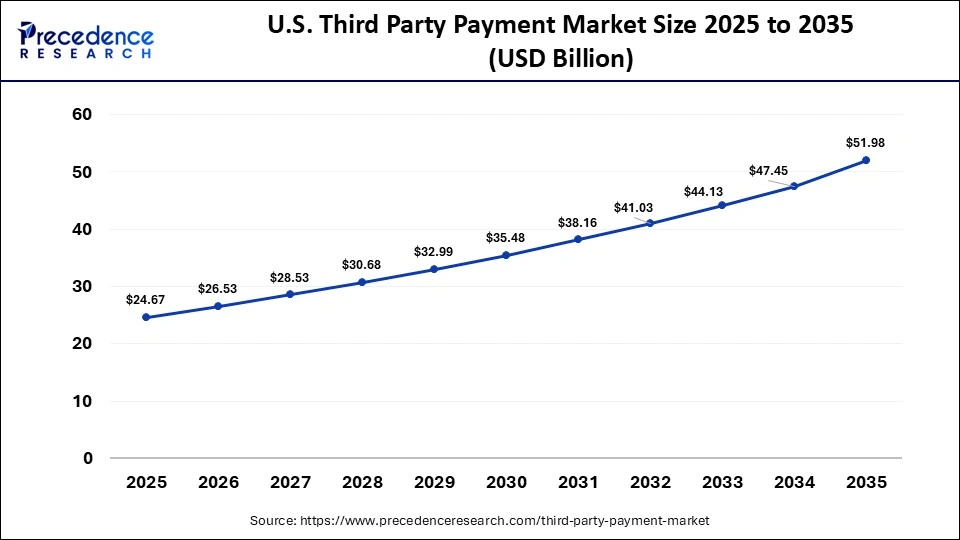
The U.S. third party payment market size is calculated at USD 24.67 billion in 2025 and is expected to reach nearly USD 51.98 billion in 2035, accelerating at a strong CAGR of 7.74% between 2026 and 2035.
U.S. Third Party Payment Market Trends
The U.S. is one of the fastest-evolving, driven by changing aviation demands, advanced technology adoption, and growing demand for cost-effective operations. The key trends in the U.S.
Why is Asia Pacific Experiencing the Fastest Growth in the Third Party Payment Market?
Asia Pacific is expected to witness the fastest growth during the predicted timeframe due to the large population base, rapid smartphone penetration, low-cost mobile connectivity, and a strong shift toward digital and mobile-first purchasing. Countries like China and India are leading the market with widespread adoption of QR-code payments and real-time digital transaction systems. Mobile payment platforms such as Alipay and WeChat Pay facilitate transactions for both urban and rural businesses, while government initiatives promote financial inclusion and cashless economies. Growth is further supported by increasing consumer confidence, rising digital literacy, expansion of online shopping platforms, and the development of robust payment infrastructures.
Third Party Payment Market Companies
Recent Developments
- In February 2026, PayU launched inFINity 3.0 to accelerate the growth of early-stage fintech startups since it allows them to transform into market-fit businesses. This was a mentorship and access to technologies and ecosystem support program to drive fintech innovation.(Source: https://www.tribuneindia.com)
- In December 2025, Setu by Pine Labs became the first agency in India to create an agentic payment experience to reduce billing errors and payment deadlines. The solution was smartly automated to increase the confidence of the users and simplify the repetitive billing procedures of the consumers.(Source: https://www.pinelabs.com)
- In June 2024, Adyen partnered with SumUpto to improve payment experiences and accelerate the settlement process of small merchants around the world. This collaboration enabled the proximity of instant payment, and millions of small or micro-enterprises in Europe and the UK have accessed their funds with easy availability as well as better money management. (Source: https://www.adyen.com)
Segments Covered in the Report
By User Type
- Individuals
- Small Businesses
- Large Enterprises
By Service Type
- Payment Processing
- Fraud Detection
- Risk Management
- Compliance Solutions
By Payment Method
- Credit/Debit Cards
- E-Wallets
- Bank Transfers
- Cryptocurrencies
By Transaction Type
- Online Transactions
- In-store Transactions
- Mobile Transactions
By Technology Adoption
- Emerging Technologies
- Legacy Systems
- Integrated Solutions
By Region
- North America
- Europe
- Asia-Pacific
- Latin America
- Middle East & Africa
For inquiries regarding discounts, bulk purchases, or customization requests, please contact us at sales@precedenceresearch.com
Frequently Asked Questions
Tags





Ask For Sample
No cookie-cutter, only authentic analysis – take the 1st step to become a Precedence Research client
 Get a Sample




 sales@precedenceresearch.com
 Schedule a Meeting
