



Trade Management Software Market Trends, Companies, Revenue / Sales Performance, Subscriber Growth, Pricing Strategies, Cloud Adoption, Infrastructure Expansion, Competitive Landscape, and Industry Outlook
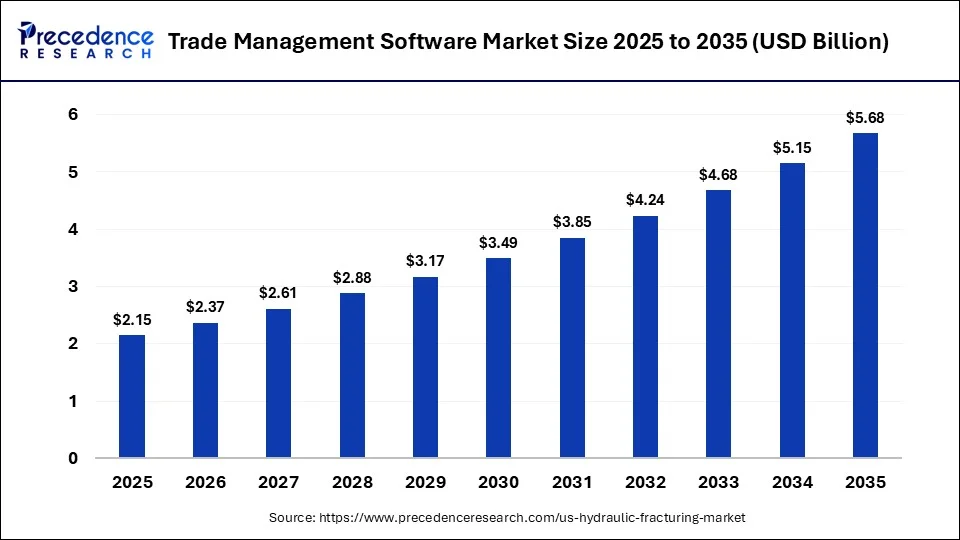
Gautam Mahajan is an ICT market research analyst. He researched customs automation, import/export management, tariff classification, trade compliance, and sanctions screening. His research is useful for those interested in software vendors, software manufacturers, supply chain vendors, logistics suppliers, and multinational companies for assessing technology adoption and market opportunities. The trade management software market was expected to reach USD 5.68 billion in 2035.
Source: https://www.precedenceresearch.com/trade-management-software-market
 Get a Sample
 Table Of Content


Trade Management Software Market Size, Demand and Trends Analysis
Gautam Mahajan has more than 5 years of enterprise software and supply chain research experience. He believes trade management is shifting from manual processing to connected workflows. Trade management software solutions are helping companies to manage customs documentation, duty calculations, and regulatory reporting in a single operating environment. The global trade management software market was valued at USD 2.37 billion in 2026 and is growing at a CAGR of 10.20% over the forecast period. Cloud-based trade platforms are being adopted because they enable seamless integration with ERP, procurement systems, logistics and transport, and have a single point of truth to maintain trade activity.
Key Takeaways
- According to WTO statistics, the trade volume of goods and services was USD 34.89 trillion in 2025, rising by 8% from 2024.
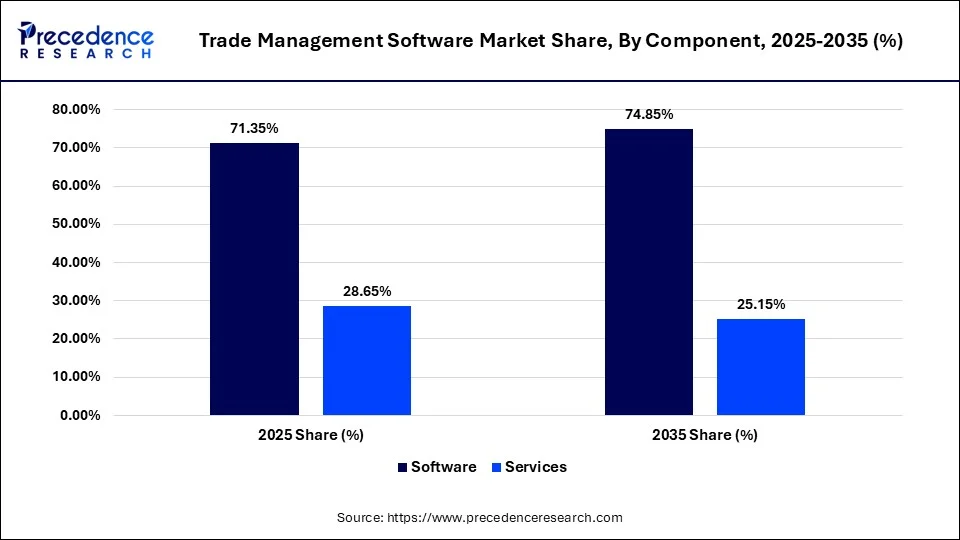
- By component, the software segment led the market with a share of 71.35% in 2025.
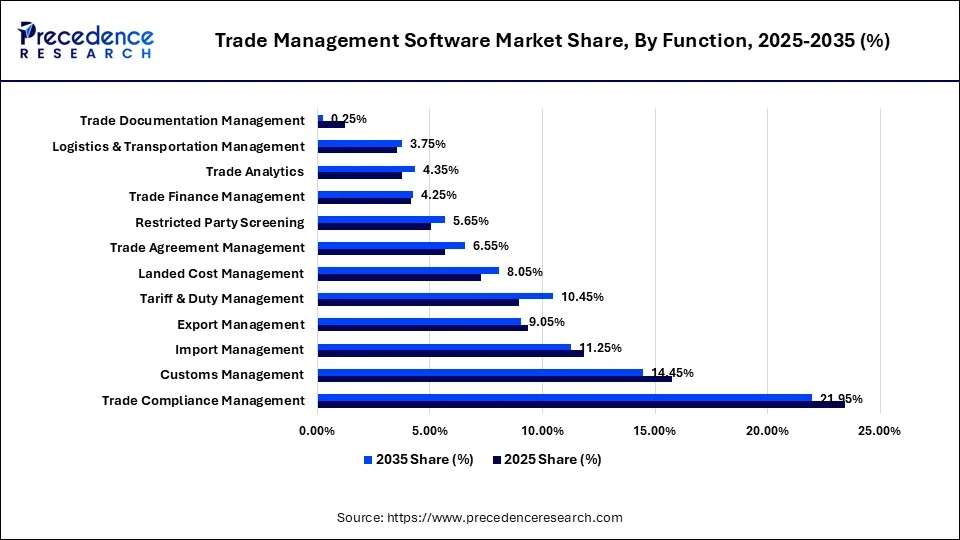
- By function, the trade compliance management segment led the market with a 23.45% share in 2025.
- By trade flow, the import segment led the market with a 53.85% share in 2025.
- By technology, the artificial intelligence and machine learning segment captured a major revenue share of 16.85% in 2025.
- By application, the trade compliance segment captured the largest market share of 21.85% in 2025.
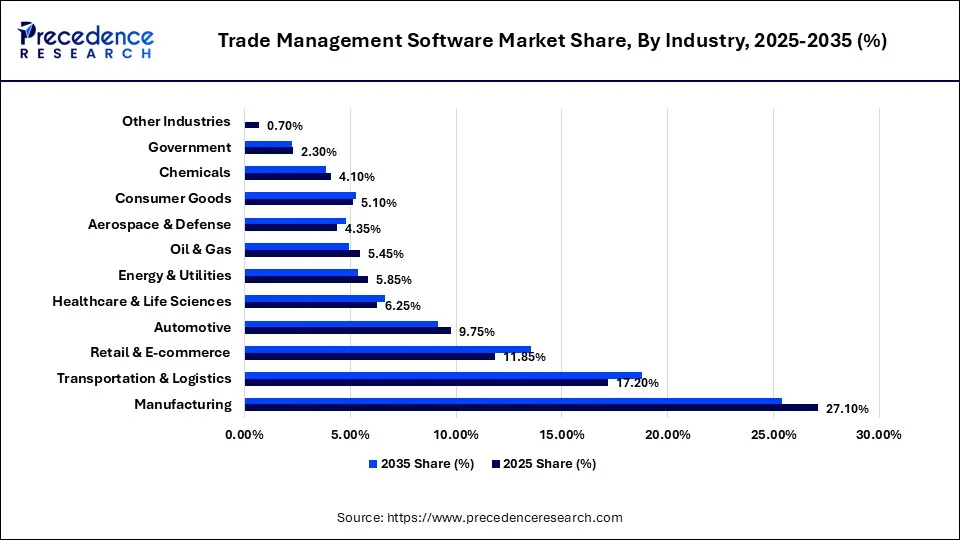
- By industry, the manufacturing segment led the market with a share of 27.1 in 2025.
- Compared to 2024, the volume of goods and services trade in the world is expected to go up to USD 34.89 trillion.
- The quantity of services and goods traded around the world was USD 34.89 trillion in 2025.
- The Global Container Throughput Index (GCT) increased from 135.4 to 137.5 between June and July 2025, showing increased trade software demand.
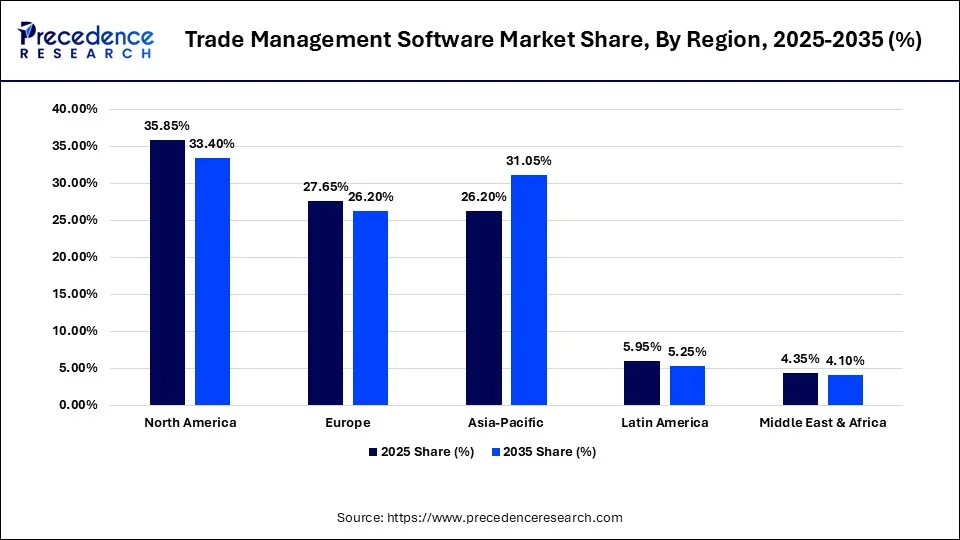
- North America held a major market share of 35.85% in 2025 while Asia-Pacific is expected to witness the fastest growth with a CAGR of 12% from 2026 to 2035.
Market Overview & Size
The value of the global trade management software market is estimated at USD 2.15 billion during 2025 and is anticipated to witness a CAGR of 10.20% between 2026 and 2035, pointing to a value of USD 5.68 billion by 2035. The market is relatively small when it comes to the volume of international transactions. But its importance in enterprise technology is increasing as firms are increasingly pressured by the need to manage cross-border transactions, customs requirements, tariffs, and compliance processes in a digital way. Global trade in goods and commercial services was valued at USD 34.89 trillion in 2025, up 8% from 2024, creating a wide and growing base of transactions available for trade management technologies to manage.
- Key Insight: The market is expected to grow to USD 5.68 billion by 2035 at 10.20% CAGR, while global trade is projected to reach USD 34.89 trillion.
Market Dynamics - Regulatory Volatility and Global Supply-Chain Complexity Are Reshaping Trade Technology Investment
| Metric | Value | Period |
| US effective tariff rate | 7.7% (highest since 1947) | 2025 |
| US customs duties collected | USD 264 billion (up from USD 79 billion in 2024) | 2025 |
| Peak US average effective tariff rate (IMF) | 23.5%, easing to ~17-18.5% | May 2025 - 2026 |
| Firms citing trade/tariffs as top business concern | 30%+ (up from 8.3%) | 2025 CFO survey |
| SMB average paid tariff rate | 6.5% to 11.4% | Dec 2024 - Jul 2025 |
| Global goods and services trade | USD 34.89 trillion (+8% YoY) | 2025 |
Uncertainty surrounding the tariffs is among the biggest drivers of spending on trade management technology. In the U.S., the effective tariff rate rose to a level of 7.7% for 2025. This is the highest since 1947, and collections on customs duties increased from USD 79 billion in 2024 to USD 264 billion in 2025. Additionally, the U.S. average effective tariff rate came in at 23.5% in May 2025 but dropped to around 17–18.5% in 2026. Regular changes of tariffs and duty rates are driving the need for more rapid and comprehensive changes to trade rules, particularly across extensive product and shipment databases.
Businesses are also increasingly facing up to trade policy. A survey of CFOs by the Fed of Richmond's research team revealed that 30.5% of respondents said trade/tariffs were their number one business concern for 2025, up from 8.3% of CFOs who responded that way in a previous survey. Smaller businesses are at risk of similar pressure, as cited in the Boston Fed's report that the average tariff paid increased from 6.5% to 11.4% in 1 year for smaller businesses. This is introducing SMEs and medium-sized importers/exporters into a space dominated by larger businesses using software.
On the other hand, the amount of international trade is increasing. According to WTO statistics, the trade volume of goods and services was USD 34.89 trillion in 2025, rising by 8% from 2024, with the volume of goods growing 6% and the volume of services growing 8%. Spreadsheet and manual operations are becoming increasingly difficult with the higher volume of transactions and regular adjustments to tariff rules and customs regulations needed to meet compliance obligations.
- Key Insight: Compared to 2024, the volume of goods and services trade in the world is expected to go up to USD 34.89 trillion. Trade concerns grew by more than 30% for the surveyed CFOs, as well as tariff concerns, in 2025.
Source: Tax Foundation; Federal Reserve Bank of Richmond; Federal Reserve Bank of Boston; IMF World Economic Outlook; World Trade Organization (2025-2026)
Pricing Analysis - Subscription Models, Transaction Volumes and Compliance Complexity Reshape Trade Software Economics
| Commercial Model | How It Works | Typical Fit |
| Subscription/Per-Module License | Recurring fee for platform modules (compliance, customs, duty management) | ERP-embedded and enterprise platform vendors (SAP, Oracle, Thomson Reuters) |
| Transaction/Shipment-Volume Pricing | Fee scales with the number of shipments, declarations, or transactions processed | Customs filing and logistics-network platforms (Descartes, WiseTech/CargoWise) |
| Per-Entity/Per-Trade-Lane Pricing | Fee scales with the number of legal entities or trade corridors managed | Multinational compliance and FTA management platforms |
| Managed-Service/Consulting Fee | Bundled technology plus advisory for classification, FTA qualification, or customs brokerage | Trade consulting and customs-brokerage-linked vendors (Livingston International) |
| Usage-Based API Pricing | Fee tied to API calls for tariff classification, screening, or duty calculation. | Embedded compliance APIs (Avalara-style tax/duty calculation) |
Prices are now trending more towards transaction volume, shipment quantity, trade lane, and legal entity-based. This way, vendors will be more closely connected to their software use and trading that happens on the platform. The change is especially significant during periods of change in regulations. Tariff changes in thousands of items can require classifications to be changed instantly, rates calculated, and compliance procedures adjusted. Automated software to manage such shifts can provide far greater benefit during volatile trading than during quiet times. This allows vendors to monetize their platform based on usage, transaction volume, or on some quantifiable means of duty savings.
- Key Insight: These shifting pricing models align with customer value and include per-payment, per-shipment, per-trade, and results-based pricing.
Source: Precedence Research Database
Demand-Supply Analysis - Rising Trade Complexity Is Increasing Demand for Integrated Compliance and Customs Infrastructure
There is more demand for a single platform managing trade compliance now than there is for unified solutions, especially from mid-market companies and SMEs who have traditionally relied on spreadsheets, manual processes, or customs brokers to manage trade compliance. Government customs agencies, too, are working to move over to digitization. WTO research also reveals that the impact of the Trade Facilitation Agreement (TFA) has added more than USD 230 billion to global trade, lowered average trade costs by 1-4%, and by 87% in trade transaction customs processing time (CTPT) after digitalization at the Kenya-Tanzania border.
This leaves a disconnect between government digitalization efforts and the private sector's capacity to integrate their trade systems into these emerging digital customs services. WCO and World Bank research has determined that China, South Korea, Singapore, and the UAE are at the forefront of digital customs infrastructure. Additionally, companies want to ensure their tariff systems are rapid and agile to adapt to new tariff changes, and many legacy platforms continue to rely on manually managed rules for compliance.
There are components of the private marketplace that are relatively well established, like customs filing or denied-party screening. But there is still more complexity in real-time duty optimization, tariff classification using AI, and global trade-agreement management. These services need continually updated tariffs, rules of origin, the list of sanctions, and regulatory information from multiple jurisdictions, which can be hard to keep at a global level.
- Key Insight: Average trade costs in the Kenya-Tanzania case decreased by 87% due to digitalization, and integrated platforms can deliver considerable benefits in reducing average trade costs by 1-4%.
Value Chain & Supply Chain - Trade Data, Compliance Intelligence and Workflow Automation Capture the Highest Strategic Value
| Value Chain Stage | Function | Where Strategic Value Concentrates |
| Data Capture | Shipment, product, and supplier data intake | Low-moderate - largely commoditized integration layer |
| Classification & Compliance Rules | HS code classification, restricted-party screening, regulatory rule application | High - requires continuously maintained proprietary trade content across every served jurisdiction. |
| Duty & Cost Calculation | Tariff, duty, and landed-cost computation | High - direct, quantifiable financial impact drives willingness to pay, especially amid tariff volatility |
| Documentation & Filing | Customs declarations, certificates of origin, export documentation | Moderate - increasingly automated and embedded within government single-window systems |
| Analytics & Reporting | Trade-risk scoring, audit trail, scenario planning | Emerging high value as enterprises seek to model tariff-policy scenarios proactively rather than react after the fact |
The trade management software value chain starts with trade and shipment data collection and extends to product classification, compliance verification, duty computation, document preparation, customs clearance, customs filing, and reporting. The top strategic level is the trade content and compliance intelligence layer, as these depend on the right and up-to-date volumes of data on tariff schedules, trade agreements, sanctions lists, and regulatory requirements in various countries.
The amount of effort and speed required to keep up-to-date with trading regulations grows more significant as the regulations themselves are updated more quickly. Broadly regulated vendors and reliable vendors with more trade content may help customers in more markets and eliminate the need for manual updating.
- Key Insight: Architects and consultants gleaned from the trade software chain is that the best value lies in thick boxes of always-current data. Regularly updated tariff, sanctions, trade-agreement, and regulatory data, not just the workflow automation alone.
Technology & Innovation - AI Is Moving Trade Management from Rule-Based Compliance Toward Predictive Trade Intelligence
The use of AI in the interpretation and application of trade regulations, product classification, and compliance checks. They are gaining importance for companies that want to better and more quickly respond to the requirements of trade management. According to the WTO's 2025 World Trade Report, AI is a general-purpose technology with the potential to reduce trade costs, assist with regulatory compliance, and enable businesses of all sizes.
In trade management software, AI is taking applications beyond hard-coded rules. New systems can be used to process unstructured regulatory data, help classify a product, evaluate potential duty treatment, and determine compliance risks prior to filing a shipment. Blockchain and IoT are more specific applications in relation to validating documents and tracking shipments. The role of artificial intelligence is much wider, as it can be used directly in classification, in interpretation of regulations, and in analysis of compliance.
Customs government agencies have the same migration towards data-driven systems. BACUDA, promoted by the World Customs Organization, is dedicated to developing analytical capabilities and data handling skills of customs agencies. Private trade software providers thus must deal with more and more digital and data-oriented government customs systems, instead of just replacing manual processes within the government.
- Key Insight: AI is transforming the compliance landscape for trade software, moving away from just identifying and following rules, to categorising and interpreting regulations and identifying potential risks, before goods are brought to Customs.
Regulatory & Risk Environment - Tariffs, Sanctions and Export Controls Are Embedding Compliance into Core Trade Workflows
The provisions of the 2025 U.S. tariff regime further contributed to some additional uncertainty, as tariffs can be imposed or adjusted quickly using the provisions of the International Emergency Economic Powers Act. The speed of technology for trade platforms is now much greater than the previous requirement of changes to the tariff schedules every few years. Tariff schedules, duty rates by country for specific commodities, and compliance rules must be updated many times more frequently than in the past.
EU Single Window Environment for Customs (EU CSW - CERTEX) is an example of the transformation in Europe. This system was designed in Regulation (EU) 2022/2399, and will be applied in the first phase of its implementation in 2025 and progressively over the next decade. The initiative is driving more focus on a more robust need for digital customs data flows and provides software providers with a chance to make enterprise trade systems directly accessible to government infrastructure.
Trade compliance goes beyond tariffs. The enforcement of sanctions and export control restrictions is becoming more critical for industries manufacturing dual-use goods and/or products with export control restrictions, such as aerospace and defense, semiconductors, and advanced materials. Companies require systems that can handle the import/export controls, sanctions, and restricted-parties requirements in the same trade workflow.
- Key Insight: Huge overlap in trade compliance now includes tariffs, sanctions, and export controls, which necessitate quick updating of regulatory rules and increase the need for systems to do so.
Customer & Application Analysis - Multinational Manufacturers and Logistics-Intensive Enterprises Drive Platform Adoption
Despite efforts to boost trade across the SOP, acceptance or rejection of software is increasingly driven by the complexity of cross-border operations and size. Importers and manufacturers have a number of suppliers and manufacturing operations in different countries. They are required to have detailed control over classification, duties, and compliance. Efficient and user-friendly customs and trade tools are needed by freight forwarders and logistics companies to support clearance activities with several customers. E-commerce and retailers are beginning to be significant users as well, given the rise of DTC cross-border shipping.
There may also be sudden increases in shipment activity resulting from changes in trade policy. The RWI/ISL Global Container Throughput Index rose from 135.4 in June 2025 to 137.5 in July 2025 and accounts for approximately 64% of all container traffic in the world's 90 largest ports. The increase reflected export front-loading ahead of announced U.S. tariff changes. Showing how tariff announcements can create sudden shipment surges and place additional pressure on trade-compliance systems.
Highly regulated industries have various priorities. The aerospace & defence, healthcare & life science, and chemicals sectors are more focused on restricted party screening and export automation. For these sectors, a trade compliance failure can result in regulatory sanctions and embarrassment; compliance checks are not just about duty saving.
- Key Insight: Between June and July 2025, the Global Container Throughput Index (GCT) increased from 135.4 to 137.5, demonstrating the quick turnaround possible in response to escalating trade infrastructure pressure in response to tariff announcements.
Competitive Intelligence
Competitive Landscape - Integrated Trade, Customs, ERP and Supply-Chain Platforms Intensify Competition
Aditi believes there are four competitive groups in the market. The first includes platforms for logistics and trade, such as WiseTech Global following its August 2025 acquisition of E2open for USD 2.1 billion. The second consists of trade-content and compliance experts like Thomson Reuters ONESOURCE, Descartes and MIC Customs Solutions. The fourth group is supply-chain visibility vendors that, like FourKites, are getting into the business of trading data, like Infor Nexus, project44, and One Network Enterprises.
The WiseTech-E2open deal is representative of the escalating convergence of logistics execution with trade management. The companies, which span from one system to another, are seeking to integrate transportation, customs, compliance, and trade data onto a single platform. This trend may lead to pressure on specialist trade-compliance vendors and ERP modules that don't include extensive logistics functions.
- Key Insight: WiseTech Global's USD 2.1 billion E2open buy is reflective of further consolidation between logistical execution and trade management software.
Tentative Leading Company Universe - 20 Companies Shaping the Trade Management Software Market
| # | Company | HQ | Market Position | Core Strength |
| 1 | WiseTech Global (CargoWise, E2open) | Australia | Global logistics & trade platform leader | Logistics execution + trade/supply-chain SaaS (post-E2open acquisition, Aug 2025) |
| 2 | Thomson Reuters (ONESOURCE Global Trade) | Canada | Enterprise trade compliance leader | Trade content, tariff classification, global compliance (via 2018 Integration Point acquisition) |
| 3 | Descartes Systems Group | Canada | Logistics & customs network leader | Global logistics network, customs filing, denied-party screening |
| 4 | SAP (SAP Global Trade Services) | Germany | ERP-embedded trade compliance leader | Deep ERP integration for large multinational manufacturers |
| 5 | Oracle (Global Trade Management Cloud) | U.S. | ERP-embedded trade compliance leader | Cloud ERP-integrated trade management |
| 6 | Livingston International | Canada | Customs brokerage & trade services leader | North American customs brokerage plus trade technology |
| 7 | Aptean | U.S. | Industry-specific ERP/trade software provider | Vertical-market trade and supply-chain software |
| 8 | MIC Customs Solutions | Austria | Customs & global trade specialist | Customs management, denied-party screening, FTA management |
| 9 | Infor (Infor Nexus) | U.S. | Supply-chain network & trade visibility leader | Multi-enterprise supply-chain network with trade visibility |
| 10 | Avalara | U.S. | Tax & customs compliance specialist | Cross-border tax determination and customs duty calculation |
| 11 | IBM (Sterling Global Trade Management) | U.S. | Enterprise supply-chain software leader | Supply-chain and trade compliance within broader Sterling suite |
| 12 | QAD (Global Trade & Transportation Execution) | U.S. | ERP-embedded trade compliance provider | Trade compliance embedded in QAD Adaptive ERP for manufacturers |
| 13 | Bamboo Rose | U.S. | Retail supply-chain & sourcing specialist | Retail/consumer-goods sourcing and trade compliance |
| 14 | One Network Enterprises | U.S. | Multi-party supply-chain network specialist | Control-tower supply-chain visibility with trade functionality |
| 15 | Blue Tiger International | U.S. | Trade compliance consulting & technology | Mid-market import/export compliance software and advisory |
| 16 | Basware | Finland | Procurement & invoicing specialist | E-invoicing and procurement with trade-adjacent functionality |
| 17 | project44 | U.S. | Supply-chain visibility specialist | Real-time transportation visibility with customs/trade data links |
| 18 | FourKites | U.S | Supply-chain visibility specialist | Real-time shipment tracking with trade-compliance integrations |
| 19 | Expeditors International | U.S. | Global logistics & customs brokerage leader | In-house trade technology supporting global freight forwarding |
| 20 | Kuehne+Nagel (KN FreightNet) | Switzerland | Global logistics & customs brokerage leader | In-house trade and customs technology supporting freight forwarding |
Market Share & Competitive Ranking - Platform Scale, Installed Base and Trade Data Depth Determine Revenue Capture
| Competitive Tier | Indicative Market Position |
| Global logistics + trade platform (post-consolidation) | Estimated share range, not separately disclosed |
| Enterprise trade-content & compliance leader | Estimated share range, not separately disclosed |
| ERP-embedded trade compliance provider | Estimated share range, not separately disclosed |
| Customs/denied-party screening specialist | Estimated share range, not separately disclosed |
| Supply-chain visibility / control-tower specialist | Smaller current revenue base, disproportionate growth |
There is no publicly available independent assessment of which company or software dominates the trade management software market. The market is intertwined with such other parts of the software industry as logistics execution, ERP, tax compliance, customs, and supply-chain visibility, making it challenging to distinguish trade-management revenue from other software companies. The revenue items that are reported as trade management revenues are not reported by most of the vendors as a separate financial item.
The depth of the trade content, the extent of platform coverage, enterprise integrations, and the amount of acquisition activity are other indicators that are worth considering in assessing competitive strength.
- Key Insight: The most reliable competitive metrics are installed base, integration depth and coverage, trade-management depth, and M&A activity. With most vendors not disclosing any revenues in this category, it is difficult to make any in-depth conclusions.
Competitive Benchmarking - Trade Content, Compliance Intelligence and Integration Depth Create Structural Advantages
Competition between the leaders of the vendors is based on the level of accuracy and comprehensiveness of the available trade content, such as tariff schedules, free-trade agreements, sanctions lists, and country-specific requirements. Another great feature is that seamless integration with ERP, logistics, and supply-chain systems makes the trade compliance process less labor-intensive by integrating every facet of your procurement, finance, inventory, and transportation operations.
The quickness of amending trade rules is becoming more important, especially. A vendor who can provide a tariff schedule that can be updated within a few hours or days, and not weeks. This will have a distinct advantage when it becomes important for a customer to react to a change in policies. With the current environment going round, response time may be more important than just supplying the maximum amount of software features.
- Key Insight: Rapid compliance updates measured in hours or days rather than weeks are becoming a key differentiator as tariff changes accelerate.
Product Portfolio Benchmarking - Integrated Trade Platforms Compete with Specialized Compliance and Customs Solutions
Businesses like Large platforms WiseTech/E2open, Thomson Reuters, SAP and Oracle in compliance, customs, duty management and trade analytics are progressing their coverage. They are thought to be contenders against specialist suppliers like specialist customs solutions firm MIC Customs Solutions for customs screening, tax calculations systems Avalara, visibility and trade data specialists project44 and FourKites for shipment visibility.
This gives rise to two competitive strategies. Any vendor can develop a wider range of solutions that span the entire trade process or remain more focused on less of the process and cut competition by offering greater functionality and specialization.
- Key Insight: Vendors are now being faced with the choice of plugging into more end-to-end platforms or going for those specialised and higher value for the trade requirements.
Technology & Innovation Benchmarking - AI, Automation and Real-Time Trade Intelligence Define Technology Leadership
Technology leadership is increasingly tied to practical AI applications rather than traditional workflow automation alone. Some of the key areas are automated tariff classification, warnings about duty-rate changes, and restricted-party screening. For enterprise contracts, the vendors who provide higher classification accuracy or measurable reduction in customs-processing times have much bigger cards to play.
Measurable improvement in WCO's functioning, as evidenced in the WTO example of an 87% customs processing time reduction after digitalisation at the Kenya-Tanzania border, will play a useful role in influencing technology purchasing decisions.
- Key Insight: Technology leaders will increasingly be judged by measurable outcomes such as classification accuracy and customs-processing improvements, rather than feature count alone.
Application Competitive Benchmarking - Compliance, Customs and Duty Optimization Form the Core Competitive Battleground
Trade compliance, customs automation, and other applications are the most mature use cases, as most businesses in international trade will need some degree of these functions. Data fiddling is going to be the next big challenge, as software will be able to assist companies not only in avoiding tariff violations but also in actually cutting duty expenses. Any vendor who can show real duty savings is in a far better commercial position, as it means the software can offer benefits that extend beyond the compliance cost.
Another qualification will be FTA. Automated qualification can enable businesses to identify if their product qualifies for preferential trade tariffs, and thus leverage lower tariff rates. Dallas Fed results on USMCA revealed that adherence to the agreement protected Mexican and Canadian exporters when tariffs raised in the 2025 shock came on the scene. For companies that are not automating this process, they may find that there is a cost-saving benefit to automating qualification for FTA.
- Key Insight: Applications of duty optimisation and FTA qualification are becoming higher-value since they can offer the possibility of measurable savings in addition to a simple compliance application.
Geographic Competitive Landscape - North America Leads While Asia-Pacific Emerges as a High-Growth Trade Technology Market
North America continues to lead the market as enterprise software is well established there, and the tariff changes introduced in 2025–2026 will expose the market. It is a significant near-term market for tariff monitoring and duty optimisation tools. Around the EU CSW-CERTEX program, the European Union is building up the long-term need for the creation of digital customs integration in Europe. The architecture of the EU CSW-CERTEX program is developing around the EU the need for the long term to create digital customs integration in Europe.
Its growth prospects are very different in Asia-Pacific, where government efforts provide substantial support for digital customs systems. According to WCO and the World Bank, China, South Korea, Singapore, and the United Arab Emirates (UAE) are among the top global leaders in technologies such as AI, blockchain, big data, and single-window customs technology. For vendors to tap into these markets, therefore, they should not just be creating basic customs digital infrastructure but connect with advanced ones of the government.
- Key Insight: Through government-led adoption of AI, big data, and single-window customs, the momentum is on the rise for AI customs in Asia-Pacific, while North America receives immediate tariff-driven demand.
Infrastructure & Deployment Benchmarking - Cloud Architecture and Integration Ecosystems Define Technology Scalability
Cloud-based trade management platforms benefit from frequent changes in regulations, as vendors can make updates in the central platform, and changes can be disseminated to customers as soon as they are made without having to wait for individual IT teams to install software patches. This is very crucial when tariff schedules and/or specific country requirements change in an unpredictable manner.
Governments' customs infrastructure is also transitioning towards cloud-based and API-driven systems. API integration is becoming more vital than batch-based data in the era of increased real-time connections with EU CSW-CERTEX or single-window platforms in Asia-Pacific.
- Key Insight: Cloud architecture and API connectivity give trade platforms a practical advantage when regulatory rules need to be updated and exchanged in real time.
Customer & Channel Benchmarking - ERP Integration and Enterprise Relationships Strengthen Platform Stickiness
Repurposing trade software can be challenging in an ERP, procurement, finance, logistics, and customs environment. These relationships are advantageous for providers that are integrated with SAP, Oracle, and QAD. They are linked tightly with freight-forwarders and customs-broker companies like Descartes and WiseTech/CargoWise.
Customs Brokers are an important group to keep, as they may have direct regulatory duties in varying jurisdictions. Having experience with their software platform can thus affect enterprise buying choices and be a crucial aspect of the trust factor.
- Key Insight: In trade management systems, these connections between the software and the brokers, logistics, and ERP integration provide a higher switching cost and help reinforce customer retention.
Strategic Developments - AI, Cloud Integration and Automated Compliance Shape Vendor Investment Priorities
It appears that it is becoming more common to see logistics execution and trade management activities being merged together in the marketplace, and WiseTech Global's recently announced acquisition of E2open is a good example. Vendors investing in product-level solutions include AI-powered tariff classification tools, automated duty-rate compliance analysis solutions, and other duty-rate change monitoring solutions.
Government customs agencies are also moving to speed up digital transformation, with efforts like EU CSW-CERTEX and Single Window systems in Asia-Pacific. This is driving demand for trade software vendors for real-time API and direct connections to governments' digital customs infrastructure.
Source: Precedence Research Database
- Key Insight: Investment in an AI-driven classification system, predictive tariff monitoring, cloud integration, and government real-time connectivity is facilitating the market growth.
M&A Landscape - Trade Content, Customs Technology and Supply-Chain Intelligence Drive Strategic Consolidation
| Date | Transaction | Value | Strategic Rationale |
| May 25, 2025 (announced) | WiseTech Global agrees to acquire E2open Parent Holdings | USD 2.1 billion enterprise value (USD 3.30/share, 68% premium to unaffected price) | Extends WiseTech's CargoWise logistics-execution base into global/domestic trade, demand planning, and direct enterprise supply-chain relationships |
| August 3, 2025 (completed) | WiseTech Global completes E2open acquisition | Fully debt-funded via USD 3 billion syndicated facility | Creates a combined platform spanning logistics execution and trade/supply-chain management with minimal prior product overlap |
| December 30, 2025 | WiseTech agrees to divest Expedient (logistics software acquired via E2open deal) | Not disclosed | Resolves ACCC competition concerns raised after WiseTech completed the E2open deal ahead of regulatory review. |
- Key Insight: WiseTech's USD 2.1 billion debt-funded offering of E2open has been completed in about three months at a 68% share price premium, while WiseTech was prepared to forfeit a smaller acquisition of Expedient just to complete the larger one.
Source: WiseTech Global; E2open; Cravath, Swaine & Moore LLP; Australian Competition & Consumer Commission (2025-2026)
Company Profiles - Detailed Intelligence Across Leading Trade Management Software Participants
WiseTech Global (CargoWise / E2open)
HQ: Sydney, Australia Founded: 1994 Ownership: Public (ASX: WTC)
A world-class logistics execution system for freight forwarders and customs brokers worldwide, WiseTech Global's CargoWise platform serves over 16,500 logistics companies in 195 countries around the world. WiseTech closed its enterprise-value acquisition of NYSE-listed E2open, a provider of connected supply-chain SaaS, for USD 2.1 billion in August 2025. This transaction was 100 percent debt-financed with a USD 3 billion syndicated facility. The purchase will extend WiseTech's operations from providing logistics services to importers, exporters, and manufacturers both domestic and international to trading, demand-planning and supply-chain management.
- Key Strengths: CargoWise has a strong presence in the logistics-execution market as well as relationships with 46 out of the top 50 3PLs, along with E2open's direct presence in enterprise trade and supply-chain relationships, which provides WiseTech with one of the widest market positions in the industry.
- Key Vulnerabilities: Challenges with scale and complexity of the E2open integration. Additionally, the company's Expedient logistics software business - an acquisition via the E2open transaction - was subject to a competition investigation by Australia's ACCC, over which WiseTech must divest in December 2025.
Thomson Reuters (ONESOURCE Global Trade)
HQ: Toronto, Canada Founded: 2008 (ONESOURCE); Thomson Reuters founded 2008 via merger Ownership: Public (TSX/NYSE: TRI)
ONESOURCE Global Trade is Thomson Reuters' trade compliance and tariff management solution. Being reaffirmed by the 2018 purchase of Integration Point, a global trade management software provider. The pairing combined Thomson Reuters' trade-content expertise, alongside workflow technology dedicated to compliance.
- Key Strengths: The platform features robust integration between tax, trade content, and compliance workflows. Thomson Reuters further extends its global expertise in regulatory support and research to trade management.
- Key Vulnerabilities: Trade management is one of a large number of product areas in an information-services business. The platform thus rivals dedicated trade specialists as well as a larger integrated platform like the combined WiseTech/E2open offering.
Descartes Systems Group
HQ: Waterloo, Canada Founded: 1981 Ownership: Public (NASDAQ/TSX: DSGX)
Descartes' single platform integrates customs filing, denied-party verification, and global visibility into logistics for one of the largest logistics/trade networks in the industry. The Company has also been consistent throughout its history in making tuck-in acquisitions in related trade and logistics technology areas.
- Key Strengths: Very broad logistics and customs-filing network and high network effects and competitive advantage. Descartes also has proven business expertise as a large active acquirer of neighboring trade/e-tech businesses.
- Key Vulnerabilities: As WiseTech/E2open becomes one platform, bringing logistics execution and trade management together in a size-big-to-Descartes combination, competition is increasing.
SAP (SAP Global Trade Services)
HQ: Walldorf, Germany Founded: 1972 (SAP); GTS as a dedicated module since the 2000s Ownership: Public (ETR: SAP)
Motivated by the odds of strong integration within the SAP ERP environment, SAP Global Trade Services is already apparent in the minds of and to multinationals who have already adopted SAP as their enterprise platform of choice. It connects to enterprise financial and supply-chain information to facilitate trade transactions in the current ERP system.
- Key Strengths: SAP is heavily entrenched in the ERP market for large multinational manufacturers and has a strong foothold in financial, procurement, logistics, and supply-chain information.
- Key Vulnerabilities: Specialized trade-management solution vendors that are focused on trade content and regulatory research capabilities will be able to provide deeper insights into compliance intelligence than can a trade module built into a comprehensive ERP solution.
Avalara
HQ: Seattle, Washington, US Founded: 2004 Ownership: Private (acquired by Vista Equity Partners, 2022, from public NYSE: AVLR)
Avalara's business is based on automated tax determination products, and now it's gone global with customs and import-compliance calculations. This places the company at the nexus of two overarching areas, such as tax technology and trade compliance, which intersect at an ever-important juncture in the administration of business transactions.
- Key Strengths: With Avalara's rising tax automation brand and customer base, offering an opportunity to cross-sell customs duty and landed cost services is very appealing as e-commerce grows at a global level.
- Key Vulnerabilities: It has a much more limited set of core trade-management tools compared to stand-alone global trade management solutions, especially when it comes to compliance workflows, restricted-party screening, and free-trade-agreement management.
Company Strategic Positioning - Platform Breadth, Trade Intelligence and Enterprise Integration Define Future Leaders
There are 5 different strategic stances that vendors actually are at in this market right now, and each stance brings a different win. Owning the consolidated logistics-trade platform leader, WiseTech Global (now merged with E2open), is the sole vendor to have a truly wide footprint in both logistics execution and trade management. The enterprise trade-content leaders tier includes Thomson Reuters ONESOURCE, Descartes, and MIC Customs Solutions. They can provide deep and continually updated trade-content databases, an aspect that takes a long, continuous period of investment to implement, which will be difficult to replicate quickly on the back of an existing platform.
The ERP-Embedded Leaders tier lists SAP, Oracle, and QAD, though not by virtue of making the best trade-management product available. The compliance and tax-adjacent specialists category includes those with offshore resellers that sell trade capabilities adjacent to the compliance area they've sold in to the same buyers, namely Avalara and Basware. The supply-chain visibility extenders tier consists of the four companies established to build another type of platform for shipment visibility, but later extended into trade data, such as project44, FourKites, Infor Nexus and One Network Enterprises.
- Key Insight: Vendors that have a strong hold on just a single dimension, either on trade/content or on ERP distribution or on logistics scale. They are not as well positioned to weather the storm as vendors with both strengths. Also, WiseTech's offering of a trade solution integrated with a logistics solution and ERP offering is the single stand-out that I can find across the market today.
Opportunity & White-Space Analysis - AI Compliance, SME Cloud Adoption and Emerging Trade Corridors Create High-Value Opportunities
An obvious space exists between the government's customs registration on digital systems and being able to effectively link private companies to these real-time systems. The WTO has correlated the benefits of the 'Trade Facilitation Agreement' with USD 230 billion of extra trade and an average reduction in trade costs of 1-4%. The vendors' API-native platforms, which enjoy frequent updates and are connected to traditional, batch-processing systems, are able to capitalize on the government's growing e-commerce infrastructure to capture market share from those businesses that are still relying on the more traditional systems.
The other underdeveloped opportunity for FTA is the automation of its qualification. A company's financial profit is easy to see when the duty correctly qualifies the products, and the company succeeds within the duty rules of the agreement in question. USMCA is a good example of the Dallas Fed work showing how compliance with an agreement can also offer companies protection from tariffs, but many still fall for the manual process of determining qualification.
- Key Insight: Private trade platforms to increasingly digital government customs infrastructure is the largest white space opportunity, with FTA automation providing a direct savings opportunity.
Major White Spaces
- Classifying tariffs using Artificial Intelligence and predicting duty rates.
- Full government integration (single window and digital customs) real-time API.
- Automated Free Trade Agreement (FTA) qualification and capture of preferential duty.
- Cloud-based compliance solutions that are affordable for SMEs and mid-market companies.
- This encompasses duty optimization as its own service, with a value capture element that people can actually pay for, as opposed to it being a point of
- compliance and a cost center.
- The products included restricted-party screening for export control sensitive verticals such as aerospace & defense and semiconductors.
Industry Structure - High Integration Requirements and Regulatory Complexity Create Meaningful Entry Barriers
| Force | Intensity | Strategic Interpretation |
| Supplier Power | Medium | Trade-content data providers and cloud infrastructure vendors have moderate influence over vendor economics. |
| Buyer Power | Medium-High | Large multinational enterprises have significant procurement leverage and demand deep ERP/logistics integration. |
| Threat of New Entrants | Medium-Low | Continuously maintained multi-jurisdiction trade content and enterprise trust are difficult and slow to replicate. |
| Threat of Substitutes | Low-Medium | Manual compliance processes and customs brokers remain substitutes, but 2025-2026's tariff volatility has sharply reduced their viability. |
| Competitive Rivalry | High | ERP vendors, logistics platforms, trade-content specialists, and supply-chain visibility players increasingly compete for the same enterprise budgets |
Source: Precedence Research Database
- Key Insights: Competitive rivalry is high due to the convergence of ERP, logistics, vision, and trade content in a budget search, and the threat of new entrants is medium-low. Because enterprise trust and multi-jurisdiction trade content require several years to develop, and recent tariff instability has definitely reduced the ease with which manual compliance can be used.
PESTLE Analysis - Geopolitical Volatility, Trade Regulation and Digitalization Reshape Market Economics
| Dimension | Assessment |
| Political | Escalating and unpredictable tariff policy (IEEPA-driven US tariffs, retaliatory measures) is the single largest political driver of platform investment. |
| Economic | Rising customs duty collections (nearly 3.3x in the US within one year) directly increase the financial stakes of accurate trade management. |
| Social | Growing cross-border e-commerce increases consumer and SME exposure to customs and duty complexity. |
| Technological | AI and predictive analytics are shifting platforms from reactive compliance toward proactive duty optimization and risk forecasting, per WTO research. |
| Legal | The EU's CSW-CERTEX rollout, export controls, sanctions regimes, and multi-jurisdiction customs law create continuous compliance-logic maintenance requirements. |
| Environmental | Limited direct impact, though nearshoring/friend-shoring trends driven partly by tariff avoidance have secondary supply-chain sustainability implications |
Source: Brookings Institution; Tax Foundation; European Parliament; World Trade Organization
- Key Insight: Political and economic pressures dominate, with US customs duty collections increasing by nearly 3.3 times in one year, raising the financial bar on correct trade management decisions. Legal pressures from the CSW-CERTEX roll-out in the EU and multi-jurisdiction customs law keep this compliance maintenance never-ending.
Market Attractiveness - AI, Cloud Trade Compliance and Duty Optimization Represent the Highest-Value Growth Pools
The market is recognized as highly attractive with a CAGR of 10.20%, via growth in trade-compliance requirements and high switching costs incurred as a result of software's integration into ERP and logistics processes. It is complemented by market expectations via strategic consolidation. WiseTech Global's E2open sale boosted the unaffected share price by 68% due to the strategic relevance to the buyer for the comprehensiveness and scalability of the scaled and integrated trade technology platforms.
The most attractive applications are focused on those that bring measurable financial benefits for the customer. These include duty optimisation, automated FTA qualification, AI-powered tariff classification, and connection with government digital customs processes and systems, all via real-time direct connections. These applications enable trade management software to go beyond compliance administration. That helps directly control cost, sourcing, and cross-border operating efficiency.
- Key Insight: The market is highly attractive with a CAGR of 10.20%, having some of the best opportunities in the field of duty optimization, FTA automation, real-time digital customs integration, and AI classification.
Segmentation Analysis
By Component
Source: Precedence Research Database
Aman interpreted that the market share of cloud platforms, automated compliance capability, and AI-driven trade workflows continue to shift from 2025 onward. The software segment held 71.35% of the market share, with a 10.75% CAGR. On the other hand, services will see a 28.65% share in 2025 and a 25.15% share by 2035, on an 8.85% CAGR.
- Key Insight: Software will further expand its already dominant share of 71.35% by 2035 with a CAGR of 10.75%, while Services will take a backseat from the platform advantage and make its way to a 25.15% share in the market in the coming years.
By Function
Source: Precedence Research Database
Trade compliance management held strong revenue in 2025 with a 23.45% market share and a 9.55% CAGR, as the function sees continuous demand due to the complexity of the regulations. Customs management on second largest market share at 15.75%, despite logging only a 9.35% CAGR, as automated customs declarations and clearance processing continue to boost processing efficiencies. Thus far but doesn't necessarily gain market share. Market share for trade agreement management increases at an 11.85% CAGR from 5.65% to 6.55%. This is the highest, as companies gain preferential duty benefits they leave on the table by not having their trade agreements automatically qualify.
- Key Insight: Tariff and duty management will more than double its market share from 8.95% to 10.45% of the market at an 11.80% CAGR. On the other hand, trade analytics will expand at the fastest rate out of all functions (12.20% CAGR), directly affected by the tariff volatility driving this market.
By Deployment
Source: Precedence Research Database
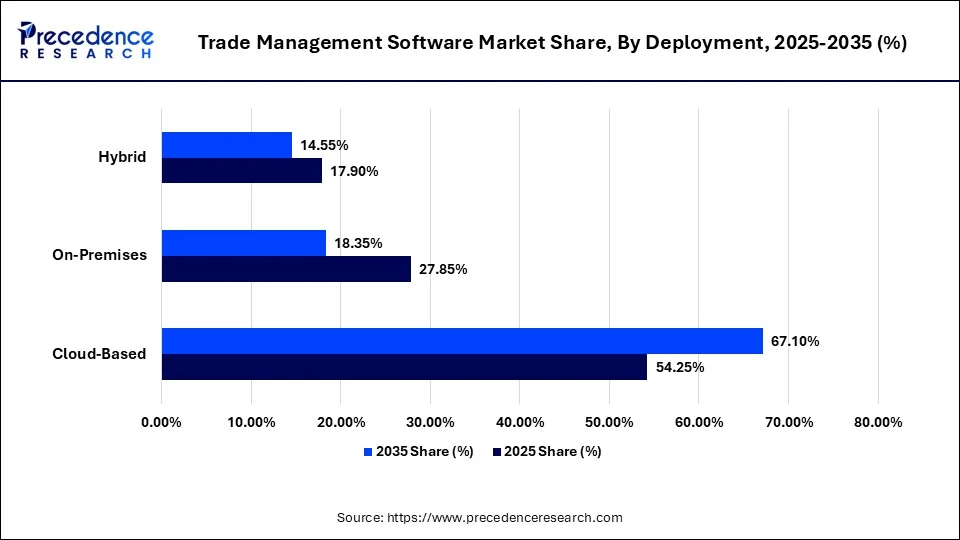
Cloud-based deployment already dominates this category with 54.25% market share in 2025. This will take a significant step up to 67.10% market share by 2035 at a CAGR of 12.65%. That is the fastest of the three deployment modes, as there is a significant uplift in the pace at which enterprises are willing to migrate off older systems. Due to the ability to deploy scalable infrastructure and faster regulatory changes.
- Key Insight: Cloud-based deployment more than doubles its 54.25% market share in 2035 at a 12.65% CAGR.
By Enterprise Size
Source: Precedence Research Database
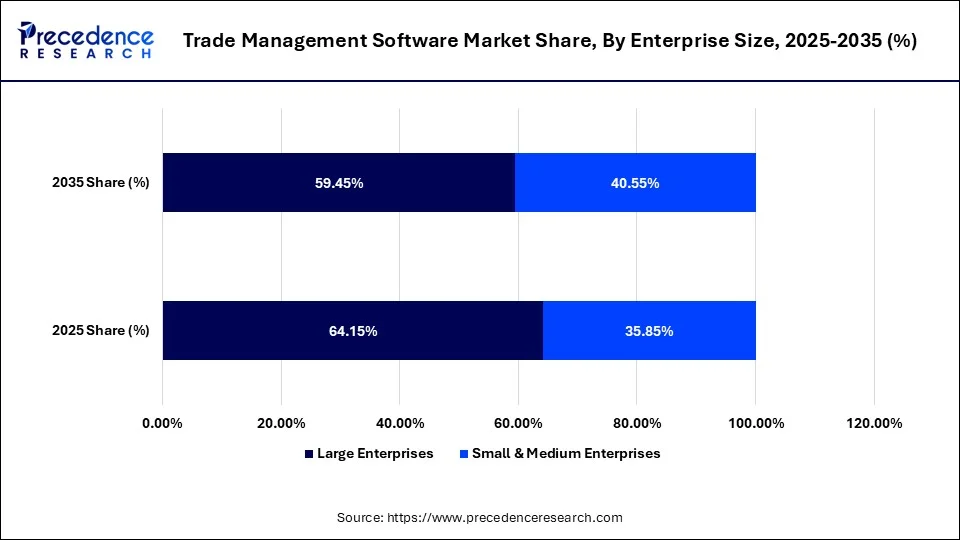
Large enterprises accounted for the largest share in 2025 with 64.15%, but dropping to a 59.45% market share in 2035 at a 9.45% CAGR. Due to continuing demand from this buyer segment, from the formidable multinational trade networks, and genuinely complex compliance rules. Small and medium enterprises are making new gains, rising from 35.85% to 40.55% market share, at the fastest 11.65% CAGR. Owing to this, SaaS can now be the main solution for a company that previously would not have felt able to afford the cost of a traditional, on-premises deployment.
- Key Insight: A modest 11.65% CAGR in growth compared to 9.45% for large enterprises, making smaller businesses more able to afford enterprise-grade trade management through SaaS pricing, is key to the increase in their market share.
By Trade Flow
Source: Precedence Research Database
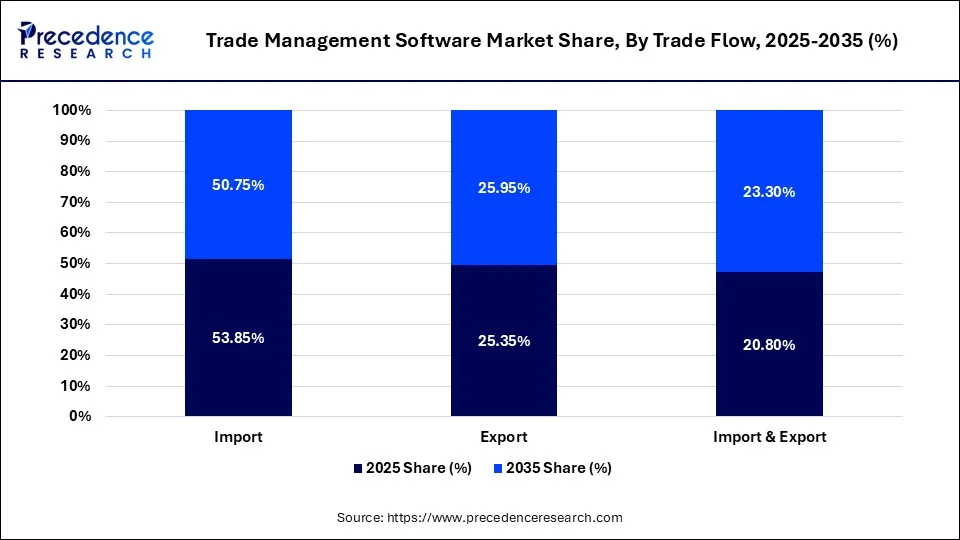
Import workflows have the biggest share of imports at 53.85% in 2025, narrowing slightly to 50.75% in 2035 at 9.55% CAGR, because handling customs, tariffs, and landed costs is quite software-intensive compared to the other two types of flow. The other fastest-growing sector, with an 11.55% CAGR, is import & export, which is an indicator of multinational companies' growing interest in a single, global trade system.
- Key Insight: Import and export combined grow fastest of the three trade-flow categories at an 11.55% CAGR, climbing to 23.30% market share by 2035.
By Technology
Source: Precedence Research Database
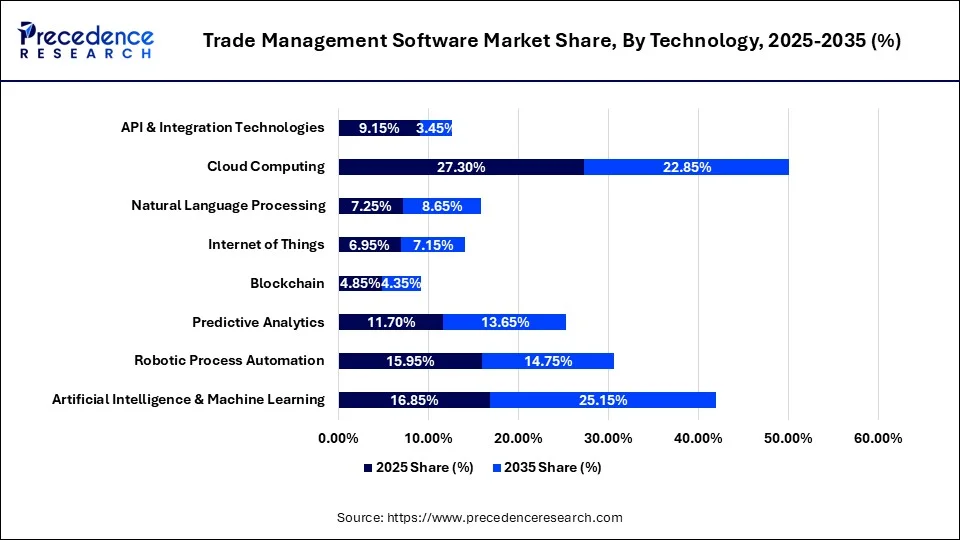
Cloud computing has the highest technology share at 27.30% market share through 2025, and is expected to fall to 22.85% market share by 2035 at a relatively low growth of 8.65% CAGR. Artificial intelligence and machine learning are the market leader with a 14.90 CAGR, which is the quickest for any technology category, rising from 16.85% to 25.15% market share. Due to its capacity to actually automate compliance analysis, classification, and trade-risk scoring rather than supporting these functions.
- Key Insight: AI and machine learning rise from 16.85% to 25.15% at 14.90% CAGR, which is the fastest among all the technology segments, whereas API and Integration Technologies drop significantly from 9.15% to 3.45% at 9.50% CAGR.
By Application
Source: Precedence Research Database
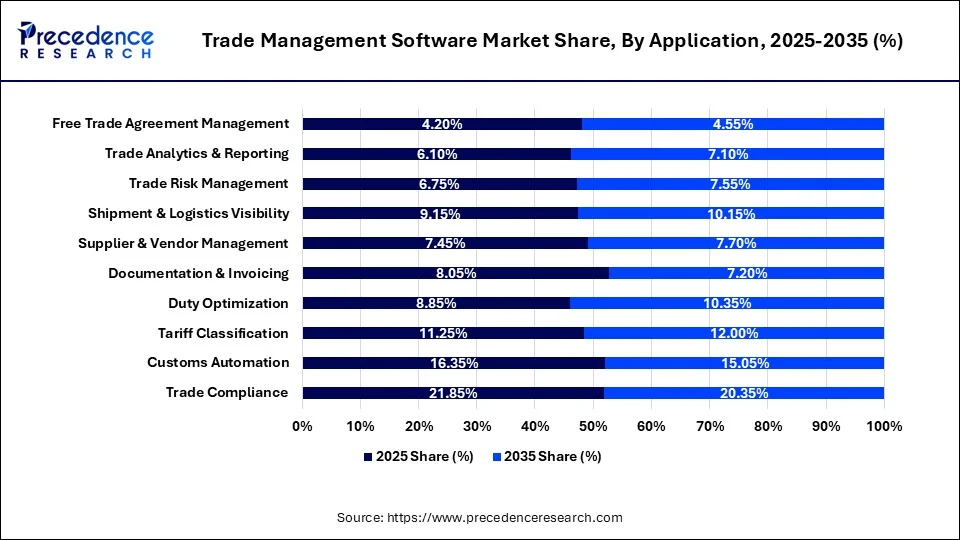
The trade compliance application segment was the largest in 2025 at 21.85% market share and is expected to grow at 9.40% CAGR to a 20.35% market share by 2035. On the other hand, duty optimization grows from 8.85% market share to 10.35% at an 11.75% CAGR. This is the highest CAGR owing to tariff volatility, making duty optimization more in demand.
- Key Insights: Duty optimization is the fastest-growing segment (11.75% CAGR), increasing its market share from 8.85% to 10.35%, while trade compliance remains the largest segment despite a decline from 21.85% to 20.35% share by 2035.
By Industry
Source: Precedence Research Database
This market is led by manufacturing with 27.10% market share in 2025 (25.40% by 2035). However, relative market share is slighting with a 9.50% CAGR due to the various trade-management requirements of complex international manufacturing supply chains. Retail and e-commerce expands its market share from 11.85 to 13.55% at an 11.40% CAGR, as the international trade pain points that were once more problematic to retailers have kept growing.
- Key Insight: Retail and e-commerce are toppling the CAGR at 11.40%, highlighting the continuing expansion of cross-border customs exposure.
By Region
Source: Precedence Research Database
Mature usage and adoption of enterprise software on top of already complex trade-compliance infrastructure in North America ensures that the region accounts for the largest market share of 35.85% in 2025. Asia-Pacific is experiencing the highest growth, increasing its market share by 31.05% with a CAGR of 12.00%. The highest of all regions in the dataset which is driven by robust growth in manufacturing, international trade, and customs digitization.
- Key Insight: Asia-Pacific is increasing significantly, from 26.20% market share in 2025 to 31.05% market share in 2035.
Key Strategic Questions Addressed
1. How large will the Trade Management Software market become by 2030 and 2035?
2. The market is moving faster than ever toward on-premises versus cloud deployments, or what is causing this move to the cloud and at what pace?
3. What functional categories (Tariff & Duty Management, Trade Analytics, Trade Agreement Management) will reap the biggest revenue increase?
4. What is driving the change in the behaviour of enterprises when making their purchases to meet trade compliance software regulations?
5. Where will the industries be turning to for the highest growth expenditure of trade-management software by 2035?
6. What will the future of regulation screening and workflow for risk classification under the tariff look like?
7. How is the pricing of new features and services evolving as vendors evolve from per-seat licensing to per-transaction and per-volume approaches?
8. What will be the impact on the competitive landscape of more SME deployments?
9. How will the future of competitive consolidation in the market be shaped by WiseTech Global's acquisition of E2open?
10. Who are the vendors that provide platform breadth, trade data depth, and enterprise integration to the greatest extent?
11. What are the biggest geographical white spaces, especially in Asia-Pacific?
12. What kind of takeover do you consider to be the most significant in the field of trade-management software in recent years?
13. Which technologies and business models are likely to provide the new generation of profit pools in trade management?
14. With the emergence of scale-up independent platforms, what should ERP embedded vendors like SAP and Oracle do?
15. How can regulatory fragmentation (various tariff regimes in different countries) create competitive threats to standardized platforms at the global level?
Source: Precedence Research Database
Expert Insights
Trade management software isn't just delivering basic customs docs. It's building a connected solution to help manage compliance, tariffs, shipments, and cross-border costs. In the combination of features such as customs automation with real-time tariff intelligence, automated product categorization, sanctions screening, and landed costs, there are great trend opportunities. Global companies will keep trade technology on the strategic agenda as trade continues to grow across borders and tariffs are constantly changing. There are increased regulatory demands, and the supply chain presents risks of disruption. I also see a practical application of artificial intelligence in classification, document extraction, compliance, and in the analysis of trade data in the not-too-distant future, but not as a replacement for the skill of experts.
Our Experts
- The report's analytical basis was laid by Gautam Mahajan, who led the primary market research, created the market methodology, and analyzed the segmentation, technology adoption, regional trends, competitive positioning, and forecasts.
- Collection and validation of customs regulations, tariff schedules, company disclosures, software developments, trade data, and other quantitative data sources gathered by Aman independently bolstered the evidence on which the market estimates were based.
- The report has been read by Aditi, who has reviewed the whole research document, market calculations, and supporting evidence. Any inconsistent aspect(s) from the research have been resolved, and the research has been refined, and the report has been finalized for accuracy and clarity.
Trade Management Software Market Segmentation List
By Component
- Software
- Services
By Function
- Trade Compliance Management
- Customs Management
- Import Management
- Export Management
- Tariff & Duty Management
- Landed Cost Management
- Trade Agreement Management
- Restricted Party Screening
- Trade Finance Management
- Trade Analytics
- Logistics & Transportation Management
- Trade Documentation Management
By Deployment
- Cloud-Based
- On-Premises
- Hybrid
By Enterprise Size
- Large Enterprises
- Small & Medium Enterprises
By Trade Flow
- Import
- Export
- Import & Export
By Technology
- Artificial Intelligence & Machine Learning
- Robotic Process Automation
- Predictive Analytics
- Blockchain
- Internet of Things
- Natural Language Processing
- Cloud Computing
- API & Integration Technologies
By Application
- Trade Compliance
- Customs Automation
- Tariff Classification
- Duty Optimization
- Documentation & Invoicing
- Supplier & Vendor Management
- Shipment & Logistics Visibility
- Trade Risk Management
- Trade Analytics & Reporting
- Free Trade Agreement Management
By Industry
- Manufacturing
- Transportation & Logistics
- Retail & E-commerce
- Automotive
- Healthcare & Life Sciences
- Energy & Utilities
- Oil & Gas
- Aerospace & Defense
- Consumer Goods
- Chemicals
- Government
- Other Industries
By Region
- North America
- U.S.
- Canada
- Mexico
- Europe
- Germany
- U.K.
- France
- Italy
- Spain
- Netherlands
- Belgium
- Switzerland
- Rest of Europe
- Asia-Pacific
- China
- Japan
- India
- South Korea
- Australia
- Singapore
- Rest of Asia-Pacific
- Latin America
- Brazil
- Mexico
- Argentina
- Rest of Latin America
- Middle East & Africa
- UAE
- Saudi Arabia
- South Africa
- Rest of Middle East & Africa
References
Precedence Research Database
"Trade Management Software Market - Market Size and Segmentation Data"
https://www.precedenceresearch.com
Data used: Market size, CAGR, and all segment share/CAGR tables
WiseTech Global / E2open
"WiseTech Global Completes Strategic Acquisition of E2open" - August 3, 2025
https://www.wisetechglobal.com/news/wisetech-global-completes-strategic-acquisition-of-e2open/
Data used: WiseTech-E2open M&A deal value, structure, and completion date
Cravath, Swaine & Moore LLP
"WiseTech Global's USD 2.1 Billion Acquisition of e2open" - May 26, 2025
https://www.cravath.com/news-insights/wisetech-globals-dollar21-billion-acquisition-of-e2open.html
Data used: Deal announcement date and enterprise value detail
Logistics Viewpoints
"WiseTech Global Acquires E2open, Marking a Shift in the Global Trade Compliance Market" - August 5, 2025
https://logisticsviewpoints.com/2025/08/05/wisetech-global-acquires-e2open-marking-a-shift-in-the-global-trade-compliance-market/
Data used: Strategic rationale and market-impact context
Australian Competition & Consumer Commission (ACCC)
"WiseTech to Divest Expedient Following ACCC Investigation" - January 5, 2026
https://www.accc.gov.au/media-release/wisetech-to-divest-expedient-following-accc-investigation
Data used: Post-acquisition regulatory divestiture detail
Tax Foundation
"Trump Tariffs Tracker: Rates, Revenue, and Impact" - 2026 (updated)
https://taxfoundation.org/research/all/federal/trump-tariffs-trade-war/
Data used: 2025 effective US tariff rate and customs duty collection figures
Federal Reserve Bank of Richmond
"Tariffs: Estimating the Economic Impact of the 2025 Measures and Proposals" - December 9, 2025
https://www.richmondfed.org/publications/research/economic_brief/2025/eb_25-12
Data used: CFO survey data on trade/tariffs as top business concern
Federal Reserve Bank of Boston
"Who Will Pay for Tariffs? Businesses' Expectations about Costs and Prices" - September 29, 2025
https://www.bostonfed.org/publications/current-policy-perspectives/2025/who-pays-for-tariffs.aspx
Data used: SMB average tariff rate impact data
For inquiries regarding discounts, bulk purchases, or customization requests, please contact us at sales@precedenceresearch.com
Frequently Asked Questions





Ask For Sample
No cookie-cutter, only authentic analysis – take the 1st step to become a Precedence Research client
 Get a Sample




 sales@precedenceresearch.com
 Schedule a Meeting
