



Trade Surveillance Systems Market Trends, Companies, Revenue / Sales Performance, Subscriber Growth, Pricing Strategies, Cloud Adoption, Infrastructure Expansion, Competitive Landscape, and Industry Outlook
Trade Surveillance Systems Market (By Component: Software, Services; By Deployment Mode: Cloud-based, On-premise, Fixed Income; By Organization Type: Exchanges, Brokerage Firms, Banks, Asset Management Firms, Regulatory Authorities; By Technology: Rule-based Surveillance, AI & Machine Learning-based Surveillance, Big Data Analytics; By End-Use Industry: BFSI, Capital Markets, Regulatory Bodies) - Global Industry Analysis, Size, Trends, Leading Companies, Regional Outlook, and Forecast 2026 to 2035
Source: https://www.precedenceresearch.com/trade-surveillance-systems-market
 Get a Sample
 Table Of Content


What is the Trade Surveillance Systems Market Size in 2026?
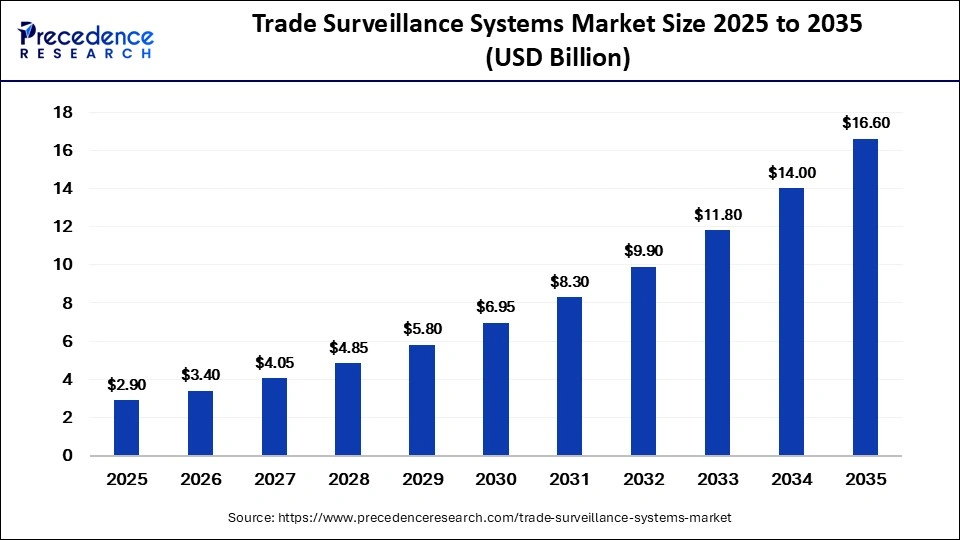
The global trade surveillance systems market size accounted for USD 2.90 billion in 2025 and is predicted to increase from USD 3.40 billion in 2026 to approximately USD 16.60 billion by 2035, expanding at a CAGR of 19.06% from 2026 to 2035. The market growth is attributed to rising regulatory scrutiny, expanding algorithmic trading volumes, and increasing adoption of AI-powered compliance monitoring solutions.
Key Takeaways
- North America dominated the market with a 40% share in 2025.
- Asia Pacific is expected to grow at the fastest CAGR of 22% between 2026 and 2035.
- By component, the software segment contributed the highest market share of 70% in 2025.
- By component, the services segment held a 30% share of the market in 2025 and is expected to grow at a CAGR of 15.5% between 2026 and 2035.
- By deployment mode, the cloud-based segment held a major market share of 55% in 2025.
- By deployment mode, the on-premise segment held a 45% share in 2025 and is expected to grow at a 13.5% CAGR between 2026 and 2035.
- By organization type, the brokerage firms segment contributed the highest market share of 30% in 2025.
- By organization type, the banks segment held a 25% market share in 2025 and is expected to grow at a CAGR of 17% over the projected period.
- By technology, the rule-based surveillance segment contributed the highest market share of 40% in 2025.
- By technology, the AI & machine learning segment held a 35% share of the market in 2025 and is expected to grow at a CAGR of 22.5% between 2026 and 2035.
- By end-use industry, the BFSI segment contributed the highest market share of 50% in 2025.
- By end-use industry, the capital markets segment held a 35% share of the market in 2025 and is expected to grow at a significant CAGR of 18.5% between 2026 and 2035.
Market Overview
Rising regulatory scrutiny and growing multi-asset trading complexity are key drivers accelerating the growth of the trade surveillance systems market. Compliance technologies used to identify insider trading, wash trades, and manipulation include real-time trade surveillance systems. Such platforms operate on rule engines, artificial intelligence, machine learning, and analytics that analyze trading behavior.
They interpret order, execution, communications, and cross-market activity in equities, derivatives, FX, commodities, and digital assets. The FINRA in 2025 Regulatory Oversight Report encouraged companies to have mechanisms to detect spoofing, layering, and manipulative trading activities. Furthermore, the increasing algorithmic trading, cross-border transactions, and stronger enforcement demands remain major long-term market drivers.
Impact of Artificial Intelligence on the Trade Surveillance Systems Market
AI is being integrated into trade surveillance platforms to analyze orders, executions, price behavior, communications, and cross-market behavior in real-time. These features assist in detecting spoofing, insider trading, and collusion that can be detected by these capabilities more quickly, in contrast to conventional rule-based tools. Machine learning is updated to new trading strategies, which means that surveillance systems are more effective in a rapidly evolving market.
Market Trends
- Expansion of Cross-Asset Trading Activities: Growing participation across equities, FX, derivatives, and commodities fuels demand for unified surveillance platforms.
- Increase in Digital Asset Market Oversight: Rising cryptocurrency trading volumes are driving the adoption of advanced monitoring tools for new asset classes.
Market Scope
| Report Coverage | Details |
| Market Size in 2025 | USD 2.90 Billion |
| Market Size in 2026 | USD 3.40 Billion |
| Market Size by 2035 | USD 16.60 Billion |
| Market Growth Rate from 2026 to 2035 | CAGR of 19.06% |
| Dominating Region | North America |
| Fastest Growing Region | Asia Pacific |
| Base Year | 2025 |
| Forecast Period | 2026 to 2035 |
| Segments Covered | Component, Deployment Mode, Organization Type, Technology, End-Use Industry, and Region |
| Regions Covered | North America, Europe, Asia-Pacific, Latin America, and Middle East & Africa |
Market Dynamics
Drivers
Growing Digital Asset Adoption
Growing adoption of digital assets is anticipated to strengthen market growth in the coming years. Institutional investors, exchanges, and brokers are increasingly entering into crypto spot markets, derivatives, and tokenized asset markets. Vendors of surveillance systems have begun to create tools that track the trading behavior of blockchains in addition to conventional market trading. Moreover, the increasing cross-border trading activity is expected to accelerate demand for advanced surveillance platforms.
Restraint
High Implementation and Integration Costs
The high implementation and integration costs are expected to remain a major restraint for the trade surveillance systems market. These surveillance systems that are multi-asset monitoring require custom work, testing, and moving the historical data, which can be very expensive to the project budget. Furthermore, the restricted operating efficiency through excessive false positive alerts is anticipated to challenge industry growth.
Opportunity
Expanding Cloud Infrastructure
The expansion of cloud-native infrastructure is expected to create significant growth opportunities for the trade surveillance systems market. Traditional on-premise systems often struggle with rising data volumes, high maintenance costs, and slow deployment cycles. In contrast, cloud-based solutions offer scalable computing resources that support real-time analytics, efficient data storage, and rapid adaptation to evolving regulatory requirements. Additionally, mid-sized brokers are increasingly shifting toward subscription-based models, which reduce upfront implementation costs and improve accessibility to advanced surveillance capabilities.
Segment Insight
Component Insight
Trade Surveillance Systems Market Share, By Component, 2025-2035 (%)
| Component | 2025 | 2035 | CAGR (%) |
| Software | 70.00% | 72.00% | 18.50% |
| Services | 30.00% | 28.00% | 15.50% |
The Software Segment Dominated the Market with a 70% Share in 2025
The software segment dominated the trade surveillance systems market with a 70% share in 2025, driven by the increasing adoption of artificial intelligence (AI), machine learning, and advanced investigative tools across compliance functions. Financial institutions are increasingly deploying unified platforms to monitor orders, executions, price movements, and communication logs. Integrated solutions supporting equities, derivatives, foreign exchange (FX), and digital assets are replacing fragmented legacy systems, enhancing efficiency and oversight.
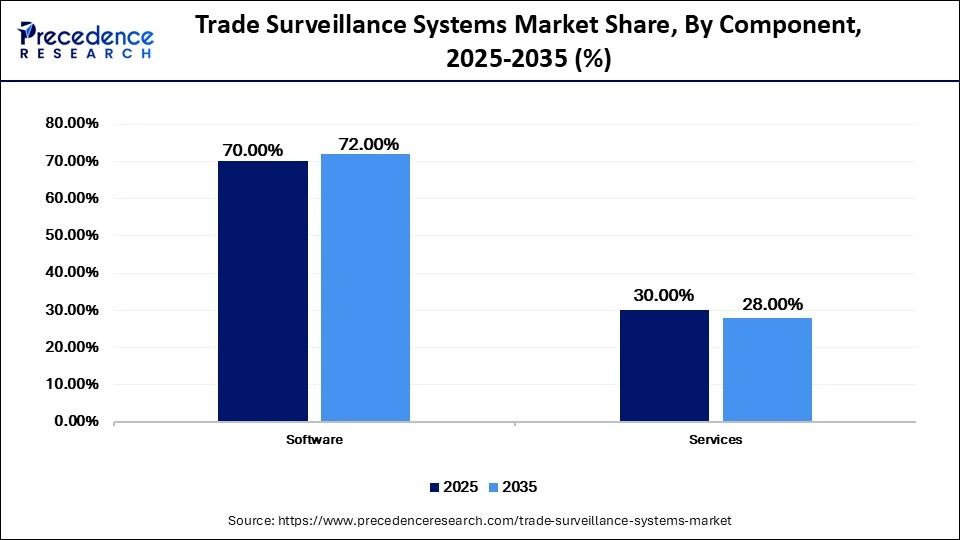
The services segment accounted for a 30% share in 2025 and is projected to grow at a CAGR of 15.5% during the forecast period. The segment's growth is driven by the need for expert support in deployment, calibration, system upgrades, and governance reviews. Consulting services play a critical role in translating regulatory requirements into practical surveillance frameworks and escalation processes.
Deployment Mode Insights
The Cloud-based Segment Held a 55% Market Share in 2025
The cloud-based segment dominated the trade surveillance systems market with a share of 55% in 2025, driven by the need for scalable computing, reduced upfront infrastructure costs, and faster deployment timelines. Financial institutions are increasingly leveraging cloud platforms to manage growing volumes of trading data, including orders, executions, market feeds, and communications. The ability to create unified surveillance environments across multiple subsidiaries and jurisdictions further supports adoption.
Trade Surveillance Systems Market Share, By Deployment Mode, 2025-2035 (%)
| Deployment Mode | 2025 | 2035 | CAGR (%) |
| Cloud-based | 55.00% | 65.00% | 21.50% |
| On-premise | 45.00% | 35.00% | 13.50% |
The on-premise segment held a 45% share of the market in 2025 and is expected to grow at a significant rate of CAGR of 13.5% in the upcoming period, owing to the growing number of institutions focusing on the direct ownership of structures and internal governance measures. Strict data residency requirements and the need for low-latency processing, especially among high-frequency trading firms, continue to support on-premise deployments.
Organization Type Insights
Why Did the Brokerage Firms Segment Dominate the Market in 2025?
The brokerage firms segment dominated the trade surveillance systems market with a share of 30% in 2025, driven by high volumes of client orders, retail trading activity, and multi-venue execution routing. Firms are adopting integrated surveillance systems that combine alert generation, case management, and communication monitoring within a single interface.
The banks segment held a 25% share of the market in 2025 and is expected to grow at a CAGR of 17% between 2026 and 2035. This is because financial institutions operate across diverse asset classes, including FX, rates, credit, equities, and commodities, requiring robust surveillance systems. Increasing regulatory expectations from authorities such as the Federal Reserve and OCC are further driving investments in monitoring infrastructure and integration with risk and compliance systems.
Trade Surveillance Systems Market Share, By Organization Type, 2025-2035 (%)
| Organization Type | 2025 | 2035 | CAGR (%) |
| Brokerage Firms | 30.00% | 28.00% | 16.50% |
| Banks | 25.00% | 24.00% | 17.00% |
| Exchanges | 20.00% | 22.00% | 18.50% |
| Asset Management Firms | 15.00% | 16.00% | 17.50% |
| Regulatory Authorities | 10.00% | 10.00% | 18.00% |
The exchanges segment held a 20% share of the market in 2025 and is expected to grow at a CAGR of 18.5% during the projection period, owing to the growing demand for real-time market integrity controls in equities, derivatives, commodities, and digital trading facilities. Nasdaq stated in 2025 that its surveillance solutions support more than 50 exchanges. The growing adoption of advanced surveillance platforms by global exchanges highlights strong demand for specialized solutions.
The regulatory authorities segment held a 10% share of the market in 2025 and is expected to grow at a significant CAGR of 18% between 2026 and 2035, supported by the need for independent tools to detect market abuse, suspicious trading patterns, and participant behavior. Agencies increasingly rely on multi-source data analysis, including transaction reports and exchange feeds, to strengthen oversight.
Technology Insights
Trade Surveillance Systems Market Share, By Technology, 2025-2035 (%)
| Technology | 2025 | 2035 | CAGR (%) |
| Rule-based Surveillance | 40.00% | 30.00% | 13.50% |
| AI & Machine Learning | 35.00% | 45.00% | 22.50% |
| Big Data Analytics | 25.00% | 25.00% | 17.50% |
The Rule-based Surveillance Segment Dominated the Market in 2025
The rule-based surveillance segment dominated the trade surveillance systems market with a 40% share in 2025, owing to its foundation in established compliance frameworks and predefined alert scenarios. These systems are widely used to detect activities such as spoofing, wash trading, layering, and rapid order cancellations. Their ease of implementation makes them particularly attractive to smaller institutions.
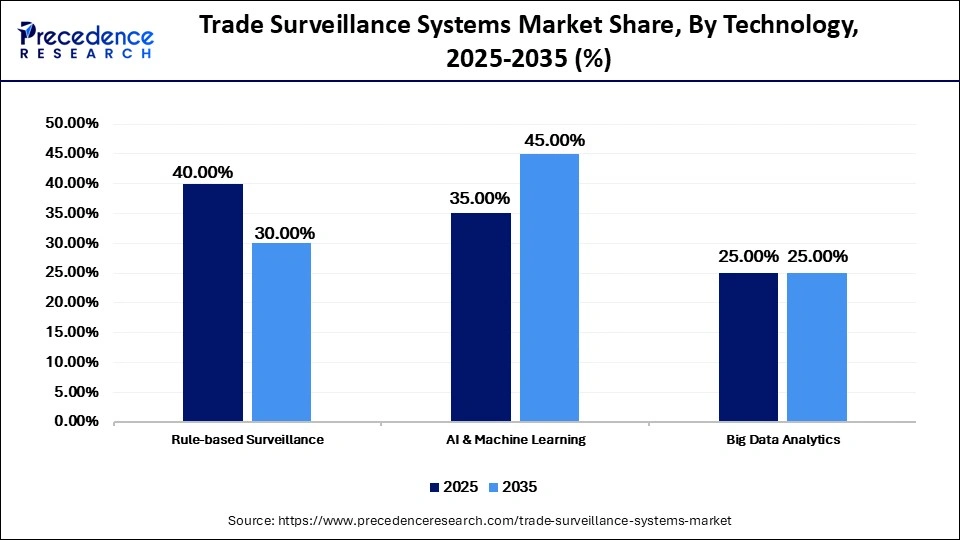
The AI & machine learning segment accounted for a 35% share in 2025 and is expected to grow at the fastest CAGR of 22.5%. The segment growth is driven by the need to improve alert accuracy, reduce false positives, and enhance detection capabilities in increasingly complex trading environments. Rising adoption among digital asset platforms and fintech firms is further accelerating this trend.
The big data analytics segment held a 25% share in 2025 and is projected to grow at a CAGR of 17.5%, supported by the need to process large volumes of structured and unstructured data. These solutions enable rapid querying, historical pattern analysis, and integration of multiple data sources, improving investigation speed and accuracy. Companies are turning to big data platforms to integrate desk-based sources, entity-based sources, and geography-based sources. Fast querying facilitates quicker investigations and analysis of historical patterns. These abilities maintain high demand for big data analytics solutions.
End-Use Industry Insights
The BFSI Segment Dominated the Market with 50% of Market Share in 2025
The BFSI segment led the market with a 50% share in 2025, driven by large financial institutions replacing siloed systems with integrated surveillance platforms connected to order management systems (OMS), execution management systems (EMS), CRM platforms, and risk engines. Banking institutions are also expanding multilingual monitoring capabilities to support global operations.
For instance, in February 2026, Nasdaq announced that Japan Exchange Group's Osaka Exchange selected its Eqlipse Trading and Market Surveillance platforms to support next-generation derivatives infrastructure and enhance monitoring capabilities.
Trade Surveillance Systems Market Share, By End-Use Industry, 2025-2035 (%)
| End-Use Industry | 2025 | 2035 | CAGR (%) |
| BFSI | 50.00% | 48.00% | 17.00% |
| Capital Markets | 35.00% | 37.00% | 18.50% |
| Regulatory Bodies | 15.00% | 15.00% | 17.50% |
The capital markets segment accounted for a 35% share in 2025 and is projected to grow at the highest CAGR of 18.5%. Increasing market fragmentation, high trading volumes, and complex cross-venue strategies are driving demand for advanced surveillance tools capable of detecting sophisticated trading patterns in real time.
The regulatory bodies segment held a 15% share in 2025 and is expected to grow at a CAGR of 17.5%, driven by increasing investments in advanced technologies such as graph analytics, entity resolution, and automated case management. Cross-border investigations are also driving the need for interoperable and secure data-sharing systems.
Regional Insights
North America Trade Surveillance Systems Market Size and Growth 2026 to 2035
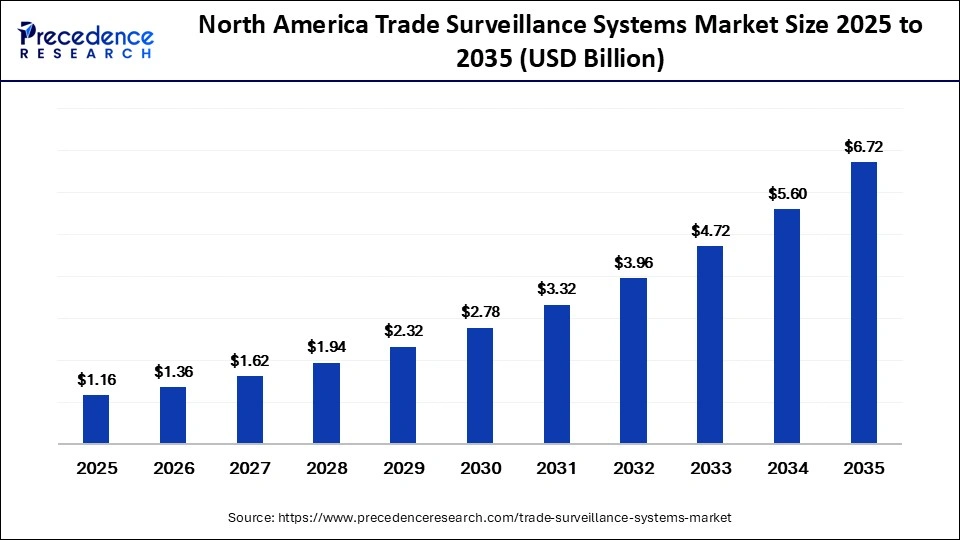
The North America trade surveillance systems market size is estimated at USD 1.16 billion in 2025 and is projected to reach approximately USD 6.72 billion by 2035, with a 19.20% CAGR from 2026 to 2035.
What Made North America the Dominant Region in the Market in 2025?
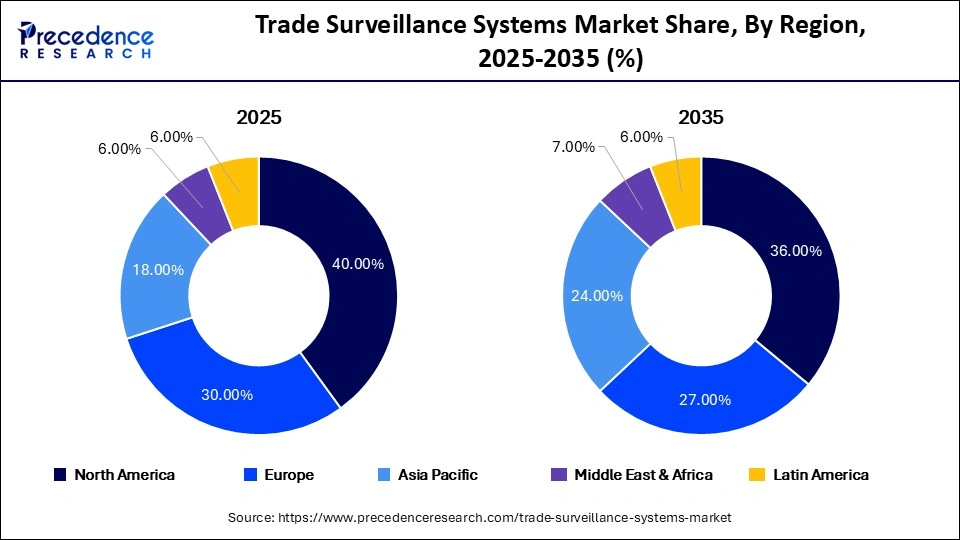
North America led the trade surveillance systems market, capturing the largest revenue share of 40% in 2025. This is mainly due to the strong presence of investment banks, broker-dealers, futures exchanges, and highly advanced electronic trading ecosystems. Institutions operate across multiple asset classes, including equities, options, Treasuries, ETFs, commodities, and digital assets, creating continuous demand for multi-asset surveillance solutions. Additionally, high trading volumes, such as those reported by CME Group, further reinforce the need for advanced monitoring capabilities. The region's mature client base and early adoption of innovative technologies continue to attract new product developments from vendors, sustaining its leadership position.
U.S. Trade Surveillance Systems Market Size and Growth 2026 to 2035
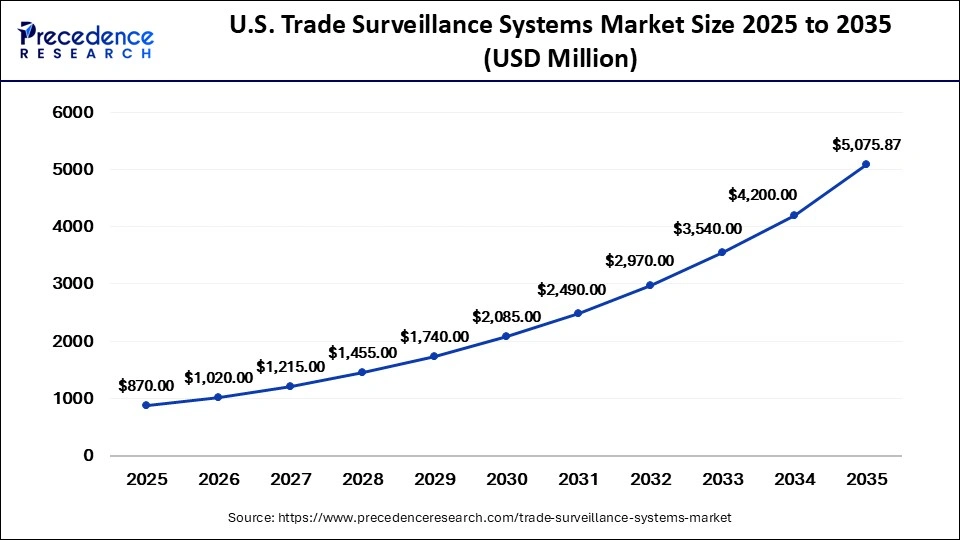
The U.S. trade surveillance systems market size is calculated at USD 870.00 million in 2025 and is expected to reach nearly USD 5,075.87 million in 2035, accelerating at a strong CAGR of 19.29% between 2026 and 2035.
U.S. Market Trends
The U.S. leads the market within North America, supported by its highly sophisticated capital markets infrastructure. Major financial institutions such as JPMorgan Chase, Goldman Sachs, Morgan Stanley, and Citigroup rely on advanced surveillance systems to monitor trading behavior, communication records, and cross-asset risk exposure. The strong focus on compliance, risk management, and technological innovation continues to drive market growth in the country.
Europe: The Second-Largest Market
Europe held the second-largest market share of 30% in 2025 and is estimated to grow at a strong CAGR of 16% over the projected period. This growth is largely driven by well-established regulatory frameworks and harmonization across financial markets. Regulations such as MiFID II and the Market Abuse Regulation (MAR) are pushing institutions to invest in sophisticated surveillance systems. Additionally, ongoing digital infrastructure initiatives by major exchanges are further supporting the adoption of advanced monitoring solutions.
UK Market Trends
The UK is a major contributor to the European market, with London serving as a global hub for banking, trading, and asset management activities. Post-Brexit regulatory changes have increased compliance complexity, prompting firms to adopt more automated and scalable surveillance solutions. These factors position the UK as a key center for trade surveillance innovation in Europe.
Asia Pacific: The Fastest-Growing Region
Asia Pacific held a 18% share of the market in 2025 and is expected to grow at the fastest CAGR of 22% over the forecast period, driven by expanding capital markets, rising retail investor participation, and increasing regulatory oversight across major economies. The rapid adoption of digital trading platforms and mobile investing is further accelerating the demand for automated surveillance systems. Additionally, growing exchange activity and increased participation from foreign investors are strengthening the need for robust monitoring solutions.
China Market Trends
In China, the market is by high trading volumes and rapidly evolving financial infrastructure. Major exchanges such as the Shanghai Stock Exchange and Shenzhen Stock Exchange generate substantial order flows, necessitating continuous monitoring for market manipulation, spoofing, and abnormal trading patterns. The expansion of mutual funds, futures trading, and bond markets is further driving demand for advanced trade surveillance systems.
Trade Surveillance Systems Market Value Chain Analysis
- Data Acquisition & Market Feed Integration
The foundation of trade surveillance systems lies in collecting orders, trades, quotes, communications, and market data for monitoring purposes.
Key Players: Bloomberg, Refinitiv, ICE Data Services, FactSet.
- Software Development & Analytics Engine Creation
Collected data is converted into surveillance platforms using AI, rules engines, alert management, and case investigation tools.
Key Players: Nasdaq, NICE Actimize, Eventus, BAE Systems.
- Infrastructure Deployment & System Integration
Platforms are deployed through cloud or on-premise environments and integrated with trading, compliance, and reporting systems.
Key Players: Amazon Web Services (AWS), Microsoft Azure, Oracle, Accenture.
- End-User Monitoring & Regulatory Compliance
Banks, brokers, exchanges, and regulators use these systems for real-time surveillance, investigations, and reporting.
Key Players: JPMorgan Chase, Goldman Sachs, FINRA, London Stock Exchange Group (LSEG).
Trade Surveillance Systems Market Companies
- Nasdaq
- NICE Actimize
- FIS
- Refinitiv
- SIX Group
- ACA Group
- Software AG
- IBM
- Oracle
- Fenergo
- Aquis Exchange
- b-next
- Scila
- Eventus Systems
- OneMarketData
Recent Developments
- In January 2026, London Stock Exchange Group launched a Trade Surveillance platform to detect market abuse and financial crime more efficiently. The solution supports MiFID and FX monitoring while processing billions of trade and order messages daily using proprietary data. The launch addresses rising regulatory complexity and the need for scalable, data-driven surveillance tools.(Source: https://www.lseg.com)
- In March 2026, Webull partnered with Solidus Labs to strengthen digital asset surveillance in the United States and Canada. The collaboration enhances risk monitoring using crypto-native analytics tailored for evolving compliance needs. Both companies plan further expansion into additional markets where digital asset trading is active.(Source: https://www.businesswire.com)
Segments Covered in the Report
By Component
- Software
- Services
By Deployment Mode
- Cloud-based
- On-premise
- Fixed Income
By Organization Type
- Exchanges
- Brokerage Firms
- Banks
- Asset Management Firms
- Regulatory Authorities
By Technology
- Rule-based Surveillance
- AI & Machine Learning-based Surveillance
- Big Data Analytics
By End-Use Industry
- BFSI
- Capital Markets
- Regulatory Bodies
By Region
- North America
- Latin America
- Europe
- Asia-pacific
- Middle and East Africa
For inquiries regarding discounts, bulk purchases, or customization requests, please contact us at sales@precedenceresearch.com
Frequently Asked Questions





Ask For Sample
No cookie-cutter, only authentic analysis – take the 1st step to become a Precedence Research client
 Get a Sample




 sales@precedenceresearch.com
 Schedule a Meeting
