



Trade Credit Insurance Market Trends, Companies, Revenue / Sales Performance, Subscriber Growth, Pricing Strategies, Cloud Adoption, Infrastructure Expansion, Competitive Landscape, and Industry Outlook
Trade Credit Insurance Market (By Enterprise Size: Large Enterprises, Small & Medium Enterprises; By Coverage: Whole Turnover Coverage, Single Buyer Coverage; By Application: Domestic, International; By End User: Food & Beverage, IT & Telecom, Healthcare, Energy, Automotive, Others) - Global Industry Analysis, Size, Trends, Leading Companies, Regional Outlook, and Forecast 2026 to 2035
Source: https://www.precedenceresearch.com/trade-credit-insurance-market
 Get a Sample
 Table Of Content


What is the Trade Credit Insurance Market Size in 2026?
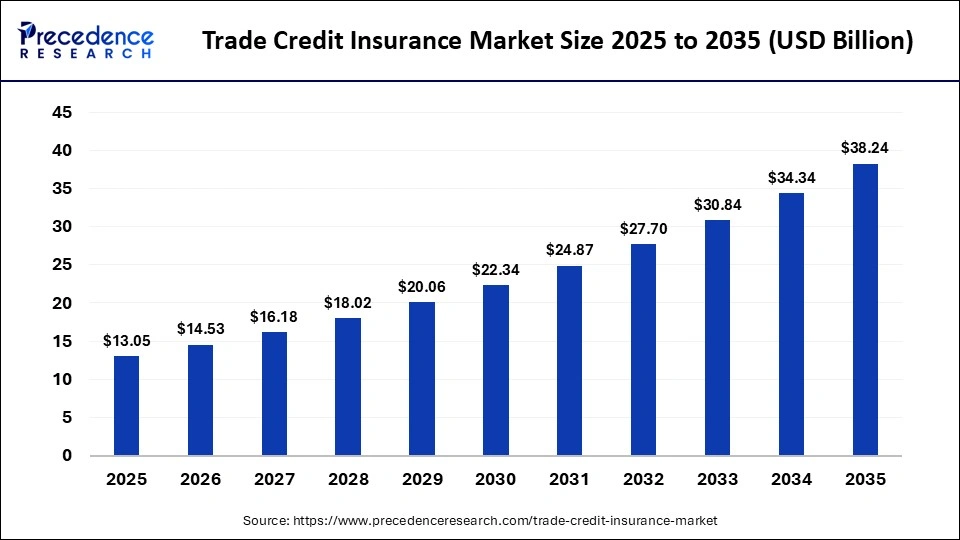
The global trade credit insurance market size was calculated at USD 13.05 billion in 2025 and is predicted to increase from USD 14.53 billion in 2026 to approximately USD 38.24 billion by 2035, expanding at a CAGR of 11.35% from 2026 to 2035. The growth of the market can be attributed to the growing globalization and cross-border trade, the growth of small and medium-sized enterprises, and increased adoption of core banking solutions, leading to demand for trade credit insurance to reduce the risk of non-payment from foreign buyers.
Market Highlights
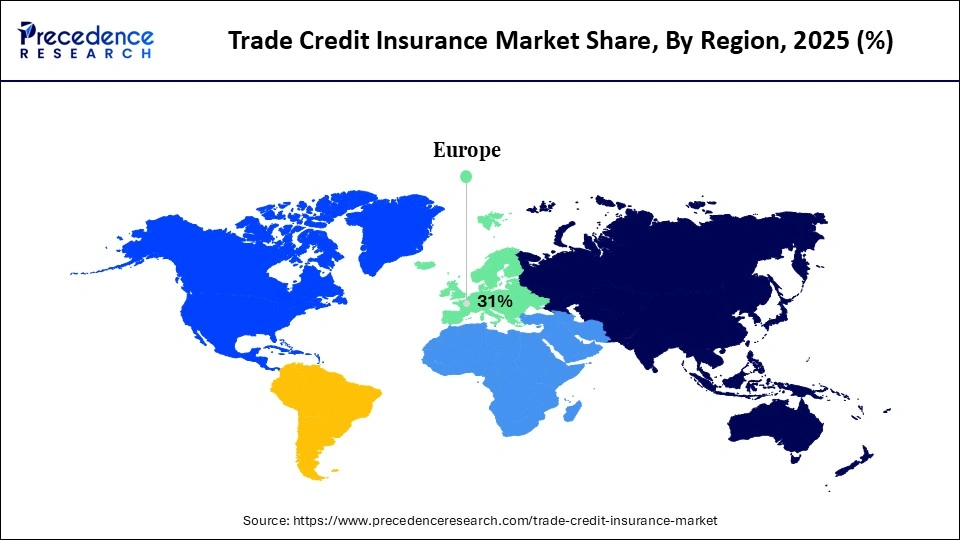
- Europe dominated the global trade credit insurance market with largest share of 31% in 2025.
- Asia Pacific is expected to grow at the fastest CAGR in the market during the forecast period.
- By enterprise size, the large enterprises segment held a dominant position in the market with the highest share of 61% in 2025.
- By enterprise size, the small and medium enterprises segment is expected to grow at the fastest CAGR in the market during the forecast period.
- By coverage, the whole turnover coverage segment held a dominant position in the market in 2025.
- By coverage, the single buyer coverage segment is expected to grow at the fastest CAGR in the market during the forecast period.
- By application, the international application segment held a dominant position in the market in 2025.
- By application, the domestic application segment is expected to grow at the fastest CAGR in the market during the forecast period.
- By end-user, the food and beverages segment held a dominant position in the trade credit insurance market in 2025.
- By end-user, the automotive segment is expected to grow at the fastest CAGR in the market during the forecast period.
Market Overview
Trade credit insurance is a form of insurance that protects businesses against political and commercial risks, losses from customer non-payment, insolvency, or default. It is used to safeguard accounts receivable from goods or services sold on credit, providing compensation when buyers fail to pay. It helps in managing risk and maintaining a stable payment flow.
The trade credit insurance market is driven by increasing global expansion of cross-border trade activities, economic uncertainty, and growing demand for risk management solutions. The growing adoption of digital platforms and advancements in data analytics are improving accessibility. However, high premiums and limited awareness of small-sized enterprises remain challenges while expansion continues across markets.
What is the Impact of AI on the Market's Growth?
AI is transforming the trade credit insurance market by transforming risk assessment, underwriting precision, and claims efficiency. Advanced AI models evaluate vast volumes of structured and unstructured data in real time to identify early warning signals of buyer distress and continuously refine risk scoring. This enables insurers to predict, enhance underwriting decision processes, and personalize pricing while reducing processing time. In claims management, AI automates documentation verification, fraud detection, and case triage with significant reductions in settlement timelines. AI increases accuracy, transparency, portfolio performance, and operational efficiency, allowing faster, data-driven, and more reliable credit risk protection.
What are the Trade Credit Insurance Market Trends?
- Integration with Trade Finance Solutions: For small enterprises, insurance is incorporated into supply chain finance, factoring, and invoice discounting, which improves credit access and strengthens lender confidence.
- Rising Adoption of AI and Advanced Analytics: Enhanced credit risk evaluation through predictive modeling, real-time risk monitoring, and automated underwriting, enabling dynamic premium pricing.
- Shift towards Customized and Sector-Specific Coverage: Tailor-made policies are being offered by the insurers with different risk profiles for manufacturing, energy, retail, and technology industries.
- Expansion of Domestic Trade Credit Insurance: Trade credit insurance protects domestic transactions beyond export coverage, driven by growing payment risks in local markets.
- Digitalization of Policy Management and Claims: To improve operational efficiency, transparency, and faster claim settlements, end-to-end platforms, automation, and data-driven decision tools adoption has increased.
Market Scope
| Report Coverage | Details |
| Market Size in 2025 | USD 13.05 Billion |
| Market Size in 2026 | USD 14.53 Billion |
| Market Size by 2035 | USD 38.24 Billion |
| Market Growth Rate from 2026 to 2035 | CAGR of 11.35% |
| Dominating Region | Europe |
| Fastest Growing Region | Asia Pacific |
| Base Year | 2025 |
| Forecast Period | 2026 to 2035 |
| Segments Covered | Enterprise Size, Coverage, Application, End User, and Region |
| Regions Covered | North America, Europe, Asia-Pacific, Latin America, and Middle East & Africa |
Market Dynamics
Driver
Rising Global Trade and Payment Default Risks
More international transactions, along with concerns regarding delayed payments and bankruptcies, are just a few of the reasons why individuals are resorting to trade credit insurance facilities. Businesses are taking this route to secure their cash flows and prevent themselves from any dangers.
Restraint
High Premium Costs and Complex Policy Terms
The high cost of insurance premiums and complicated insurance policies might make it difficult for small businesses to adopt them. Another problem here is that many firms in developing countries lack awareness about the benefits of trade credit insurance.
Opportunity
Growing Digitalization and SME Expansion
With growing numbers of digital risk management systems in use and small/medium-sized firms venturing into international business activities, various market opportunities have emerged. It is due to this reason that the insurers are now making use of technology such as artificial intelligence in risk management.
Segments Insights
Enterprise Size Insights
How did the Large Enterprises Segment Lead the Trade Credit Insurance Market?
The large enterprises segment led the market in 2025, driven by high transaction volumes, extended payment cycles, and greater exposure to non-payment risk. Some of the market players are involved in offering trade credit insurance tailored to large enterprises to protect cash flow and receivables, while managing credit risk. Increased policy adoption by banks and lenders for large-value financing. High premiums and revenue from the segment are expected with early uptake across industries like healthcare, utilities, and technology, combined with large sales values and technology.
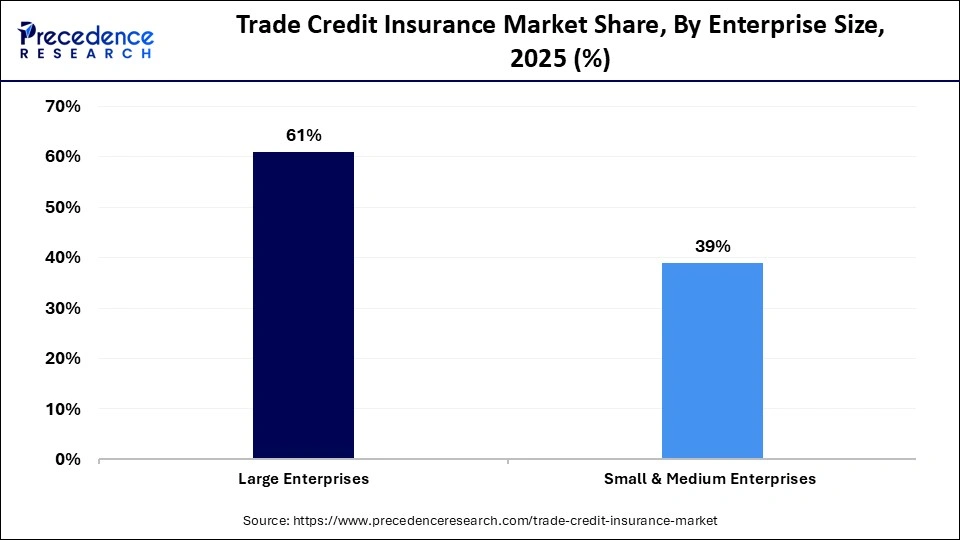
The small and medium enterprises segment is expected to grow at the fastest CAGR over the forecast period. These enterprises face higher exposure to cash-flow disruptions from delayed or unpaid invoices. Protecting their receivables is critical for financial stability and business continuity since a large share of their sales is led on credit. Digital onboarding via brokers and fintech platforms makes policies easier and faster to access, supporting the growth of the segment. Government support programs and export credit initiatives are increasing awareness and encouraging SMEs to use trade credit insurance to manage risk and access financing more easily.
Coverage Insights
How did the Whole Turnover Coverage Segment Dominate the Trade Credit Insurance Market?
The whole turnover coverage segment dominated the market in 2025. The segment provides complete coverage across a company's entire mortgagor portfolio rather than covering individual buyers. The high share of this segment can be credited to the whole turnover coverage, since it helps manage credit risk more efficiently and reduces administrative costs. It supports stronger credit control and financial planning. Since it ensures broader risk protection, it is mostly preferred by lenders for factoring, supply chain finance, and securitization. Further, the revenue is driven by its balance sheet-level coverage, underwriting based on portfolio performance, and flexibility in deductible structures.
The single buyer coverage segment is expected to grow with the highest CAGR in the market between 2026 and 2035. The growth is attributed to the rising projects, exposure to a few high-value customers, and commodity transactions, involving long payment tenors and substantial contract values, making targeted risk protection indispensable. This policy provides highly tailored coverage and defined credit limits for specific counterparties, helping companies manage risk while working with new or financially uncertain customers. These policies are used as top-up protection when existing coverage is insufficient.
Application Insights
How did the International Application Segment Dominate the Trade Credit Insurance Market?
The international application segment dominated the market in 2025 due to increased cross-border transactions, leading to higher payment and political risks compared to domestic trade. Increased likelihood of delayed or failed payments while dealing with unfamiliar buyers, varying regulations, currency fluctuations, and geopolitical uncertainties. Financial protection is essential for global trades involving large consignments and longer payment terms. The segment's growth is further supported by the rising availability of export-focused insurance products.
The domestic application segment is expected to grow with the highest CAGR in the market between 2026 and 2035. The growth is driven by the rising adoption of trade credit insurance within domestic sales, since payment risks are not limited to international trade. Rising economic uncertainty, customer concentration, and delayed payments in local markets are driving firms to protect receivables from domestic buyers. Further, the growth is attributed to expanding credit sales within domestic supply chains and consolidation among buyers, improved awareness, and policies becoming more accessible and affordable.
End-User Insights
What made the Food and Beverages Segment Dominate the Trade Credit Insurance Market?
The food and beverages segment dominated the market in 2025. This domination is due to the rising food and beverage trade activities, frequent transactions, and strong reliance on credit-based sales across complex supply chains. There is a need for the protection of cash flow since firms in this industry operate with low margins, changing consumer expectations, such as high-quality ingredients and volatile agricultural commodity pricing. Intense competition and evolving consumer demand encourage suppliers to offer extended payment terms, increasing credit exposure.
The automotive segment is anticipated to register the fastest CAGR over the forecast period. Financial uncertainties, high-value transactions, rapid technological advancements, changing customer tastes, complex global supply chains, and government regulations are driving the segment's growth in the market. With rapid technological advancements and rising awareness of credit risk across manufacturers, suppliers, and distributors, businesses are increasingly adopting trade credit insurance to protect receivables, maintain liquidity, and support expansion, driving segment growth.
Regional Insights
What Factors Have Driven the Dominance of Europe in the Trade Credit Insurance Market?
Europe dominated the global market in 2025. The presence of a highly developed trade ecosystem, strong institutional support, and adoption of advanced technologies in the region are the key factors driving the region's growth. The region is a hub for major global providers such as Allianz Trade, Atradius, and Coface, which enhances market penetration and innovation. Favorable government initiatives and high cross-border trade within and beyond the European Union are driving the European market's growth. Adoption of trade credit insurance has significantly increased across the region due to strong legal frameworks, high SME participation in global trade, and increased awareness of insolvency risks.
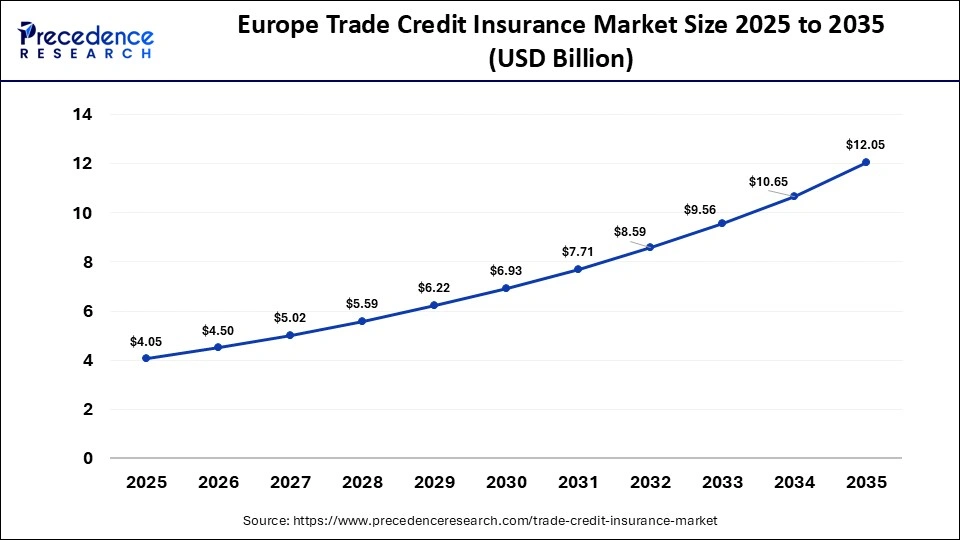
Europe Trade Credit Insurance Market Size and Growth 2026 to 2035
The Europe trade credit insurance market size has grown strongly in recent years. It will grow from USD 4.05 billion in 2025 to USD 12.05 billion in 2035, expanding at a compound annual growth rate (CAGR) of 11.52% between 2026 and 2035.
Germany Trade Credit Insurance Market Trends
Germany is witnessing a steady growth in the market. The market is shaped by the country's strong export-focused economy, large manufacturing firms, and high exposure to cross-border trade activities, which increases the payment risks. Protection against buyer default is essential for maintaining business continuity, since German firms such as automotive, machinery, chemicals, and industrial equipment rely on international trade. Firms are encouraged to strengthen credit risk management to sustain in the market due to increasing global economic uncertainty, supply chain disturbances, and changing trade conditions. As a result, countries like Germany are highly adopting trade credit insurance to safeguard receivables and support expansion into emerging or higher-risk markets.
What makes Asia Pacific the Fastest Growing Region in the Trade Credit Insurance Market?
Asia Pacific is the fastest-growing region in the market, driven by expanding businesses across the region and increased trade activities across borders. China, India, Japan, and Australia are the fast-growing economies, experiencing a surge in exports, manufacturing, and supply chain activity, and anticipating the need to protect payments and cash flow. Driven by SME digitization and widening ECA capacity, such as Sinosure, NEXI, K-Sure, and EFA, are supporting cross-border trade. Rapid infrastructure development is increasing trade finance demand. Rising business insolvencies and credit risks are encouraging firms to actively manage receivables through trade credit insurance. Further, the adoption of trade credit insurance is driven by growing intra-regional trade agreements and digital trade finance platforms.
Indian Trade Credit Insurance Market Trends
India's trade credit market is gradually gaining momentum as businesses become more aware of the need to protect themselves from delayed payments and buyer defaults. A key milestone in the Indian market is when the Insurance Regulatory and Development Authority of India (IRDA) authorized trade credit insurance for the Ministry of Micro, Small, and Medium Enterprises (MSME) sector and enabled coverage for receivables financed through the Trade Receivables Discounting System (TReDS) platform under a regulatory sandbox framework. This step made easy access to working capital for the SMEs while protecting lenders and insurers from payment risks. Rising domestic and export trade, growing SME ecosystem, and increasing use of digital trade finance platforms are driving the market in the country.
Why is Latin America growing quickly?
Latin America is rapidly growing in the Trade Credit Insurance Market because more regional trade is occurring; access to banking is improving and there is increasing awareness of how to manage financial risk. Export-oriented sectors are adopting trade credit insurance (TCl) to protect themselves from the loss of funds due to defaulting on payments or due to political risk like revolution As small and medium sized enterprises (SME's) across Latin America continue to grow through providing products into new global markets, there will be additional opportunities for TCl underwriters to penetrate the Latin American market.
Brazil Trade Credit Insurance Market Trends
Brazil is the primary participant in the Trade Credit Insurance Market in Latin America because of its significantly sized industrial base, rapidly expanding export businesses in addition to a high level of trade with North America, Western Europe and Asia. Every month, companies from the Brazilian market are obtaining TCl to help them protect themselves from the delays associated with being able to collect on their credit sales. The continued strong demonstrating of the demand for agricultural products, minerals, and manufactured goods is driving the adoption of TCl insurance.
What Factors Contribute to Strong Economic Growth in the Middle East?
Economic growth in the Middle East and Africa region is largely attributable to the growth of trade credit insurance: sustained infrastructure investment; the establishment of international trading corridors; the emergence of economic diversification incentives. Governments of Gulf States have placed a high priority on developing non-oil based sectors, which has resulted in increased cross-border commerce and the use of payment protection services. With the introduction of structured trade finance programs to support businesses exporting from Africa and promote regional economic activity, there are numerous opportunities for trade credit insurers to enter into new business relationships on a long-term basis.
United Arab Emirates (UAE) Trade Credit Insurance Market Trends
The United Arab Emirates is the regional leader in terms of trade credit insurance because of its status as a global trade and logistics hub. The recent boom in international trade activity, an established banking system, and a strong commitment from the UAE government to diversify their economy have all contributed to greater demand for trade credit insurance. In addition, rapid expansion of regional export businesses and increasing levels of foreign investment will continue to fuel growth in the trade credit insurance industry within the United Arab Emirates.
Trade Credit Insurance Market Companies
- Allianz Trade
- Atradius N.V.
- Coface
- American International Group, Inc. (AIG)
- Zurich
- Chubb
- QBE Insurance Group Limited
- Great American Insurance Company
- Aon plc
- Credendo
- Aon plc
- EULER HERMES
- Export Development Canada
- SINOSURE
Recent Developments
- In March 2026, Howden-owned DUAL UK launched a new Credit Risk Insurance (CRI) product to support cross-border transactions and investments. The solution provided long-term protection against non-payment risks and helped financial institutions manage complex international trade challenges.
(Source: https://www.insurancetimes.co) - In February 2026, MSIG and IFC launched a USD 6 billion credit insurance facility to support financing in developing nations. The facility helped expand lending capacity for banks and financial institutions in emerging markets through credit risk-sharing solutions. (Source: https://www.reinsurancene.ws)
- In November 2025, Unity Trade Credit commenced operations as an underwriting agency in Australia, focusing on the SME trade credit insurance market. The agency is part of the Steadfast Group and is backed by Markel through Lloyd's. (Source: https://www.insurancebusinessmag.com)
- In August 2025, M1xchange, India's leading RBI-licensed Trade Receivables Discounting System (TReDS) platform, announced its partnership with Tata AIG General Insurance Company Limited to introduce Trade Credit Insurance (TCI) on its platform. (Source: https://www.m1xchange.com)
Segments Covered in the Report
By Enterprise Size
- Large Enterprises
- Small & Medium Enterprises
By Coverage
- Whole Turnover Coverage
- Single Buyer Coverage
By Application
- Domestic
- International
By End User
- Food & Beverage
- IT & Telecom
- Healthcare
- Energy
- Automotive
- Others
By Region
- North America
- Europe
- Asia-Pacific
- Latin America
- Middle East & Africa
For inquiries regarding discounts, bulk purchases, or customization requests, please contact us at sales@precedenceresearch.com
Frequently Asked Questions





Ask For Sample
No cookie-cutter, only authentic analysis – take the 1st step to become a Precedence Research client
 Get a Sample
.webp)



 sales@precedenceresearch.com
 Schedule a Meeting
