



Underwater Robotics Market Trends, Companies, Revenue / Sales Performance, Subscriber Growth, Pricing Strategies, Cloud Adoption, Infrastructure Expansion, Competitive Landscape, and Industry Outlook
Underwater Robotics Market (By Type: Remotely Operated Vehicle (ROVs), Autonomous Underwater Vehicle (AUVs); By Application: Defense And Security, Commercial Exploration, Scientific Research, Other) - Global Industry Analysis, Size, Trends, Leading Companies, Regional Outlook, and Forecast 2026 to 2035
Source: https://www.precedenceresearch.com/underwater-robotics-market
 Get a Sample
 Table Of Content


What is Underwater Robotics Market Size in 2026?
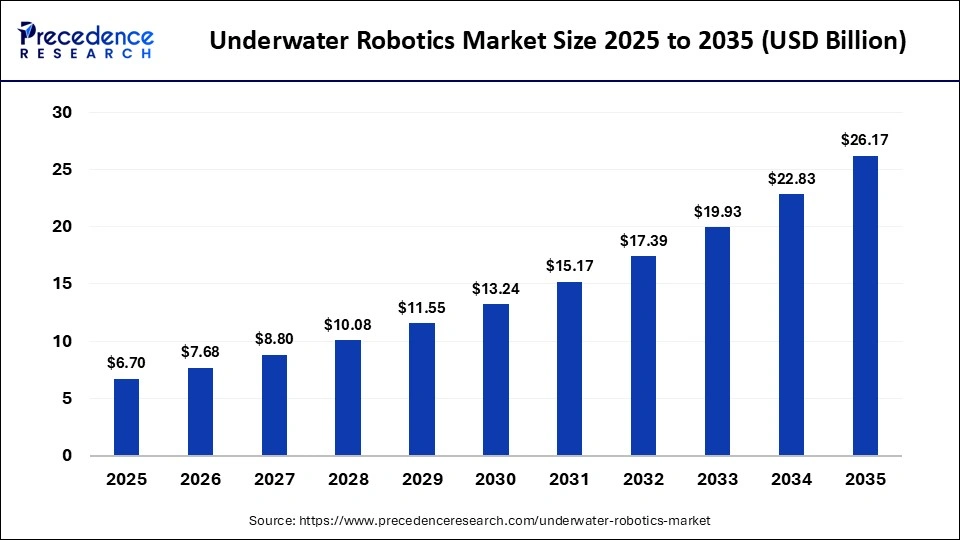
The global underwater robotics market size was calculated at USD 6.70 billion in 2025 and is predicted to increase from USD 7.68 billion in 2026 to approximately USD 26.17 billion by 2035, expanding at a CAGR of 14.60% from 2026 to 2035.Underwater robotics is essential for exploring, monitoring, and working in ocean depths to overcome human limitations and ocean challenges. The market is expanding due to its applications in marine science and environmental research, as well as in defense and security. It is extensively utilized in offshore energy extraction processes, including oil, gas, and renewable energy.
Key Takeaways
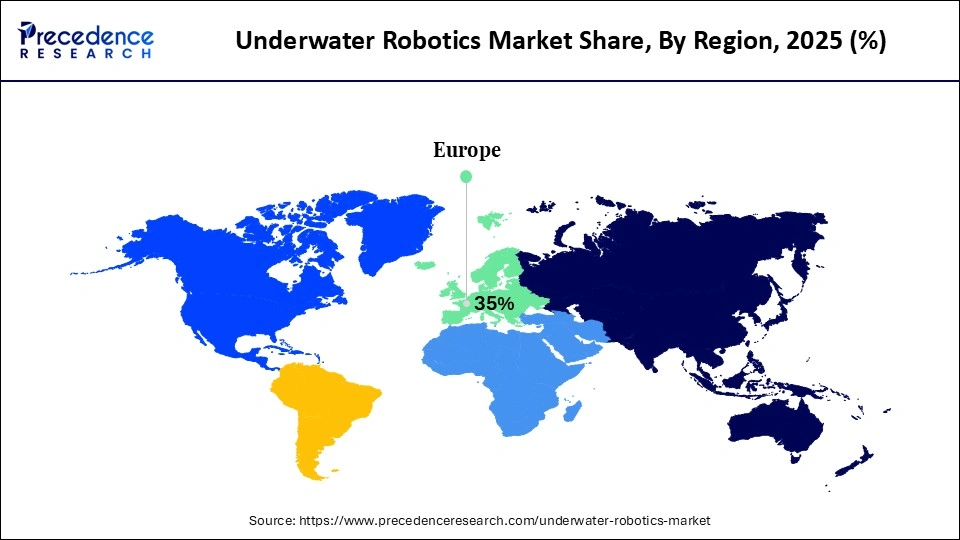
- Europe dominated the underwater robotics market with the largest share 35% in 2025.
- Asia-Pacific is expected to grow at the fastest CAGR in the market during the forecast period.
- By type, the remotely operated vehicles (ROV) segment generated the biggest market share of 82% in 2025.
- By type, the autonomous underwater vehicle (AUV) segment is expected to expand rapidly in the market in the coming years.
- By application, the commercial exploration segment accounted for the highest revenue share in the market in 2025.
- By application, the scientific research segment is expected to witness significant growth in the market over the forecast period.
What is the Underwater Robotics Market?
Underwater robots have emerged as technologically advanced machines that have significantly expanded their capacity to explore and interact with the underwater world. These tools are pivotal in various sectors for work which are considered expensive or too dangerous for humans.
It includes remotely operated vehicles (ROVs) and autonomous underwater vehicles (AUVs). These robots are equipped with sensors, cameras, and application-specific tools enabling them to navigate gathered data and manipulate objects in the aquatic environment. The market is experiencing a transformative shift driven by increasing applications across various sectors and advancements in technology to enhance operational efficiency and autonomy, driving further market growth.
What is the Role of AI in the Underwater Robotics Market?
Artificial intelligence (AI) plays a powerful role as an enabler of next-generation ocean exploration. Combined with cutting-edge underwater machinery, AI is revolutionizing the field of oceanography. With smart sensors, AI algorithms navigate complex underwater terrains while avoiding obstacles and adapting to a changing environment in real time. They operate in extreme environments for extended periods, helping with the collection of vast amounts of data from ocean water columns and deep-sea habitats. Key applications include inspection and maintenance of pipelines and wind turbines in energy and infrastructure, seabed and deep-sea mapping, and ecological study in scientific research, as well as mine detection and security operations in defense and surveillance, potentiating market growth.
What is the Global Landscape of the Underwater Robotics Market?
- Regulations of the FAA on Aircraft Safety
According to the FAA, the use of aircraft weighing scales enhances safety standards in air operations through accurate weight balancing of airplanes. This increased safety has led many airlines and MRO services to seek efficient weighing scales. - Deliveries of Commercial Aircraft
International Air Transport Association suggests that the number of deliveries of commercial aircraft has increased significantly, thus resulting in the rise in need for aircraft maintenance and weighing scales. - Activities in MRO for Aircraft
According to the Aircraft Fleet Recycling Association, there have been increasing activities in aircraft MRO, thus driving the demand for portable and electronic weighing scales for aircraft. - Investments in Airport Infrastructure Projects
Asian countries, Middle Eastern countries, and other governments have been continuously making investments in airport infrastructure projects that enhance the deployment of efficient aircraft weighing scales. - Defense Aviation Sector Modernization
Military sector's modernization programs in the United States, China, and European countries have seen increasing applications of aircraft weighing scales for accurate calibration, maintenance, and operational purposes.
What are the Trends in the Underwater Robotics Market?
- Adoption and Integration of AI and Autonomy: AI is swiftly revolutionizing the domain of oceanography and underwater robotics. Utilizing AI, autonomous underwater vehicles (AUVs) can effectively map their environment, detect obstacles, and determine a course based on real-time environmental information. Additionally, it aids in analyzing underwater imagery and acoustic data to recognize marine species, observe their behavior, and estimate population sizes. Furthermore, it contributes to the assessment of ocean temperature, salinity, currents, and pH levels.
- Increasing Growth in Offshore Energy and Mining: Underwater robots play a crucial role in offshore technology development, including wind, oil and gas, and renewable energy sectors. These robots significantly reduce the risk of accidents by performing complex tasks without human presence. They also help mitigate costs by enhancing operational efficiency, reducing downtime, and lowering overall project cost.
- Integration of Advanced Sensing and Imaging: Effective underwater sensing and imaging are crucial for environmental protection and sustainable energy transition, including challenges such as marine ecosystem monitoring, efficient energy infrastructure, and resource management. With advanced sensors, robots help in gathering high-quality data while providing real-time insights critical for decision-making. With efficient operations, such as navigation, manipulation, and exploration, it minimizes the environmental impact.
Market Scope
| Report Coverage | Details |
| Market Size in 2025 | USD 6.70 Billion |
| Market Size in 2026 | USD 7.68 Billion |
| Market Size by 2035 | USD 26.17 Billion |
| Market Growth Rate from 2026 to 2035 | CAGR of 14.60% |
| Dominating Region | Europe |
| Fastest Growing Region | Asia Pacific |
| Base Year | 2025 |
| Forecast Period | 2026 to 2035 |
| Segments Covered | Type, Application, and region |
| Regions Covered | North America, Europe, Asia-Pacific, Latin America, and Middle East & Africa |
Segmental Insights
Type Insights
Which Type Segment Dominated the Underwater Robotics Market?
The remotely operated vehicles (ROVs) segment contributed the biggest revenue share of the market in 2025, as they perform high-risk, critical, and complex tasks in underwater and hazardous environments. They are used in various industries such as oil and gas, marine research, and underwater construction. With advanced camera systems and sensors, they are also used for underwater inspection and monitoring. They can remain underwater for an extended period, providing continuous monitoring, high-quality data, and helping in real-time decision-making, thereby augmenting the segment's growth.
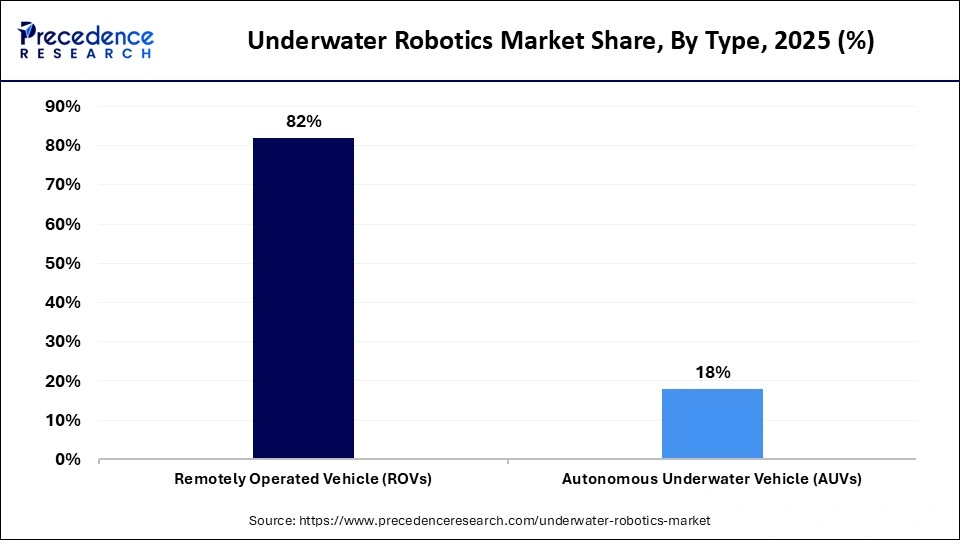
The autonomous underwater vehicle (AUV) segment is expected to grow with the highest CAGR in the market during the studied years, as AUV is more cost-effective, provide high resolution, and is safe for underwater data collection without human intervention. AUV is also used in surveying and mapping for geological studies and maritime navigation. In infrastructure, it plays a vital role in monitoring pipelines and cables to detect damage. In oceanography, it is crucial for gathering data, tracking climate change, and monitoring ecosystems, thereby contributing to the segment's expansion.
Application Insights
Which Application Segment Led the Underwater Robotics Market?
The commercial exploration segment held the largest revenue share of the market in 2025, due to the expansion of offshore energy and mining, technological advancements, and resource exploration. With the increasing demand for oil and gas and renewable energy, the development of advanced robots is increasing to maintain, install, and repair infrastructure. Combined with AI navigation and real-time data acquisition improves operational accuracy and reduces costs. Additionally, the growing demand for marine mineral exploration is pushing companies to utilize robots to extract resources, thereby fostering the segment's growth.
The scientific research segment is expected to show lucrative growth in the market over the forecast period. The growth factors include environment and climate monitoring, deep sea exploration, government funding, technological advancements, and cost-effective data collection. Researchers and scientific organizations extensively use underwater robots to monitor the marine ecosystem, study climate change, and assess biodiversity. Furthermore, with advanced sensors and high-resolution imaging, long-duration research is conducted without human intervention.
Regional Insights
Europe Underwater Robotics Market Size and Growth 2026 to 2035
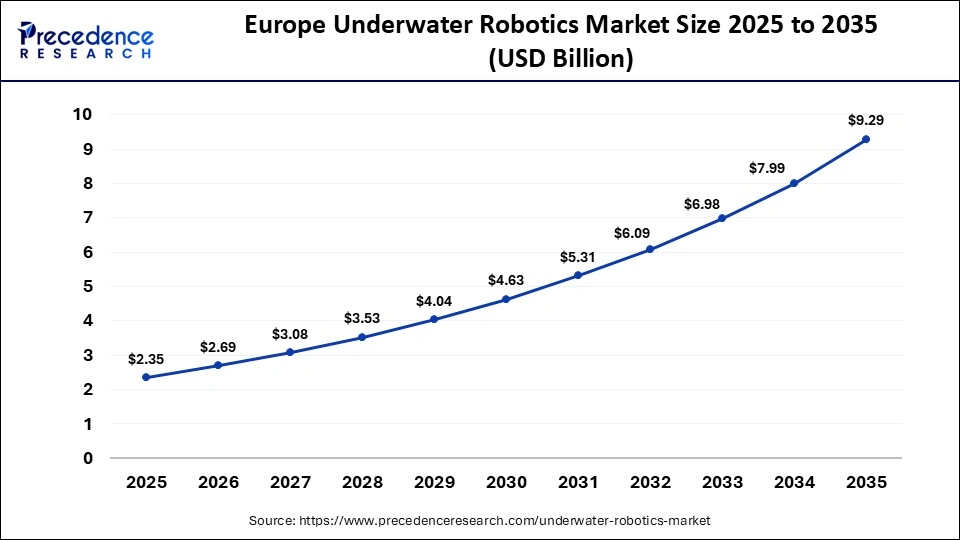
The Europe underwater robotics market size is expected to be worth USD 9.29 billion by 2035, increasing from USD 2.35 billion by 2025, growing at a CAGR of 14.73% from 2026 to 2035.
Why Europe Dominated the Underwater Robotics Market?
Europe held a major revenue share of the market in 2025. The market drivers include technological advancements, R&D investments, offshore renewable energy and oil and gas, defense and security applications, marine research and environmental monitoring, and supporting infrastructure and regulation. With the presence of strong key players, Europe also has strong R&D and advanced manufacturing capabilities. Furthermore, with offshore renewable energy projects, demand for ROVs and AUVs is increasing for inspections and maintenance. In sustainability and development, Europe is committed to improving ocean sustainability and environmental research, enhancing market growth.
Norway Market Trends
Norway is an innovator and premier user of underwater robots, especially for offshore wind farm maintenance, aquaculture, and subsea oil exploration. In marine research, aquaculture, and oil and gas, robots are highly used to enhance efficiency, safety, and sustainability. They are also used for monitoring pollution in marine ecosystems for environmental protection. Due to the country's harsh environmental conditions, ROVs and autonomous drones are highly used in the inspection of oil and gas pipelines and offshore wind farms.
How Will Asia-Pacific Grow in the Underwater Robotics Market?
Asia-Pacific is expected to witness the fastest growth during the predicted timeframe. Key drivers include technological advancements and manufacturing, offshore energy and infrastructure, defense and security, deep-sea mining and exploration, and environmental management. Extensive coastlines, rapid industrialization, and massive investment in offshore energy are driving the market further.
India Market Trends
India is experiencing rapid market growth with significant government funding directed towards maritime surveillance, offshore oil exploration, and coastal security. The market growth factors also include port and infrastructure maintenance, deep sea resource exploration, strategic naval defense, anti-submarine warfare (ASW), and the “Atma Nirbhar Bharat” push. India is extensively using AI-powered underwater robotics to explore and extract valuable minerals from the sea. With the presence of a vast coastline, India heavily uses robotics in anti-submarine warfare to secure against regional threats and maintain a fast-growing port infrastructure.
Will North America Grow in the Underwater Robotics Market?
North America is expected to grow at a considerable CAGR over the studied period, due to the rising adoption of advanced technologies, favorable government support, and increasing R&D investments. The increasing adoption of underwater robotics for diverse applications, such as energy, aquaculture, and security foster market growth. The presence of key players and evolving regulatory landscapes also contributes to the market. The region makes constant efforts for autonomous port monitoring for security, environmental compliance, and operational awareness.
U.S. Market Trends
Key players, such as Blue Robotics, Nauticus Robotics, and Blue Atlas Robotics, are the major developers of underwater robotics in the U.S. The National Science Foundation is a U.S. governmental body that funds research programs that develop AUVs. In June 2024, researchers at the Minnesota Interactive Robotics and Vision Laboratory developed AUVs that are powered by AI to collect vast amounts of data, provide detailed insights into species distribution, and create comprehensive habitat maps for understanding environmental drivers. (Source: https://www.nsf.gov/news/ai-powered-underwater-robots-revolutionize-marine)
Which Factors Drive the Underwater Robotics Market in Latin America?
Latin America is expected to grow at a notable CAGR in the foreseeable future, due to offshore oil exploration, marine research, and increasing subsea inspection activities. Underwater robotics helps energy companies inspect pipelines, platforms, and underwater equipment more safely. Growing investment in ocean monitoring also supports market expansion.
Brazil Market Trends
The Brazilian market is driven by its large offshore oil reserves and deep-water exploration projects. Underwater robots are widely used for subsea equipment inspection, pipeline monitoring, and maintenance operations, especially in offshore basins where human access remains difficult and costly.
Which Factors Drive the Underwater Robotics Market in the Middle East and Africa?
The Middle East and Africa are expected to grow at a notable CAGR in the foreseeable future. Market growth is driven by growing research and development activities, the increasing demand for the indigenous development of advanced tools, and rapidly advancing energy and aquaculture industries. The increasing investments in offshore oil and gas investments, rising maritime needs, and environmental monitoring in the UAE, Qatar, and Saudi Arabia also propel market growth.
UAE Market Trends
The UAE market is driven by offshore energy projects, smart port development, and marine infrastructure expansion. Underwater robots support port inspection, underwater asset monitoring, and security applications, helping operators improve operational safety and reduce inspection downtime.
Underwater Robotics Market Value Chain Analysis
- Raw Material Sourcing
It includes securing durable high-strength materials capable of withstanding deep-sea pressures, low temperatures, and corrosive saltwater environments, such as stainless steel, titanium, aluminum, and specialized plastics.
Key Players - Deep Ocean Engineering, Saab AB, Kongsberg Maritime - Component Fabrication and Machining
It includes delivering high-precision, customized, and reliable components for underwater robotics for durable, corrosion-resistant, and pressure-tolerant materials.
Key Players - Saab AB, International Submarine Engineering, Bluefin Robotics - Testing And Certification
It includes testing and certification to ensure that the robot operates safely, effectively, and reliably in a harsh underwater environment.
Key Players - Kongsberg Maritime, Intertek, Teledyne Marine, Saab AB - Distribution And Sales
It includes supply chain management, marketing strategies, and purchasing various models from manufacturers to end users.
Key Players - Blue Robotics, ECA Group, Kongsberg Maritime, Deep Ocean Engineering Inc. - Maintenance And After-Sales Service
It includes regular maintenance and repairs essential for underwater robots due to the harsh environment and to reduce downtime.
Key Players - Kongsberg Maritime, Deep Ocean Engineering Inc., Ocean Robotix, Atlantis Marine
Underwater Robotics Market Companies
- Saab AB: Supplies systems related to defense, submarines, surveillance, and sea combat solutions.
- Oceaneering International: Supplies ROVs, submarine engineering, inspection, and integrity management services for offshore assets.
- Kongsberg Gruppen: Supplies autonomous underwater vehicles, marine automation, navigation, and defense communications for offshore operations.
- Fugro: Supplies geotechnical surveys, seabed mapping, offshore inspections, and remote monitoring for marine operations.
- Teledyne Technologies: Supplies underwater imaging solutions, sonar, sensors, and marine acquisition systems for defense and research purposes.
Other Major Key Players
- ECA Group
- International Submarine Engineering (ISE)
- Atlas Elektronik
- TechnipFMC plc
- Soil Machine Dynamics Ltd (SMD)
- VideoRay LLC
- Deep Ocean Engineering Inc.
- General Dynamics Mission Systems
- Ocean Infinity
- Nauticus Robotics
- Saronic
- Abyss Solutions
- Saildrone
- Planys Technologies
- Planetary Ocean Defense Systems Corp (PODS)
- Lobster Robotics
- Dolobot
- Planys Technologies
- Rovco
- Saildrone
- Anduril Industries
- Hydromea SA
- Impossible Metals
- AquaHub
Recent Developments
- In February 2026, Lockheed Martin Lamprey revealed an autonomous undersea drone named The Lamprey Multi-Mission Autonomous Undersea Vehicle (MMAUV), which can hitch a ride on the surface of larger vessels to maximize efficiency. It can perform surveillance and reconnaissance, as well as launch anti-submarine torpedoes in active conflicts.(Source: https://eandt.theiet.org)
- In November 2025, the Naval Science & Technological Laboratory (NSTL), Visakhapatnam of Defence Research and Development Organisation (DRDO) developed a new generation Man-Portable Autonomous Underwater Vehicle (MP-AUVs) for mine countermeasure missions. The system is equipped with multiple AUVs with side scan sonar and underwater cameras as primary payloads for real-time detection and object classification of mines.
- In September 2025, Chinese scientists developed a new agile underwater robot named ‘Sea Turtle' for underwater exploration. With its centimeter-level breakthrough, it is more precise, ecofriendly and efficient in the water. The applications include coral observation, search and rescue, and underwater fishing.
(Source: https://www.globaltimes.cn) - In April 2025, Anduril Industries announced the successful delivery of its Dive-LD autonomous underwater vehicle (AUV) to the U.S. Navy's Unmanned Undersea Vehicle Squadron 1 (UUVRON-1). It is designed for extended deep-sea missions, with the capacity of operating at depths up to 6000 meters while remaining submerged for up to 10 days.(Source: https://global.tendernews.com)
Segments Covered in the Report
By Type
- Remotely Operated Vehicle (ROVs)
- Autonomous Underwater Vehicle (AUVs)
By Application
- Defense And Security
- Commercial Exploration
- Scientific Research
- Other
By Region
- North America
- Europe
- Asia-Pacific
- Latin America
- Middle East & Africa
For inquiries regarding discounts, bulk purchases, or customization requests, please contact us at sales@precedenceresearch.com
Frequently Asked Questions
Tags





Ask For Sample
No cookie-cutter, only authentic analysis – take the 1st step to become a Precedence Research client
 Get a Sample




 sales@precedenceresearch.com
 Schedule a Meeting
