



Unsupervised Learning Market Trends, Companies, Revenue / Sales Performance, Subscriber Growth, Pricing Strategies, Cloud Adoption, Infrastructure Expansion, Competitive Landscape, and Industry Outlook
Unsupervised Learning Market(By Technology: Natural Language Processing (NLP), Computer Vision, Speech Processing, Others; By Deployment Mode: On-premise, Cloud; By Enterprise Size: Large Enterprises, Small and Medium-sized Enterprises; By End User: BFSI, IT and Telecom, Retail and E-commerce, Healthcare, Government, Automotive and Transportation, Others) - Global Industry Analysis, Size, Trends, Leading Companies, Regional Outlook, and Forecast 2026 to 2035
Source: https://www.precedenceresearch.com/unsupervised-learning-market
 Get a Sample
 Table Of Content


What is the Unsupervised Learning Market Size?
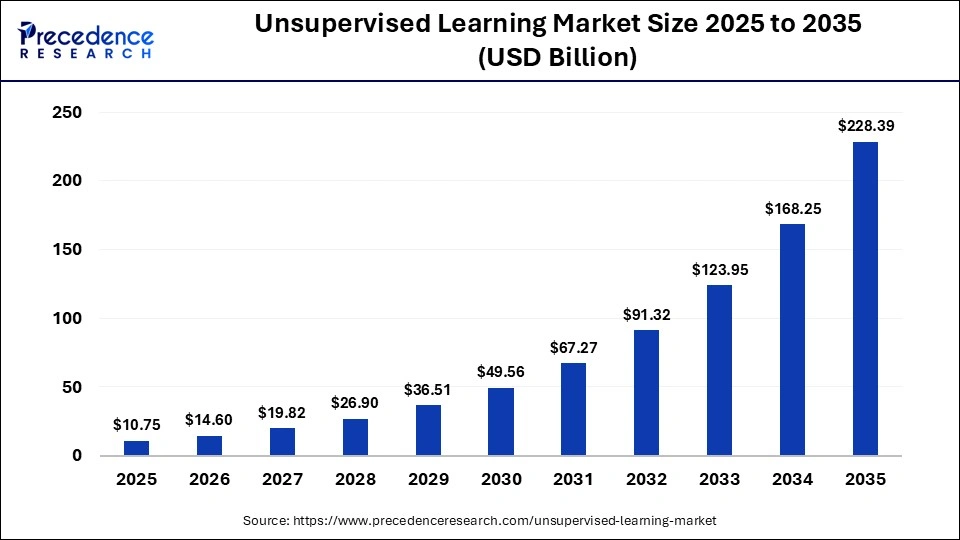
The global unsupervised learning market size is predicted to increase from USD 14.60 billion in 2026 to approximately USD 228.39 billion by 2035, expanding at a CAGR of 35.74% from 2026 to 2035. The unsupervised learning market is growing steadily, driven by the explosion of data & availability of large, diverse datasets, rising adoption of AI and machine learning, advancements in computing power & cloud infrastructure, and the need for advanced analytics & decision support, among others.
Market Highlights
- North America led the unsupervised learning market with a share in 2026.
- Asia Pacific is estimated to expand at the highest CAGR between 2026 and 2035.
- By technology, the natural language processing (NLP) segment held a dominant position in 2026.
- By technology, the speech processing segment is growing at the highest CAGR between 2026 and 2035.
- By deployment mode, the on-premise segment led the market with a market share in 2026.
- By deployment mode, the cloud segment is expected to expand at the fastest CAGR from 2026 to 2035.
- By enterprise size, the large enterprises segment held the largest revenue share in 2026.
- By enterprise size, the small and medium-sized enterprises segment is expected to grow at a solid CAGR between 2026 and 2035.
- By end user, the BFSI segment accounted for the highest share in 2026.
- By end user, the retail and e-commerce segment is expected to grow at the highest CAGR between 2026 and 2035.
Uncovering Intelligence: How Unsupervised Learning Is Redefining Global AI?
Unsupervised learning refers to AI techniques that uncover hidden patterns and insights from unlabelled data without human guidance. The market is driven by the explosion of digital data, increasing demand for advanced analytics, and the need to derive actionable insights from complex datasets. Adoption is further accelerated by advancements in computing power, cloud infrastructure, and industry digital transformation across sectors such as finance, healthcare, and retail, seeking deeper data-driven insights.
How Is AI Reshaping the Unsupervised Learning Market?
AI integration can significantly reshape the market by enabling models to extract deeper and more meaningful patterns from massive unlabeled data without human intervention. AI techniques like self-supervised learning, deep neural networks, and multimodal models can help systems understand complex data (text, images, audio) more effectively and generate richer representations that improve clustering, anomaly detection, and feature learning. This reduces dependency on labeled datasets, accelerates real-time insights, and expands applications in sectors such as healthcare, cybersecurity, and autonomous systems.
Primary Trends Driving the Unsupervised Learning Market
- Pre-Training Foundation Model: Unsupervised learning is increasingly used to pre-train foundation AI models that understand text, images, audio, and other modalities simultaneously. These systems extract patterns across different data types without labeled inputs, enabling versatile AI to power advanced applications such as multimodal search, content generation, and cross-domain pattern recognition.
- Expansion of Cloud Platforms: Organizations are shifting unsupervised learning workloads to scalable cloud environments and deploying models on edge devices, allowing real-time insights and pattern discovery where data is generated. This trend supports faster analytics, reduced latency, and cost-efficient processing for IoT devices, mobile systems, and distributed enterprise platforms.
- Growing Data Privacy Concerns: With data privacy concerns and regulations on the rise, federated unsupervised learning is gaining traction. It enables models to learn patterns from decentralized datasets while keeping data localized and secure. This trend is especially relevant in healthcare, finance, and multi-institution collaborations where sharing raw data is restricted.
- AutoML and Democratization of Unsupervised Tools: Automated machine learning (AutoML) platforms boost the unsupervised learning market, eliminating the need for deep data science expertise. These tools automate model selection, training, and tuning, accelerating deployment across companies of all sizes and expanding access beyond traditional analytics teams to small- and medium-sized enterprises (SMEs) and new market entrants.
- Hybrid Learning Approaches: Unsupervised methods are increasingly paired with supervised and reinforcement learning to improve performance and model utility. By first extracting structure from unlabeled data and then fine-tuning with labeled inputs, hybrid models yield better insights with fewer annotations, boosting predictive accuracy and reducing dependency on costly labeled datasets.
- Focus on Explainability and Interpretability: As unsupervised learning influences business decisions, there's a growing emphasis on explaining model outputs. Explainable unsupervised learning techniques help users understand why clusters, patterns, or anomalies were identified. This transparency builds trust, supports compliance, and promotes broader adoption in regulated sectors like finance and healthcare.
- Sustainable & Efficient Algorithm Development: Green AI and efficiency-focused algorithms are emerging, reducing the computing power and energy demands of large unsupervised models. Optimized training techniques and resource-efficient architectures align with sustainability goals and lower the total cost of ownership, making advanced analytics more environmentally and economically viable.
Segment Insights
Technology Insights
Which Technology Segment Dominated the Unsupervised Learning Market?
The natural language processing (NLP) segment dominated the global market, because it enables the extraction of meaningful insights from vast volumes of unstructured text and speech data, powering tasks like sentiment analysis, topic discovery, and language understanding. NLP's ability to interpret human language fuels advanced applications such as chatbots, virtual assistants, and automated content analysis, making it highly valuable across industries, seeking deeper consumer insights and strategic decision-making.
The speech processing segment is estimated to grow with the highest CAGR the market due to continuous improvements in machine learning algorithms tailored for audio data and the growing availability of large volumes of unstructured speech datasets, enabling better voice‑based applications and enhanced model training without extensive annotation efforts.
Deployment Mode Insights
Why Did the On-Premise Segment Dominate the Unsupervised Learning Market?
The on-premise segment contributed the biggest revenue share in 2026, because many enterprises require strict data control, customization, and integration with existing IT systems, particularly in regulated industries like finance and healthcare. On-premise deployment also offers enhanced security, low latency, and tailored performance, making it attractive for organizations to prioritize compliance and proprietary data governance.
The cloud segment is expected to be the fastest-growing segment in the market with the highest CAGR, as cloud platforms offer scalable infrastructure and flexible resources that can efficiently handle massive, computationally intensive unsupervised models without the need for costly on-premise hardware. Cloud deployment reduces upfront investment with pay-as-you-go pricing, accelerates model development and deployment, and enables global accessibility and collaboration across teams. These advantages make advanced unsupervised learning more affordable and easier to adopt for businesses of all sizes.
Enterprise Size Insights
Why Does the Large Enterprises Segment Represent the Largest Segment in 2026?
The large enterprises segment accounted for the largest revenue share in the unsupervised learning market, because large organizations generate and manage massive, diverse datasets, requiring sophisticated analytics. They have the resources to invest in advanced AI infrastructure, skilled talent, and custom deployments, enabling deep insights and strategic decision-making. Large enterprises also use unsupervised learning across multiple functions like fraud detection, customer analytics, and supply-chain optimization, increasing overall adoption.
The small and medium-sized enterprises segment is expected to be the fastest-growing in the global market, because SMEs increasingly access affordable, user-friendly AI tools and cloud-based platforms that require minimal upfront infrastructure and technical expertise. These solutions enable smaller firms to analyze data, automate processes, and gain insights without large IT teams. Competitive pressures push SMEs to adopt advanced analytics to improve efficiency and customer engagement, leveling the playing field with larger competitors.
End User Insights
What Made BFSI the Dominant Segment in the Unsupervised Learning Market?
The BFSI segment held the largest revenue share in the market, because financial institutions leverage unsupervised models to analyze huge volumes of transactional and behavioral data for fraud detection, risk assessment, and customer segmentation. These capabilities boost security, optimize decision-making, and improve personalized services, making unsupervised learning crucial for handling complex, high-value financial workflows.
The retail and e-commerce segment is expected to grow at the fastest CAGR in the market. The segmental growth stems from ability of unsupervised learning models to analyze vast amounts of unlabelled customer data for segmentation, recommendation engines, and purchasing behavior trends, enabling highly personalized experiences, improved inventory and trend insights, and continuous AI investment to stay competitive.
Regional Insights
Why is North America the Dominant Region for Unsupervised Learning Market?
North America dominated the market, due to substantial investments in AI, machine learning, and big data technologies. The region has a mature technological ecosystem with access to vast structured and unstructured data and the presence of leading tech companies and research institutions, driving innovation and early adoption across industries.
U.S. Market Trends
The U.S. holds a major market share in North America as it is leading in AI research and development with substantial public and private investments. It hosts major tech giants and innovation hubs and has a robust ecosystem of data infrastructure, top talent, and early AI adoption across industries, accelerating commercialization and technological breakthroughs.
How is Asia Pacific Growing in the Unsupervised Learning Market?
Asia‑Pacific is expected to host the fastest-growing market in the coming years. This is because rapid digital transformation and IT infrastructure investments are accelerating AI and ML adoption. Governments and the private sector are funding the deployment of innovation and smart technology. The region generates vast data across industries, fueling the development of advanced analytics and learning models. These trends boost regional demand and technological integration.
China Market Trends
The market in China is driven by strong government backing through national AI strategies and growing research and infrastructure development. China's massive digital data ecosystems fuel model training and adoption in the region. Moreover, leading tech companies invest heavily in AI and cloud services, driving innovation and localized solutions in China.
Latin America's Unsupervised Learning Industry Growth
Latin America shows a complicated regulatory matrix for the aim of AI-driven technologies, which is directly affecting the range of machine learning algorithms. The regulatory frameworks change mainly between countries, which creates uncertainty for brands that work across borders. For example, Brazil's General Data Protection Law (LGPD) has strictly imposed needs on personal data processing, which has compelled businesses to develop algorithmic transparency and use explainable AI practices. This is specifically complicated in fields like finance and healthcare, in which data sensitivity is high in nature. Mexico and Argentina are in line to fix their AI governance designs that align with worldwide digital norms.
Brazil Unsupervised Learning Market Trends
The demand for unsupervised learning in Brazil is witnessing fast development, which is being driven by huge national encouragement for artificial intelligence, which is accepted across private and public industries. As Brazil manages huge, unstructured data that flows without any manual labeling resources, unsupervised procedures like anomaly detection, clustering, and dimensionality reduction have been necessary. The big-scale urban centers, like Sao Paula, have utilized unsupervised machine learning models to figure out urban changes and informal settlements by using open geodata. Hsi avoids the demand for labeled data collections and is resource-intensive.
How is the Growth of MEA in the Unsupervised Learning Market?
The development of unsupervised learning in the Middle East and Africa (MEA) is developing quickly, fueled by huge regions' data creation, which is behind historical data labelling and strong national artificial intelligence compulsions. MEA organizations have possessed huge stores of unrecognized data and raw data, too. By manual process, labelling data is labor-intensive and costly, which makes unsupervised systems excessively attention-grabbing because they demand zero human tagging to reveal designs.
Trend of Unsupervised Learning Market in UAE
The UAE Government has created substantial funding for digital transformation and artificial intelligence. AI is transforming the main elements of national development strategies, which creates huge possibilities for individuals with the correct knowledge and skills. AI skills are being excessively valued across sectors like finance, healthcare, logistics, education, smart city growth, and robotics.
Who are the Major Players in the Global Unsupervised Learning Market?
The major players in the unsupervised learning market include Microsoft Corporation, Google LLC (Alphabet), IBM Corporation, Amazon Web Services (AWS), SAP SE, Oracle Corporation , H2O.ai, DataRobot , RapidMiner, Databricks, Qualcomm , NVIDIA Corporation, Salesforce, Inc., Intel Corporation, SAS Institute
Recent Developments
- In January 2026, the Technology Innovation Institute unveiled Falcon‑H1R, a lightweight AI model designed for efficient reasoning and unsupervised learning on constrained hardware tools. This launch reflects a broader trend toward energy‑efficient and accessible AI, accelerating adoption in real‑world settings where traditional large models are impractical.(Souirce: https://www.tii.ae)
- In December 2025, WiMi Hologram Cloud launched a hybrid quantum‑neural network for unsupervised data clustering, integrating quantum optimization with neural architectures to improve clustering speed and accuracy on large, complex datasets. This hybrid model highlights the merging of quantum computing with practical AI, accelerating unsupervised learning in domains where classical methods struggle with scale or complexity.(Source: https://in.investing.com)
- In February 2025, researchers at the University of Technology, Sydney, introduced Torque Clustering, a new unsupervised algorithm that autonomously identifies data patterns without human guidance. Built on principles inspired by physical torque dynamics, this approach demonstrated exceptional efficiency and accuracy across diverse datasets, enabling applications from biology to finance.(Source: https://www.uts.edu.au)
Unsupervised Learning Market Segments
By Technology
- Natural Language Processing (NLP)
- Computer Vision
- Speech Processing
- Others
By Deployment Mode
- On-premise
- Cloud
By Enterprise Size
- Large Enterprises
- Small and Medium-sized Enterprises
By End User
- BFSI
- IT and Telecom
- Retail and E-commerce
- Healthcare
- Government
- Automotive and Transportation
- Others
By Region
- North America
- Europe
- Asia-Pacific
- Latin America
- Middle East & Africa
For inquiries regarding discounts, bulk purchases, or customization requests, please contact us at sales@precedenceresearch.com
Frequently Asked Questions





Ask For Sample
No cookie-cutter, only authentic analysis – take the 1st step to become a Precedence Research client
 Get a Sample




 sales@precedenceresearch.com
 Schedule a Meeting
