



U.S. Hydraulic Fracturing Market Size, Share and Trends 2026 to 2035
U.S. Hydraulic Fracturing Market (By Well Type: Horizontal and Vertical; By Application: Shale Gas, Tight Oil, and Tight Gas) Industry Size, Share, Growth, Trends 2025-2035
Source: https://www.precedenceresearch.com/us-hydraulic-fracturing-market
 Get a Sample
 Table Of Content


The U.S. hydraulic fracturing market size accounted for USD 12.37 billion in 2025 and is predicted to touch around USD 27.36 billion by 2035, growing at a CAGR of 8.26% from 2026 to 2035. The market is mainly driven by advancements in horizontal drilling and multi-stage completions, abundant shale and tight-rock reserves, energy demand both domestically and globally, and ongoing activities to redevelop and re-fracture wells to improve production efficiency.
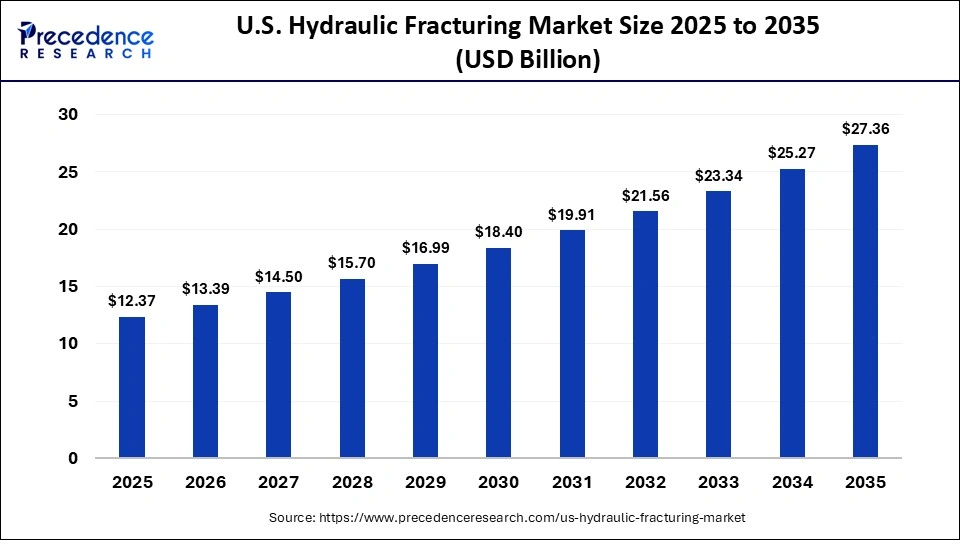
U.S. Hydraulic Fracturing Market Statical Scope
| Reports Attributes | Statistics |
| Market Size in 2025 | USD 12.37 Billion |
| Market Size in 2026 | USD 13.39 Billion |
| Market Size by 2035 | USD 27.36 Billion |
| CAGR 2026 to 2035 | 8.26% |
| Base Year | 2025 |
| Forecast Period | 2026 to 2035 |
The market is crucial as it has made the U.S. the leading oil and gas producer in the world, achieved energy independence, reduced energy costs for consumers, and driven significant economic growth through the shale revolution. It unlocks tight rock and shale formations, allowing the U.S. to become a net exporter and a global leader in oil and gas. It reduces dependence on foreign oil markets that may be politically unstable, ensuring a reliable domestic fuel supply even during global disruptions.
This increase in natural gas and oil supply results in lower energy bills for both households and industries. By combining horizontal drilling with multi-stage fracking, it improves well production. The abundant natural gas supply has historically contributed to lower emissions in the power sector by replacing coal. It also promotes the transition to electric vehicles and the use of recycled water to reduce costs and emissions.
India Laboratory Informatics Market, By Product, 2025 (%)
| Segments | Shares (%) |
| LIMS | 30.00% |
| ELN | 15.00% |
- Horizontal - The horizontal segment, with a share of 88% in 2025, accounts for the largest revenue share in the U.S. hydraulic fracturing market as it enables a single wellbore to reach thousands of feet of tight shale formation. This broad contact with the reservoir increases oil and gas recovery rates, makes unconventional plays financially feasible, and minimizes surface impacts compared to traditional vertical wells.
- Vertical - Vertical wells, with a share of 12% in 2025, are significant in the U.S. hydraulic fracturing market due to their lower initial costs, simpler operational needs, and ongoing relevance in established conventional oil and gas fields.
India Laboratory Informatics Market, By Product, 2025 (%)
| Segments | Shares (%) |
| LIMS | 30.00% |
| ELN | 15.00% |
- Shale gas - The shale gas segment, with a share of 57% in 2025, is leading the U.S. hydraulic fracturing market. It accesses vast unconventional gas reserves through horizontal drilling and high-pressure fluid injection. This method promotes domestic energy independence, powers plants and factories, and generates consistent, long-term demand for fracking equipment, proppants, and well services.
- Tight oil - The tight oil segment, with a share of 28% in 2025, is essential to the U.S. hydraulic fracturing market as it releases significant domestic petroleum reserves trapped in impermeable rock. It creates ongoing demand for advanced fracking services, positions the U.S. as a top global oil producer, and offers short-cycle production flexibility that helps stabilize domestic energy supplies.
- Tight gas - The tight gas segment, with a share of 15% in 2025, is crucial in the U.S. hydraulic fracturing market as it extracts natural gas trapped in hard, low-permeability sandstone and carbonate rock formations. Without extensive artificial stimulation like fracking, these large domestic reserves cannot be produced economically, making this segment vital for national energy independence, power generation, and industrial supply.
Competitive Landscape
The U.S. hydraulic fracturing market is a competitive and consolidated industry driven by technological advancements like e-fleets, digital automation, and ESG compliance. Key players in this market include Halliburton, SLB (Schlumberger), Baker Hughes, Liberty Energy, and ProFrac Holding Corp.
- Halliburton is recognized as a leader in pressure pumping, providing high-capacity conventional and automated fracturing systems, SmartSet composite plugs, and optimized proppant delivery integration.
- SLB (Schlumberger) offers a full range of subsurface and surface hydraulic fracturing solutions, utilizing HiWAY flow-channel fracturing technology along with autonomous surface execution and digital monitoring systems.
- Baker Hughes provides advanced fracturing and completion services through its integrated oilfield services, emphasizing custom-engineered fracturing fluids, low-emission spreads, and tools for maximizing zonal isolation in production.
- Liberty Energy is a significant pressure-pumping provider in North America, focusing on ESG-driven operations and utilizing advanced digiFrac electric fleets to reduce fuel consumption and noise pollution.
- ProFrac Holding Corp. is an emerging leader that is rapidly upgrading fleets, manufacturing proprietary hydraulic fracturing equipment, and offering large-scale stimulation services across major U.S. shale plays.
Segments Covered in the Report
By Well Type
- Horizontal
- Vertical
By Application
- Shale Gas
- Tight Oil
- Tight Gas
For inquiries regarding discounts, bulk purchases, or customization requests, please contact us at sales@precedenceresearch.com
Frequently Asked Questions





Ask For Sample
No cookie-cutter, only authentic analysis – take the 1st step to become a Precedence Research client
 Get a Sample



 sales@precedenceresearch.com
 Schedule a Meeting



