



US Stroke Diagnostic and Therapeutic Market Size, Key Companies, Company Production Capacity, Healthcare Infrastructure Growth, Product Utilization, Regulatory Compliance, Company Expansion Strategies, Company Investment Strategies, and Market Outlook
Rohan Patil, a Healthcare Industry Expert, highlights that the US stroke diagnostic and therapeutic market has reached USD 6.97 billion in 2026 and is on track to reach USD 15.04 billion by 2035, advancing at a CAGR of 8.92%. Key US stroke diagnostic and therapeutic market companies shaping the market include Neural Analytics, Cordis Corporation, Cerebrotech Medical Systems, Inc., Koninklijke Philips N.V., while major growth segments span type, application.
Source: https://www.precedenceresearch.com/us-stroke-diagnostic-and-therapeutic-market
 Get a Sample
 Table Of Content


US Stroke Diagnostic and Therapeutic Market Size and Forecast 2026 to 2035
The US stroke diagnostic and therapeutic market size accounted for USD 6.40 billion in 2025 and is predicted to increase from USD 6.97 billion in 2026 to approximately USD 15.04 billion by 2035, expanding at a CAGR of 8.92% from 2026 to 2035. The market is driven by the increasing adoption of advanced imaging technologies, an escalating incidence of stroke due to aging, and increasing industrial development.
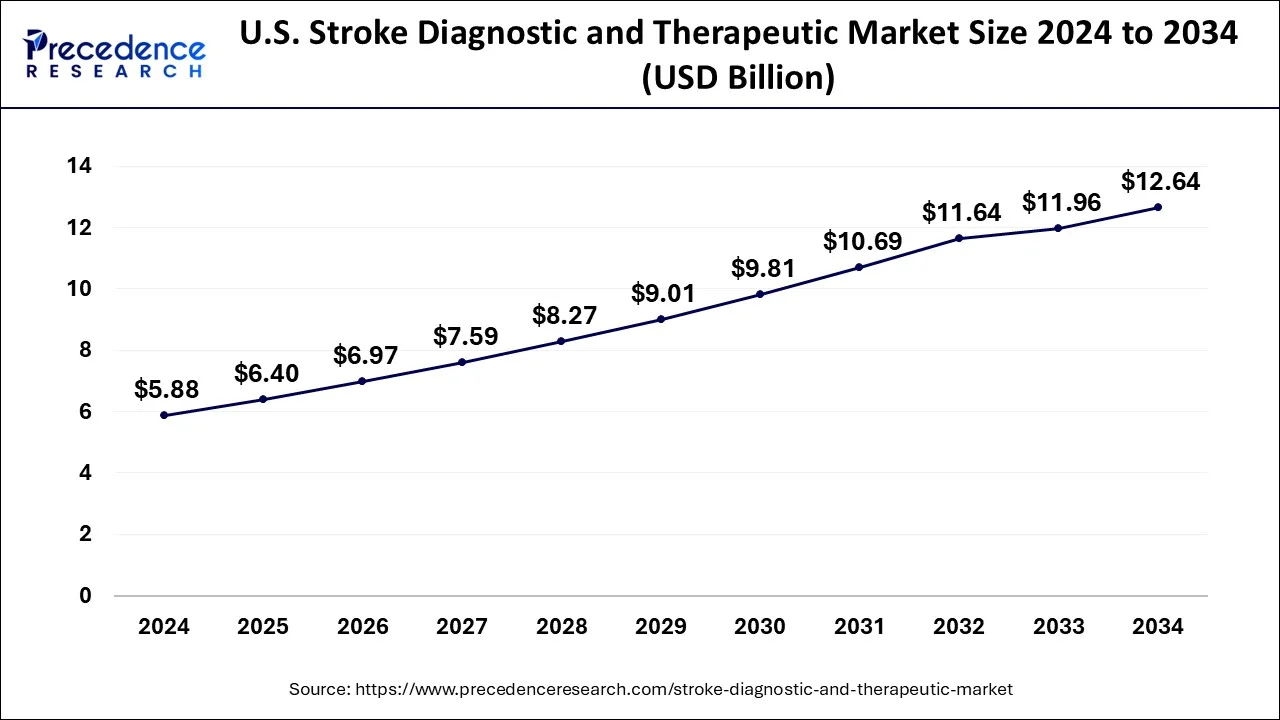
Key Takeaways
- By type, the diagnostics segment contributed the highest revenue share in 2025.
- By type, the therapeutics segment is expected to grow at the fastest pace during the forecast period.
- By application, the ischemic stroke segment held the largest revenue share of the market in 2025.
- By application, the hemorrhagic stroke segment is expected to grow at a notable CAGR between 2026 and 2035.
Market Overview
The U.S. stroke diagnostic and therapeutic market comprises a variety of technologies that include diagnostic devices, medicines, and healthcare services used to identify and manage ischemic (blood clot) and hemorrhagic (bleeding) strokes. Demand for these products is increasing due to a rapidly growing number of people with stroke risk factors such as high blood pressure, diabetes, obesity, and coronary artery disease. Additionally, with an increasing number of people in the United States over the age of 65, there will be additional demand for these products.
The increased use of new imaging modalities (e.g., CT perfusion and MRI), which enable earlier detection and more accurate decisions regarding treatment, and the growing use of mechanical thrombectomy, a minimally invasive method for treating clot-related strokes, will continue to improve the ability of healthcare providers to treat patients in a timelier manner. Finally, we expect that innovations in AI-assisted stroke diagnostics and new stroke therapies will continue to drive growth within the market.
AI-Driven Precision Transforming Stroke Diagnostics and Treatment in the U.S.
AI is revolutionizing the U.S. stroke diagnostic and therapeutic market by making the identification of strokes quicker, easier, and more accurate while also supporting timely decisions about treatment from the moment of diagnosis to ongoing treatment for patients with ischemic strokes after hospital discharge. An example of this would be using AI to analyze CT and MRI scans, quickly identifying occlusions in the large vessels of the brain, determining whether there is damage to surrounding tissues, and helping to prioritize patients for immediate intervention.
In addition, AI will improve predictive analytics, monitoring patients, planning patient-specific treatments, and enhancing the delivery of services. All these advances in the use of AI should lead to significant improvements in overall clinical outcomes and fewer delays in providing timely interventions for patients with ischemic strokes, as well as increasing demand for more efficient stroke management solutions. As hospitals continue to adopt AI into their operational workflows, as digital health investments continue to grow, and as demand for more efficient stroke management solutions continues to rise, the market is expected to grow rapidly.
U.S. Stroke Diagnostic and Therapeutic Market Trends
- The U.S. remains the largest market for stroke diagnostics and therapeutics due to its high disease burden, an advanced healthcare system, and the growing use of imaging technologies for diagnosis (such as CT, MRI, and AI-assisted systems).
- According to the CDC, around 795,000 people in the U.S. have a stroke each year, and approximately 610,000 of those are first-time strokes. The increase in the number of strokes is driving the demand for faster diagnostic methods and thrombectomy devices; clot retrieval systems; rehabilitation therapies; etc. According to the CDC, a stroke occurs every 40 seconds in the U.S., with almost 87% of strokes being ischaemic, which also indicates that there is strong demand for ischaemic stroke treatment solutions.
- Both the government and research organizations continue to drive innovation in stroke treatment by providing financial support for research efforts aimed at developing new ways of treating patients with stroke. For example, in FY 2025, the National Institute of Health (NIH) awarded nearly $35.3 billion in extramural grants to support advancements in neurological disease research, imaging technology, and novel stroke therapies.
- The CDC and American Stroke Association continue to promote awareness regarding the importance of early identification and treatment of stroke, resulting in greater use of comprehensive stroke centers, tele-stroke networks, etc., and increasing the number of minimally invasive neurovascular surgical procedures, which will further drive the growth of the stroke care market in the U.S. over time.
Market Report Coverage and Key Metrics
| Report Highlights | Details |
| Market Size in 2025 | USD 6.40 Billion |
| Market Size in 2026 | USD 6.97 Billion |
| Market Size by 2035 | USD 15.04 Billion |
| Growth Rate From 2026 to 2035 | CAGR of 8.92% |
| Base Year | 2025 |
| Forecast Period | 2026 to 2035 |
| Segments Covered | Type, and Application |
Market Dynamics
Drivers
Growing Number of Stroke Patients and Aging Population
The increase in stroke incidence in the U.S., especially among the rapidly increasing older population, will continue to drive the market. The higher incidence rates of both ischemic and hemorrhagic strokes will create an increasing demand for rapid diagnostic imaging, clot retrieval procedures, and advanced therapeutic interventions, leading healthcare providers to make investments in new technologies for the management of stroke.
Restraint
Cost of Advanced Stroke Care
The cost of advanced stroke diagnostics, imaging systems, thrombolytic medications, and mechanical thrombectomy procedures is a constraint on market growth. Many hospitals do not have the budget to purchase the newest technologies. Patients will bear a large financial burden from their treatment costs that will limit widespread access to advanced technologies for stroke diagnostics and therapies.
Opportunity
Expansion of Stroke Diagnosis with AI Technology
The use of AI in stroke diagnosis represents a tremendous market opportunity. AI helps clinicians detect stroke much quicker, with the potential for improved treatment decisions. With the continued growth of digital health platforms, tele-stroke networks, and predictive analytics, there is an opportunity to improve patient care and to promote the expansion of the market in the future.
Market Segmentation Analysis
Type Insights
Why Did the Diagnostics Segment Dominate the U.S. Stroke Diagnostic And Therapeutic Market?
The diagnostics segment accounted for the largest market share in 2025, as there is an urgent requirement for rapid identification of strokes and treatment planning. Advanced imaging technology is being utilized in emergency departments, including CT scans, MRI equipment, and vascular imaging devices. However, those technologies are going to be enhanced by AI-assisted diagnostic platforms and the growing number of stroke screening initiatives within the U.S.
The therapeutics segment is expected to grow at the fastest CAGR in the market between 2026 and 2035, driven by continuous advancements in clot-removal devices, thrombolytic drugs, and neuroprotective therapies. Rising investment in stroke care innovation, expanding access to specialized stroke centers, and increasing adoption of minimally invasive treatment procedures are expected to accelerate therapeutic market expansion across the country.
Application Insights
Which Application Segment Dominated the U.S. Stroke Diagnostic And Therapeutic Market?
The ischemic stroke segment accounted for the highest market share in 2025, due to the increasing prevalence of ischemic stroke compared to other types of stroke, which accounts for all stroke-related hospital admissions. Increased use of diagnostic imaging, thrombolytic agents, and mechanical thrombectomy has created a high demand for stroke diagnosis and treatment in the U.S. In addition, increased awareness of early treatment and positive outcomes has been instrumental in the segmental growth.
The hemorrhagic stroke segment is expected to have the fastest growth during the projected period, due to the increasing clinical application of advanced neuroimaging technologies and improved surgical treatments. The increased awareness of how to manage intracerebral hemorrhages and the increased use of critical care related to the management of intracerebral hemorrhages will positively impact the growth of the hemorrhagic stroke segment, along with the increased focus of research aimed at developing targeted treatment regimens.
Market Competitive Landscape: Leading Companies and Strategies
The U.S. stroke diagnostic and therapeutic market is largely semi-consolidated, characterized by an ongoing competitive environment that is influenced by advanced imaging devices, neurovascular devices, and innovative therapeutic agents. Primary competitors in this market include Medtronic, Stryker, GE HealthCare, Siemens Healthineers, Abbott Laboratories, Johnson & Johnson, Bristol Myers Squibb, and Boehringer Ingelheim. All of these organizations possess significant experience in the provision of diagnostic, thrombectomy, imaging, and stroke therapies.
High levels of regulation, extensive reimbursement, and significant investment in research and development create large barriers to market entry. Strategic competition is driven by product launches, acquisitions, meeting regulatory requirements for clinical trial data, deployment of AI-based products/services, and development of partnerships with healthcare providers. Future performance in this marketplace will be significantly affected by the introduction of new technologies, the ability to obtain and maintain patent rights to products/services, and increased demand for timely and efficient diagnosis of stroke events and less intrusive therapeutic methods.
U.S. Stroke Diagnostic and Therapeutic Market Companies
- Neural Analytics
- Cordis Corporation
- Cerebrotech Medical Systems, Inc.
- Koninklijke Philips N.V.
- Boston Scientific Corporation
- GE Healthcare
- Medfield Diagnostics
- NIRX
- Gowerlabs
- Genentech Inc.
- Hyperfine MRI
- Stryker Corporation
- Abbott Laboratories
Recent Developments US Stroke Diagnostic and Therapeutic Market (2025-2026)
- In June 2026, the FDA cleared THUNDERBOLT, Penumbra's computer-assisted vacuum thrombectomy system for acute ischemic stroke. The device uses advanced aspiration technology to detect and remove blood clots more efficiently, potentially improving procedural success, accelerating blood flow restoration, and enhancing patient outcomes in stroke care.(Source: https://cardiovascularbusiness.com)
- In September 2025, GE Healthcare announced the acquisition of icometrix to meet the growing demand for MRI in personalized treatment planning. The acquisition aligns with GE Healthcare's precision care strategy and is expected to strengthen the company's clinical decision support applications for timely diagnosis and monitoring.(Source: https://www.businesswire.com)
Segments Covered in the Report
By Type
- Diagnostics
- Magnetic Resonance Imaging (MRI)
- Computed Tomography Scan (CT scan)
- Electrocardiography
- Carotid Ultrasound
- Cerebral Angiography
- Others
- Therapeutics
- Tissue Plasminogen Activator
- Antiplatelet
- Antihypertensive
- Anticoagulant
By Application
- Haemorrhagic Stroke
- Ischemic Stroke
For inquiries regarding discounts, bulk purchases, or customization requests, please contact us at sales@precedenceresearch.com
Frequently Asked Questions





Ask For Sample
No cookie-cutter, only authentic analysis – take the 1st step to become a Precedence Research client
 Get a Sample




 sales@precedenceresearch.com
 Schedule a Meeting
