



Vaccine Technologies Market Size, Companies, Share, Patient Volume, Treatment Adoption Rates, Pricing Analysis, Regulatory Landscape, Competitive Positioning, and Demand Forecast
Vaccine Technologies Market (By Technology: Live Attenuated Vaccines, Inactivated Vaccines, Recombinant, Conjugate, and Subunit Vaccines, Toxoid Vaccines, Others; By Delivery Method: Parenteral, Oral, Nasal; By Type: Monovalent Vaccines, Multivalent Vaccines) - Global Industry Analysis, Size, Trends, Leading Companies, Regional Outlook, and Forecast 2026 to 2035
Source: https://www.precedenceresearch.com/vaccine-technologies-market
 Get a Sample
 Table Of Content


What is the Vaccine Technologies Market Size?
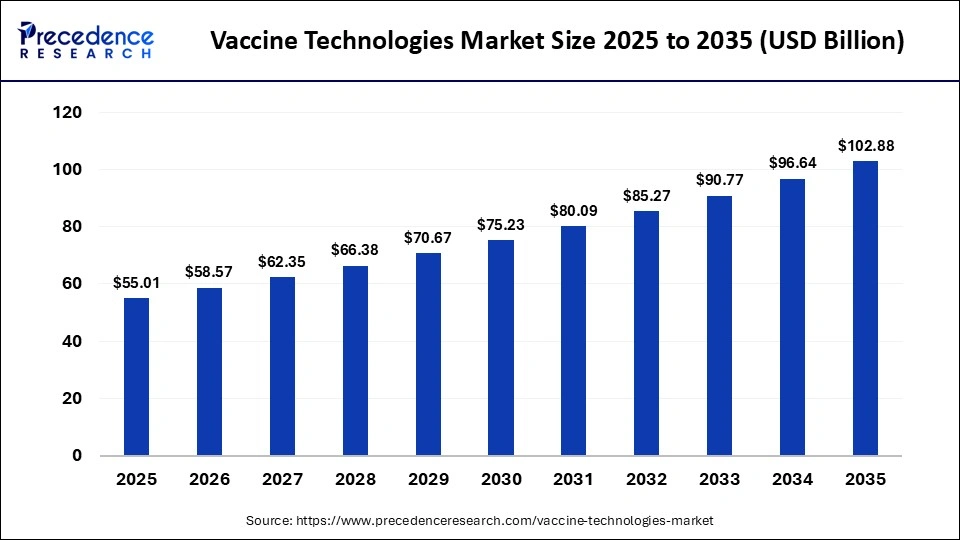
The global vaccine technologies market size was calculated at USD 55.01 billion in 2025 and is predicted to increase from USD 58.57 billion in 2026 to approximately USD 102.88 billion by 2035, expanding at a CAGR of 6.46% from 2026 to 2035. The vaccine technologies market drives innovations such as mRNA and nanoball platforms, improving pandemic preparedness, production speed, and logistical reliability. It also reduces global mortality by managing infectious diseases, addressing chronic health issues, and supporting economic development through stable public health.
Key Takeaways
- North America held a dominant position in the market in 2025.
- Asia-Pacific is expected to be the fastest-growing region with the highest CAGR during the forecast period.
- By technology, the recombinant, conjugate, and subunit vaccines segment contributed the biggest revenue share in the market in 2025.
- By technology, the inactivated vaccines segment is expected to witness the fastest growth in the market with the highest CAGR over the forecast period.
- By delivery method, the parenteral segment accounted for the highest revenue share in the market in 2025.
- By delivery method, the oral segment is expected to expand rapidly in the market with the fastest CAGR in the coming years.
- By type, the multivalent vaccines segment registered its dominance over the global market with the largest share in 2025.
- By type, the monovalent vaccines segment is expected to grow at the fastest CAGR in the market between 2026 and 2035.
What is the Vaccine Technologies Market?
Vaccine development is essential for public health and crucial in controlling infectious diseases and reducing global morbidity and mortality. It includes various immune responses, ranging from traditional methods to advanced genetic techniques. Vaccine types include live-attenuated, inactivated, protein-based, and innovative mRNA or DNA platforms, helping in the production of antigens to provide long-lasting immunity against diseases. It is rapidly evolving with scientific advancements, allowing different vaccine platforms to tackle a wide range of diseases and to enhance defense against pathogens.
In the COVID-19 pandemic, several vaccine technologies, including mRNA, offered effective protection against the virus. The significant shift towards mRNA technologies, nanoparticle vaccines, and recombinant methods is improving development speed and efficacy. Demand for combination vaccines, government immunization programs, and the need for vaccines against RSV and flu strains are driving this trend further. The market is promoting needle-free delivery systems and rapid-response vaccines for new infectious diseases. Rapid R&D investments and strategic partnerships boost vaccine stability and shelf life while expanding the market presence.
What is the Role of AI in the Vaccine Technologies Market?
Artificial Intelligence is a powerful tool in vaccine development. As traditional vaccine faces challenges, emerging technologies such as AI, genomics, and synthetic biology offer various solutions to increase the process. By leveraging these technologies and fostering global collaborations, researchers are able to develop safer, more effective, and accessible vaccines. AI-driven methods help in analyzing vast genomic data, protein structures, and immune interactions, enabling rapid identification of potential vaccine candidates.
Machine learning (ML) and AI algorithms also help in predicting antigenic epitopes, immunogenicity, and antigens. Also, deep learning methods are used for sequence predictions, protein folding, and identifying vaccine candidates. Hidden Markov Models (HMMs) predict B-cell and T-cell epitopes, which recognize sequence motifs and structural patterns. ML techniques also enhance the prediction of antigenic epitopes and immunogenicity, accelerating antigen discovery, thus saving time and resources.
What Are the Trends in the Vaccine Technologies Market?
- Genetic-Based Vaccines: Genetic-based vaccines, such as mRNA and DNA, are a major driver due to their rapid development, allowing quick adaptation to new pathogens like SARS-CoV-2. It enhances safety by avoiding live viruses, promoting strong immune responses, and facilitating scalable manufacturing. These vaccines are designed and produced in weeks instead of years, playing a crucial role in effective pandemic response. The advanced manufacturing process allows for rapid, high-volume production, especially with mRNA platforms. By utilizing these technologies, vaccines are derived with targeted immune responses against specific antigens in preventive and therapeutic vaccination.
- Advanced Delivery Systems (ADS): ADS plays a crucial role in modern vaccine technologies, such as in next-generation platforms like mRNA and DNA vaccines, ensuring the protection of antigens and delivery to target cells. These systems also improve the stability of vaccines, which is vital for their storage, transport, and distribution, especially in remote areas. Additionally, it is designed for controlled and sustained release, prolonging the immune system's exposure to the antigen, reducing the need for multiple booster doses. Moreover, advanced systems enable vaccine delivery through various methods, including mucosal (nasal or oral) or transdermal (microneedles) routes, allowing for painless self-administration.
- Digital and AI Integration : The digital and AI Integration into vaccine development is transforming as it boosts the development timeline by refining antigen selection, forecasting epitopes, and recognizing adjuvants, while reducing the duration from years to just months. It also analyzes vast datasets, including viral genomic and proteomic data, to identify the most promising and highly immunogenic antigens, improving vaccine efficacy and providing wide coverage against emerging variants. Furthermore, AI helps in the early detection of optimal candidates during the preclinical stages, which reduces the need for extensive animal testing, helping in the evolution of the market.
Market Scope
| Report Coverage | Details |
| Market Size in 2025 | USD 55.01 Billion |
| Market Size in 2026 | USD 58.57 Billion |
| Market Size by 2035 | USD 102.88 Billion |
| Market Growth Rate from 2026 to 2035 | CAGR of 6.46% |
| Dominating Region | North America |
| Fastest Growing Region | Asia Pacific |
| Base Year | 2025 |
| Forecast Period | 2026 to 2035 |
| Segments Covered | Technology, Delivery Method, Type, and region |
| Regions Covered | North America, Europe, Asia-Pacific, Latin America, and Middle East & Africa |
Segmental Insights
Technology Insights
Which Technology Segment Dominated the Vaccine Technologies Market?
The recombinant, conjugate, and subunit vaccines segment contributed the largest revenue share in the market in 2025, as it represents a new generation of vaccine technology, moving from whole pathogens to engineered components. They also improve safety, accurate targeted immune responses, and support scalable and cost-effective manufacturing. These vaccines provide highly purified antigens, reducing adverse reactions, for addressing pandemic threats like COVID-19. Also, they are rapidly developed through genetic engineering, are more stable, and often do not require strict ultra-cold storage, improving accessibility in developing regions.
The inactivated vaccines segment is expected to show the fastest growth in the market over the forecast period. It is important in vaccine technology due to its safety, stability, and wide-ranging immunity. It is essential in quick response to pandemics, immunocompromised people, and improving immunization in low-resource areas.
Inactivated vaccines are more robust and can be kept at regular refrigeration temperatures. They also produce a broad immune response against various illnesses such as polio, hepatitis A, rabies, and influenza. It is essential due to its proven safety and ability for large-scale production, making it vital for global public health efforts.
Delivery Method Insights
How the Parenteral Segment Dominated the Vaccine Technologies Market?
The parenteral segment contributed the biggest revenue share of the market in 2025, as this route delivers vaccines directly into tissues, ensuring high bioavailability, bypassing the digestive system, while obtaining strong and rapid immune responses. Different parenteral routes include intramuscular, subcutaneous, and intradermal injections.
It is effective for various vaccine types, including inactivated viruses, subunit vaccines, and mRNA vaccines, which require direct activation for protective immunity. Parenteral vaccines are highly used in controlling diseases like polio, measles, tetanus, and hepatitis B, providing reliable dosing and reducing variability in patient responses.
The oral segment is expected to expand rapidly in the market, as it offers a non-invasive and affordable option compared to traditional injections. It effectively triggers mucosal immunity at the main entry points of pathogens into the body. Oral vaccines focus on the gut-associated lymphoid tissue (GALT), which plays a crucial role in localized immune response in the gastrointestinal tract. Oral vaccines improve patients' wellness by removing the discomfort and fear linked to needles, particularly in children. Furthermore, these vaccines allow self-administration, eliminating the need for trained healthcare workers.
They are also useful for quick, large-scale distribution during pandemics or in remote areas with limited resources. Additionally, oral vaccines are cost-effective to manufacture and do not require extensive, high-standard aseptic purification. They are highly favored by individuals with weakened immune systems or those with bleeding disorders.
Type Insights
Why Did the Multivalent Vaccines Segment Lead the Vaccine Technologies Market?
The multivalent vaccines segment led the market in 2025, as they allow a single vaccine to protect against multiple strains or pathogens, boosting immunity. By integrating various antigens into one formulation, these vaccines are able to tackle challenges against rapidly evolving pathogens, improving logistical efficiency, and boosting patient compliance. A single injection minimizes clinic visits, reduces pain, and alleviates the burden on the healthcare system. Furthermore, multivalent platforms, including utilizing mRNA technology, are rapidly evolving with new antigens to address emerging variants for effective pandemic response.
The monovalent vaccines segment is expected to grow with the highest CAGR in the market during the studied years. Monovalent vaccines target a single strain or antigen of a pathogen, offering specific immunity while reducing immune imprinting. They generate strong immune responses against dominant strains, while outperforming multivalent vaccines in providing high-level protection. Additionally, they are also easier to design and produce for rapid development against new strains, which makes them essential for precise protection against evolving pathogens.
Regional Insights
Which Factors Drive the Vaccine Technologies Market in North America?
North America held a major market share in 2025, due to its advanced research facilities, significant financial research investments, and faster regulatory process. The presence of key players such as Moderna and Pfizer, successful public-private partnerships, and significant healthcare expenditures, strengthens this dominance further. Collaboration between research institutions, government, and private companies fosters innovation in development. Market growth is further supported by preventive health and a high demand for vaccines across all age groups.
U.S. Market Trends
The U.S. is dominant in the market due to massive public and private R&D investment, rapid, agile manufacturing capability, a mature biotech system, and the development of mRNA vaccines. The U.S. government is heavily investing in research through agencies such as NIH and DoD. The high concentration of top-tier universities, biotech firms, and research institutes create robust pipeline for innovation. Additionally, due to an advanced technological ecosystem, mRNA and vector-based vaccines are rapidly adopted to tackle emerging threats.
How Will Asia-Pacific Grow in the Vaccine Technologies Market?
Asia-Pacific is expected to experience the fastest growth during the predicted timeframe, as the region is a global powerhouse in vaccine technology and manufacturing. The dominance is further driven by massive manufacturing capacity, rapid adoption of advanced technologies like mRNA, and strong government involvement and support. It has strong, high-throughput, and cost-effective manufacturing capabilities, allowing for rapid production during pandemics. With a heterogeneous population, comprehensive clinical trials improve the global vaccine results.
India Market Trends
India is one of the dominant countries in the region due to its unique combination of massive manufacturing capability, cost-effective production, long history of institutions and research, and highly skilled workforce. It supplies approximately 65 to 70% of the total vaccine requirements of the WHO. With diverse platforms, manufacturers are adopting advanced technologies, including mRNA viral vector and DNA platforms. Additionally, with strong government policies supporting research, development, and export, have increased the India's reputation as a reliable global supplier has increased.
How is Europe Expanding in the Vaccine Technologies Market?
Europe is expected to grow at a notable CAGR in the foreseeable future, due to increased biotechnology investment, healthcare facilities, and the number of immunization programs. There is an emphasis on sophisticated vaccine technologies, such as mRNA and protein subunit vaccines, among other types of vaccines.
Germany Market Trends
Germany is an important market for vaccine technologies owing to the presence of an advanced pharmaceutical industry and biotechnology research activities in the nation. Next-generation vaccine development initiatives, such as mRNA technology, are being encouraged by Germany. Market growth is being boosted by increasing investment in health care and cooperation with international pharmaceutical companies.
How is Latin America Emerging in the Vaccine Technologies Market?
Latin America is expected to grow at a considerable CAGR in the upcoming period. It has been steadily establishing itself within the vaccine technology industry owing to the increasing immunization programs and improved health care infrastructure. The governments have been backing vaccine manufacturing and distribution within the continent. Increased investments in biotechnology studies and partnerships with foreign pharma giants are also propelling the growth of the market.
Brazil Market Trends
The Brazilian market is driven by the increasing public vaccination schemes and the development of biotechnology. The country helps promote vaccine production and studies related to infectious diseases. The investments being made towards health care in Brazil are also contributing to growth.
How is the Middle East and Africa Developing in the Vaccine Technologies Market?
The Middle East and Africa are considered to be a significantly growing area, owing to improvements in their healthcare infrastructure and growing awareness about vaccines. Their governments are increasing efforts for vaccination and even importing vaccines. Additionally, the focus on preventing infectious diseases and advancements in their healthcare sectors is also helping their market.
UAE Market Trends
The UAE is witnessing growth in the market owing to the presence of sophisticated healthcare infrastructure and increasing investments in biotechnology. The UAE promotes vaccine development, clinical testing, and collaboration with international pharmaceutical companies.
Competitive Landscape
The market for vaccine technologies faces stiff competition from big players like pharma and biotech firms, who emphasize the development and production of innovative vaccines. The market leaders compete using technologies such as mRNA, recombinant, viral vector, and protein subunit vaccines. Research and collaboration with governments and healthcare institutions are also on the rise, along with significant investments towards research, trials, and collaborations aimed at improving market positions.
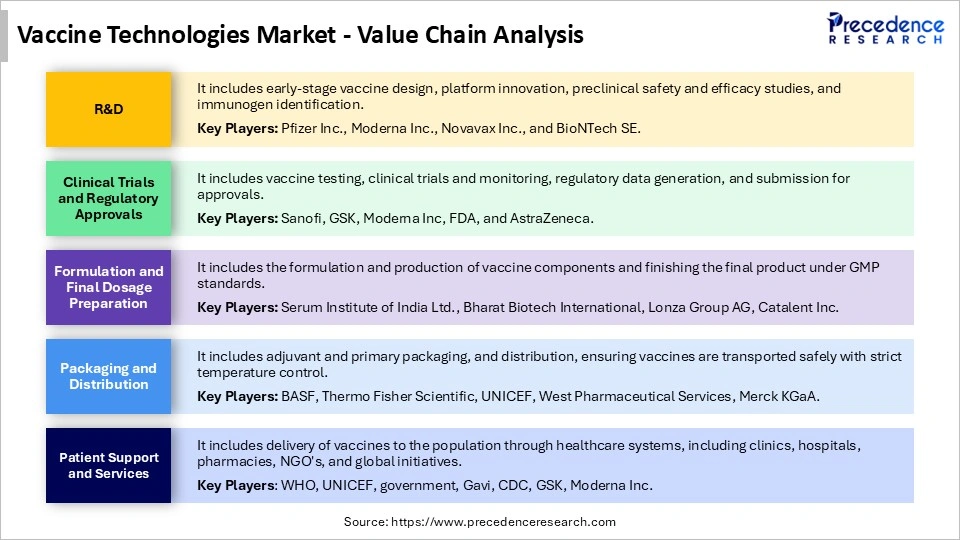
Vaccine Technologies Market Value Chain Analysis
Top Companies in the Vaccine Technologies Market
- Merck & Co., Inc.
- Pfizer Inc.
- GSK plc
- Sanofi S.A.
- Moderna, Inc.
- Johnson & Johnson
- AstraZeneca PLC
- CSL Limited
- Novavax, Inc.
- Bavarian Nordic
- Serum Institute of India Pvt. Ltd.
- Bharat Biotech
- BioNTech
- Sinovac Biotech
- Valneva SE
- Dynavax Technologies
Recent Developments in the Vaccine Technologies Market
- In February 2026, Sanofi completed its acquisition of Dynavax Technologies Corporation to strengthen Sanofi's presence in adult immunization by bringing together Dynavax's adult Hepatitis B vaccine and shingles vaccine candidate with its global commercial reach, skill, and development capability.
(Source – https://www.sanofi.com) - In June 2025, BioNTech announced the strategic acquisition of rival mRNA developer CureVac in a public exchange offer to expand its mRNA vaccine portfolio. It aims strengthen the research, development, manufacturing, and commercialization, particularly the COVID-19 vaccine, which was developed in collaboration with Pfizer, Inc. (Source - https://investors.biontech.de)
Segments Covered in the Report
By Technology
- Live Attenuated Vaccines
- Inactivated Vaccines
- Recombinant, Conjugate, and Subunit Vaccines
- Toxoid Vaccines
- Others
By Delivery Method
- Parenteral
- Oral
- Nasal
By Type
- Monovalent Vaccines
- Multivalent Vaccines
By Region
- North America
- Europe
- Asia-Pacific
- Latin America
- Middle East & Africa
For inquiries regarding discounts, bulk purchases, or customization requests, please contact us at sales@precedenceresearch.com
Frequently Asked Questions





Ask For Sample
No cookie-cutter, only authentic analysis – take the 1st step to become a Precedence Research client
 Get a Sample




 sales@precedenceresearch.com
 Schedule a Meeting
