



Virtual Reality in Gaming Market Size, Companies, Trends, Competitive Landscape, and Industry Outlook
Virtual Reality In Gaming Market (By Component: Hardware, Software; By Connecting Device: Gaming Console, PC/Desktop, Smartphone; By End-User: Individual Users, Commercial Space (Arcades/VR Centers)) - Global Industry Analysis, Size, Trends, Leading Companies, Regional Outlook, and Forecast 2026 to 2035
Source: https://www.precedenceresearch.com/virtual-reality-in-gaming-market
 Get a Sample
 Table Of Content


What is the Virtual Reality In Gaming Market Size?
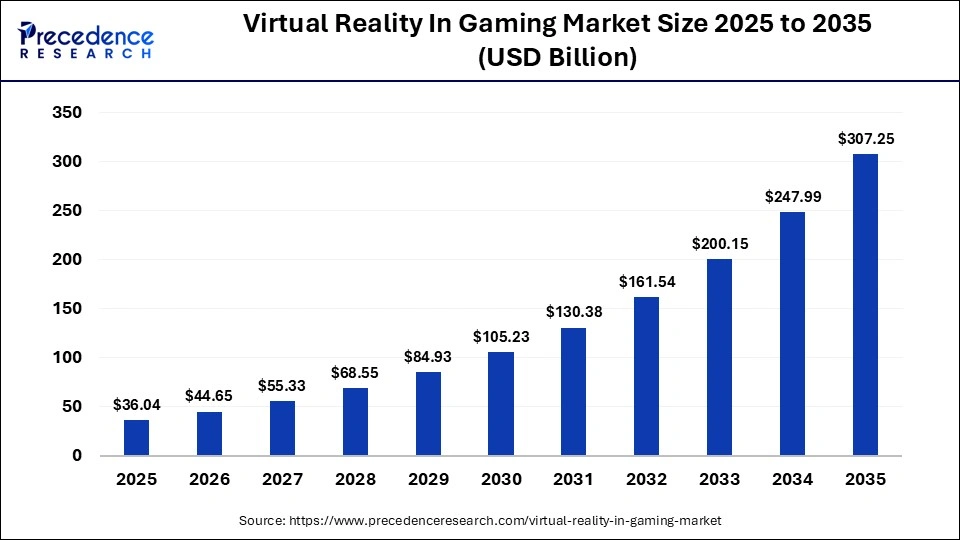
The global virtual reality in gaming market size is predicted to increase from USD 44.65 billion in 2026 to approximately USD 307.25 billion by 2035, expanding at a CAGR of 23.90% from 2026 to 2035. The virtual reality in gaming market is expanding steadily, driven by immersive gameplay demand, advancing hardware, rising content innovation, and growing adoption across casual and competitive gaming audiences.
Market Highlights
- North America led the virtual reality in gaming market with 38% share in 2026.
- The Asia Pacific is estimated to grow at the fastest CAGR of 23.2% between 2026 and 2035.
- By component, the hardware segment captured approximately 62% market share in 2026.
- By component, the software segment is growing at a strong CAGR of 23.7% between 2026 and 2035.
- By connecting device, the gaming console segment held around 52% market share in 2026.
- By connecting device, the smartphone segment is projected to grow at a significant CAGR of 23.3% between 2026 and 2035.
- By end-user, the individual users segment led the market and held a 68% market share in 2026.
- By end-user, the commercial space (arcades/VR centers) segment is expected to expand at a notable CAGR of 23.7% from 2026 to 2035.
Is Virtual Reality Changing the Way Games are Played?
The virtual reality gaming market offers gamers immersive experiences via VR systems, software, and videos that enable users to create their own 3D worlds. This is accomplished through the use of motion sensors, including head-mounted displays, to allow for real-time user interaction and experience in a fully immersive 3D environment.
As the virtual reality market matures and as gamers continue to desire a greater level of immersion and a more engaging experience when compared to traditional console or PC-based gaming, new technologies and improvements to existing technologies, the declining costs of VR hardware, and the recent growth of social VR communities are creating more opportunities for game developers to enhance their ability to retain players.
New technologies such as haptic feedback, advanced eye-tracking technology, artificial intelligence (AI), and 'smart' environments have also been incorporated into many of the latest immersive games being developed. Interest in competitive gaming, metaverse-type games, and VR experiences at public locations, along with the constant need for more content, is further expanding the uses of virtual reality and creating a supportive developer ecosystem that positions VR as a powerful change agent within the global gaming industry.
Government Initiatives Taken for Virtual Reality in the Gaming Market
In May 2026, the government officially declared to market about AI, AR-VR, and remaining digital machines for the purpose of museum digitisation, heritage preservation, and cultural dissemination. It has also featured programs like NMMA, SPPEL, and JATAN, along with investment assistance for ASI's protective work and excavation. (Source: https://telanganatoday.com)
Technological Developments in Virtual Reality in the Gaming Market
One of the huge ways AI is updating VR gaming is through intelligent surroundings. Regular games depend on pre-scripted actions, but AI-driven VR games have delivered feedback in real-time for player behaviour. Non-player characters (NPCs)can now accept, learn, and respond realistically, which makes every gaming session different.
It enables VR games to accept single players. By evaluating shifting designs, decision-making, and reaction period, AI can tailor storylines, issues, and difficulty levels. Such personalization ensures longer play session times and rigid emotional connections for the gaming industry, which makes VR gaming more delightful and available to a huge audience.
AI is also updating sound and visuals in VR gaming. High-level AI algorithm develops lighting, upscale textures, and makes realistic physics effects in real-time. AI-driven audio systems create spatial sound which gives feedback for an actual player shifting, as it develops immersion.
Key Trends in Virtual Reality In Gaming Market
- Enhanced Haptics: Technological advancements in haptics technology lead to more authentic sensations as players experience touch, motion, and force. These innovations have created a greater level of immersion, allowing for virtual interactions that mimic real-world physicality.
- Standalone VR Headsets: Standalone VR headset technology has eliminated external hardware components, thereby improving accessibility through convenience and lowering barriers to entry for the casual and mainstream gaming audience.
- Social VR Games: VR video games are transitioning from traditional game experiences into social game experiences with an emphasis on community and collaboration. This is accomplished through shared environments, player interaction and engagement, and the strengthening of the virtual gaming community.
- AI-Enabled Game Play: The use of artificial intelligence in video games allows for adaptive gameplay mechanics, intelligent NPCs, and personalized user experiences that respond to player actions and decisions throughout their play experience.
- Cross-Platform Play: The ability to connect between VR and non-VR players for online gaming has created more opportunities for increased user growth, longer-lasting content, and overall greater flexibility when it comes to gameplay options.
Segmental Insights
Component Insights
What Is the Reason for the Dominance of the Hardware Segment in the Virtual Reality in Gaming Market?
Hardware leads virtual reality in gaming market with a 55-70% share in 2026. Hardware has a key role in providing users with an immersive VR experience. Head-mounted displays, motion controllers, sensors, and tracking systems are critical for providing an engaging and realistic experience for users. Ongoing improvements in display resolution, refresh rates, ergonomic design, and 3D spatial tracking are all driving hardware adoption. In addition, ongoing product releases by video game console manufacturers and VR headset manufacturers support sustained growth in demand, as manufacturers replace their existing products regularly.
The software component has experienced rapid growth, with a CAGR of 23.2%, as VR developers have become increasingly focused on creating immersive content for their users, in addition to utilizing game engines and platform ecosystems. Developers' increasing investment in developing VR-native video games, multiplayer gaming environments, and developing platforms that support cross-device compatibility has accelerated VR adoption. Moreover, developers are continually releasing software updates that increase the level of realism, improve physics, and enhance the level of interactivity within their VR software; consequently, developers' software updates do not currently require end-users to upgrade their hardware to access these enhanced features.
Connecting Device Insights
What Is Driving The Growth Of VR Connection Through Game Consoles?
Game consoles are the dominant VR connection device with a 46-57% share in the virtual reality in gaming market in 2026, due to their integrated hardware-software solutions, large user base, and premium price of their products in comparison to high-end computers. Game consoles have plug-and-play support for VR, their performance is more consistent than that of a computer, and they offer exclusive titles that keep users interested in gaming. Also, game console manufacturers have developed strong brand ecosystems around their products and have innovated a lot by introducing new versions of their consoles continuously.
Smartphones are the fastest-growing type of connecting device, with a 23.3% CAGR due to their accessibility and improvements in mobile hardware. The introduction of new processors and displays, along with the creation of better mobile sensors, has resulted in smoother VR experience, and with the development of lightweight VR headsets and the introduction of app-based VR games, the entry barriers have been lowered for first-time users. Furthermore, with the introduction of a 5G network and continued development of cloud-based gaming services, mobile VR will become even more appealing as a means to enhance gaming interaction through virtual reality.
End-User Insights
How Are Individual Users Driving VR Gaming Demand?
Individual users represent the biggest share of 65-70% in the VR in gaming market because of the increase in popularity for consumers wanting more immersive at-home entertainment experiences, as well as increased prices of VR headsets and a growing number of unique types of gaming content available for a household to use. Gamers want to be able to play their games in a personalized way that allows for social interaction with others and health/exercise-oriented VR game formats.
Commercial users represent the fastest-growing end-user segment, with a 23.7% CAGR in the VR gaming industry due, in part, to the global expansion of VR gaming and arcade centers. These locations provide opportunities for users to participate in shared/semi-shared/premium virtual reality experiences without having to purchase their own hardware and thus do not require an upfront investment. Many location-based virtual reality properties provide opportunities for multiplayer, motion-based, and premium simulations not easily replicated at home.
Regional Insights
How Big is the North America Virtual Reality in Gaming Market Size?
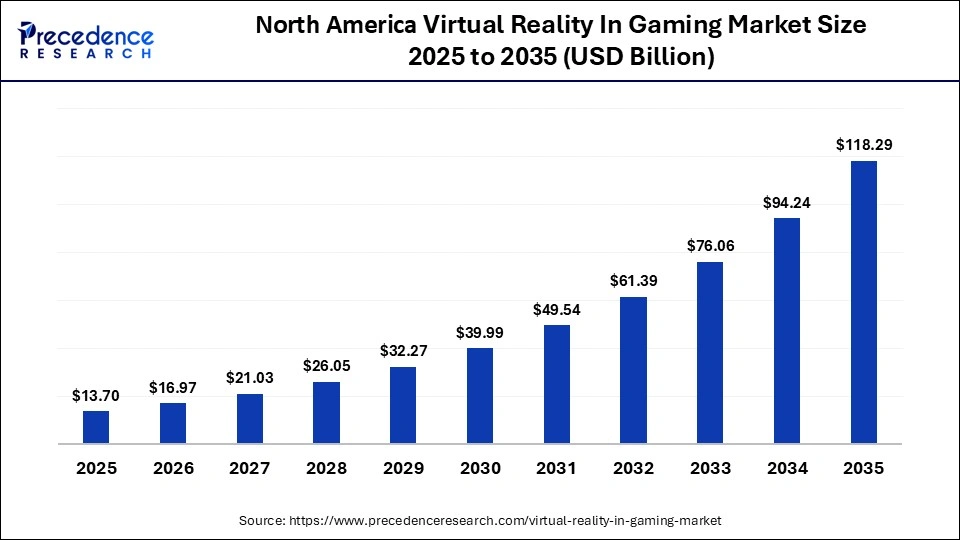
The North America virtual reality in gaming market size is estimated at USD 16.97 billion in 2026 and is projected to reach approximately USD 118.29 billion by 2035, with a 24.06% CAGR from 2026 to 2035.
Why Is North America the Top Region for Virtual Reality in Gaming Market?
North America is the top region for virtual reality in gaming due to its cutting-edge technology infrastructure, numerous game developers, and consumers accepting VR as an essential part of the gaming experience. The widespread availability of high-speed internet connections and VR-ready devices provide opportunities for unique content creation and innovation. The many active gaming communities and early acceptance of Next-Generation Platforms continues to be a source of innovation and experimentation and confirms that North America is the leading region for virtual engagement.
What is the Size of the U.S. Virtual Reality in Gaming Market?
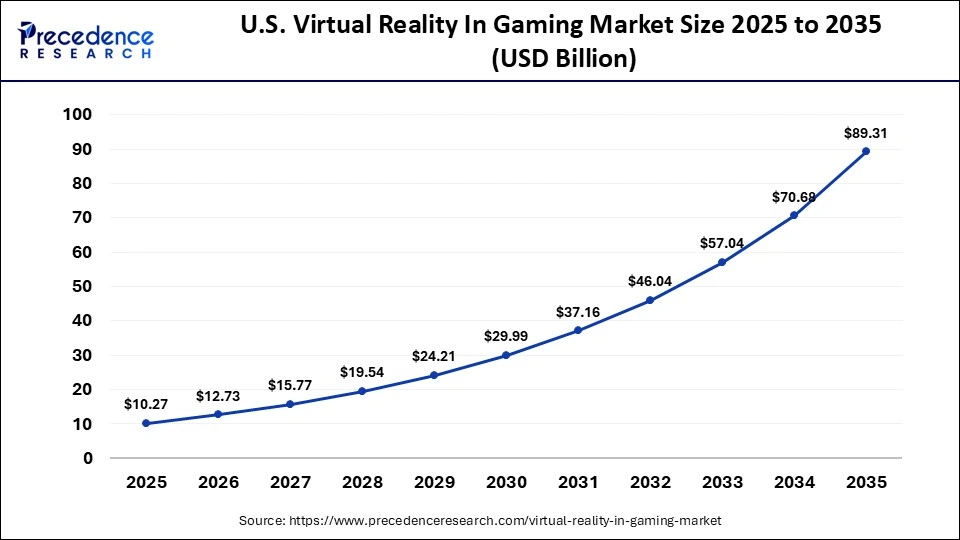
The U.S. virtual reality in gaming market size is calculated at USD 12.73 billion in 2026 and is expected to reach nearly USD 89.29 billion in 2035, accelerating at a strong CAGR of 24.15% between 2026 and 2035.
U.S. Virtual Reality In Gaming Market Trends
The U.S. has a unique situation in that there are multiple high-quality gaming hubs as well as a large number of game studios driving the progress of VR gaming. There is a thriving culture of early adopters and an enormous amount of support from developers, leading to rapid development of innovative content and platforms. Gamers in the USA are hungry for immersive experiences, which drives the continual experimentation with VR across all gaming categories, from action to simulation.
In October 2025, U.S. agencies are using video gaming and VR training tools to simulate real-world hazards, helping government workers spot dangers and improve safety before facing them on real job sites. The U.S. is also a leader in the global market, with many venture capital firms investing in VR and an increasing number of experiential entertainment locations providing additional support for the U.S. VR gaming industry.
Why Is Asia Pacific Experiencing the Fastest Growth of Virtual Reality in Gaming Market?
The Asia Pacific region's virtual reality gaming market is growing rapidly due to consumer interest, mobile phone penetration, and investments made in the interactive entertainment industry. Localized content and lower-cost virtual reality solutions are appealing to different markets in this region, along with gaming cafes and social venues that bring together different users of virtual reality in gaming. The combination of many users' cultural devotion to gaming and the increasing amount of individuals with access to digital literacy will allow this region a fertile environment for continued development of new and creative immersive play and experience opportunities.
China Virtual Reality In Gaming Market Trends
China's rapidly changing gaming culture combined with the size of China's gaming population is resulting in a significant increase in the number of people playing virtual reality games in China. China's rapidly growing technical infrastructure, coupled with the number of virtual reality gaming arcades that are opening throughout China, exposes millions of people to immersive gaming titles. Chinese VR gaming developers are designing games for the Chinese market that take into consideration the region's specific flavor, including social interaction and advanced graphics. The establishment of collaborative gaming events and showcases for technology will contribute to the continued visibility of virtual reality games.
What are the Advancements in the Virtual Reality in Gaming Market in Europe?
Europe is expected to have significant growth in the market, fueled by increasing adoption of VR technology in gaming, supported by favorable regulations and government initiatives aimed at promoting digital innovation. Countries like Germany and the UK are leading players, as they are witnessing a rising number of VR gaming startups and investments in immersive technologies. Players are also seen actively investing in VR gaming development, thus propelling the market further.
Germany Market Trends
The region benefits from strong participation by leading virtual reality game company ecosystems. The landscape is also characterized by a diverse range of gaming experiences, from casual to high-end gaming, appealing to a broad audience.
What are the Key Trends in the Virtual Reality In Gaming Market in Latin America?
Latin America is expected to have significant market growth over the forecast period. This growth is driven by increasing smartphone penetration, a growing gaming population, and rising disposable incomes. Countries like Brazil and Mexico are leading players, with significant investments being made in VR technology and gaming infrastructure, supported by government initiatives to promote digital entertainment.
Brazil Market Trends
The country has an innovative gaming culture and technological advancements. The market landscape is quite vibrant, with numerous startups and established companies competing for market share.
How is the Middle East and Africa Region Growing in the Virtual Reality In Gaming Market?
The Middle East and Africa region is expected to have significant growth in the market, driven by increasing internet penetration, a young population eager for new gaming experiences, and investments in digital infrastructure. Countries like the UAE and South Africa are leading players, with government initiatives aimed at fostering technology adoption and innovation in gaming.
South Africa Market Trends
South Africa is growing steadily with the help of local developers creating unique gaming experiences. The country's market landscape is evolving, with both local and international players entering the market.
Who are the Major Players in the Global Virtual Reality in Gaming Market?
The major players in the virtual reality in gaming market include Meta Platforms, Inc. (Oculus/Meta Quest), Sony Interactive Entertainment LLC (PlayStation VR), HTC Corporation (Vive), Samsung Electronics Co., Ltd., Google LLC (VR Services & Platforms), Valve Corporation (Index VR/SteamVR), Microsoft Corporation (Mixed/Cloud VR Titles), Qualcomm Incorporated (VR Chips/Processors), Electronic Arts Inc. (VR Game Content), Unity Technologies (VR Development Engine), Epic Games, Inc. (Unreal Engine / VR Content), Razer Inc. (Gaming Peripherals/VR Gear), ZEISS International (Optics for VR HMDs), FOVE, Inc. (Eye-Tracking VR Tech), and Activision Blizzard, Inc. (VR Game Titles).
Recent Developments
- In May 2026, Virtuix Holdings Inc, which is the top developer of complete body virtual reality systems, revealed that Omni ne and Omni One cores are currently available for official purchase in Canada through Virtuix's online shop, which marks the latest stage in the brand's worldwide rollout. (Source: https://markets.businessinsider.com)
- In May 2026, Samsung Electronics recently released the global accessibility of its current Odyssey gaming monitors and ViewFinity S8 lineup, which has fixed the latest benchmarks in results and resolution across professional displays and gaming. (Source: https://news.samsung.com)
- In October 2025, xAI, Elon Musk's AI company, is developing an AI-powered video game using advanced “world models” to blend real and virtual environments, with plans to launch the immersive title by 2026.(Source: https://www.indiatvnews.com)
- In July 2025, Burnley FC partners with VR sports tech firm Rezzil to stream a live football match in virtual reality, offering fans an immersive way to watch the Aug. 9 friendly via the Premier League Player app.(Source: https://burnleyfootballclub.com)
- In March 2025, Sandbox VR expands its Netflix collaboration “Squid Game Virtuals” by adding the new “Repeat Racers” mini-game, challenging players in physics-inspired races tied to the show's second-season themes.(Source: https://www.01net.it)
Virtual Reality In Gaming Market Segments
By Component
- Hardware
- Software
By Connecting Device
- Gaming Console
- PC/Desktop
- Smartphone
By End-User
- Individual Users
- Commercial Space (Arcades/VR Centers)
By Region
- North America
- Europe
- Asia-Pacific
- Latin America
- Middle East & Africa
For inquiries regarding discounts, bulk purchases, or customization requests, please contact us at sales@precedenceresearch.com
Frequently Asked Questions





Ask For Sample
No cookie-cutter, only authentic analysis – take the 1st step to become a Precedence Research client
 Get a Sample




 sales@precedenceresearch.com
 Schedule a Meeting
