



E-commerce Market Size, Share and Trends 2026 to 2035
E-commerce Market (By Model Type: Business to Business (B2B), Business to Consumer (B2C); By Application: Home Appliances, Fashion Products, Groceries, Books, Others) - Global Industry Analysis, Size, Trends, Leading Companies, Regional Outlook, and Forecast 2026 to 2035
 Get a Sample
 Table Of Content
E-commerce Market Size and Forecast 2026 to 2035
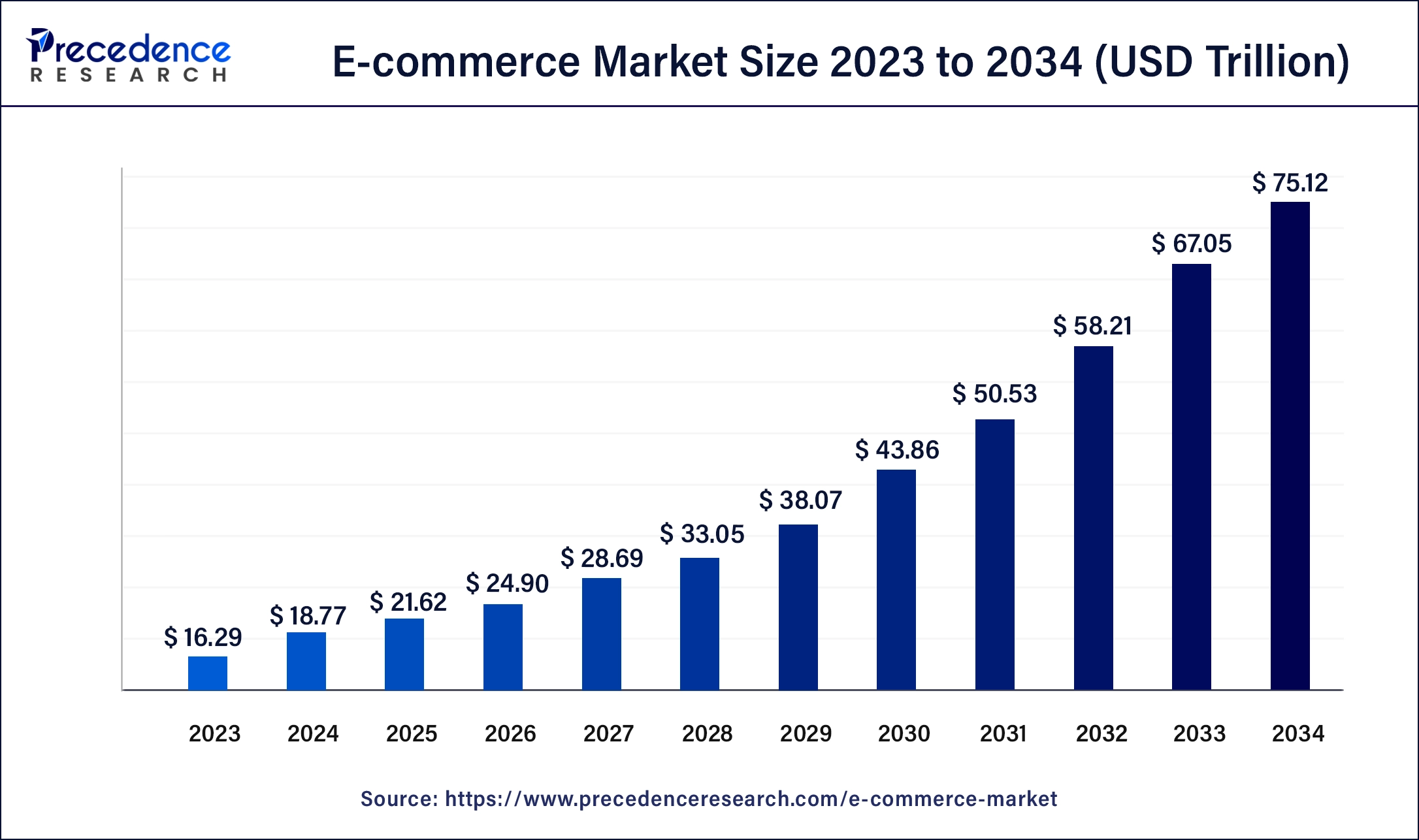
The global E-commerce market size is accounted at USD 21.62 trillion in 2025 and predicted to increase from USD 24.90 trillion in 2026 to approximately USD 83.19 trillion by 2035, representing a CAGR of 14.43% from 2026 to 2035.
E-commerce Market Key Takeaways
- In terms of revenue, the E-commerce market is valued at $21.62 trillion in 2025.
- It is projected to reach $83.19 trillion by 2035.
- The E-commerce market is expected to grow at a CAGR of 14.43% from 2026 to 2035.
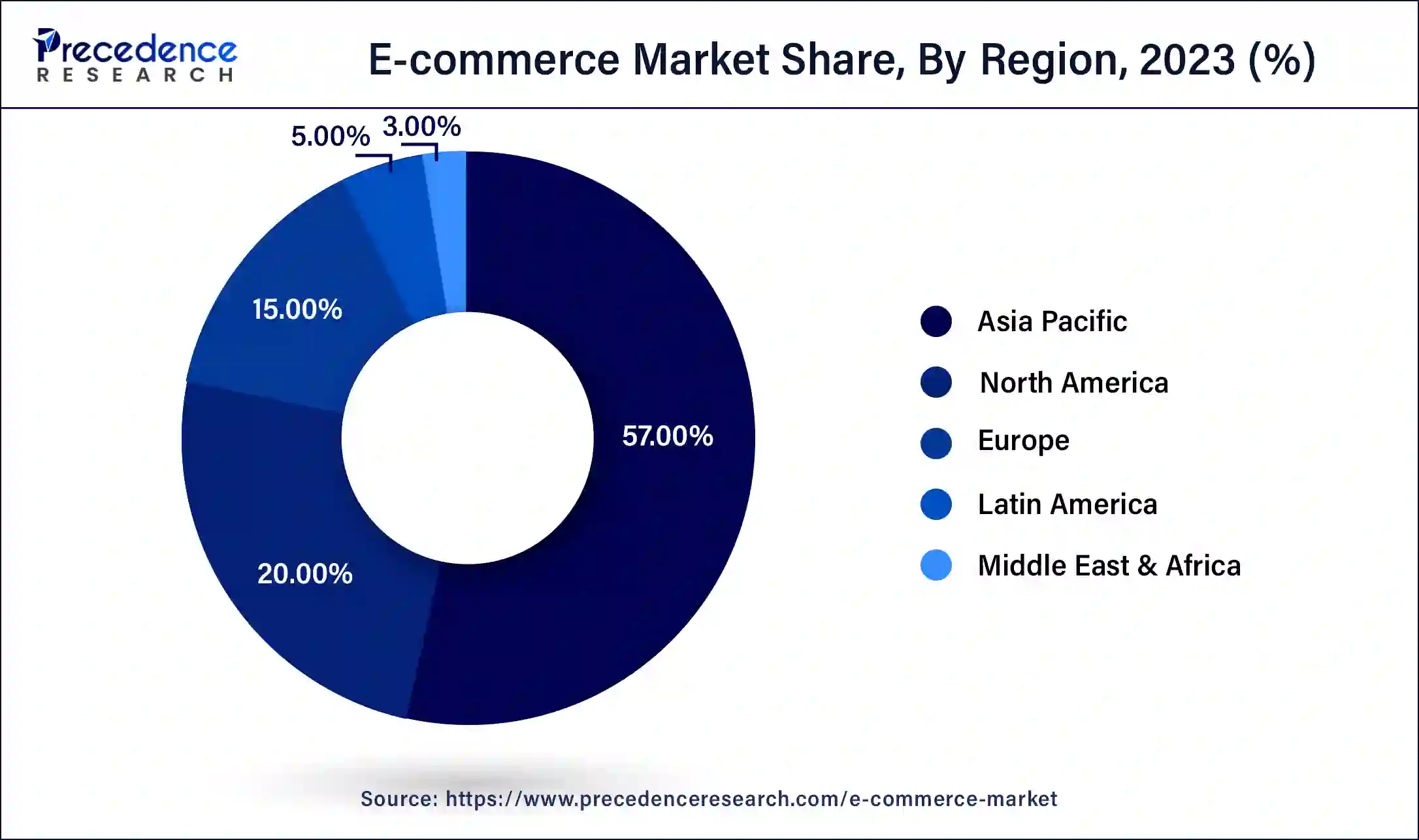
- Asia Pacific contributed more than 57% of revenue share in 2025.
- By Model Type, the Business to Business (B2B) segment captured more than 65% of revenue share in 2025.
- By application, the home appliances segment is expected to garner a significant market share over the forecast period.
How is AI contributing to the E-commerce Industry?
AI uses extensive customer data to provide hyper-personalized suggestions according to browsing history and purchases, as well as demographics. It drives a chatbot and virtual assistants such as Agentforce to provide 24/7 customer care. The machine learning reinforces inventory planning and demand forecasting. Dynamic pricing and visual search accuracy are made possible by algorithms.
Generative tools are used to generate marketing content automatically. Real-time fraud provides better security to transactions, conversion levels, loyalty, and efficiency.
What is the E-commerce?
The advent of the internet and digital technologies has revolutionized the way business is conducted, giving rise to the booming phenomenon known as e-commerce. E-commerce, or electronic commerce, includes the online buying or selling of goods. The e-commerce services hold the capacity to transform the global marketplace in profound ways. This virtual marketplace eliminates the constraints of physical distance and opens up new avenues for businesses to connect with consumers, making it an essential aspect of modern commerce.
E-commerce has evolved from a novel concept into a multi-trillion-dollar industry, reshaping the traditional retail landscape and redefining consumer behavior. The ease of access, convenience, and a limitless variety of products and services available on e-commerce platforms have attracted a massive number of customers, fundamentally altering the way people shop and interact with businesses. The e-commerce landscape is characterized by its constant evolution, driven by innovations in payment systems, logistics, user experience, and data analytics.
- According to the GSMA, a third of the world's population, or around 1.2 billion connections, will be covered by 5G networks by 2025.
E-commerce Market Growth Factors
The rise of mobile devices and apps has extended the reach of e-commerce, enabling customers to shop on the go. Moreover, emerging technologies like artificial intelligence (AI), virtual reality (VR), and augmented reality (AR) are transforming how products are showcased and experienced online. The global e-commerce market is driven by the increasing integration of advanced technologies such as AI, VR and AR, the growing inclination of consumers towards online shopping, rising investment, growing collaboration and increasing government initiatives.
Market Outlook:
- Industry Growth Overview: E-commerce develops using AI personalisation, B2B digitalisation, mobile use, and operational maturity instead of aggressive growth tactics.
- Global Expansion: Europe reinforces the strategies of cross-border logistics, refinement of digital experiences, and phygital retail closeness.
- Major investors: Sequoia Capital, Andreessen Horowitz, Accel, Forerunner Ventures, L Catterton, Bessemer Venture Partners, Index Ventures, Lightspeed Venture Partners, Shopify Ventures, Amazon Corporate Venture Capital.
Market Scope
| Report Coverage | Details |
| Market Size in 2026 | USD 24.90 Trillion |
| Market Size in 2025 | USD 21.62 Trillion |
| Market Size by 2035 | USD 83.19 Trillion |
| Growth Rate from 2026 to 2035 | CAGR of 14.43% |
| Largest Market | Asia Pacific |
| Base Year | 2025 |
| Forecast Period | 2026 to 2035 |
| Segments Covered | By Model Type and By Application |
| Regions Covered | North America, Europe, Asia-Pacific, Latin America, and Middle East & Africa |
Market Dynamics
Driver
Rising penetration of the internet
The widespread availability of the internet, along with increased access through smartphones and other devices, has enabled a larger portion of the global population to connect and shop online. As more people gain internet access, the potential customer base for e-commerce continues to expand. For instance, according to the Internet in India Report 2022, in India, the number of internet active users is around 759 million and is expected to reach around 900 million by 2025. Out of 759 million, about 399 million are from rural areas and 360 million from urban areas. Therefore, the growing number of internet users across the globe is expected to flourish the e-commerce industry over the projected year.
Restraint
Cybersecurity concerns
As e-commerce transactions involve the exchange of sensitive personal and financial information, the risk of cyberattacks, data breaches, and identity theft is a major concern. Businesses must invest in robust cybersecurity measures to protect customer data and maintain trust. For instance, according to secondary analysis, Account Take Over (ATO), which increased by 131% in the second half of 2022 compared to H1 in 2021, continues to be an e-commerce fraud issue in 2023. Thus, the growing cybersecurity concern is expected to hamper the market growth over the forecast period.
Opportunity
Increasing government initiatives
The increasing government initiatives are expected to provide a lucrative opportunity for market growth over the forecast period. For instance, the Union Ministry of India launched Bharat Craft, an Indian e-commerce website patterned after Alibaba. Multiple governments across the globe are penetrating online services to boost the sales of locally-produced goods to improve businesses. All these elements along with a substantial focus on cyber regulations by government authorities will present opportunities for the market to grow.
Technological Advancement
Technological advancements in the e-commerce market feature mobile commerce, voice commerce, blockchain, and AI. Voice commerce is a fascinating technology, popularly approached by half of the population, introducing a smart assistant to individuals. It includes Google Assistant and Alexa, supporting customers in browsing and purchasing products with the help of voice commands. Mobile commerce, smartphones are mainly preferred by users for easy payment options and access to other applications. Blockchain technology strengthens the supply chain process by tracking, reporting details, also ensures safety in online payments.
Artificial intelligence (AI), a popular technology, offers personalized features for a better shopping experience. AI assists and guides users through virtual assistance and chatbots. The advancement is contributing to financial safety with contactless payment options such as QR codes, NFC, and mobile wallets. The innovation in the e-commerce market is uplifting development in existing businesses and paving the way for new businesses.
Model Type Insights
Based on the model type, the global E-commerce market is segmented into Business to Business (B2B) and Business to Consumer (B2C). The Business to Business (B2B) segment is expected to hold the largest market share over the forecast period. B2B e-commerce encompasses a wide range of industries, products, and services, from industrial machinery and raw materials to software solutions and professional services. It involves various online platforms, websites, and marketplaces that facilitate these transactions. B2B e-commerce transactions can include bulk orders, ongoing supply agreements, subscription-based services, and more. The increasing propensity of businesses to sell and purchase products and services online is credited with the segment's rise.
Furthermore, it is predicted that during the period of the projection year, the business-to-business e-commerce market would be driven by rising smartphone adoption and internet usage. For instance, according to secondary analysis, In 2022, 84 percent of all mobile connections will be in North America, which will have the greatest adoption rate of smartphones. By 2030, 90 percent of smartphones will be in use in North America, with the CIS and Asia Pacific predicted to have the fastest growth. Therefore, the aforementioned fact drives the segment growth during the forecast period.
Application Insights
Based on the application, the global e-commerce market is segmented into home appliances, fashion products, groceries, books, and others. The home appliances segment is expected to garner a significant market share over the forecast period. Home appliances available in the e-commerce websites encompass a wide range of products that are essential for daily living, such as kitchen appliances, laundry machines, air conditioning units, and more. The convenience, variety, and competitive pricing offered by e-commerce platforms have contributed to the expansion of online sales in the home appliances sector.
On the other hand, the fashion products segment is expected to grow at the highest CAGR over the forecast period. Fashion e-commerce encompasses a wide range of products, including clothing, footwear, accessories, and beauty products. The convenience, extensive product range, and trends-driven nature of fashion have contributed to the rapid growth of online fashion retail. For instance, Myntra predicts that in the following five years, the Indian fashion eCommerce market would reach $30 billion. This indicates that during the next five years, about one-third of India's fashion will be marketed online or via digital channels.
Regional Insights
Asia Pacific E-commerce Market Size and Growth 2026 to 2035
The Asia Pacific E-commerce market size is estimated at USD 12.32 trillion in 2025 and is predicted to be worth around USD 47.42 trillion by 2035, at a CAGR of 14.40% from 2026 to 2035.
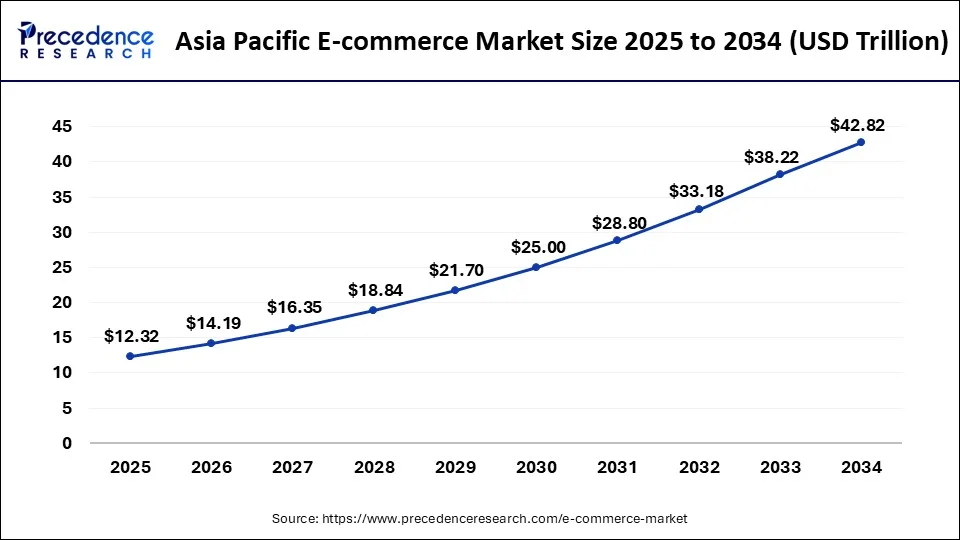
Asia Pacific is expected to dominate the market over the forecast period. The market growth in the region is attributed to the growing urbanization and increasing investment in network infrastructure especially in the countries like India, China and Japan. For instance, as per United Nations Human Settlements Program, in Asia-Pacific area, urbanization is still a defining megatrend. Asia is home to more than 2.2 billion people or 54% of the world's metropolitan population.
Currently, Asia Pacific is dominating the e-commerce market. Within the region, China contributes the most with its largest market share in the market. China is the sole competitor with the highest e-commerce sales globally. The rising demand for e-commerce in industries leads to the expansion of several businesses across regions.
Japan E-Commerce Market Analysis
Japan E-commerce market is majorly driven by the highly urbanized consumers that value accurate logistics and scheduled delivery services. Japanese shoppers highly demand luxury brands and prioritize high-quality customer services with precise product details. The key market players include Amazon Japan, Rakuten, and Yahoo shopping. This social commerce is deeply integrated with the messaging applications, fueling the market's growth further.
Additionally, according to the latest report published by GSMA “Mobile Economy Asia Pacific” in 2022, more than 400 million 5G connections, or slightly over 14% of all mobile connections, will exist by 2025. In addition, according to IBEF, the majority of the industry's growth has been driven by internet and smartphone use. The 'Digital India' program caused a dramatic increase in internet connections, reaching 850 million in 2022 in India. Furthermore, the rising government initiative is also one of the important factors that propel the market expansion in the region during the forecast period.
North America is expected to hold a prominent market share over the forecast period. The market growth in the region is driven by the well-established digital infrastructures and the presence of major e-commerce companies including Amazon, Walmart, eBay and others. Amazon, in particular, has a substantial share of the market and offers a wide range of products, including its Amazon Prime subscription service. Amazon continues to be the industry leader in retail e-commerce with a market share of 37.8%.
Moreover, the COVID-19 pandemic is one of the major reciprocating factors that has influenced the market growth in the region. For instance, E-commerce sales rose from $571.2 billion in 2019 to $815.4 billion in 2020, the first year of the pandemic, according to the most recent 2020 ARTS release, a surge of $244.2 billion or 43%. Therefore, the aforementioned facts drive the market growth in the region over the forecast period.
China E-commerce Market Trends
Content-driven social commerce ecosystems expand Cinas e-commerce market. China is the pacesetter of demand with interest-based discovery models. Social media such as Douyin and Xiaohongshu influence an impulse buy. Repeat buying and inventory are automated in agentic commerce. Brands to use WeChat mini-programs and closed communities to build more retention through personal traffic.
U.S. E-commerce Market Trends
Digital retail restructuring in the U.S. is expected to grow through efficiency. The U.S. is all about profitability and operational discipline. Retail media becomes a powerful mechanism of advertising. TikTok Shop and Instagram integrate hassle-free checkout options. AR enhances the level of engagement in fashion and home decor and alleviates pressure on the management of returns.
Europe E-Commerce Market Analysis
The Europe E-commerce market is largely driven by the high internet and smartphone usage as nearly 74% of European users shop through online platforms, especially products from sections of fashion and apparel. The European market is majorly shaped by the European Commission's Digital Markets Act, which regulates platforms like Zalando and Amazon to ensure third-party seller treatment. Moreover, strict GDPR data protection laws need robust compliance for personalized digital stores.
Germany E-Commerce Market Analysis
The Germany E-commerce market is largely driven by high internet penetration, mature digital consumer base, and localization factor. The majority of German consumers prefer shopping with the local brand as they prioritize convenience and security. According to the sources, nearly 75% of the German population shop online, making Germany a deeply evolved digital economy. Additionally, the preference for home delivery with the help of providers like DHL remains at the top by German people. There is strong demand for eco-friendly packaging, ethical sourcing, and carbon-neutral shipping, supporting the market's growth.
Competitive Landscape
The competitive landscape of the E-commerce market is highly dynamic and defined by aggressive delivery speeds, integration of social commerce, and AI-driven customizations. The competitive hierarchy is segmented between global tech giants, regional powerhouses, and localized infrastructure. The leading companies like Amazon and Alibaba are driving market growth with massive scale and global logistics systems along with the heavy AI investment. They dominate with the help of third-party seller ecosystems and cloud infrastructure.
The consumers are increasingly favoring high frequency and quick commerce with instant delivery. Leading platforms are implementing AI-based inventory management and generative AI product summaries to minimize errors and accelerate decision-making. Micro-fulfillment centers and real-time order visibility are considered as a standard as platforms prioritize to deliver orders on the exact day.
Top E-commerce Market Companies and their Offerings:
- Apple Inc.: Sells iPhone, Mac, iPad, Watch, integrated software platforms, and secure digital services that focus on design, privacy, and ecosystem integration.
- Amazon.com Inc.: Manages an international marketplace, Prime solutions, AWS cloud computing, and a retail advertising engine that facilitates scalable online commerce activities.
- Flipkart Internet Pvt. Ltd.: Operates an Indian online marketplace of electronics, fashion, groceries, and quick commerce supported by the network Ekart logistics chain.
E-commerce Market Companies
- Apple Inc.
- Amazon.com Inc.
- Flipkart Internet Pvt. Ltd.
- Costco Wholesale Corp.
- Ebates Performance Marketing Inc.
- eBay Inc.
- Best Buy Co. Inc.
- Groupon Inc.
- Inter IKEA Systems B.V.
- JD.com Inc.
- Otto GmbH & Co. KG
- Lojas Americanas S.A.
- priceline.com LLC
- Shopify Inc.
- The Home Depot Inc.
Recent Development
- In May 2025, Davalindia, India's largest private retail chain specializing in generic medicines, launched its e-commerce platform in Varanasi, providing accessibility and affordable healthcare through digital channels. Source: indianretailer.com
- In May 2025, Unicommerce, an e-commerce enablement software-as-a-service (SaaS) firm, processed more than 20 million quick commerce (Q-commerce) order items via its flagship platform, Uniware, in the last financial year. Source: business-standard.com
- In April 2022, ANS Commerce was purchased by Bengaluru-based Flipkart. The acquisition will improve Flipkart's marketplace for online shopping. An Indian company called ANS Commerce offers e-commerce services.
- In February 2023, Swaven, a prominent provider of eCommerce enablement and analytics software throughout EMEA, APAC, and LATAM, will be acquired by MikMak, the premier eCommerce acceleration platform for multichannel companies. The two businesses' merger opens the way for MikMak 3.0, the most cutting-edge eCommerce analytics platform in the world.
Segments Covered in the Report
By Model Type
- Business to Business (B2B)
- Business to Consumer (B2C)
By Application
- Home Appliances
- Fashion Products
- Groceries
- Books
- Others
By Geography
- North America
- Europe
- Asia-Pacific
- Latin America
- Middle East and Africa
For inquiries regarding discounts, bulk purchases, or customization requests, please contact us at sales@precedenceresearch.com
Frequently Asked Questions





Ask For Sample
No cookie-cutter, only authentic analysis – take the 1st step to become a Precedence Research client




 sales@precedenceresearch.com
 Schedule a Meeting



