



Logistics Market Size, Key Companies, Company Market Share, Freight Volume, Logistics Cost, Fleet Utilization, Trade Flows, Competitive Positioning, and Demand Trends
Logistics Market (By Transportation Type: Airways, Waterways, Railways, Roadways; By Logistics Type: First Party, Second Party, Third Party, Contract Logistics; By End User: Industrial and Manufacturing, Retail, Healthcare, Oil & Gas, Others) - Global Industry Analysis, Size, Trends, Leading Companies, Regional Outlook, and Forecast 2026 to 2035
Source: https://www.precedenceresearch.com/logistics-market
 Get a Sample
 Table Of Content


What is the Logistics Market Size?
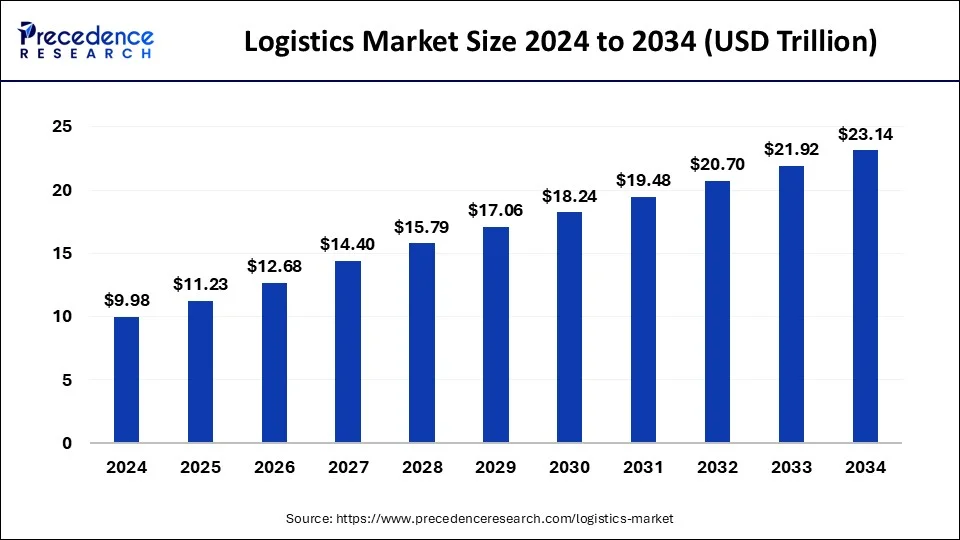
The global logistics market size is estimated at USD 11.23 trillion in 2025 and is projected to grow to USD 12.68 trillion in 2026 and to approximately USD 24.36 trillion by 2035, at a CAGR of 8.05% from 2026 to 2035. The market's growth is mainly driven by rapid transformation from e-commerce expansion, AI-powered route optimization, and significant government infrastructure investments that lower supply chain costs.
Market Highlights
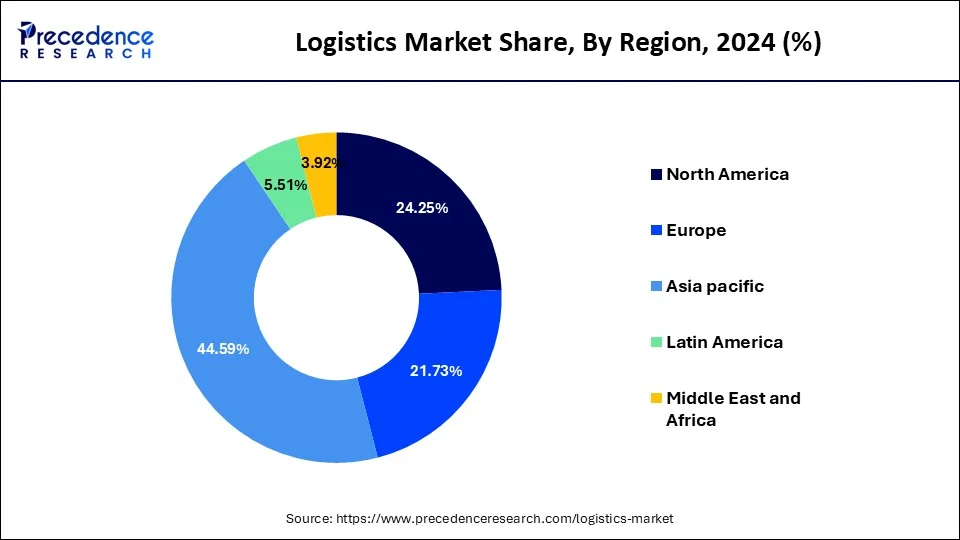
- Asia Pacific dominated the global market with the largest market share of 44.59% in 2025.
- North America is expected to grow at a notable CAGR in the foreseeable future.
- By transportation type, the roadways segment held a major revenue share in the market in 2025.
- By transportation type, the waterways segment is expected to witness the fastest growth in the market over the forecast period.
- By logistics type, the third-party logistics segment held a dominant position in the market with a share in 2025.
- By logistics type, the second party logistics segment is expected to grow with the highest CAGR in the market during the studied years.
- By end user, the industrial and manufacturing segment accounted for a considerable revenue share in the market in 2025.
- By end user, the healthcare sector segment is expected to show the fastest growth over the forecast period.
Market Overview
E-Commerce with Technology Drives Logistics Growth
The current growth in demand for logistics options is significantly enhanced by the rapid expansion of the e-commerce industry and the increasing accessibility of high-speed internet connectivity. As e-commerce continues to flourish, there is a burgeoning demand for efficient logistics services to meet the expectations of consumers who prefer online shopping. This shift in customer behavior drives the need for tailored logistics solutions.
Online retail platforms are not only expanding but also enhancing market reach through the provision of convenient home delivery services. Concurrently, manufacturers are adopting green logistics practices to mitigate environmental impacts, thereby bolstering their sustainability profiles. Additionally, logistics providers are integrating advanced technological systems to boost operational efficiency and transparency. Innovations like blockchain technology, artificial intelligence (AI), the internet of things (IoT), and augmented reality (AR) are increasingly being incorporated into logistics monitoring systems, further enhancing their effectiveness and responsiveness to market needs. Such factors collectively act as significant drivers for market expansion and transformation in the logistics sector.
Role of AI in the Growth of the Logistics Market
The emergence of AI has influenced the logistics market by fostering growth through advanced technologies that transform supply chains. These innovations optimize operational efficiency, reduce transit costs, and increase warehouse throughput, accommodating the rising demands of e-commerce. In warehouse settings, AI facilitates faster picking, packing, and sorting of items, achieving speeds up to 70% greater than traditional methods, consequently lowering fulfillment costs.
Machine learning algorithms play a crucial role by analyzing traffic patterns, weather conditions, and delivery schedules, which aid in determining the most efficient delivery routes and saving valuable time. Additionally, these technologies assist in maintaining balanced inventory levels, preventing stockouts, and reducing holding costs, thereby enhancing overall supply chain management. 
Logistics Market Trends
Increasing digitization and automation
- Logistics plays a critical part within the supply chain, encompassing the transportation of goods, services, and related information from origin to consumption. Currently, the industry is undergoing a transformative shift towards digitization and automation. Logistics companies are increasingly leveraging advanced technologies such as the IoT, AI, machine learning, and robotics to optimize their operations. These innovations aim to enhance efficiency and reduce costs, with practical applications including warehouse automation, the use of autonomous vehicles, and predictive analytics. This transition not only streamlines workflows but also positions logistics to meet the evolving demands of the marketplace effectively.
Increasing demand for waterways transportation
- Waterways transportation, often termed inland waterways transportation, involves the conveyance of goods and passengers via rivers, canals, lakes, and coastal waters. This mode of transport is typically more cost-effective for moving substantial volumes of goods over extended distances due to its high carrying capacity. As a result, there is a burgeoning demand for water transportation, particularly contributing to the expansion of the global logistics market in the anticipated forecast period. Factors such as efficiency and environmental advantages are further propelling this growth.
Market Growth Factors
- The popularity of online shopping culture among consumers, leading to higher demand for efficient fulfillment and fast, reliable last-mile delivery services by companies, helps to fuel the growth of the market.
- The growth of e-commerce is increasing the volume of returns, which is helpful for logistics and helps to fuel the growth of the market.
- Technological advancements, helpful to cut costs, improve operational efficiency, and gain real-time visibility, also fuel the growth of the market.
- Growing government investments in smart infrastructure to lower transit times and freight costs also fuel the growth of the market.
- Increased adoption of outsourcing by key market companies to focus on core capabilities is another major industry driver.
Market Outlook
- Industry Outlook: The logistics industry is evolving into a technology-centric, data-rich sector anchored in efficiency, resiliency, and customer experience. Companies are repositioning themselves from pure transporters to end-to-end supply-chain partners, providing value-added services such as integrated WMS/TMS systems, customs management, returns processing, and real-time monitoring.
- Sustainability Trend: Sustainability is increasingly central to logistics transformation, characterized by trends such as fleet electrification, alternative fuels like hydrogen and biofuels, and carbon-optimized routing through AI for reduced fuel consumption.
- Startups: Digital freight marketplaces that match shippers to carriers in real time. AI-based routing & fleet optimization platforms reducing cost and emissions. Robotic and micro-fulfilment technologies enabling rapid urban fulfilment. Autonomous delivery startups are working on drones, sidewalk robots, and autonomous vans.
Strategic Opportunities for Development in the Logistics Sector
- Prospects for High Revenue Growth: Logistics companies can benefit from various sectors such as e-commerce, last-mile delivery, cold-chain logistics, reverse logistics, and integrated supply chains. The increasing demand for fast delivery and specialized transport solutions opens new avenues for premium logistics services.
- Prospects for Using New Technologies: AI-driven technologies such as route optimization, predictive analytics, warehouse automation, in-band tracking, and robotics enhance operational efficiency. Companies leveraging real-time visibility and smart decision-making enjoy significant advantages through improved speed, reliability, and cost-effectiveness.
- Prospects for Regional Expansion: Companies can enhance their operations in rapidly industrialized nations by focusing on e-commerce, infrastructure, and logistics. Developing regional warehouses and logistics centers, along with forming partnerships, can improve service levels and decrease delivery times.
Market Scope
| Report Coverage | Details |
| Market Size by 2035 | USD 24.36 Trillion |
| Market Size in 2025 | USD 11.23 Trillion |
| Market Size in 2026 | USD 12.68 Trillion |
| Growth Rate from 2026 to 2035 | CAGR of 8.05% |
| Largest Market | North America |
| Base Year | 2025 |
| Forecast Period | 2026 to 2035 |
| Segments Covered | Transportation Type, Logistics Type, End User, and Region |
| Regions Covered | North America, Europe, Asia-Pacific, Latin America, and the Middle East & Africa |
Market Dynamics
Drivers
Growing E-Commerce Platforms
The preference for online shopping is a significant driver of logistics demand. Consumers expectations for rapid or same-day delivery have led businesses to implement omnichannel retail strategies, localized warehousing, effective inventory management, and specialized last-mile delivery networks. Additionally, increasing order volumes, infrastructure demands, and the adoption of AI technologies contribute to the market's growth.
Restraints
Rising Fuel Prices and Operational Costs
Rising fuel prices and operational costs pose challenges to market growth by shrinking profit margins and prompting companies to impose fuel surcharges on consumers. These increases also affect small fleet operators and subcontractors, leading to reduced capacity and greater delivery delays. Thus, logistics companies are pressured to modernize their logistics networks, resulting in substantial costs and initial investments.
Opportunity
Warehousing and Automation
Warehousing and automation are contributing significantly to market growth by reducing fulfillment times, lowering operational costs, and enhancing accuracy. These advancements allow companies to scale operations efficiently and meet consumer demands.
Automated guided vehicles (AGVs), autonomous mobile robots (AMRs), and conveyor systems accelerate picking and packing processes, further driving market growth. Additionally, automated systems optimize vertical storage, enabling businesses to maximize inventory storage in limited space, which also supports market expansion.
Segments Insights
Transportation Type Insights
The roadways segment led the global market in 2025, providing exceptional door-to-door flexibility along with first-mile and last-mile connectivity. This segment is crucial for digital retail platforms, which depend on trucks and vans for urban logistics, including essential first-mile, middle-mile, and last-mile functions. It serves as an indispensable link between air hubs, seaports, and rail terminals, directly connecting consumers. The diversity of truckloads within this segment caters to various delivery needs and purposes. Additionally, significant government investments aimed at enhancing multimodal infrastructure are driving market growth.
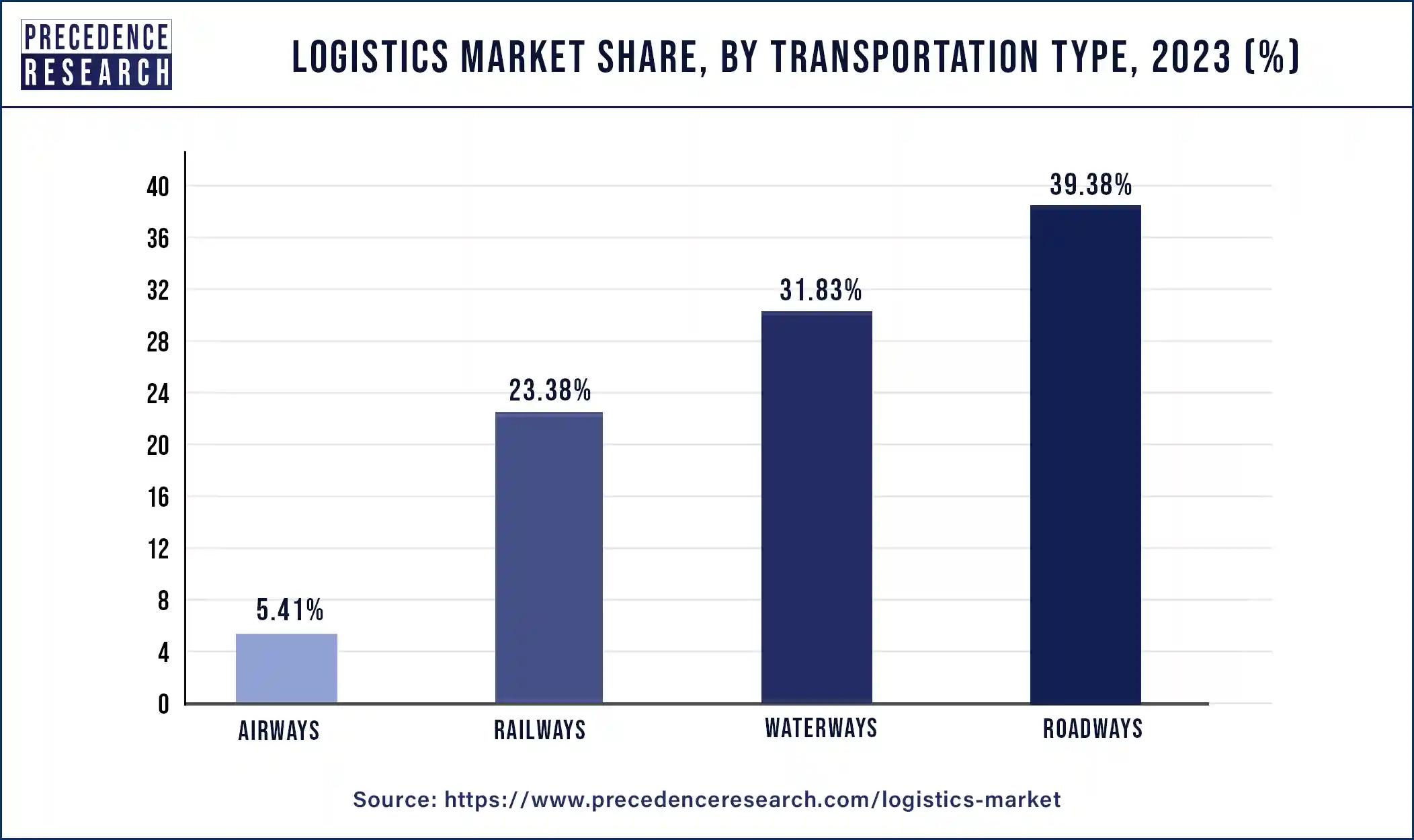
The waterways segment is identified as the fastest-growing segment during the forecast period, characterized by its critical and cost-effective role in the market. It supports the global supply chain, particularly focusing on high capacity and lower carbon emissions. The mode of transport is essential in multimodal logistics, facilitated by advanced technologies such as hybrid vessels and digital route optimization. Additionally, this segment is categorized into various options for logistics providers to select the most suitable alternative. 
Logistics Market Revenue, By Transportation Type, 2022-2024 (USD Billion)
| Transportation Type | 2022 | 2023 | 2024 |
| Airways | 428.41 | 485.38 | 545.14 |
| Waterways | 2,524.17 | 2,853.85 | 3198.64 |
| Railways | 1,862.44 | 2,095.78 | 2337.90 |
| Roadways | 3,168.25 | 3,528.38 | 3895.02 |
Logistics Type Insights
The third-party logistics segment experienced dominance in the global market in 2025, driven mainly by the rapid expansion of e-commerce, omni-channel retailing, and the restructuring of global supply chains. This segment acts as the backbone of global supply chains, as companies turn to external providers for outsourcing fulfillment, warehousing, and transportation to reduce capital costs.
Emphasis on third-party logistics is also placed on technological innovations, which support advancements like predictive maintenance, automated control towers, and blockchain technology to enhance tracking transparency.
The demand for second-party logistics is the fastest-growing within the forecast period, focusing on outsourcing supply chain operations like transportation and storage to carriers such as trucking, rail, and shipping companies. This segment provides necessary equipment for moving and storing goods, targeting long-haul transport, freight corridors, and bulk commodity transport, enabling companies to execute physical logistics efficiently.
End User Insights
The industrial and manufacturing segment dominated the global logistics market in 2025, driven by rapid automation, localized supply chain shifts, and third-party logistics integration. Its focus is on optimizing the movement of raw materials, production flow, and finished goods for enhanced manufacturing efficiency.
Major investments in AI, IoT, and WMS enhance visibility and streamline production, driving market growth. Additionally, outsourcing logistics to third-party providers reduces costs and allows companies to concentrate on core production, further contributing to market growth.
Logistics in the healthcare sector plays a crucial role, primarily due to several factors. Key drivers include the increasing demand for advanced cold chain logistics for biologics and a notable rise in third-party logistics outsourcing. The implementation of IoT and AI tracking technologies plays a significant role in modernizing the industry, further accelerating market growth.
The high-volume manufacturing capabilities and complex global distribution networks within pharmaceutical and biological companies also contribute to this expansion. Furthermore, hospitals, clinics, and diagnostic centers are increasingly dependent on the market for last-mile deliveries and emergency supply distribution, which further fuels growth.
Logistics Market Revenue, By End User, 2022-2024 (USD Billion)
| End User | 2022 | 2023 | 2024 |
| Industrial & Manufacturing | 2,570.59 | 2,867.46 | 3171.02 |
| Retail & E-Commerce | 1,439.24 | 1,607.90 | 1780.80 |
| Healthcare | 899.54 | 1,032.35 | 1174.50 |
| Oil & Gas | 600.09 | 681.54 | 767.34 |
| Others | 2,473.81 | 2,774.13 | 3083.05 |
Regional Insights
Asia Pacific Dominated the Logistics Market Trends
Asia Pacific led the global market in 2025, driven by increasing cross-border e-commerce, manufacturing shifts to Southeast Asia, and infrastructure policies. Notably, in September 2026, Uzbekistan and China partnered on transport and logistics to enhance e-commerce through improved infrastructure and technology.
Warehousing and distribution services significantly contribute to market growth in the region. Third-party logistics and contract logistics are also pivotal in the industry. Moreover, road freight and air freight facilitate market expansion, driven by the demand for high-value e-commerce items and just-in-time manufacturing requirements.
What is the Asia Pacific Logistics Market Size?
The Asia Pacific logistics market size was valued at USD 5.07 trillion in 2025 and is expected to reach around USD 12.11 trillion by 2035 with a CAGR of 9.10% from 2026 to 2035.

China Logistics Market Trends
China's market growth is driven by major infrastructure projects like the Belt and Road Initiative and technological investments in automation and robotics. For instance, the newly launched Pinglu Canal connects the Guangxi River system to Beibu Bay, allowing 5,000-ton vessels and cutting coastal shipping routes by 560 kilometers, enhancing transport integration for inland regions.
North America Logistics Market Trends
North America is the fastest-growing region, driven by USMCA trade, e-commerce, and nearshoring. The rise of e-commerce is pushing operators to set up micro-fulfillment centers for prompt delivery. Public funding aids in modernizing logistics infrastructure, while increasing preference for rail and intermodal options further supports market growth in North America.
U.S. Logistics Market Trends
The U.S. plays a pivotal role in the growth of logistics demand, primarily due to its dominant road freight sector and significant investments in infrastructure. The road transport segment is essential for improving the domestic supply chain, facilitating the movement of goods across the nation. Additionally, the availability of temperature-controlled and specialized spaces enhances logistical solutions for transporting livestock and fragile items, ensuring their safe and stable handling during transit.
Europe Logistics Market Trends
Europe's logistics market is experiencing steady growth driven by several factors, including the rise of cross-border e-commerce, the reshoring of manufacturing, and a strong industry-wide emphasis on supply chain digitalization and sustainability. Key segments such as transportation, warehousing, and distribution contribute to high demand by transitioning to modern, automated fulfillment centers located near urban areas. Substantial investments are being made in technologies like robotics technology, digital control towers, and real-time network visibility, bolstered by 5G corridors, which enhance throughput and reduce manual handling, further propelling the market forward.
Germany Logistics Market Trends
Germany significantly contributes to market growth as a global trade hub and logistics powerhouse. Its strategic geographical location and extensive logistics infrastructure further enhance this market expansion. Additionally, the region's freight transport dominates the logistical share, thereby accelerating growth in Europe.
Latin America Logistics Market
Latin America features a diverse economic environment characterized by vibrant urban markets, the growth of digital freight systems, and increasing cross-border trade, tempered by infrastructure deficiencies and regulatory inconsistencies. Brazil stands at the forefront with its advanced e-commerce logistics, well-developed domestic transportation frameworks, and substantial investments in warehousing automation.
Mexico gains an advantage through nearshoring, established manufacturing sectors, and integration with North American trade principles. Meanwhile, Chile and Colombia are enhancing their logistics frameworks with modernized ports, streamlined digital customs processes, and a focus on expanding cold-chain logistics. Despite facing challenges such as poor road conditions, customs delays, and elevated logistics expenses, the region offers significant prospects in last-mile delivery, cold-chain solutions, and further digital transformation.
Middle East and Africa Logistics Market Trends
The Middle East and Africa are experiencing consistent growth, primarily due to heavy infrastructure investments, a booming e-commerce sector, and their strategic position as a global trade hub. Key drivers include leadership in automation, logistics, mega investment projects, and international trade gateways, with courier, express, and parcel services contributing most significantly to market expansion.
UAE significantly influences market growth in the region, driven by stringent freight regulations. Transportation services dominate the market, with warehousing and distribution as the fastest-growing segments. The online retail sector's expansion necessitates businesses to outsource logistics for quicker order fulfillment, further propelling market growth.
Saudi Arabia Logistics Market Trends
Rapid growth in the logistics sector in Saudi Arabia is being propelled by significant investments aimed at realizing strategic visions. This expansion is characterized by the creation of dedicated logistics areas near ports and a robust focus on digitalization within the supply chain. Additionally, new trade agreements with various nations and organizations are reinforcing these advancements, positioning Saudi Arabia as a central logistics hub.
Nigeria Logistics Market Trends
Nigeria is beginning to experience rapid growth within its logistics environment, driven primarily by the continued expansion of e-commerce, high levels of manufacturing growth, and an increasing demand for last-mile delivery services and inland transportation services in urban areas.
Government Initiatives for the Logistics Market
- National Logistics Policy (NLP): Provides a comprehensive and all-encompassing framework for improving the logistics industry in India in terms of efficiency, coherence, uniformity, and competitiveness.
- PM GatiShakti National Master Plan: Integrates infrastructure planning across railways, roads, ports, airports, waterways, and logistics infrastructure through a digital platform, helping government agencies coordinate projects and improve end-to-end connectivity.
- Unified Logistics Interface Platform (ULIP): Enables digitization in the logistics industry through data integration and systems of the government thereby increasing visibility of cargo, information transfer, and efficiency.
- Logistics Ease Across Different States (LEADS): The initiative evaluates logistics performance across Indian states and Union Territories, helping identify infrastructure, service, regulatory, and operational bottlenecks and encouraging states to improve their logistics ecosystems.
- Maritime Amrit Kaal Vision 2047: India's long-term maritime strategy focuses on modernizing ports, strengthening shipping infrastructure, improving coastal and inland connectivity, promoting digitalization, and supporting greener maritime transportation.
- Green Logistics Initiatives: Aims at encouraging cleaner methods of transporting cargo through more train and ships involvement, measuring emissions, and introducing sustainable logistics practices.
- U.S. Supply Chain Sovereignty Initiative: Aims at enhancing the resilience and visibility of the U.S. supply chain by intensifying the synchronisation of freight hubs' capacities.
- EU Sustainable Transport Investment: European initiatives are directing financial and policy support toward sustainable transport infrastructure, with emphasis on cleaner mobility, resilient transportation systems, and investment that can accelerate the transition toward lower-carbon freight and logistics. (Source: https://www.unepfi.org)
Value Chain Analysis
- Raw Material Sourcing: Though logistics is service-driven, it heavily relies on upstream sourcing of key materials: vehicles, trailers, containers, pallets, fuel, spare parts, warehouse racking systems, automation hardware, packaging materials, and digital infrastructure components sensors, telematics units, battery systems, and communication modules.
- Technological Advancements: Technology is redefining logistics through automation, intelligence, and connectivity. AI and machine learning power demand forecasting, route optimization, and predictive maintenance. IoT sensors provide real-time tracking of cargo, temperature, humidity, and fleet performance.
Competitive Landscape
The highly competitive and technology-driven logistics market is characterized by intense rivalry among massive legacy players and emerging digital disruptors, along with companies fiercely competing to optimize supply chain agility, end-to-end visibility, and sustainability. DHL Group, Kuehne + Nagel, United Parcel Service, and FedEx are some of the key players in the market. The main aim of these key players is to aid e-commerce platforms as well as retail distribution. They are also known to provide comprehensive supply chain, ocean freight, and container freight station services.
The key players in the market should adopt AI-driven demand forecasting, invest in warehouse automation, establish localized micro-fulfillment centers, and prioritize verifiable, eco-friendly green logistics. Such strategies will help the market ensure operational resilience and meet shifting consumer expectations.
Logistics Market Companies
- C.H. Robinson Worldwide Inc: A major third-party logistics (3PL) provider, C.H. Robinson offers a comprehensive suite of services including truckload, LTL Less-Than-Truckload, ocean, air, and intermodal freight transportation.
- FedEx: FedEx provides a broad portfolio of transportation, e-commerce, and business services. Core offerings include time-definite express parcel delivery domestic and international, LTL and truckload freight services, and comprehensive supply chain solutions through FedEx logistics.
- Kuehne+Nagel: They are a top global sea and air freight forwarder and offer specialized end-to-end solutions for various industries, including healthcare and perishables, along with e-commerce fulfillment, warehousing, and customs clearance services.
- Nippon Express: Nippon Express offers integrated logistics solutions, including air, ocean, and ground transportation, warehousing, distribution, and customs clearance. They provide end-to-end supply chain management services globally, catering to a wide range of industries.
- DHL Supply Chain: provides a comprehensive suite of logistics solutions from start to finish of the supply chain, which includes warehousing automation and advanced predictive and analytical capabilities, based on global, national, and local, emerging and mature markets.
- FedEx Corporation: provides time-definite express transportation, international freight forwarding, and digital shipment tracking capabilities, which enhance the efficiency of global trade.
- United Parcel Service Inc. (UPS): delivers parcels and freight, with specific areas of expertise including small parcel delivery and international logistics through the use of data-driven route optimization software to improve the efficiency of your supply chain processes.
- Kuehne+Nagel International AG: offers sea freight services for a variety of products; air freight services for perishables, pharmaceuticals, and industrial supply chains; and contract logistics services with strong capabilities.
- DB Schenker: supplies integrated logistics services involving land transport of goods, global freight forwarding, and bespoke supply chain solutions for both industrial and automotive customers.
- C.H. Robinson: Worldwide provides digital freight brokerage and multimodal transportation services, as well as a wide variety of supply chain visibility solutions, to enterprise customers, including those that operate worldwide.
Other Major Key Players
- MOLLER - MAERSK
- DSV (DSV Panalpina)
- Robinson Worldwide Inc.
- Kuehne+Nagel
- GEODIS
Recent Developments
- In January 2025, Sustainable Shared Transport Inc. (SST), a subsidiary of Yamato Holdings Co., Ltd. and Fujitsu Limited, today announced the launch of a joint transportation and delivery system for shippers and logistics providers in Japan.
- In May 2025, Firnal announced the launch of an international manufacturing and logistics division in partnership with DVR International. This new division focuses on international manufacturing, shipping, and risk mitigation to meet global supply chain challenges and offer stability.
Segments Covered in the Report
By Transportation Type
- Airways
- Waterways
- Railways
- Roadways
By Logistics Type
- First Party
- Second Party
- Third Party
- Contract Logistics
- Freight Forwarders
- Asset-based logistics provider
- Contract Warehousing
- Providers
- Others
By End User
- Industrial and Manufacturing
- Retail
- Healthcare
- Oil & Gas
- Others
By Region
- North America
- Europe
- Asia-Pacific
- Latin America
- The Middle East and Africa
For inquiries regarding discounts, bulk purchases, or customization requests, please contact us at sales@precedenceresearch.com
Frequently Asked Questions
Tags





Ask For Sample
No cookie-cutter, only authentic analysis – take the 1st step to become a Precedence Research client
 Get a Sample




 sales@precedenceresearch.com
 Schedule a Meeting
