



Smart Healthcare Market Trends, Procedure Volume, Healthcare Spending, Technology Adoption, Reimbursement Analysis, Cost Structure, Market Penetration, and Growth Outlook
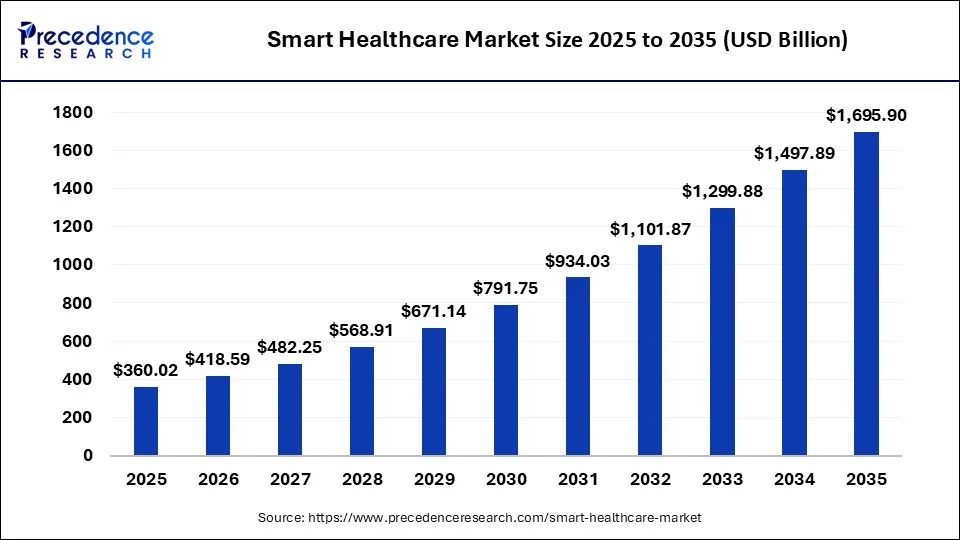
The global smart healthcare market is projected to grow from USD 360.02 billion in 2025 to USD 1,695.90 billion by 2035, registering a CAGR of 16.76%. Growth is driven by the increasing adoption of telemedicine, remote patient monitoring, AI-powered diagnostics, IoT-enabled healthcare solutions, wearable devices, and supportive government initiatives for healthcare digitalization. North America dominates the market due to its advanced healthcare infrastructure, widespread adoption of digital health technologies, and strong government support, while Asia Pacific is expected to witness the fastest growth, fueled by expanding healthcare infrastructure, rising healthcare investments, and rapid deployment of AI-based healthcare systems and telemedicine platforms.
Source: https://www.precedenceresearch.com/smart-healthcare-market
 Get a Sample
 Table Of Content


What is the Smart Healthcare Market Size?
The global smart Healthcare market size accounted for USD 360.02 billion in 2025 and is projected to reach USD 1,695.90 billion by 2035, growing at a CAGR of 16.76% between 2026 and 2035. The increased adoption of remote patient monitoring and telehealth solutions, along with government support and investments, drives the global smart healthcare market.
Market Highlights
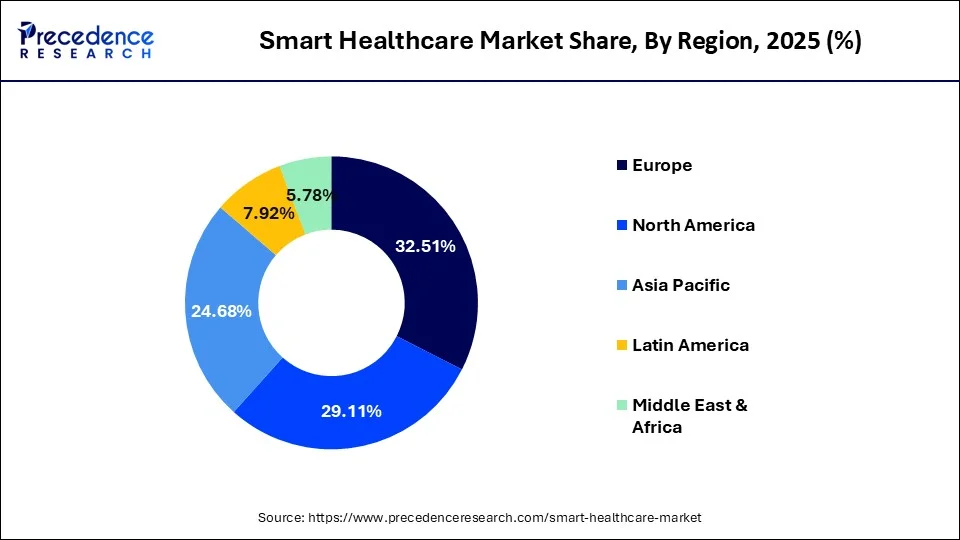
- North America held a market share of 17.18% in 2025
- Asia Pacific region is estimated to expand the fastest CAGR of 24.68% between 2026 to 2035
- By product, the telemedicine segment registered a maximum market share of 42.42% in 2025
Market Overview
The smart healthcare market comprises technologies and digital solutions that help healthcare providers deliver better patient care and improve operational efficiency. These solutions include telemedicine platforms, mobile health applications, wearable devices, electronic health records, and remote patient monitoring systems. Healthcare organizations are increasingly adopting smart technologies to enhance diagnosis, streamline workflows, and reduce treatment costs. Rising demand for connected healthcare services and growing use of artificial intelligence and Internet of Things technologies are contributing to the market expansion.
How Did AI Benefit the Smart Healthcare Market?
Healthcare artificial intelligence is revolutionizing medicine by improving diagnosis, treatment, and efficiency. It aids in disease detection by interpreting medical images and analyzing patient data, thus facilitating the formulation of personalized treatment plans. It optimizes workflows by taking away administrative burdens and streamlining clinical operations so that one can have cost-effective remedial approaches toward patient care, including remote monitoring, risk alerting, and virtual assistance. AI speeds up drug discovery, cutting drug development costs and introducing innovations that lead to cost reduction and improved outcomes for the healthcare network.
Smart Healthcare Market Growth Factors
- The rising prevalence of chronic diseases such as diabetes, cancer, heart disease, and an ageing population is increasing demand for continuous patient monitoring and advanced healthcare technologies.
- The growing adoption of telemedicine, remote patient monitoring systems, and mobile health applications such as mHealth is improving healthcare accessibility and encouraging wider acceptance of digital healthcare services.
- The rapid advancement in artificial intelligence (AI), cloud computing, and the Internet of Things is reshaping how healthcare services are delivered. This evolution enhances patient outcomes, streamlines operations, and reduces costs.
- Increasing healthcare spending and government initiatives aimed at healthcare digitalization are encouraging rapid adoption of connected and intelligent healthcare systems.
- Rising use of wearable devices and personalised healthcare solutions is further contributing to the smart healthcare market growth.
Market Outlook
- Industry Growth Overview: The smart healthcare industry is experiencing significant growth due to rapid digital transformation and technological advancements. With the increased chronic disease prevalence and ageing population are the major adapters of smart healthcare infrastructure. Supportive government policies and significant investments in healthcare infrastructure and innovative technologies are further boosting this industrial growth.
- Sustainability Trends: The smart healthcare industry had saw a significant shift towards sustainability driven by the rising environmental concerns and increasing healthcare demands. Manufacturing companies are focusing on innovating biodegradable and recyclable materials for the production of eco-friendly and sustainable medical devices. The spectacular surge of energy-efficient infrastructure, sustainable medical materials, green manufacturing practices, circular economy principles, and AI adoption is solidifying sustainability efforts in the industry.
- Global Expansion: The smart healthcare industry is expanding rapidly in emerging regions, including Latin America and the Middle East & Africa, due to an increased focus on technological advancements and increased demand for patient-centric care. Governments of these regions are investing heavily in supporting digital health deployments to provide affordable smart healthcare and patient-centric services. These efforts are expanding healthcare expenditure across emerging economies.
Strategic Growth Opportunities
- High Growth Commercial Opportunities: The massive commercialization of IoT and AI in the medical sector is conducive to the modernization of therapies and infrastructure advancement. The strong tech engagements across the smart industries are connecting hospital systems, doctors and patients, which broadens the smart perspective in the product and system commercialization spectrum. The rising sales of smartwatches and fitness bans promotes close monitoring, sponsoring wrist innovation. The wearable devices are the joint wellness idea of the healthcare providers and patients to meet real-time healthcare needs. The digitization registration sponsored by the tech rollouts is paving the way for tech leaders to elevate their expertise in the patient admission and discharge space.
- Emerging Technology Opportunities: The technologies are highly integrated for commercial purposes, featuring systems and infrastructure advocacy to comply with the medical technical needs. The smart programs and connected devices underscore massive tech scope to continue with the tech-influenced product sales. The fascinating automation and robotics goals in the medical packaging space are allowing for the fastest delivery of components and innovations that serves to the personalized drugs and other advanced therapy needs. The consistency with the modernization goals is accomplished with smart pathways to the drug discovery and development space that justify tech interference in research and development.
- Geographic Expansion Opportunities: The regional market is accelerating with the existing medical dynamics supporting doctors' and patients' high-end needs for wellness perfection. Mobile health and modernized robotics are the assistance to the medical settings. This automation expansion allows the regional responsible science and medical industries to meet smart discoveries.
Future Outlook and Strategic Recommendations
- Long-term Industry Outlook: The virtualization and display industries are the next-generation long-term goal for market innovation strategies. High-performance sensors and AI tools are promising high-end responsibility and tech delivery to the market space. The home care culture is steadily expanding the role and development of virtual expertise to soon rule the vast medical domain.
- Emerging Business Models: The growing application expansion is ultimately reframing the business models in tech, component, packaging and formulation processes. Best-in-class hardware as a service and software as a service are transforming the market dynamics. The popular subscription-based models are stimulating the monitoring businesses, whereas digital technology is making space for the combatting infrastructure to service innovation. The startups and valuable transformation to smart awareness strategies are sharpening the future of the market.
Market Scope
| Report Highlights | Details |
| Market Size in 2025 | USD 360.02 Billion |
| Market Size in 2026 | USD 418.59 Billion |
| Market Size in 2035 | USD 1,695.90 Billion |
| Growth Rate from 2026 to 2035 | CAGR of 16.76% |
| Fastest Growing Market | Asia Pacific |
| Base Year | 2025 |
| Forecast Period | 2026 to 2035 |
| Segments Covered | Product Type, and Region |
| Regions Covered | North America, Europe, Asia-Pacific, Latin America, and Middle East & Africa |
Market Dynamics
Drivers
Chronic Diseases and Aging Population
The increasing number of diseases like diabetes, cardiovascular diseases, and cancer is driving an urgent need for efficient and proactive healthcare solutions. These require constant monitoring and have different treatment plans being laid down for every individual-personal approach that smart health technology provides efficiently. Besides that, another big fuel for this growing demand is the worldwide aging population, as the elderly require patient monitoring at a distance, together with personal healthcare management on a specific plan to keep up with the current living platform, hence the need for smart healthcare.
Restraint
Issues Related to Data Privacy and Data Security
The wide-scale implementation of any smart healthcare technologies implies this great collection, wireless connectivity, and big data concept, thus raising concerns about data privacy and security. Patients and healthcare providers often consider breaches or unauthorized access to or misuse of their sensitive health information as grave threats. Such factors may pose resistance to and delay in developing and implementing smart healthcare solutions, because ensuring data protection, along with compliance with different regulations, is a difficult matter but is crucial for maintaining trust and upholding the confidentiality of patients.
Opportunity
Robotic Surgery
Robotic surgery is a key growth area within smart healthcare, with systems providing improvements in precision and control in minimally invasive interventions. It has decreased the risks of surgery and hence lowers recovery times and fosters better results for patients. There is always potential for improvements within robotics and AI integration, thereby enabling surgical procedures to be made safer and more efficacious to a greater extent, and enabling their applicability in many other specialty areas as well. With rising acceptance, robotic surgery is poised to revolutionize operative care and offer a notable competitive edge for healthcare providers.
Segments Insights
Product Type Insights
Which Product Type Segment Dominated the Smart Healthcare Market?
The telemedicine segment held a dominant position in the market in 2025, due to the growing demand for remote healthcare services and improved patient accessibility. Telemedicine is often integrated into a broader health tech ecosystem, working alongside electronic health records (EHRs), data analytics, and other smart healthcare solutions. This integration enhances overall healthcare efficiency and data-driven decision-making. Hospitals and healthcare providers are adopting telemedicine solutions to reduce costs and enhance patient management. Rising prevalence of chronic diseases and continuous improvements in internet connectivity and digital infrastructure are expected to further support the expansion of this segment.
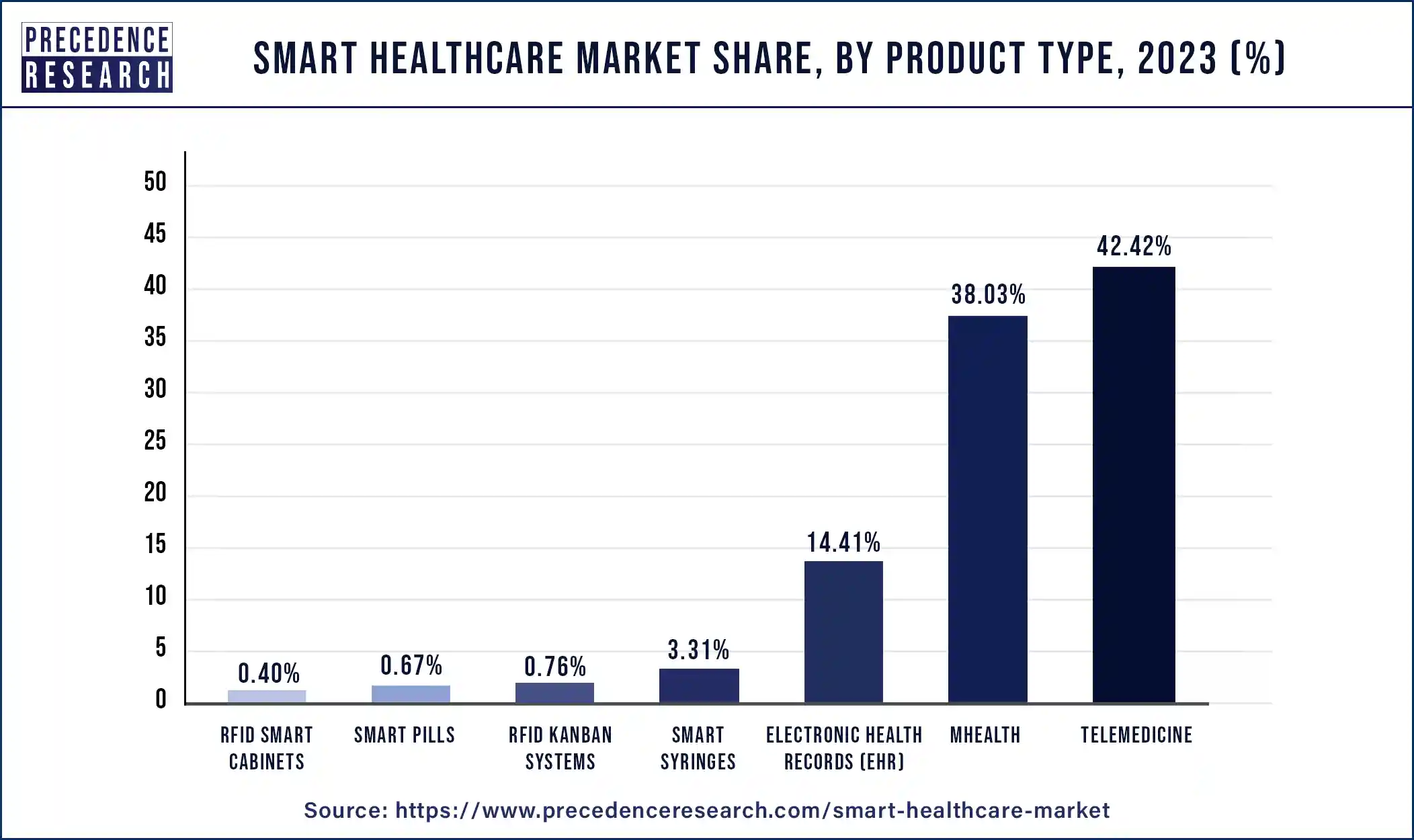
The mHealth segment is expected to grow at the fastest CAGR during the studied period, due to the widespread use of smartphones, wearable devices, and health-related mobile applications. Wearable devices and sensors connected to mobile apps facilitate real-time monitoring, leading to better management of health conditions and reduced hospitalisation. Consumers are increasingly relying on mobile platforms for fitness tracking, medication reminders, chronic disease management, and health monitoring. Growing awareness regarding preventive healthcare and rising demand for personalized health services are contributing to the segment expansion.
Smart Healthcare Market Revenue, By Product Type, 2023-2025 (USD Million)
| By Product | 2023 | 2024 | 2025 |
| RFID Kanban systems | 1,975.4 | 2,428.4 | 2,979.1 |
| RFID Smart Cabinets | 1,032.0 | 1,152.5 | 1,283.7 |
| Electronic Health Records (EHR) | 37,342.0 | 39,358.4 | 41,680.6 |
| Telemedicine | 1,09,916.7 | 1,39,044.6 | 1,73,027.1 |
| mHealth | 98,563.8 | 1,13,545.0 | 1,28,526.3 |
| Smart Pills | 1,746.8 | 1,951.5 | 2,199.4 |
| Smart Syringes | 8,566.3 | 9,385.2 | 10,327.3 |
Regional Insights
What Factors Made North America the Dominant Region in the Smart Healthcare Market?
North America held a major market share in 2025, due to its widespread adoption of digital health technologies, strong healthcare infrastructure, and high spending on connected medical devices. The region has supportive government policies for digital health deployment, and the accessibility of high-digital-literacy resources further strengthens regional growth. The presence of major technology companies and healthcare providers has made the region a key center for smart healthcare development. In addition, the successful adoption of e-prescription systems and Electronic Health Records (EHR) in different healthcare centres is driving regional market development.
U.S. Smart Healthcare Market Size in the 2026 to 2035
The U.S. smart healthcare market size is estimated at USD 80.86 billion in 2025 and is predicted to be worth around USD 307.6 billion by 2035, at a CAGR of 14.29% from 2026 to 2035
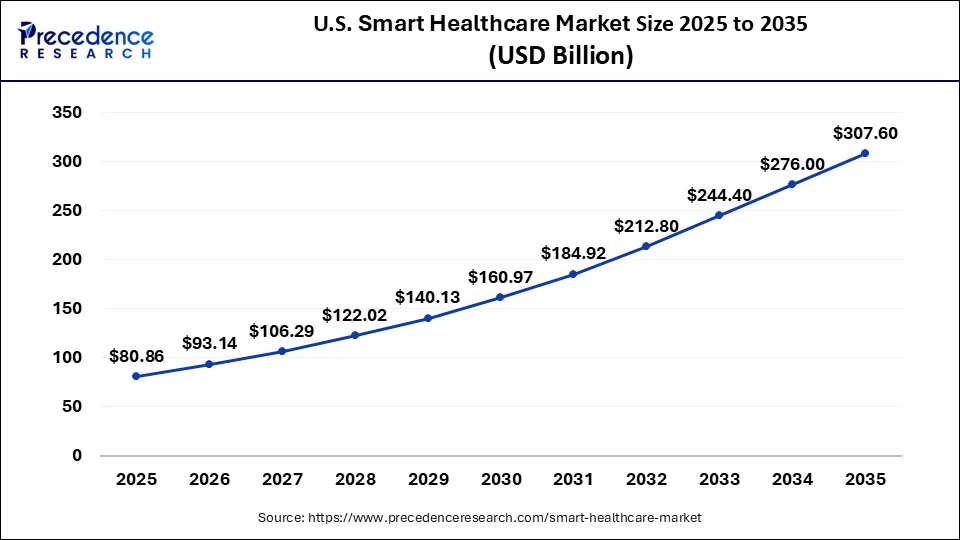
The U.S. market is driven by advanced healthcare facilities and the rapid integration of digital solutions. The strong presence of key market players and government support make the U.S. an early adopter of innovative technologies like EHRs and telemedicine devices. The government has introduced various supportive regulations and policies, such as the FDA's digital health center for excellence, which encourage the research and adoption of smart healthcare technologies across the country.
Which Factors Influence the Fastest Growth of the Asia-Pacific Smart Healthcare Market?
Asia-Pacific is expected to experience the fastest growth during the predicted timeframe. The growth is fueled by expanding healthcare infrastructure and rising healthcare expenditure. Countries across the region, including China, India, Japan, and South Korea, are investing heavily in telemedicine and AI-based healthcare systems. The government of Asia is focusing on the implementation of EHR and data interoperability for centralizing patient data and enhancing care coordination. Government initiatives, including India's Ayushman Bharat digital mission and Singapore's one citizen, one record project, are stepping toward a paperless healthcare system.
China Market Trends
The Chinese market is growing due to significant government support for healthcare modernization and digital transformation. Rapid expansion of telemedicine platforms, increasing use of AI in diagnostics, and strong investments in healthcare technologies are driving the growth of the smart healthcare market in China. Government initiatives like the ‘Healthy China to 2030' plan promote integration in healthcare of advanced technologies like digital health solutions and innovations.
India's Pharmaceutical Exports to Top 10 Countries
| Rank | Country | 2023-2024 |
| 1 | U.S.A | 8731.3 |
| 2 | U.K. | 784.33 |
| 3 | Brazil | 655.64 |
| 4 | France | 667.53 |
| 5 | South Africa | 718.54 |
| 6 | Canada | 502.42 |
| 7 | Netherlands | 699.27 |
| 8 | Germany | 567.42 |
| 9 | Russia | 518.47 |
| 10 | Nigeria | 508.12 |
India's pharmaceutical exports has reached USD 30,466.85 million during the period April-May 2025, that has marked 9.40% development form the last developing year. The drug formulations and biologicals has dominated with USD 22,928.83million as it counts 75% of total exports ,which is being followed by Bulk Drugs of amount USD 4, 869.98 million and the vaccines up to USD 1,222.40 million. India has shows rigid leadership in solving infectious diseases like HIV and tuberculosis that has merged with organizations like as the Global Fund and have USD25 million for its Seventh Replenishment. The country has opposed its strategic position as an main exporter of reliable and quality medicines that has pharmaceutical exports who has reached USD 30,4666.85 million in 2025.
Which Factors Made Europe a Significantly Growing Region in the Smart Healthcare Market?
Europe is expected to grow at a considerable CAGR in the upcoming period in the smart healthcare market. The growth is supported by increasing digital transformation across healthcare systems. The rising elderly populations, growing demand for personalized medicine, and government-backed e-health initiatives are encouraging adoption. Countries across the region, such as Germany and the UK, are investing in connected healthcare infrastructure and telemedicine services. Strong regulatory frameworks and collaborations between technology providers and health institutions are promoting innovation and making Europe region grow in the market.
Germany Market Trends
Germany leads the European market due to its highly developed healthcare sector and strong emphasis on digitalization. Government programs aimed at expanding electronic health records (EHR) and telemedicine services have accelerated market growth. Increasing investment in healthcare IT and growing demand for advanced diagnostic technologies and connected devices are further supporting the adoption of smart healthcare solutions. With the strong existence of the medtech industry, Germany is expected to enhance its access to digital solutions in both hospital-based smart healthcare and home care-based services.
How is Latin America Growing in the Smart Healthcare Market?
Latin America is considered to be a significantly growing area, due to increasing investment in healthcare digitalization and improving access to medical services. Governments across the region are implementing initiatives to modernize healthcare infrastructure and improve care delivery. Countries such as Brazil, Chile, Argentina, and Colombia are increasingly adopting telemedicine and remote monitoring technologies, which further support the market growth. The rising prevalence of chronic disease, expanding internet connectivity, and increasing awareness of digital health solutions are contributing to the growth of Latin America in the market.
Brazil Market Trends
Brazil accounts for the largest share of the Latin American market, due to its expanding healthcare infrastructure, improving access to medical services, and increasing adoption of digital technologies. The government's efforts aimed at enhancing healthcare infrastructure and expanding digital health services are fueling the adoption of smart healthcare. Growing awareness regarding remote patient monitoring and increasing demand for efficient healthcare delivery systems continue to strengthen the country's position in the market.
Will the Middle East and Africa Grow in the Smart Healthcare Market?
The Middle East and Africa are expected to grow at a considerable CAGR in the upcoming period, driven by rising healthcare expenditure and ongoing modernizations of healthcare systems. The increasing adoption of telemedicine platforms, connected medical devices, and AI-based healthcare solutions is enhancing patient care across the region. Government initiatives like supportive policies and investments and digital health infrastructure, including the UAE's Vision 2071 and Saudi Arabia's Vision 2030, contribute to this growth. Growing demand for advanced healthcare services and increasing focus on preventive care continue to support market expansion in the region.
Saudi Arabia Market Trends
The Saudi Arabian is growing due to government investments in healthcare modernization and digital transformation. Government programs under Vision 2030 are encouraging the adoption of advanced medical technologies and connected healthcare systems. The country's focus on expanding digital health platforms, integration of AI in diagnostics, and virtual care is fueling the growth of the market. Increasing healthcare expenditure, improving infrastructure, and a strong focus on enhancing patient care are further supporting the country's growth in the market.
Smart Healthcare Market - Value Chain Analysis
- R&D – the research and development plays a crucial role in smart healthcare due to its strong innovation and advancement activities. The adoption of innovative technologies like daily medicine, wearable and IoT devices, personalized medicine, and insights of health data analytics makes R&D facilitate smart healthcare.
- Clinical Trials and Regulatory Approvals – the smart healthcare sector involves several clinical trials and regulatory approval processes for novel technologies and medications, including digital health technologies, medical devices, and data protection.
- Formulation and Final Dosage Preparation – the smart healthcare undergoes a significant formulation and final dose preparation process for defining product development, personalization, and technological integration. This process helps to optimize efficacy, safety, stability, and patient complaints.
- Distribution to Hospitals, Pharmacies – the distribution to hospitals and pharmacies crucial process for ensuring the medical products and devices reach their end users efficiently and effectively. Distribution channels like direct hospital, wholesalers and distributors, and pharmacy chains are the main smart healthcare infrastructure.
- Patient Support and Services – there are several components in smart healthcare require patient support and services to enable seamless delivery and adoption of advanced solutions. Technical Support, clinical support, and patient support a crucial players in this sector.
Competitive Landscape
The smart healthcare market is highly competitive, with leading companies focusing on digital innovation, connected devices, and integrated healthcare platforms. Major participants are expanding their portfolio through partnerships, acquisitions, and investments in artificial intelligence, cloud computing, and remote patient monitoring technologies. Companies are strengthening their market position by continuous advancement in mobile health applications and personalized medicine solutions. For sustained growth in the smart healthcare market, companies should prioritize AI-enabled healthcare services, interoperability, and affordable digital solutions.
Top Companies in the Smart Healthcare Market & Their Offerings:
Tier 1 Companies
- Allscripts – Specialized in offering cloud-based software platforms like EHR and Veradigm, population health management, patient engagement, telehealth, and interoperability.
- Logi-Tag Systems – Specialized in smart label and RFID solutions, and offers comprehensive smart healthcare
- solutions with a strong focus on asset and inventory management, including RFID and NFC tags and supply chain optimization.
- Cerner Corporation has been integrating Oracle Health's portfolios since its acquisition by Oracle, fueling its expertise in cloud-based analytics and AI technologies.
- SAMSUNG – Offering sophisticated wearable devices, remote care, digital diagnostics, digital health infrastructure, and secure mobile platforms for hospitals, care providers, and patients.
- Cisco Systems – creating a secure and connected network infrastructure for small hospitals, including cloud management networks, smart space solutions, collaborative tools, and indoor wayfinding.
- GENERAL ELECTRIC COMPANY – Provide cutting-edge medical technologies and AI-enabled applications, such as AI-driven analytics, patient monitoring, smart workflow & dose management, and medical imaging and diagnostics.
Tier 2 Companies
- Siemens Healthcare Private Limited
- IBM Corporation
- BD
- AirStrip
- Terumo Corporation
- eClinicalWorksResideo Technologies, Inc.
- STANLEY Healthcare
- Medtronic
Smart Healthcare Market Companies
- Allscripts
- Logi-Tag Systems
- Cerner Corporation
- SAMSUNG
- Cisco Systems
- GENERAL ELECTRIC COMPANY
- Siemens Healthcare Private Limited
- IBM Corporation
- BD
- AirStrip
- Terumo Corporation
- eClinicalWorksResideo Technologies, Inc.
- STANLEY Healthcare
- Medtronic
Recent Developments & Innovations in the Smart Healthcare Industry
- In May 2026, OURA announced the launch of Oura Ring 5, the smallest smart ring in the world. It is designed with lightweight, non-allergenic titanium delivering advanced health sensing and insights in a more comfortable and compact form. Oura 5 ring combines innovative hardware with new software that works beyond tracking to action, such as spanning preventive health, metabolic insights, live activities, and more.
- In March 2026, Trivitron Healthcare launched Kiran Smart Track, an intelligent application designed to monitor radiation protection apparel used in healthcare settings. The application allows users to get comprehensive product details by simply scanning the QR code integrated into each radiation protection garment. The app includes capabilities like immediate quality evaluations, real-time shelf life tracking, and detailed product insights within a single interface.
- In May 2025, Oracle Health partnered with the Cleveland Clinic and G42 for the development of a comprehensive AI-driven healthcare delivery platform to enhance patient care and public health management. This platform is leverages AI, intelligent clinical applications, and nation-scale data analytics for creating secure, accessible, and scalable care models to positively impact on health and longevity of people.
- In March 2025, Samsung Electronics launched the ‘smart home health initiative' in collaboration with Florida State University (FSU). This announcement was made by Samsung Electronics' North American subsidiary and the FSU's College of Nursing and Digital Health Innovation Research Institute.
Segments Covered in the Report
By Product Type
- RFID Kanban Systems
- RFID Smart Cabinets
- Electronic Health Records (EHR)
- Telemedicine
- mHealth
- Smart Pills
- Smart Syringes
By Region
- North America
- Europe
- Asia-Pacific
- Latin America
- The Middle East and Africa
For inquiries regarding discounts, bulk purchases, or customization requests, please contact us at sales@precedenceresearch.com
Frequently Asked Questions
Tags





Ask For Sample
No cookie-cutter, only authentic analysis – take the 1st step to become a Precedence Research client
 Get a Sample
.webp)



 sales@precedenceresearch.com
 Schedule a Meeting
