



Aerospace Composite Market Size, Share and Trends 2026 to 2035
Aerospace Composite Market (By Fiber Type: Glass Fiber, Carbon Fiber, Aramid Fiber, Other Fiber Types; By Manufacturing Process: ATL or AFP, Filament Winding, Resin Transfer Molding, Hand Layup, Other; By Aircraft: Commercial Aircraft, Business and General Aviation, Civil Helicopter, Other) - Global Industry Analysis, Size, Trends, Leading Companies, Regional Outlook, and Forecast 2026 to 2035
Source: https://www.precedenceresearch.com/aerospace-composite-market
 Get a Sample
 Table Of Content


What is the Aerospace Composite Market Size?
The global aerospace composite market size accounted for USD 41.61 billion in 2025 and is predicted to increase from USD 46.40 billion in 2026 to approximately USD 119.15 billion by 2035, expanding at a CAGR of 11.09% from 2026 to 2035.
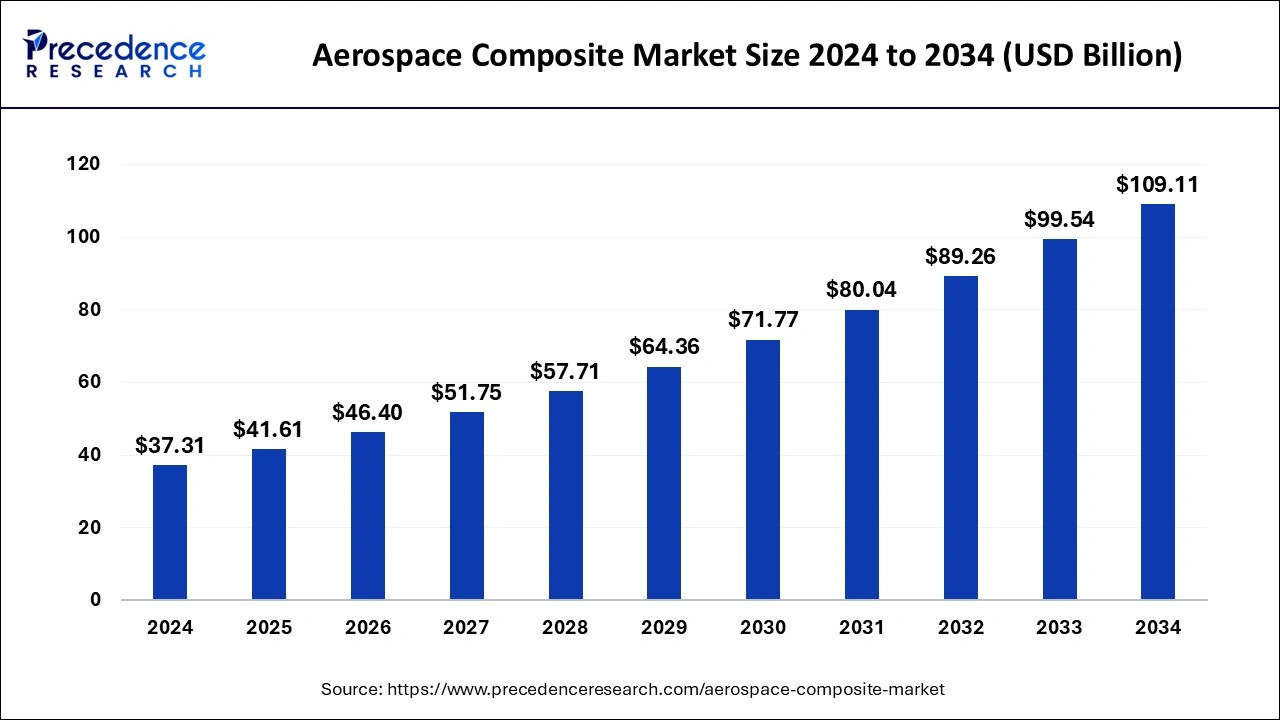
Aerospace Composite Market Key Takeaways
- The global aerospace composite market was valued at USD 41.61 billion in 2025.
- It is projected to reach USD 119.15 billion by 2035.
- The market is expected to grow at a CAGR of 11.09% from 2026 to 2035.
- North America held the dominant share of the aerospace composite market in 2025.
- Asia Pacific is observed to expand at a rapid pace during the forecast period.
- By fiber type, the carbon fiber segment accounted for the dominating share of the market in 2025.
- By fiber type, the aramid fiber segment is expected to witness significant growth during the forecast period.
- By manufacturing process, the ATL or AFP segment held the largest segment of the market in 2025 and is expected to sustain the position throughout the forecast period.
- By manufacturing process, the resin transfer molding segment is expected to grow significantly during the forecast period.
- By aircraft, the commercial aircraft segment accounted for the dominating share of the market in 2025 and is projected to continue its dominance over the forecast period.
- By aircraft, the business & general aviation segment is expected to witness considerable growth in the market over the forecast period.
Market Overview
Aerospace science is rapidly turning to composite materials due to their high strength, low weight, low electrical conductivity, and durability, which makes them well-suited for aircraft construction. Composites are increasingly becoming popular in the aerospace industry due to their utilization in important structural elements, including fuselage sections, wings, and tail structures. Composites offer an exceptional strength-to-weight ratio, which ensures a reduction in overall weight and upholds structural robustness under harsh conditions.
Composite materials offer several benefits in aircraft applications when compared to traditional materials such as metals. Composite materials are versatile as their physical and mechanical properties can often be customized for application by adjusting the composition of the specific material. Composite uses provide more options for the design geometry of aircraft structures as they are ideal for compound curves and organic shapes, including wheel fairings, engine cowlings, and wing tips.
How AI in Aerospace Composites: Smart Materials, Smarter Manufacturing
Artificial Intelligence (AI) in the aerospace composite industry can significantly impact the design, manufacturing, and quality control of composite materials. AI can help in the prediction of composite materials, reduce defects, and increase the rate of production. Machine learning can be used to improve composite layup planning, which can help in cutting down waste and increasing the strength of the composite materials.
With the increasing need to make aeroplanes lighter, AI can significantly impact the future of innovation in the aerospace industry.
Aerospace Composite Market Growth Factors
- High-temperature stability, coupled with reduced weight and high strength, is likely to promote the growth of the aerospace composite market in the upcoming years.
- The rise in the partnerships between manufacturers and government investment in aerospace infrastructures increases the use of aerospace composites, which is expected to accelerate the growth of the aerospace composite market.
- Increasing investment in the aerospace sector coupled with improving gasoline efficiency is expected to boost the demand for the aerospace composite market during the forecast period.
- The demand for the aerospace composite market is primarily driven by increased stiffness, reduced weight, increased strength, longer lifespan, better corrosion resistance properties, and reduced tooling and assembly costs.
- The rapid advancement in aerospace technology and innovation is expected to fuel the market growth.
Market Scope
| Report Coverage | Details |
| Growth Rate from 2026 to 2035 | CAGR of 11.09% |
| Market Size in 2025 | USD 46.40 Billion |
| Market Size in 2026 | USD 37.31 Billion |
| Market Size by 2035 | USD 119.15 Billion |
| Largest Market | North America |
| Base Year | 2025 |
| Forecast Period | 2026 to 2035 |
| Segments Covered | Fiber Type, Manufacturing Process, and Aircraft |
| Regions Covered | North America, Europe, Asia-Pacific, Latin America, and Middle East & Africa |
Market Dynamics
Driver
Rising application of composites in aerospace
The increasing application of composites in aerospace is expected to boost the growth of the aerospace composite market during the forecast period. Composite materials are widely used in aerospace applications, including engine blades, brackets, nacelles, interiors, wide-body wings, single aisle wings, and others. Composites offer versatility, which makes them used for both structural applications and components in almost all aircraft and spacecraft. Components, including fan blades and casing materials, are increasingly constructed from composites owing to their excellent capacity to withstand extreme temperatures while maintaining structural integrity.
The successful application of composites in missiles has substantially increased the development of primary structures for space vehicles. Moreover, factors such as lightweight, high temperature and chemical resistance, high dimensional stability, stiffness, and improved performance made this material popular in various aerospace components and structural applications. Therefore, the use of composites in aerospace enhances engine efficiency and contributes significantly to the reduction of overall aircraft weight.
- According to the data provided by the Boeing Commercial Market Outlook 2021-2040, North America will require 9,160 new airplane deliveries by the end of 2040, and airline fleet growth in North America is expected to be 1.7 percent between 2019 and 2040.
Restraint
High cost of ceramic matrix composites
The high cost associated with composite materials in aerospace is anticipated to hamper the growth of the market. High cost is required for the production of composite materials in the aerospace sector due to the expensive raw materials, including advanced carbon or glass and epoxy resin, which may restrict the expansion of the global aerospace composite market during the forecast period.
Opportunity
Rapid advancements in technology
The rapid advancements in technology are projected to offer a lucrative opportunity for the growth of the aerospace composite market during the forecast period. The continuous technological advancements in components and structural applications in airplanes increase the use of composites instead of conventional materials such as aluminum. In recent years, the significant rise in passenger traffic and the stringent emission regulations led to a surging demand for new-generation aircraft. Manufacturers are developing new aircraft models in the military, commercial, and general aviation sectors, which require efficient engines with improved performance and low-weight material. Additionally, several Governments around the world are promoting the use of lightweight materials to enhance gasoline efficiency, boost plane performance, and reduce gas consumption. Thereby driving the market's growth.
- In April 2024, in research that may lead to next-generation airplanes and spacecraft, MIT engineers used carbon nanotubes to prevent cracking in multilayered composites. To save on fuel and reduce aircraft emissions, engineers are looking to build lighter, stronger airplanes out of advanced composites. These engineered materials are made from high-performance fibers that are embedded in polymer sheets. The sheets can be stacked and pressed into one multilayered material and made into extremely lightweight and durable structures.
Segment Insights
Fiber Type Insights
The carbon fiber segment accounted for the dominating share of the aerospace composite market in 2025. Carbon fiber plays a vital role in the aviation and aerospace sectors due to its special properties, such as high stiffness, high strength, low density, lightweight, high-temperature capability, and moderate pricing compared to glass and aramid fibers. Carbon fiber is one of the most recognized types of fiber reinforcement globally. Carbon fiber can be derived from three polymer precursors: polyacrylonitrile (PAN), pitch, and rayon.
The aramid fiber segment is expected to witness significant growth in the aerospace composite market during the forecast period, owing to the increasing use of lightweight and durable components for aircraft interiors. Aramid-based composites are widely used for components that are subjected to high stress, for instance, the construction of gliders.
Manufacturing Process Insights
The ATL or AFP segment held the largest segment of the aerospace composite market in 2025 and is expected to sustain the position throughout the forecast period. ATP and AFP are advanced manufacturing techniques reshaping the production of composite structures. ATL and AFP have become critical to the aviation and space industries. Automated tape placement (ATP) and automated fiber placement (AFP) are most commonly used in the aerospace industry to manufacture components, including aircraft skins and wing panels. Aerospace designs often involve complex geometries and shapes. The use of ATL and AFP systems allows for intricate patterns, enabling the creation of components with sophisticated designs that would be quite challenging to achieve manually.
- In March 2021, Mikrosam completed the installation of a custom-made prepreg tape slitting and tow-rewinding machine at the National Institute for Aviation Research (NIAR) at Wichita State University in the USA. It will be used for research into composite prepregs by NIAR's Advanced Technologies Laboratory for Aerospace Systems (ATLAS), a multi-disciplinary manufacturing environment.
In the aerospace composite market, the resin transfer molding segment is expected to grow significantly during the forecast period. The growth of the segment is majorly driven by the growing use of injection molding for producing complex aerospace components.
Aircraft Insights
The commercial aircraft segment accounted for the dominating share of the aerospace composite market in 2025 and is projected to continue its dominance over the forecast period. Commercial aircraft extensively use feature composite materials for the construction of wing structures, which include carbon-fiber-reinforced composites, as they offer high strength and stiffness.
The growth of the segment is also driven by the adoption of composites for fuel efficiency and lower greenhouse gas emissions in aerospace. Aerospace composites are often used for multiple interior components of commercial aircraft, such as panels, partitions, and overhead. Therefore, the use of composites reduces weight and allows for creative design, which results in a comfortable and pleasing experience for passengers.
The business & general aviation segment is expected to witness considerable growth in the aerospace composite market over the forecast period owing to the increasing focus on fuel efficiency. The use of composites in business and general aviation makes them highly impact-resistant, with thermal stability and damage tolerance. The strength, resilience, and lightweight properties allow for the unique demands of aerospace applications. In addition, the imposition of environmental regulations increases the adoption of aerospace composites for emission reductions, pushing for lighter and more efficient designs.
Regional Insights
North America held the dominant share of the aerospace composite market in 2025. The region is observed to witness prolific growth during the forecast period. The region's growth is attributed to the presence of prominent aviation market players, rapid advancement in technology, increasing applications for composites, the emergence of 3D printing, rising government investment in the aerospace industry, and growing demand for lightweight material or fuel efficiency in aerospace. Thereby dominating the market in North America.
The U.S. is a leading market in aerospace technology and highly relies on aerospace composites. The country has the largest aerospace industry in the world and is also one of the largest exporters of commercial aircraft. Aerospace composites are widely used in aircraft and spacecraft applications. Aerospace composites offer excessive strength-to-weight ratio and high-quality standards of aerospace composite materials, as well as flexibility in designing, manufacturing, and testing aerospace composite structures. Several market players have adopted marketing strategies such as new product launches, collaborations, and expansions to maintain their market share and gain a competitive edge.
- In 2022, A&D exports rose by 4.4 percent to a total of $104.8 billion. The leading destinations for U.S. A&D exports in 2022 were Canada, France, Germany, the United Kingdom, and Brazil. A&D imports declined to $27.5 billion, with top countries of origin including France, Canada, the United Kingdom, and Japan.
- In February 2024, Firefly Aerospace Inc. (Cedar Park, Texas, U.S.) held an official ribbon cutting in celebration of the company's Rocket Ranch expansion in Briggs, Texas. Firefly more than doubled the size of its manufacturing facilities, added two new test stands, and installed state-of-the-art machinery to support the production of Northrop Grumman's (Falls Church, Va., U.S.) Antares 330 and the medium launch vehicle (MLV) are co-developing together, leveraging Firefly's composite technologies.
- The United States has the largest aerospace industry in the world. According to the Federal Aviation Administration (FAA), With an estimated 2.9 million passengers boarding more than 45,000 flights daily in the U.S.
Asia Pacific is observed to expand at a rapid pace during the forecast period. The increasing government investment in the aerospace sector, rising demand for fuel-efficient aircraft engines, and increasing demand for aerospace composites across various applications. Additionally, the adoption of advanced technology and sustainability goals aligns with the benefits offered by aerospace composites, which is expected to propel the demand for the aerospace composite market in the region.
Among all countries, China is one of the largest aerospace composites producers and consumers in the region and is likely to fuel the market's revenue with its robust growth in domestic aircraft production.
- In January 2024, Tata Advanced Systems Ltd. (TASL) collaborated with Boeing to manufacture advanced composite assemblies. Tata Advanced Systems Ltd. (TASL), a wholly owned subsidiary of Tata Sons, announced it has signed a contract with Boeing Commercial Aeroplanes (BCA) to manufacture and supply advanced composite assemblies for the Boeing 737 MAX, 777X, and 787 Dreamliner.
- In January 2024, Indian Prime Minister Narendra Modi inaugurated in Bengaluru Boeing's largest aerospace engineering facility outside the United States. The state-of-the-art Boeing India Engineering and Technology Center (BIETC) was built with an investment of ?1,600 crore. It is located on a 43-acre campus and is the largest American aerospace major's investment outside the U.S. Boeing stated that the BIETC will become a cornerstone for partnering with India on next-generation products and services for the global aerospace and defense industry.
Europe: Strong Aerospace Innovation Hub
Europe's aerospace composite market is growing in the aerospace sector because aircraft companies are increasingly using composites to reduce fuel consumption and emissions. Engineering, collaborative research, and environmental regulations support the adoption of advanced composites. Germany and France stand out as leaders in composite production and aircraft programs.
Germany Aerospace Composite Market Trends
Germany's demand for aerospace composites is fueled by its strong engineering industry. Composites are used to manufacture structural components to enhance aircraft efficiency and reduce weight. At the same time, high production costs and rigorous certification requirements shape adoption patterns while sustainability and recyclability considerations become more prominent in material selection.
Latin America: Growing Aviation Materials Use
The Latin American aerospace composite market is growing steadily. The key driver of the Latin American market is Brazil and its aerospace industry and activities. The modernization of the defence forces and production of regional aircraft are driving the Latin American market for aerospace composites.
Middle East & Africa: Rising Demand for Modern Fleets
The Middle East & Africa aerospace composites market is growing due to increasing airline fleets and new aviation hubs. The Middle East & Africa market is also growing due to increasing defence activities. The Middle East & Africa market is heavily dependent on imports. The use of composites is increasing for both commercial and military aviation.
The UAE Aerospace Composite Market Trends
The UAE is growing its demand for aerospace composites for its increasing airline fleets and MRO facilities. The UAE is growing its aviation infrastructure and modernising its defence forces. At the same time, sustainability and regulatory focus on emissions reduction is encouraging adoption of advanced composites alongside efforts to localize production and strengthen supply chains.
Aerospace Composite Market Companies
- Bally Ribbon Mills
- Mitsubishi Chemical Carbon Fiber and Composites Inc.
- Toho Tenax Co., Ltd.
- Toray Industries Inc.
- SGL Carbon SE
- Hexcel Corporation
- Solvay SA
- DuPont
- Royal Ten Cate N.V.
- Materion Corp.
- Teijin Aramid B.V.
- Honeywell International Inc.
- DuPont
- Morgan Advanced Materials
- Barrday Inc.
- Plastic Reinforcement Fabrics Ltd
- Gaffco Ballistics
- M Cubed Technologies
- MKU Limited
- ArmorSource
- Elmon
- JPS Composite Materials
- ITT INC
Recent Developments
- In April 2023, Solvay and GKN Aerospace announced their plans to renew their collaboration agreement. The partnership aims at expanding the use of thermoplastic composite materials in aerospace structures. Solvay and GKN Aerospace have signed an extension to their 2017 collaboration agreement.
- In September 2024, Syensqo introduced AeroPaste 1003 aerospace adhesive. Syensqo (Alpharetta, Ga., U.S.) announced the launch of AeroPaste 1003, a new grade of its epoxy-based structural paste adhesives, which already includes AeroPaste 1006 and 1100. AeroPaste 1003 is designed for structural bonding of metallic and composite parts, rapid assembly, and repair applications and is suitable for out-of-autoclave.
- In February 2023, Toray Industries Inc. supplied the Japan Aerospace Exploration Agency's (JAXA, Tokyo) H3 launch vehicle - the successor to its H-IIA rocket - with Torayca carbon fiber and prepreg.
Segments Covered in the Report
By Fiber Type
- Glass Fiber
- Carbon Fiber
- Aramid Fiber
- Other Fiber Types
By Manufacturing Process
- ATL or AFP
- Filament Winding
- Resin Transfer Molding
- Hand Layup
- Other
By Aircraft
- Commercial Aircraft
- Business and General Aviation
- Civil Helicopter
- Other
By Geography
- North America
- Asia Pacific
- Europe
- Latin America
- Middle East & Africa
For inquiries regarding discounts, bulk purchases, or customization requests, please contact us at sales@precedenceresearch.com
Frequently Asked Questions
Tags





Ask For Sample
No cookie-cutter, only authentic analysis – take the 1st step to become a Precedence Research client
 Get a Sample




 sales@precedenceresearch.com
 Schedule a Meeting
