



Agricultural Haying and Forage Machinery Market Size, Share, Trends, Companies, and Forecast 2026-2035
Laxmi Narayan is a skilled market research analyst specializing in machinery and equipment. His research focuses on haying and forage equipment, balers, mowers, harvesting machinery, forage harvesters, and related agricultural technologies. His findings are valuable for machinery manufacturers, dealers, farmers, agricultural equipment suppliers, and other industry stakeholders and encourage them to significantly assess market trends, technology adoption, competitive developments, and growth opportunities.
Source: https://www.precedenceresearch.com/agricultural-haying-and-forage-machinery-market
 Get a Sample
 Table Of Content


Agricultural Haying and Forage Machinery Market Size and Forecast 2026 to 2035
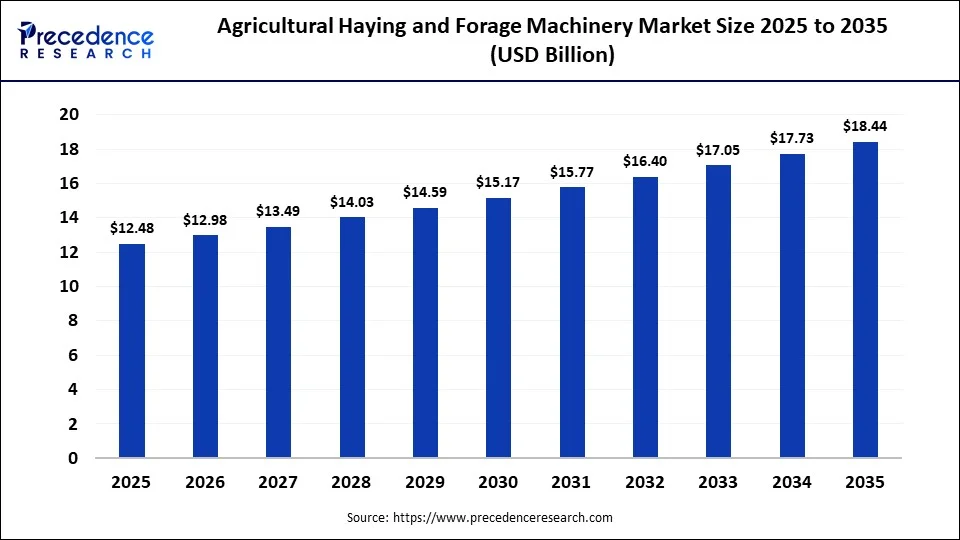
Laxmi Narayan has great experience in the machinery and equipment industry. He believes that the evolution of modern agriculture reflects the digital changes in logistics and software networks. The agricultural haying and forage machinery market is transforming from manual operations to automated, connected workflows. Digital farm platforms and ISOBUS-connected implements manage field mapping, moisture sensing, and precision baling with the help of a single dashboard. The global agricultural haying and forage machinery market is projected to reach USD 12.98 billion by 2026, with a CAGR of 3.98% from 2026 to 2035. This growth is driven by the increasing adoption of haying and forage equipment, benefiting sectors like dairy, livestock, and commercial hay production.
Key Takeaways
- AGCO generated approximately USD 10.1 billion in annual revenue in 2025, invested around USD 487.7 million in research and development, and operates a network of about 2,800 independent dealers and distributors across 140 countries.
- By machinery type, the mowers segment led the market with 29.35% market share in 2026.
- By operation type, the manual/semi-automatic segment dominated with 61.40% market share in 2026.
- By power source, the PTO-driven segment led with the largest share of 48.25% in 2026
- By application, the hay production segment dominated the market with 34.20% market share in 2026.
- By end user, the large farms segment led the market with 32.75% market share in 2026.
- By sales channel, the OEM sales segment dominated with 52.85% market share in 2026.
- North America held a major market share of 32.40% in 2026, while Asia-Pacific is expected to witness the fastest growth with a CAGR of 5.85% from 2026 to 2035.
Market Overview and Size
The global agricultural haying and forage machinery market is estimated at USD 12.98 billion in 2026 and is anticipated to witness a CAGR of 3.98% between 2026 and 2035. This market expansion is mainly stemming from the increasing adoption and use of haying and forage equipment, which supports the entire process, including cutting, conditioning, drying, collecting, baling, and harvesting forage crops, and creating a wide and growing customer base across dairy, livestock, and commercial hay production.
Key Insight: The agricultural haying and forage machinery market is poised for growth, valued at USD 12.98 billion in 2026 and projected to witness a CAGR of 3.98% between 2026 and 2035.
Which Companies Are Leading the Agricultural Haying and Forage Machinery Market?
| Company | Major Brands / Products | Competitive Position |
| John Deere | Balers, mowers, forage harvesters | Global leader |
| AGCO | Fendt, Massey Ferguson | Major global competitor |
| CNH Industrial | New Holland, Case IH | Full-line competitor |
| CLAAS | JAGUAR forage harvesters, balers | Forage technology leader |
| Krone | BiG X, BiG Pack, EasyCut | Forage specialist |
| Kubota | Mowers, balers, hay tools | Strong diversified player |
| KUHN Group | Mowers, tedders, rakes, balers | Specialist leader |
| Vermeer | Balers and forage equipment | Specialist player |
| Farm King | Hay and forage equipment | Regional specialist |
| Yanmar | Agricultural machinery | Diversified competitor |
| Iseki | Agricultural machinery | Regional competitor |
| Mahindra & Mahindra | Agricultural equipment | Emerging-market scale |
| SDF Group | Agricultural machinery | European competitor |
| Kverneland | Implements and hay equipment | Technology competitor |
| Great Plains | Agricultural implements | Specialized competitor |
The competitive landscape mainly comprises global agricultural equipment manufacturers and specialist forage machinery companies. Among these 15 major competitors, John Deere holds global dominance by offering balers, mowers, and forage harvesters, followed by AGCO and CNH Industrial with Fendt, Massey, and Ferguson, and New Holland, respectively. CLAAS, Krone, and Farm King are mainly known for forage-related harvesting or production, whereas Kubota and KUHN Group mainly benefit from their Mowers, balers, and tedders. Moreover, Yanmar, Iseki, Mahindra & Mahindra, and SDF Group also have a competitive position in agricultural equipment and machinery.
Key Insight: This highlights that John Deere, AGCO, CNH Industrial, Kubota, CLAAS, Krone, and KUHN Group are among the significant competitors in the agricultural haying and forage machinery market. John Deere leads the global market, followed by AGCO and CNH Industrial, while CLAAS and Krone compete through their forage expertise and technologies.
Source: Precedence Research Database
Which Agricultural Haying and Forage Machinery Products Generate the Highest Demand?
| Machinery Type | Primary Function | Commercial Importance |
| Mowers | Cutting forage crops | Very High |
| Mower conditioners | Conditioning cut crops | Very High |
| Balers | Compressing hay or forage | Very High |
| Round balers | Producing cylindrical bales | Very High |
| Square balers | Producing dense rectangular bales | High |
| Rakes | Gathering forage into windrows | High |
| Tedders | Spreading and turning forage | High |
| Forage harvesters | Harvesting silage crops | Very High |
| Windrowers | Cutting and arranging crops | High |
| Forage wagons | Collection and transport | High |
| Bale wrappers | Preserving forage | Growing |
The increasing demand for agricultural haying and forage machinery products generally depends on their types and their primary function across haying and forage production. Among these types of machinery, mowers, mower conditioners, balers, and round balers are considered commercially important because they are essential for cutting, conditioning, and baling forage. Forage harvesters also have very high importance for harvesting silage crops. Square balers, rakes, and tedders also support the formation of rectangular bales, collection of windrows, and drying of the forage, while windrowers, forage wagons, and bale wrappers also contribute to cutting, handling, collection, and transportation, along with growing preservation demands.
Key Insight: Mowers, mower conditioners, balers, and round balers are representing highly demanded machinery for cutting, conditioning, and baling. Whereas forage harvesters also attract high importance due to rising demand for harvesting silage crops.
Source: Precedence Research Database
Why Are Mowers the Largest Segment in the Haying and Forage Machinery Market?
| Growth Driver | Impact on Mower Demand |
| Larger livestock farms | Higher |
| Multiple annual forage cuts | Higher |
| Replacement of older machinery | Higher |
| Commercial hay production | Very High |
| Tractor compatibility | High |
| Demand for wider working widths | Increasing |
| Automation | Emerging |
| Precision farming integration | Increasing |
Mowers are considered crucial for nearly every mechanized forage production system. Among various types, disc and drum mowers are gaining traction because of their strong leverage across dairy farms, livestock operations, and commercial hay production. Their increasing demand is mainly driven by growing livestock farms, multiple annual forage cuts, rising replacement of older machinery, and expanding commercial hay production. Additionally, tractor compatibility, increasing demand for wider working widths and precision farming integration, and the emergence of current automation also contribute to the segmental growth. Overall, this recurring replacement demand is particularly driven by their cutting equipment for seasonal harvesting operations.
Key Insight: Mowers maintain their largest segment position in the haying and forage machinery market because of their expanding mechanized forage production systems and recurring replacement demand.
Source: Precedence Research Database
How is the Baler Market Driving Agricultural Haying Machinery Demand?
| Baler Type | Primary Customer | Market Opportunity |
| Round baler | Small and medium farms | Very High |
| Large square baler | Commercial operations | Very High |
| High-density baler | Large-scale producers | Growing |
| Silage baler | Dairy and livestock | High |
| Compact baler | Small farms | Growing |
Balers are among the highest-value categories within the market because they convert loose forage into transportable and storable bales. Round balers and large square balers are driving higher opportunity among small and medium farms and commercial operations, whereas high-density balers, silage balers, and compact balers also serve large-scale producers, dairy and livestock, and small farms.
The market is largely prioritizing higher bale density, automation, and moisture measurement, along with bale weighing, less operator intervention, precision control, and remote monitoring, which further contributes to the agricultural haying machinery demand. For instance, Krone provides a large forage portfolio comprising disc mowers, tedders, rakes, and forage wagons, round balers, square balers, mower conditioners, and self-propelled forage harvesters.
Key Insight: Balers are a major driver of the need for agricultural haying machinery, as they are widely used for their emphasis on automation and moisture measurement, along with bale weighing, less operator intervention, and remote monitoring.
Source: Precedence Research Database
What is Driving Growth in the Agricultural Haying and Forage Machinery Market?
| Market Driver | Growth Impact |
| Dairy industry expansion | Very High |
| Livestock production | Very High |
| Farm mechanization | Very High |
| Labor shortages | High |
| Aging equipment replacement | High |
| Higher-quality forage requirements | High |
| Precision agriculture | Growing |
| Automation | Growing |
| Large commercial farms | Very High |
| Contract farming | High |
| Emerging-market mechanization | High |
The market is highly associated with the economics of dairy, cattle, livestock, and commercial feed production and influences investment and adoption. The expanding growth of the agricultural haying and forage machinery market is mainly driven by wider dairy industry expansion, livestock production, and escalating farm mechanization, along with labor shortages, replacement of aging equipment, and rising demands for higher-quality forage. This growth is further attributed to emerging automation and precision agriculture, along with contract farming and large commercial farms positively impact market expansion in emerging-market mechanization. For instance, AGCO's annual report highlights hay tools and forage equipment as serving cattle, dairy, horse, and renewable-fuel sectors.
Key Insight: Expanding dairy industry, livestock production, and escalating farm mechanization are the strongest drivers of the market, while emerging precision agriculture and automation are significantly driving the future of the agricultural haying and forage machinery market.
Source: Precedence Research Database
Why Is John Deere a Major Agricultural Haying and Forage Machinery Company?
| Competitive Factor | Position |
| Global brand recognition | Very Strong |
| Dealer network | Very Strong |
| Precision technology | Very Strong |
| Hay equipment portfolio | Very Strong |
| Forage harvesting | Strong |
| Digital connectivity | Very Strong |
| Parts business | Very Strong |
| Customer financing | Very Strong |
John Deere acts as a dominant player in the agricultural haying and forage machinery market, mainly for their hay and forage machinery for their small agriculture and turf business. John Deere's complete portfolio mainly encompasses self-propelled forage harvesters, hay and forage equipment, along with rotary mowers, various attachments, and service parts. The small agriculture & turf segment specifically directly aims at dairy and livestock producers as customer categories.
John Deere maintains its market position mainly by prioritizing various competitive advantages such as global brand recognition, dealer network, precision technology, strong hay equipment portfolio. Furthermore, forage harvesting, digital connectivity, and customer financing mainly serve to strengthen its position. This further helps to bridge hay and forage equipment with a broader agricultural ecosystem, which mainly comprises tractors, precision technology, telematics, dealer services, and farm-management solutions.
Key Insight: John Deere's major competitive advantage connects hay and forage equipment with a massive agricultural ecosystem for its consumers by offering the strongest portfolio of self-propelled forage harvesters, hay and forage equipment, and rotary mowers, with a small agriculture & turf segment directly impacting consumer demand.
Source: Precedence Research Database
How Large is AGCO's Hay and Forage Equipment Business?
| AGCO Indicator | 2025 Data |
| Annual revenue | USD 10.1 billion |
| R&D expenditure | USD 487.7 million |
| Independent dealers and distributors | ~2,800 |
| Countries served | 140 |
| Global employees | ~22,000 |
| Hay tools and forage equipment share of net sales category | 11% |
AGCO highlights its global presence in the agricultural equipment manufacturing industry and operates brands that mainly include Fendt, Massey Ferguson, Valtra, and PTx.
AGCO generated roughly USD 10.1 billion in annual revenue in 2025 and approximately USD 487.7 million in research and development investment. The company also has around 2,800 independent dealers and distributors across 140 countries. Its market potential is mainly due to its hay tools and forage equipment, with other machinery categories in its public financial reporting, including planters, implements, precision agriculture solutions, and other equipment; therefore, the mentioned percentage does not represent standalone hay and forage machinery revenue.
AGCO's hay and forage portfolio is mainly framed by recognizing its prominent products, such as round balers, rectangular balers, loader wagons, self-propelled and windrowers, as well as forage harvesters, disc mowers, spreaders, rakes, tedders, and mower conditioners. This portfolio further contributes to its market presence through revenue and investment in the agricultural haying and forage machinery market.
Key Insight: AGCO represents its presence as a key competitor in the agricultural equipment manufacturing industry, flexing its potential strengths of brands such as Fendt and Massey Ferguson, along with the USD 10.1 billion annual revenue in 2025 and about USD 487.7 in research and development for further future market potential.
Source: Precedence Research Database; AGCO Corporation 2025 Annual Report (verified)
How Is Precision Agriculture Changing Hay and Forage Machinery?
| Technology | Application |
| GPS guidance | Machine navigation |
| Telematics | Fleet monitoring |
| Automation | Reduced operator workload |
| Moisture sensors | Bale-quality monitoring |
| Yield monitoring | Forage analysis |
| Variable machine settings | Improved harvesting |
| Automated bale density | Consistent bale quality |
| Machine connectivity | Farm management |
| Predictive maintenance | Reduced downtime |
| Autonomous machinery | Emerging opportunity |
Precision agriculture is transforming the hay and forage machinery by rapidly integrating digital technology into machinery operations for better quality, navigation, monitoring, and management throughout. This technological transformation is mainly driven by GPS guidance, telematics, and machine connectivity for machine navigation, fleet monitoring, and farm management. Furthermore, recent automation and predictive maintenance help to mitigate workload and downtime. Other technological shifts include moisture sensors, yield monitoring, variable machine settings that continuously work on consistent bale quality and density, and monitoring forage analysis.
AGCO's broader precision agriculture strategy and PTx technology investments also highlight the prominence of digital technologies across agricultural equipment ecosystems.
Key Insight: Precision agriculture is transforming hay and forage machinery by advancing digital technology and machinery operations with better quality, navigation, monitoring, and management, and strengthening the agricultural equipment ecosystems.
Source: Precedence Research Database
What Are the Biggest Technology Trends in Hay and Forage Equipment?
How Is Automation Improving Baling Operations?
Automation is rapidly being leveraged to improve baling efficiency by controlling Bale density through bale size adjustment, moisture monitoring, machine settings optimization, and wrapping automation, which ultimately mitigates operational workload and lowers downtime.
Why Are High-Capacity Forage Harvesters Becoming Important?
High-capacity forage harvesters are becoming essential mainly because large dairy and livestock operations necessitate faster harvesting windows, which drives the demand for high-horsepower machines, wider working widths, faster crop throughput, enhanced fuel efficiency, and advanced crop-flow management.
How Is Data Improving Forage Quality?
Recently, data has accelerated forage quality by leveraging digital technologies that have heightened crop moisture monitoring, machine productivity, bale characteristics, fuel consumption, harvest timing, and overall equipment performance.
Key Insight: Automation, high-capacity technologies, and data-driven approaches are generally transforming hay and forage equipment with improved quality, efficiency, and overall better management.
Source: Precedence Research Database
What is the Agricultural Haying and Forage Machinery Market Value Chain?
| Value Chain Stage | Key Participants |
| Steel and metals | Raw material suppliers |
| Engines | Engine manufacturers |
| Hydraulics | Component suppliers |
| Electronics | Precision technology suppliers |
| Machinery manufacturing | OEMs |
| Implements | Specialized manufacturers |
| Dealer distribution | Equipment dealers |
| Financing | OEM and financial institutions |
| Parts | OEM and aftermarket suppliers |
| Services | Dealers and independent providers |
| End users | Farmers and contractors |
The agricultural haying and forage machinery market value chain starts with raw material suppliers and extends to manufacturing, distribution, aftermarket services, and end users. Steel and metals provide key components, whereas engines, hydraulics, and electronics offer precision technology components. OEMs and specialized manufacturers lead machinery manufacturing and implementation. Equipment dealers and independent providers then distribute and finance, and provide parts and services to end users, ultimately farmers and contractors.
Key Insight: The value chain analysis for the agricultural haying and forage machinery market highlights the strong role of OEMs and manufacturers, with the help of key technological trends it mainly drive efficient performance and quality products and services to the end users.
Source: Precedence Research Database
What Factors Influence Haying and Forage Machinery Pricing?
How Much Does Agricultural Haying and Forage Equipment Cost?
The haying and forage machinery pricing varies based on machinery size, automation, and capacity. Working width, horsepower demand, automation, bale density, machine capacity, brand, dealer support, and used machinery availability are also responsible for the price variations, whereas precision technology and financing significantly affect equipment pricing as essential purchasing factors. Premium pricing is generally related to self-propelled forage harvesters, high-density square balers, large-capacity mower systems, connected equipment, and automated harvesting systems offering advanced functionality.
| Pricing Factor | Impact on Equipment Price |
| Working width | High |
| Horsepower requirement | High |
| Automation | High |
| Precision technology | Increasing |
| Bale density | High |
| Machine capacity | Very High |
| Brand | High |
| Dealer support | Moderate |
| Financing | Important purchasing factor |
| Used machinery availability | Major factor |
Key Insight: Haying and forage machinery pricing is mainly driven by automation, machine capacity, and increasing financing, which provide advanced functionality with high performance, demanding premium prices.
Source: Precedence Research Database
What is the Competitive Landscape of the Agricultural Haying and Forage Machinery Market?
The market is categorized into three major competitive groups.
- Global Full-Line Manufacturers: This category generally includes John Deere, AGCO, CNH Industrial, and Kubota, and these differentiate through their extensive equipment portfolios along with massive dealer networks.
- Specialist Forage Machinery Manufacturers: This category involves manufacturers such as Krone, KUHN Group, CLAAS, and Vermeer, which compete through their superior specialization and product-specific engineering.
- Regional and Emerging Manufacturers: This category mainly includes manufacturers such as Mahindra, Yanmar, Iseki, Farm King, regional Chinese manufacturers, and Indian agricultural machinery companies. These are also differentiate through less cost, local manufacturing, and regional distribution.
Key insight: The competitive landscape of the market is mainly shaped by the established equipment portfolios, specialization, expanding dealer networks, and distribution of the competitor groups, which ultimately serve consumer demands efficiently.
Source: Precedence Research Database
Which Companies Have the Strongest Competitive Advantages?
| Company | Scale | Forage Specialization | Technology | Distribution | Overall Position |
| John Deere | Very Strong | Very Strong | Very Strong | Very Strong | Market Leader |
| AGCO | Very Strong | Very Strong | Very Strong | Very Strong | Market Leader |
| CNH Industrial | Very Strong | Very Strong | Very Strong | Very Strong | Market Leader |
| CLAAS | Strong | Very Strong | Very Strong | Strong | Technology Leader |
| Krone | Strong | Very Strong | Strong | Strong | Specialist Leader |
| Kubota | Very Strong | Strong | Strong | Very Strong | Global Challenger |
| KUHN | Strong | Very Strong | Strong | Strong | Specialist Leader |
| Vermeer | Moderate | Very Strong | Strong | Strong | Specialist |
This table offers a high-level comparison of nine different market companies; among those, John Deere, AGCO, and CNH Industrial led the market with their scale, forage specialization, technology, and distribution. CLAAS and Krone are also known for their forage specialization and technologies, whereas Kubota benefits from its scale and distribution and is marketed as a global challenger. Furthermore, KUHN and Vermeer are also maintaining their growth through their specialized capabilities.
Key Insight: John Deere, AGCO, and CNH Industrial held the market leadership through their scale, forage specialization, technology, and distribution, while CLAAS and Krone are technological and specialized leaders through their forage specialization.
Source: Precedence Research Database
What Are the Biggest Opportunities in the Agricultural Haying and Forage Machinery Market?
Where Will New Investment Opportunities Be Found?
| Opportunity Area | Growth Potential |
| High-density balers | Very High |
| Autonomous forage equipment | High |
| Precision hay equipment | Very High |
| Dairy mechanization | Very High |
| Asia Pacific | Very High |
| India | High |
| China | Very High |
| Smart sensors | High |
| Aftermarket services | Very High |
| Connected machinery | High |
| Commercial contractors | Very High |
| Used equipment platforms | Growing |
The market has great opportunities lying in high-density balers, autonomous forage equipment, precision hay equipment, and dairy mechanization. Asia Pacific, especially India and China, represents a high-growth opportunity due to their agricultural base. Aftermarket services and commercial contractors are also contributing to significant accessibility, along with major growth potential. Meanwhile, smart sensors, connected machinery, and used equipment platforms are also offering surging future potential in the market.
Key Insight: High-density balers, Autonomous forage equipment, Precision hay equipment, and Dairy mechanization have greater market potential, whereas Asia Pacific also holds long-term future opportunities.
Source: Precedence Research Database
What Challenges Could Affect the Agricultural Haying and Forage Machinery Market?
| Challenge | Potential Impact |
| High machinery costs | High |
| Farm income volatility | Very High |
| Interest rates | High |
| Dealer inventory | High |
| Raw material costs | Moderate |
| Labor shortages | Mixed |
| Weather conditions | High |
| Seasonal demand | Very High |
| Supply-chain disruptions | Moderate |
| Lower commodity prices | High |
The market is mainly constrained by various challenges such as high machinery costs, farm income volatility, interest rates, dealer inventory, raw material costs, labor shortages, weather conditions, seasonal demand, supply chain disruptions, and lower commodity prices. These challenges may limit consumer adoption and investment capabilities. AGCO also highlighted that global farm-equipment demand declined in many major markets during 2025 because of softer end-market conditions, representing that equipment demand can depend on farm economics and purchasing confidence.
Key Insights: Farm income volatility, higher machinery costs, and seasonal demand are considered major challenges for market growth, and lower commodity costs also limit equipment purchases.
Source: Precedence Research Database; AGCO Corporation FY2025 full-year results (verified)
What Will Drive the Agricultural Haying and Forage Machinery Market Through 2035?
The market is expected to become increasingly technology-driven.
How Will Automation Transform Hay Harvesting?
Nowadays, machines are largely adopting automated steering, bale formation, crop monitoring, harvesting settings, and equipment diagnostics to reduce downtime and increase efficiency.
Why Will Dairy Farms Drive Premium Equipment Demand?
Premium equipment demand is mainly driven by the increasing necessity of larger dairy farms for higher throughput, Better forage quality, reduced labor requirements, and more predictable harvesting operations.
How Will Emerging Markets Create New Demand?
Emerging markets are driving various market potential for increasing farm mechanization for compact balers, tractor-mounted equipment, cost-effective mowers, small and medium farm mechanization, along with localized forage equipment with improved customer adaptability.
Key Insight: The market is expected to grow significantly, mainly driven by automation, dairy farm mechanization, and expanding equipment adoption in emerging markets.
Source: Precedence Research Database
Agricultural Haying and Forage Machinery Market: Key Strategic Outlook
The agricultural haying and forage machinery market is shifting from conventional mechanical equipment toward more productive, connected, and automated harvesting systems. Future market leadership will not only depend on machine horsepower but also on different strategic factors such as equipment productivity, automation, precision agriculture, dealer support, aftermarket services, and digital connectivity. Farm economics, regional manufacturing, and product specialization also impact the competitive position in the market.
| Strategic Factor | Future Importance |
| Equipment productivity | Very High |
| Automation | Very High |
| Precision agriculture | Very High |
| Dealer support | Very High |
| Aftermarket services | Very High |
| Digital connectivity | High |
| Farm economics | Critical |
| Regional manufacturing | High |
| Product specialization | Very High |
Key Insight: The market's future growth potential is significantly determined by the company's strategic move towards automation, precision agriculture aftermarket services, along with product specialization over the machinery horsepower.
Source: Precedence Research Database
Segmentation Analysis
Machinery Type Insights
| Segment | 2026 Share (%) | 2035 Share (%) | CAGR | Growth Factor |
| Mowers | 29.35 | 27.2 | 3.25% | Essential role in the initial forage-cutting process maintains high replacement demand. |
| Balers | 23.8 | 25.65 | 4.85% | Demand for efficient forage storage, transportation, and high-density bales supports growth. |
| Conditioners | 12.45 | 11.7 | 3.35% | Faster drying and improved forage quality support continued adoption. |
| Forage Harvesters | 13.75 | 16.25 | 5.55% | Rising silage production and mechanization of large livestock operations drive growth. |
| Rakes | 7.25 | 6.55 | 3.05% | Necessary forage gathering operations maintain stable demand. |
| Tedders | 485% | 4.35 | 2.90% | Demand remains concentrated in hay drying applications. |
| Windrowers | 3.75 | 3.45 | 3.15% | Large-scale forage operations support specialized utilization. |
| Fodder Processors | 2.65 | 2.9 | 4.30% | Increasing focus on feed quality and processing efficiency supports growth. |
| Other Machinery | 2.1 | 1.95 | 3.05% | Specialized equipment serves niche forage applications. |
Aman interpreted that mowers dominated the market by machinery type, accounting for 29.35% market share in 2026 with a CAGR of 3.25%. This is because it performs a crucial role in the initial forage-cutting process in nearly every haymaking operation and maintains high replacement demand. Whereas the balers and forage harvesters are important growth categories, with the balers segment holding 23.80% market share in 2026 and a CAGR of 4.85% during the forecast period, and forage harvesters holding 13.75% market share in 2026 and are anticipated to have the fastest growth with a CAGR of 5.55% owing to the increasing silage production and mechanization demands.
Key Insight: Mowers led with 29.35% market share in 2026 and are growing with a CAGR of 3.25%, whereas balers and forage harvesters also represent important categories driving market adoption.
Source: Precedence Research Database
Operation Type Insights
| Segment | 2026 Share (%) | 2035 Share (%) | CAGR | Growth Factor |
| Manual/Semi-Automatic | 61.4 | 51.85 | 2.10% | Cost advantages maintain adoption, particularly among smaller farms. |
| Fully Automatic | 38.6 | 48.15 | 6.35% | Labor shortages, precision agriculture, and productivity requirements accelerate automation. |
In 2026, the manual/semi-automatic segment held dominance with a 61.40% market share and 2.10% CAGR. This dominance mainly stems from its consistent adoption due to its affordability, especially for smaller farms. On the other hand, the fully automatic segment held a 38.60% market share in 2026 and is anticipated to have the fastest growth, with a CAGR of 6.35%, driven by labor shortages and product requirements accelerating automation demand.
Key Insight: The manual/semi-automatic segment led the market with 61.40% in 2026, and the fully automated segment is shifting the market towards automation, driven by the accelerating demand for precision agriculture and productivity.
Source: Precedence Research Database
Power Source Insights
| Segment | 2026 Share (%) | 2035 Share (%) | CAGR | Growth Factor |
| PTO-Driven | 48.25 | 42.15 | 2.85% | Compatibility with existing tractor fleets supports continued dominance. |
| Self-Propelled | 31.6 | 35.85 | 5.25% | Large-scale operations increasingly prioritize capacity and operational efficiency. |
| Electric | 6.15 | 9.75 | 8.85% | Electrification and lower-emission agricultural equipment create emerging opportunities. |
| Hybrid | 8.45 | 8.95 | 4.55% | Fuel-efficiency requirements support gradual adoption. |
| Other Power Sources | 5.55 | 3.3 | 1.70% | Limited infrastructure and specialized applications constrain growth. |
The PTO-driven segment led with the largest share of 48.25% in 2026, with an estimated CAGR of 2.85%, mainly supported by its compatibility with the existing tractor fleets. The electric segment accounted for 6.15% market share in 2026 and is anticipated to grow fastest with a CAGR of 8.85%, mainly due to emerging market potential for electrification and lower-emission agricultural equipment. Furthermore, the self-propelled segment is also gaining traction due to its emphasis on operational efficiency.
Key Insight: The PTO-driven segment highlights a dominant position in the market, whereas the electric and self-propelled segments are gaining traction owing to their electrification, low-emission, and operational efficiency demands.
Source: Precedence Research Database
Application Insights
| Segment | 2026 Share (%) | 2035 Share (%) | CAGR | Growth Factor |
| Hay Production | 34.2 | 31.55 | 3.10% | Great global demand for stored dry forage maintains leadership. |
| Silage Production | 25.85 | 29.1 | 5.10% | Growth in dairy and intensive livestock farming drives mechanized silage production. |
| Forage Harvesting | 19.3 | 19.85 | 4.25% | Farm mechanization supports steady equipment adoption. |
| Livestock Feed Preparation | 14.15 | 14.6 | 4.30% | Increasing focus on feed quality and efficiency supports demand. |
| Biomass Production | 6.5 | 4.9 | 1.20% | Specialized applications remain comparatively limited. |
In 2026, the hay production segment dominated the market, accounting for 34.20% market share, with an estimated CAGR of 3.10%, mainly supported by its extensive global demand for dry stored forage. The silage production segment is expected to have the fastest growth during the forecast period, holding 25.85% market share in 2026 to 29.10% by 2026 along with a CAGR of 5.10%, mainly driven by its major potential in dairy and livestock farming.
Key Insight: Hay production remains the largest application with a 34.20% market share in 2026, but silage production is gaining the strongest traction for dairy and livestock operations with a 25.85% market share in 2026 and a CAGR of 5.10 %.
Source: Precedence Research Database
By End User Insights
| Segment | 2026 Share (%) | 2035 Share (%) | CAGR | Growth Factor |
| Large Farms | 32.75 | 34.65 | 4.55% | Higher purchasing capacity supports investment in advanced machinery. |
| Medium Farms | 23.4 | 22.3 | 3.45% | Fleet replacement and mechanization maintain demand. |
| Small Farms | 16.85 | 14.1 | 2.15% | High equipment costs and fragmented landholdings constrain adoption. |
| Dairy Farms | 13.2 | 14.65 | 4.95% | Rising demand for high-quality silage and forage supports equipment investment. |
| Livestock Farms | 8.75 | 9.1 | 4.40% | Expansion of commercial livestock production increases forage requirements. |
| Commercial Farming Operations | 325% | 3.15 | 3.65% | High-capacity equipment requirements support stable demand. |
| Custom Harvesting Contractors | 1.8 | 2.05 | 5.25% | Outsourced agricultural services increase demand for high-productivity machinery. |
The large farms segment led the market, holding a 32.75% market share in 2026 and is expected to reach 34.65% by 2035, mainly driven by their higher purchasing capacity and increasing investment in advanced machinery. The dairy farms segment is expected to have the fastest growth during the forecast period, with a CAGR of 4.95% and accounting for 13.20% market share in 2026, supported by significant equipment investments. Furthermore, medium farms and small farms are also emerging as key growth areas for increased mechanization.
Key Insight: Large farms maintain market dominance, whereas dairy farms are anticipated fastest growth during forecast period, as there is an increase in purchasing capacity and expanding equipment investments.
Source: Precedence Research Database
Sales Channel Insights
| Segment | 2026 Share (%) | 2035 Share (%) | CAGR | Growth Factor |
| OEMs | 52.85 | 49.25 | 3.25% | New machinery purchases and manufacturer financing support leadership. |
| Dealers & Distributors | 24.15 | 25.4 | 4.55% | Local service networks and equipment availability support expansion. |
| Aftermarket | 18.7 | 21.3 | 5.45% | Aging machinery fleets create recurring demand for parts and servicing. |
| Online Sales | 4.3 | 4.05 | 3.35% | Digital channels remain concentrated in smaller equipment and replacement parts. |
The OEM sales segment is represented as a major channel in industry segmentation with the highest market share of 52.85% in 2026, mainly stemming from its new machinery purchases and manufacturer financing support leadership. The installed base supports recurring aftermarket demand for replacement parts and servicing, with aftermarket holding an 18.70% market share and anticipated to have the fastest growth with a CAGR of 5.45%.
Key Insight: OEM sales led with 52.85% of market share in 2026, and aftermarket is emerging as the fastest-growing channel, holding the largest CAGR of 5.45% because of its recurring demand for parts and services.
Source: Precedence Research Database
Regional Insights
| Region | 2026 Share (%) | 2035 Share (%) | CAGR | Growth Factor |
| North America | 32.4 | 29.85 | 3.15% | Large-scale dairy, livestock, and highly mechanized farming support market leadership. |
| Europe | 26.75 | 25.1 | 3.35% | Established forage production and equipment replacement sustain demand. |
| Asia Pacific | 23.15 | 27.8 | 5.85% | Rising mechanization and expanding dairy and livestock production accelerate growth. |
| Latin America | 9.65 | 9.75 | 4.10% | Growth in commercial cattle farming supports machinery adoption. |
| Middle East & Africa | 8.05 | 7.5 | 3.20% | Gradual mechanization and livestock-sector development create opportunities. |
North America led the market in 2026, accounting for the largest market share of 32.40%, mainly due to its prominence in Large-scale dairy, livestock, and highly mechanized farming. On the other hand, Asia Pacific is expected to have the fastest growth, with a CAGR of 5.85% and market share increasing from 23.15% in 2026 to 27.80% by 2035, mainly supported by rising mechanization and expanding dairy and livestock production accelerating growth.
Key Insight: North America leads the market in 2026, and Asia Pacific is expected to have the fastest growth during the forecast period, driven by increasing agricultural mechanization and livestock production.
Source: Precedence Research Database
Expert Opinion
The agricultural haying and forage machinery market is transforming towards integrated, high-efficiency solutions that lower labor dependency, improve productivity, and optimize forage quality. Expanding advanced balers, mowers, conditioning equipment, and precision technologies provide significant market potential through automation, GPS, telematics, and smart monitoring systems.
As labor shortages and increasing costs persist, farmers are heavily investing in advanced machinery. I expect that AI will definitely play key roles in predictive maintenance, crop monitoring, machine optimization, and automation, while experienced operators and farmers will still be essential in decision-making.
Our Experts
The report's analytical basis was laid by Laxmi Narayan, who led the primary market research, created the market methodology, and analyzed the segmentation, equipment adoption, trends, competitive positioning, and forecasts.
Collection and validation of the agricultural haying and forage machinery data, hay and forage production statistics, farm machinery adoption trends, opportunities and challenges, along with competitive landscape and other quantitative data sources gathered by Aman independently bolstered the evidence on which the market estimates were based.
The report has been read by Aditi, who has reviewed the whole research document, market calculations, and supporting evidence. Any inconsistent aspect(s) from the research have been resolved; the research has been refined, and the report has been finalized for accuracy and clarity.
Agricultural Haying and Forage Machinery Market Segmentation
By Machinery Type
- Mowers
- Balers
- Conditioners
- Forage Harvesters
- Rakes
- Tedders
- Windrowers
- Fodder Processors
- Other Machinery
By Operation Type
- Manual/Semi-Automatic
- Fully Automatic
By Power Source
- PTO-Driven
- Self-Propelled
- Electric
- Hybrid
- Other Power Sources
By Application
- Hay Production
- Silage Production
- Forage Harvesting
- Livestock Feed Preparation
- Biomass Production
By End User
- Large Farms
- Medium Farms
- Small Farms
- Dairy Farms
- Livestock Farms
- Commercial Farming Operations
- Custom Harvesting Contractors
By Sales Channel
- OEMs
- Dealers & Distributors
- Aftermarket
- Online Sales
By Region
- North America (U.S., Canada, Mexico)
- Europe (Germany, U.K., France, Italy, Spain, Netherlands, Switzerland, Rest of Europe)
- Asia-Pacific (China, Japan, India, South Korea, Australia, Singapore, Rest of Asia-Pacific)
- Latin America (Brazil, Argentina, Mexico, Rest of Latin America)
- Middle East & Africa (UAE, Saudi Arabia, Israel, South Africa, Rest of Middle East & Africa)
Questions This Report Deliberately Leaves Open
- This report is the surface layer and deeper intelligence that unlocks strategic decision-making.
- How large will the global agricultural haying and forage machinery market become by 2030 and 2035?
- Why do Forage Harvesters (5.55% CAGR) and Balers (4.85% CAGR) grow significantly faster than Mowers, the largest current segment?
- How significant is the shift from Manual/Semi-Automatic to Fully Automatic operation (38.60% to 48.15% share, 6.35% CAGR) for competitive positioning among the major full-line manufacturers?
- What does AGCO's reported 11% hay-tools-and-forage share of its broader net-sales category reveal about how the segment is bundled within diversified equipment manufacturers' reporting?
- How should specialist forage manufacturers (Krone, KUHN, CLAAS, Vermeer) compete against full-line manufacturers (John Deere, AGCO, CNH Industrial, Kubota) as automation becomes a baseline expectation rather than a differentiator?
- Which power source, Electric (8.85% CAGR, fastest-growing but smallest current share) or Self-Propelled (5.25% CAGR), represents the more defensible near-term product investment?
- How exposed is the market to farm-income volatility and commodity-price cycles, given AGCO's own reported 2025 demand softening and dealer destocking?
- What role will Asia-Pacific (23.15% to 27.80% share, fastest-growing major region at 5.85% CAGR) and specifically China play in reshaping global manufacturer strategy?
- How should regional and emerging-market manufacturers (Mahindra, Yanmar, Iseki, Farm King) position themselves over global full-line players as mechanization expands in India and China?
- What is the addressable timeline for Aftermarket sales (5.45% CAGR) to become a larger share of manufacturer revenue as the installed equipment base ages?
- Which end-user segment, Custom Harvesting Contractors (fastest-growing at 5.25% CAGR despite the smallest current share) or Dairy Farms (4.95% CAGR), provides the best combination of growth and underserved opportunity?
- How much of the automation and precision-agriculture narrative (GPS guidance, telematics, moisture sensors, predictive maintenance) is currently monetized versus still aspirational across the installed base?
- What competitive challenge do full-line manufacturers face if forage-specific technology (bale density control, automated wrapping) continues to be pioneered primarily by specialists like Krone and CLAAS?
- How should manufacturers balance premium equipment investment (self-propelled forage harvesters, high-density square balers) against the large and still-growing Small and Medium Farms segments in absolute unit terms?
- What is the realistic addressable potential opportunity in used-equipment platforms, given their explicit mention as a 'growing' but not yet quantified opportunity area?
References
- Precedence Research Database
"Agricultural Haying and Forage Machinery Market- Company Landscape, Competitive Analysis, and Segmentation Data"
Data used: Market size, CAGR, all machinery-category and competitive-analysis content, and all segment share/CAGR tables presented throughout this report. - AGCO Corporation
"2025 Annual Report" and "AGCO Reports Fourth Quarter and 2025 Full Year Results" — February 5, 2026
https://www.sec.gov/Archives/edgar/data/880266/000088026626000027/agco2025annualreport_ars.htm
Data used: Verification of AGCO's 2025 revenue ($10.1B), R&D spend ($487.7M), dealer count (~2,800 in 140 countries), employee count (~22,000), and 2025 demand-softening narrative
For inquiries regarding discounts, bulk purchases, or customization requests, please contact us at sales@precedenceresearch.com
Frequently Asked Questions





Ask For Sample
No cookie-cutter, only authentic analysis – take the 1st step to become a Precedence Research client
 Get a Sample




 sales@precedenceresearch.com
 Schedule a Meeting
