



AI-Based Fever Detection Camera Market Trends, Companies, Revenue / Sales Performance, Subscriber Growth, Pricing Strategies, Cloud Adoption, Infrastructure Expansion, Competitive Landscape, and Industry Outlook
ICT industry specialist Shivani Zoting estimates the AI-based fever detection camera market at USD 2.34 billion in 2026, with continued technology adoption expected to take the market to USD 17.95 billion by 2035 at a CAGR of 25.38%. Leading AI-based fever detection camera market providers such as Hikvision, Dahua Technology, FLIR Systems (Teledyne FLIR), Axis Communications are expanding their capabilities across segments including By Type, By Technology, By Component, By Application.
Source: https://www.precedenceresearch.com/ai-based-fever-detection-camera-market
 Get a Sample
 Table Of Content


What is the AI-Based Fever Detection Camera Market Size in 2026?
The global AI-based fever detection camera market size was calculated at USD 1.87 billion in 2025 and is predicted to increase from USD 2.34 billion in 2026 to approximately USD 17.95 billion by 2035, expanding at a CAGR of 25.38% from 2026 to 2035. The AI-based fever detection camera market is growing because of the growing focus on public health safety and contactless screening.

Key Takeaways
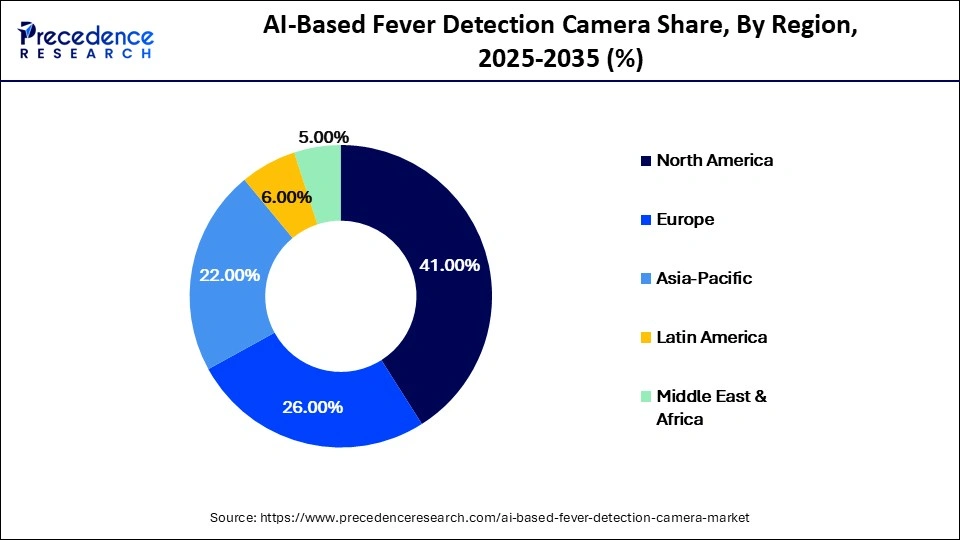
- North America dominated the AI-based fever detection camera market in 2025, with 41% market share.
- Asia-Pacific is expected to be the fastest-growing region between 2026 and 2035.
- By type, the turret/bullet cameras segment held a dominant position in the market with a share of 66% in 2025.
- By type, the handheld cameras segment is expected to grow at the fastest CAGR of during the forecast period.
- By technology type, the thermal imaging cameras segment registered its dominance over the global market with a share of 58.0 % in 2025.
- By technology type, the visible light + AI hybrid systems segment is expected to grow at the fastest CAGR during the forecast period.
- By component, the hardware (camera + sensor units) segment led the global market with a share of 61.0 % in 2025.
- By component, the services (integration, maintenance) segment is expected to witness the fastest growth in the AI-based fever detection camera market with a CAGR over the forecast period.
- By application, the healthcare facilities segment registered its dominance over the global market with a share of 32.0% in 2025.
- By application, the airports & transportation hubs segment is expected to expand rapidly in the market with a CAGR in the coming years.
Market Overview
The AI-based fever detection camera market consists of intelligent thermal imaging systems that use artificial intelligence algorithms to automatically detect elevated body temperature in individuals. These cameras combine infrared sensing, thermal imaging, facial recognition, and machine learning analytics to enable real-time screening in crowded environments. They are deployed in hospitals, airports, transportation hubs, factories, commercial buildings, and public infrastructure to support health surveillance, infection prevention, and safety monitoring. Market revenues include camera hardware, AI software, system integration, and service contracts.
What are the Market Trends?
- The AI-based fever detection camera market is experiencing increasing demand for contactless health monitoring or screening after the COVID-19 pandemic. AI-based fever detection cameras allow security teams to screen people quickly without physical interaction.
- Technological advancements in artificial intelligence and thermal imaging are driving the global AI market. Modern fever detection cameras are integrating AI algorithms that analyze thermal data in real time. The integration of the algorithm is improving the accuracy and making it more reliable and effective.
- The growing expansion of AI-based fever detection cameras from healthcare to commercial sectors such as shopping malls, offices, schools, and manufacturing sites. This extended use across non-medical environments is helping the market to grow.
- After the COVID-19 pandemic, the government and organizations are increasingly investing in surveillance technologies that help to detect health risks early in crowded areas. AI Based fever detection camera allows for fever detection across a large population quickly and efficiently.
Market Scope
| Report Coverage | Details |
| Market Size in 2025 | USD 1.87 Billion |
| Market Size in 2026 | USD 2.34 Billion |
| Market Size by 2035 | USD 17.95 Billion |
| Market Growth Rate from 2026 to 2035 | CAGR of 25.38% |
| Dominating Region | North America |
| Fastest Growing Region | Asia Pacific |
| Base Year | 2025 |
| Forecast Period | 2026 to 2035 |
| Segments Covered | Type, Technology, Component, Application, and Region |
| Regions Covered | North America, Europe, Asia-Pacific, Latin America, and Middle East & Africa |
Market Dynamics
Drivers
Rising Demand for AI-based Fever Detection Cameras
Growing demand of rapid, non-invasive health monitoring solutions is stimulating demand for contactless health screening technologies. Specifically, AI-based systems for detecting fever using visual cameras. Due to recent global pandemics, more organizations are prioritizing use of contact-free temperature screening technology AI-based fever detection cameras in public areas like airports, hospitals, and government offices to improve the health and safety of the population by reducing the need for human-to-human physical contact, thus reducing the risk of transmitting disease/virus from one person to another.
Restraint
Accuracy and Environmental Limitations
AI-based fever detection cameras can be affected or influenced by other environmental factors including temperature, humidity, and calibration issues which ultimately lead to a reduction of the reliability of the AI camera. Concerns regarding false positive and/or false negative results are a significant constraint to widespread use of fever detection cameras, especially in the healthcare industry where diagnostics need to be very precise if they are to be of any value in treatment.
Opportunity
Integration with Smart Infrastructure
As the development of smart cities proliferates along with the development of digital infrastructure, there is an opportunity for greater integration of fever detection cameras into commercial surveillance and access control systems. This intelligent automation enhances the efficiency of public health management for real time monitoring/analytics, including the ability to generate alerts and extend the functionality of AI/IoT technology in public transportation and commercial buildings.
Segmental Insights
Type Insights
AI-Based Fever Detection Camera Share, By Type, 2025-2035 (%)
| Type | 2025 |
| Turret/Bullet Cameras | 66.00% |
| Handheld Cameras | 34.00% |
Which Type Held the Largest Share of the Market in 2025?
Turret/Bullet Cameras segment registered its dominance over the global AI-based fever detection camera market with a share of 66% in 2025 due to their fixed ability to monitor a large area at the same time and their continual ability to monitor busy areas. These types of systems are widely used for ongoing temperature monitoring in airport, hospital and government buildings. These systems are also excellent choices for large-scale deployments because of their ruggedness able to withstand harsh weather and compatibility with centralized AI systems.
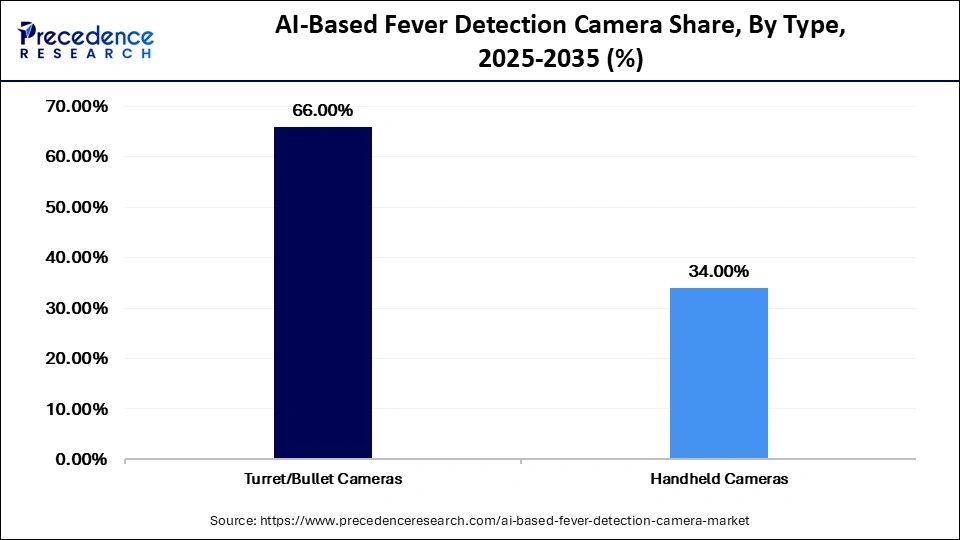
Handheld cameras have become the fastest growing segment in the video surveillance equipment market because of their portability and flexibility, ease of use, and capability to operate effectively in fast changing environments. Temporary screening setups for crowded environments, emergency events, and small facilities are also using these units. The increasing number of clinics, offices, and event-based screenings along with their cost savings and ease of setup are contributing to their rise in popularity among end users across many types of industries.
Technology Insights
AI-Based Fever Detection Camera Share, By Technology, 2025-2035 (%)
| Technology | 2025 |
| Thermal Imaging Cameras | 58.00% |
| Infrared Sensors | 27.00% |
| Visible Light + AI Hybrid Systems | 15.00% |
How Thermal Imaging AI Cameras Segment Dominated the AI-Based Fever Detection Camera Market?
The thermal imaging AI cameras segment led the global market with a share of 58.0% in 2025 because they can accurately measure temperature remotely and also because they can do so for an entire group of people at once, thermal imaging cameras dominate the market; they can detect heat in real time as well. Since thermal imaging cameras can also detect heat in real time, it is ideal for conducting mass screening in densely populated environments. Continuous improvements to both the thermal resolution of thermal imaging cameras and the use of AI for the automatic detection of people acting abnormally have contributed to the development of thermal imaging cameras as reliable solutions when needed in critical infrastructure applications.
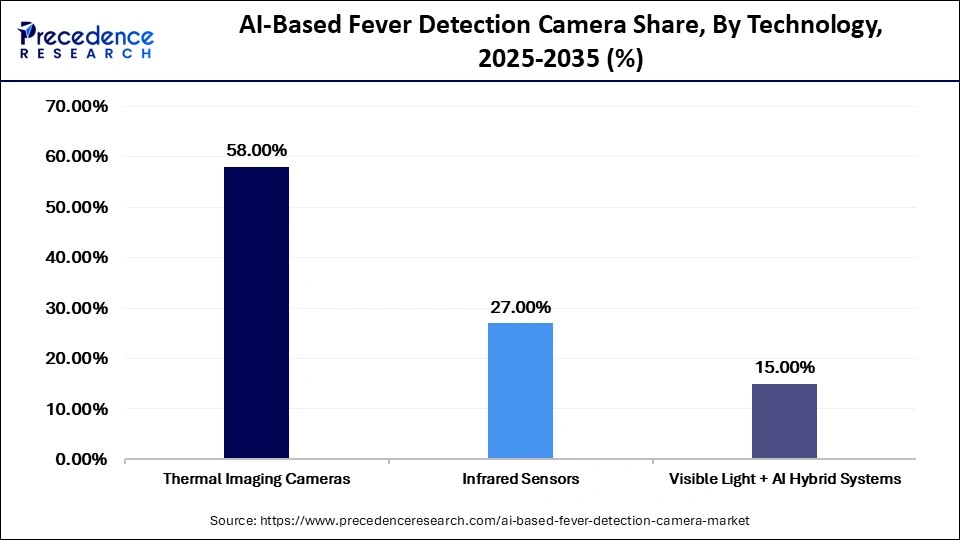
The infrared sensors are the second largest segment due to affordability and high volume utilization by basic fever detection units of this technology. Examples of infrared sensors can be found in anything from small consumer products to entry-level screening devices. Although infrared sensors can detect temperature fairly accurately, their limited operating range and sensitivity prevent them from being considered viable options for large-scale, high accuracy type applications.
Visible light + AI hybrid systems segment is fastest growing segment due to advanced analytics. This combination allows multi-functional surveillance with facial recognition, behavioural analysis, and temperature screening. The increasing demand for smart security solutions and the ability to integrate with existing CCTV systems is driving the adoption of these solutions in smart cities and corporate environments.
Component Insights
What made the Multi-Person Mass Screening Systems Segment Lead the Market?
The hardware (camera + sensor units) segment accounted for a considerable revenue share of 61.0% of the AI-based fever detection camera market as this is the foundation of the entire fever detection systems cameras, sensors & processing units. Since most organizations have to invest heavily in the purchase of physical devices when setting up large systems for their use, this ensures that the hardware component continues to dominate throughout the market. Continuous advances made in creating durable, high-resolution devices increases demand for these items which further consolidates their dominance within the market.
AI-Based Fever Detection Camera Share, By Component, 2025-2035 (%)
| Component | 2025 |
| Hardware (Camera + Sensor Units) | 61.00% |
| Software (AI Analytics Platforms) | 28.00% |
| Services (Integration, Maintenance) | 11.00% |
The software segment has seen the fastest growth rate because of the increasing use of artificial intelligence analytics, real-time monitoring of devices, and the integration of all collected data. Newer sophisticated software platforms are now offering clients many new capabilities that include; facial recognition, automated alerts & notifications, and reporting via cloud technology. The growing demand for intelligent surveillance systems and the need to manage systems across various locations leads to increased demand for AI software solutions.
Services represent the third largest segment within fever detection systems. While not as large as the previous two segments, the segment continues to grow due to the support services provided. As organizations move toward minimizing deployment issues through seamless installation, support services will also grow in importance. The increasing complexity of AI systems and the continued need for ongoing upgrades and technical assistance are driving up demand for support services at a rapid pace.
Application Insights
Why the Indoor Screening Environments Segment Dominated the Market?
The healthcare facilities is dominant segment for AI Based fever detection camera market with 32% market share due to the essential nature of these systems for continuous monitoring of patients and ensuring infection control. Hospitals & clinics are dependent on these systems for the early detection of fevers to diagnose patients and prevent the spread of infectious diseases. The requirement for these systems to integrate with systems used for managing a hospital's operations and the regulations of different governing health authorities, will increase its prevalence in this segment in order to comply with public health and safety standards.
AI-Based Fever Detection Camera Share, By Application, 2025-2035 (%)
| Application | 2025 |
| Healthcare Facilities | 32.00% |
| Airports & Transportation Hubs | 26.00% |
| Public Spaces (Malls, Stadiums, etc.) | 22.00% |
| Corporate & Enterprises | 12.00% |
| Educational Institutions | 8.00% |
Transportation hubs including airports are the fastest growing segments for fever detection systems. The rapid growth of global travel means that transportation hubs need to efficiently screen large numbers of passengers for elevated body temperature in an unobtrusive manner. As a result, governments and authorities around the world are investing significantly into screening technologies in order to improve public safety and reduce the spread of infectious disease across international borders.
Public spaces including malls, sporting arenas, and entertainment venues represent the third-largest segment for the use of fever detection systems. These locations regularly experience large numbers of concurrent patrons and need to implement technologies to monitor the body temperature of patrons to manage crowd and patron safety while also complying with applicable public health guidelines. Increased public education and enforcement of public safety regulations will lead to the widespread adoption of these technologies in these types of environments.
Regional Insights
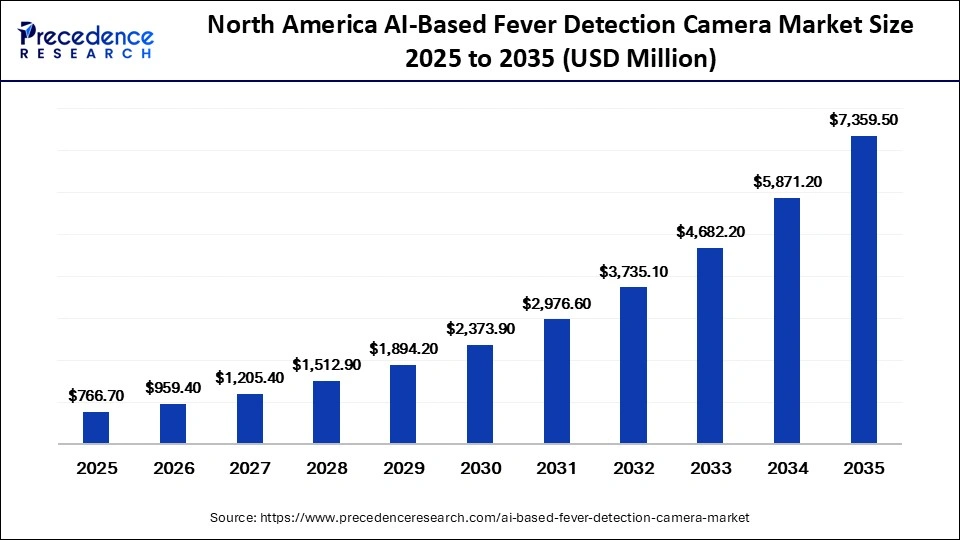
North America AI-Based Fever Detection Camera Market Size and Growth 2026 to 2035
The North America AI-based fever detection camera market size is estimated at USD 766.70 million in 2025 and is projected to reach approximately USD 7,359.50 million by 2035, with a 25.41% CAGR from 2026 to 2035.
What Factors Made the North America Dominant Region in the Market?
North America is dominated the global AI-based fever detection camera market with a share of 38.0% in 2025 due to advanced healthcare infrastructure and high adoption of innovative technologies. Many organizations prefer automated screening, which allows quick and accurate checks. North America is experiencing a technological shift by integrating machine learning and advanced algorithms to improve the accuracy of temperature screening.
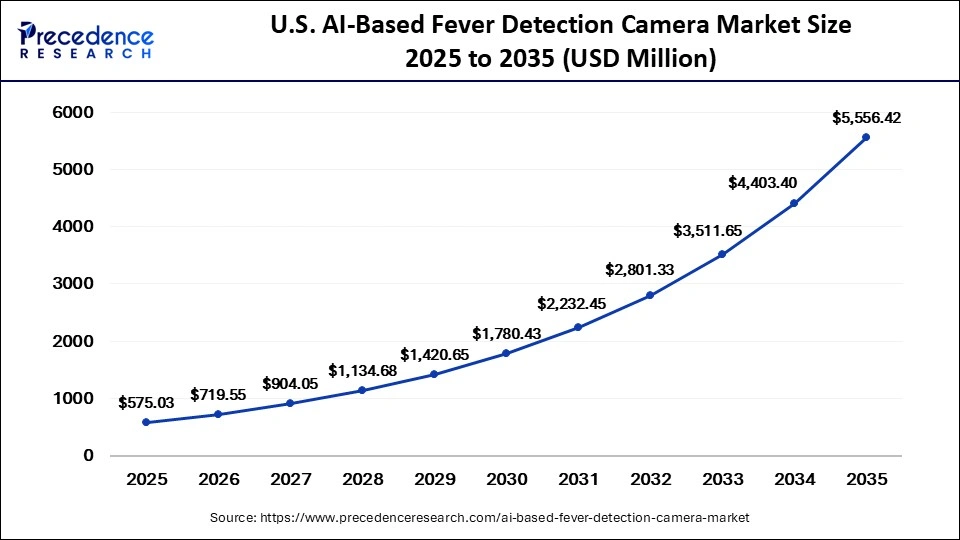
U.S. AI-Based Fever Detection Camera Market Size and Growth 2026 to 2035
The U.S. AI-based fever detection camera market size is calculated at USD 575.03 million in 2025 and is expected to reach nearly USD 5,556.42 million in 2035, accelerating at a strong CAGR of 25.46% between 2026 and 2035.
U.S. Market Trends
The U.S. plays a central role in the AI-based fever detection camera market due to the presence of key technological companies in AI and thermal imaging solutions. The region has highly adopted these cameras at airports, hospitals, manufacturing plants, and during health emergencies like the COVID-19 pandemic for continuous monitoring and safety. The significant investment in Smart technologies and monitoring systems further fuels the growth of the country in the market.
Why Asia Pacific is Growing with the Highest CAGR in the Market?
Asia Pacific expected to grow at the fastest CAGR in the AI-based fever detection camera market during the forecast period due to its large population and busy public spaces. Airports, hospitals, and metro stations across countries like India, Japan, China, and South Korea are often busy with heavy crowds. The Rajiv Gandhi International Airport (RGIA), Hyderabad, India, has implemented a fever detection camera for mass temperature screening of passengers. The government across the regions is also supporting technologies that help to manage crowd safety. These factors are contributing to the dominance of the region in the market.
China Market Trends
China plays a major role in the Asia Pacific AI-based fever detection camera market due to rapid urbanization, frequent disease outbreaks, and significant investments in healthcare infrastructure. The country has the presence of major producers of thermal cameras and surveillance systems, enabling large scale to both domestically and internationally. The government in the country focuses on smart city projects and advanced surveillance systems, which support the use of AI- powered monitoring tools.
AI-Based Fever Detection Camera Market Companies
- Hikvision
- Dahua Technology
- FLIR Systems (Teledyne FLIR)
- Axis Communications
- Bosch Security Systems
- Honeywell International
- NEC Corporation
- Hanwha Vision
- Opgal Optronic Industries
- Infrared Cameras Inc.
- Zhejiang Uniview Technologies
- Seek Thermal
- Thermoteknix Systems
- Mobotix AG
- Vivotek Inc
- Baidu Inc
- Hangzhou Hikvision Digital Technology Co. Ltd
- VVDN Technologies
- Axis Communications AB
- Altoros Systems
- Wuhan Guide Infrared Co. Ltd.
- Nippon Avionics Co. Ltd.
- Thermoteknix Systems Ltd.
- Mantra Softech (India) Pvt. Ltd.
- Vantage Integrated Security Solutions Pvt. Ltd.
- Vehant Technologies Pvt. Ltd.
- Scylla Technologies Inc.
Recent Developments
- In January 2026, University of Arkansas researchers developed CattleFever, an AI-powered system using thermal cameras to estimate cattle body temperatures via facial recognition. This technology, focusing on eyes and nostrils, aims to detect fevers early without stressful rectal exams, improving herd health monitoring and welfare.(Source: https://www.eurekalert.org)
- In May 2025, FLIR Systems announced the FLIR A400/A700 Thermal Smart Sensor and Thermal Image Streaming fixed camera solutions. These systems are designed to support elevated skin temperature screening in high-traffic environments. The systems are used in manufacturing facilities, emission monitoring, and product development industries. (Source: https://www.flircameras.com)
Segments Covered in the Report
By Type
- Turret/Bullet Cameras
- Handheld Cameras
By Technology
- Thermal Imaging Cameras
- Infrared Sensors
- Visible Light + AI Hybrid Systems
By Component
- Hardware (Camera + Sensor Units)
- Software (AI Analytics Platforms)
- Services (Integration, Maintenance)
By Application
- Healthcare Facilities
- Airports & Transportation Hubs
- Public Spaces (Malls, Stadiums, etc.)
- Corporate & Enterprises
- Educational Institutions
By Region
- North America
- Latin America
- Europe
- Asia-pacific
- Middle and East Africa
For inquiries regarding discounts, bulk purchases, or customization requests, please contact us at sales@precedenceresearch.com
Frequently Asked Questions





Ask For Sample
No cookie-cutter, only authentic analysis – take the 1st step to become a Precedence Research client
 Get a Sample




 sales@precedenceresearch.com
 Schedule a Meeting
