



All Flash Array Market Trends, Companies, Revenue / Sales Performance, Manufacturing Yield, Fab Capacity, Export & Import Dynamics, Supply Chain Analysis, Competitive Landscape, and Growth Forecast
All Flash Array Market (By Architecture Scale-Up Arrays Scale-Out Arrays Disaggregated NVMe-oF Arrays By Storage Type Block Storage File Storage Unified Storage Object-Integrated Storage By Interface Protocol Fibre Channel iSCSI NVMe over Fabrics SAS Ethernet-Based NAS By Deployment Model On-Premises Hybrid Cloud Integrated As-a-Service/Consumption-Based By Organization Size Large Enterprise Small and Medium Enterprises By Capacity Band Up to 20 TB 20 TB to 100 TB 100 TB to 500 TB Above 500 TB By Workload Type Databases Virtualization and VDI Backup and Disaster Recovery File Sharing and Collaboration By End User Industry BFSI IT and Telecom Healthcare and Life Sciences Media and Entertainment Others) - Global Industry Analysis, Size, Trends, Leading Companies, Regional Outlook, and Forecast 2026 to 2035
Source: https://www.precedenceresearch.com/all-flash-array-market
 Get a Sample
 Table Of Content


What is the All Flash Array Market Size in 2026?
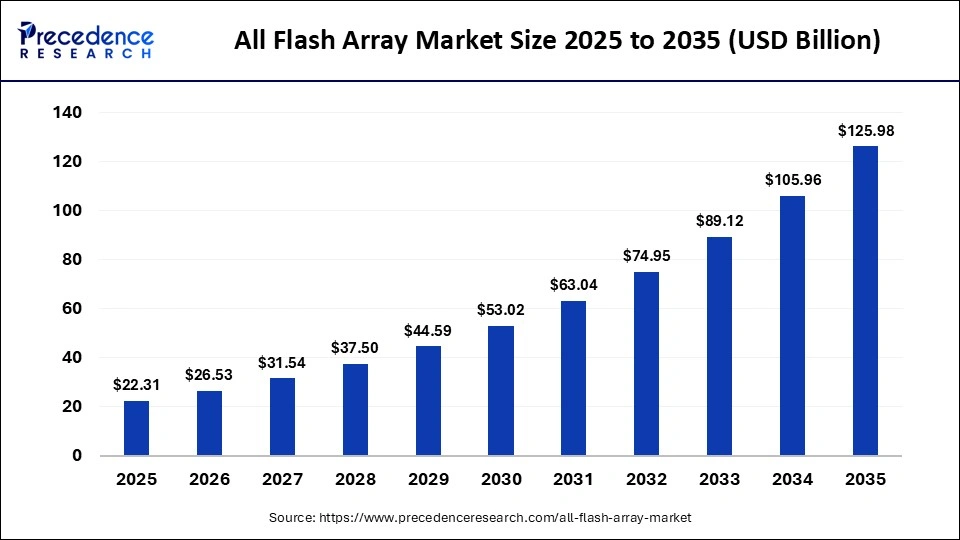
The global all flash array market size was calculated at USD 22.31 billion in 2025 and is predicted to increase from USD 26.53 billion in 2026 to approximately USD 125.98 billion by 2035, expanding at a CAGR of 18.90% from 2026 to 2035.All flash arrays have outgrown their “premium storage” label, settling instead into the role of a silent workhorse powering AI, cloud, and latency critical enterprise systems where speed is no longer optional.
Key Takeaways
- North America dominated the global all flash array market with a market share of 38.6% in 2025.
- Asia Pacific is expected to grow at the fastest CAGR in the market during the forecast period.
- By architecture, the scale up arrays segment held a major revenue share of 46.8% in the market in 2025.
- By architecture, the scale out arrays segment held the second-largest share of 33.6% in 2025 and is expected to grow at a significant rate between 2026 and 2035.
- By storage type, the block storage segment accounted for a considerable revenue share of 38.7% in the market in 2025.
- By storage type, the unified storage segment held the second-largest dominance with a market share of 31.5% and is expected to grow at a significant rate between 2026 and 2035.
- By interface protocol, the fibre channel segment dominated the market with a share of 36.4% in 2025.
- By interface protocol, the iSCSI segment held the second-largest share of 21.8% in 2025 and is expected to grow at a significant rate between 2026 and 2035.
- By end user industry, the IT and Telecom segment accounted for the highest revenue share of 28.4% in the market in 2025.
- By end user industry, the BFSI segment held the second largest dominance with 14.6% market share and is expected to grow at a significant rate between 2026 and 2035.
What is the All Flash Array Market?
The all flash array industry comprises enterprise storage systems built entirely on flash media rather than spinning hard disk drives. These arrays are designed to deliver very low latency, high input/output performance, compact form factor, strong data reduction, improved power efficiency, and high availability for mission-critical workloads. Demand is being driven by database acceleration, virtualization, analytics, AI oriented infrastructure, cyber resilience requirements, and modernization of legacy storage estates across cloud, on-premises, and hybrid IT environments.
Impact of AI on All Flash Arrays
Artificial intelligence (AI) has quietly converted all-flash arrays from merely fast storage solutions into a data nervous system. Training models and running inference pipelines require an unyielding speed, simultaneous access, and minimal latency, making conventional storage systems inadequate. For both those goals, flash arrays not only satisfy them but also actively provide continuous function for operations. What evolved is the expectation that storage should no longer be passive; it now anticipates workloads in advance, delivers real-time support to GPUs, manages a substantial amount of data fluctuations seamlessly, and manages load. In many AI settings, performance restrictions are increasingly seen in storage rather than computational units, positioning all-flash arrays at the forefront of this conversation.
Trends Influencing the All Flash Array Market
- AI-Driven Storage Design Is No Longer a Random Experiment : Next-generation storage systems are advancing to allow GPUs to run over CPUs more and have direct paths to data and some memory-type operations. This has even been extended because newly developed flash storage acts as an extension of GPU memory, essentially bringing storage and compute together.
- Hyper-scaled Data Appetite Underlies the Need for Density Race : More and more, the industry is prioritizing capacity per rack over speed. High-density SSDs and petabyte-level deployments are more common than ever, as AI datasets grow faster than infrastructure teams can handle.
- Software-Defined Storage: Taking Control of Differentiation : As hardware becomes much more shared across the board or vendors, the real distinction comes in software in areas such as automation, data reduction, or workload orchestration. In fact, this is just one of many trends that see storage solutions transition to a more flexible and scalable approach with many features that function better as a service than as a core asset.
- Cost Volatility Reshaping Buying Behavior : Flash technology adoption has evolved from simply a technical decision to one with an aspect of timing. AI-driven demand can now affect NAND supply, leading to price movement up and down, which drives enterprises to rethink their procurement strategy and hybrid architecture on occasion.
Market Scope
| Report Coverage | Details |
| Market Size in 2025 | USD 22.31 Billion |
| Market Size in 2026 | USD 26.53 Billion |
| Market Size by 2035 | USD 125.98 Billion |
| Market Growth Rate from 2026 to 2035 | CAGR of 18.90% |
| Dominating Region | North America |
| Fastest Growing Region | Asia-Pacific |
| Base Year | 2025 |
| Forecast Period | 2026 to 2035 |
| Segments Covered | Architecture, Storage Type, Interface Protocol, Deployment Model, Organization Size, Capacity Band, Workload Type, End User Industry, and Region |
| Regions Covered | North America, Europe, Asia-Pacific, Latin America, and Middle East & Africa |
Market Dynamics
Drivers
Cloud and Hybrid Models are Continuously Moving
As organizations transition to hybrid and multi cloud platforms, sustained performance becomes an imperative element. All flash arrays deliver dependable latency and a convenient model for scalability, which is particularly appealing for cloud native architectures, for which a failure or delay in the system can have a great reputational impact.
Restraint
NAND Supply Chain Shifts and Price Variation
This market remains at risk from changes within the NAND supply chain. Unexpected spikes in demand, typically due to the expansion of AI infrastructure, can result in decreased availability and increased costs, driving buyers toward deferring purchases or worse storage options.
Opportunity
Edge Computing and Real-Time Data Processing Expansion
As data generation moves closer to the edge, in factories, hospitals, and smart cities, there's a rising need for compact, high-performance storage. All flash arrays are well-positioned to support these environments where milliseconds matter, and reliability can't be negotiated.
Segmental Insights
Architecture Insights
All Flash Array Market Share, By Architecture, 2025-2035 (%)
| Architecture | 2025 | 2035 |
| Scale-Up Arrays | 46.8% | 34.7% |
| Scale-Out Arrays | 33.6% | 35.8% |
| Disaggregated NVMe-oF Arrays | 19.6% | 29.5% |
The Scale-Up Arrays Segment Dominated the Market with 46.8% of Market Share in 2025
The scale-up arrays segment dominated the all flash array market with a share of 46.8% in 2025. This majority is ascribed to organizations preferring controlled growth, not large-scale architectural overhauls. Such systems offer comfort and expand the capability of an already available structure without a radical transformation. Familiarity still matters more than aesthetic architecture for many businesses, especially those tethered to legacy systems.
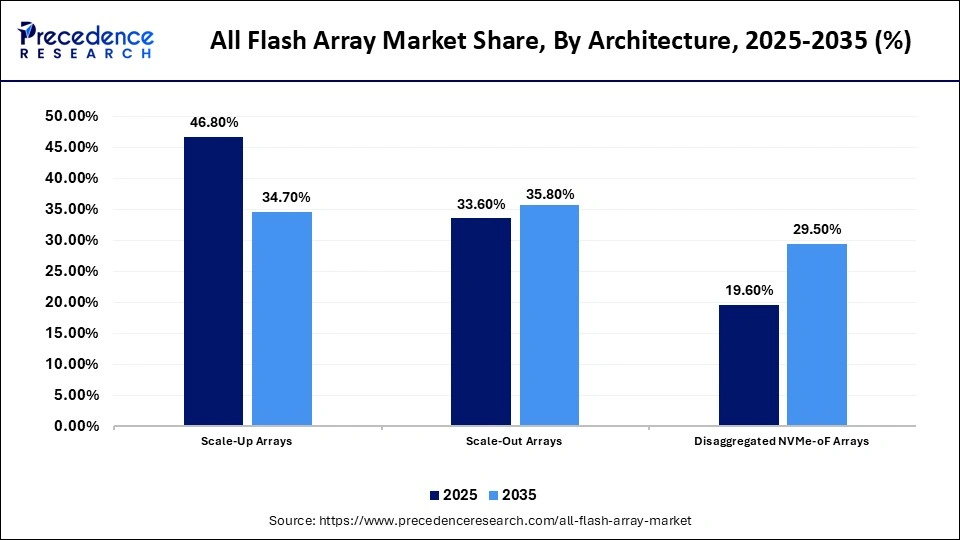
The scale-out arrays segment held the second-largest market share of 33.6% in 2025. They attract attention because of the horizontal scale, adding nodes, not scaling up every system. This sort of design changes from a convenience to a necessity since, at this point, workloads get more unpredictable as a result of AI and analytics advancements, where these architectures become an essential necessity, rather than simply an upgrade.
The disaggregated NVMe oF arrays segment held 19.6% of the market share in 2025, as they represent a more progressive move to separate storage and computing resources. Adoption is slow, but when designed for hyperscale areas that value flexibility over convention, in the end, such setups become a replacement rather than an add-on for older systems, and are highly favored if they are indeed put into place.
Storage Type Insights
The Block Storage Segment Led the Market with 38.7% of Market Share in 2025
The block storage segment led the all flash array market with a share of 38.7% in 2025, owing to compatibility with high-performance applications like databases and transactional systems. This type of storage provides accuracy, reliability, and speed, the very characteristics that businesses highly prioritize, given that even a mere delay can affect their businesses significantly.
All Flash Array Market Share, By Storage Type, 2025-2035 (%)
| Storage Type | 2025 | 2035 |
| Block Storage | 38.7% | 30.8% |
| File Storage | 18.9% | 16.4% |
| Unified Storage | 31.5% | 33.9% |
| Object-Integrated Storage | 10.9% | 18.9% |
The unified storage segment held the second-largest market share of 31.5% in 2025. It is an integration of both block and file functions into a single system, appealing to organizations wanting flexibility without needing to manage different architectures. Although it does not always perform as quickly as other alternatives, its ease of use can set it up for success.
The file storage segment held 18.9% of the market share in 2025, due to its capability of supporting collaborative settings and unstructured data processes, but often relies on hybrid or unified storage solutions. Its advancement is motivated more by the ability to effectively manage the growth of data sets than speed.The object integrated storage segment held 10.9% of the market share in 2025, due to its use in the current flash technology. This is especially true for data heavy cloud-native applications. It has not been a well-known answer for this domain yet, but the nature of its size to accommodate larger, more unstructured datasets while still retaining scalability enables it to be extremely useful in the context of AI and analytics-based environments.
Interface Protocol Insights
The Fibre Channel Segment Held a Major Market Share of 36.4% in 2025
The fibre channel segment held a major revenue share of 36.4% in the all flash array market in 2025, due to its strong position of enterprise presence. Its reliability is much more important than its evolution: it consistently achieves low latency performance. Stability is more attractive to many organizations than fresher, faster ones.
All Flash Array Market Share, By Interface Protocol, 2025-2035 (%)
| Interface Protocol | 2025 | 2035 |
| Fibre Channel | 36.4% | 24.8% |
| iSCSI | 21.8% | 17.6% |
| NVMe over Fabrics | 17.3% | 31.2% |
| SAS | 9.7% | 5.8% |
| Ethernet-Based NAS | 14.8% | 20.6% |
The iSCSI segment held the second-largest share of 21.8% in 2025, as it continues to increase in availability and cost. It may not be the lowest latency, but it does offer options compared to generic IP networks, and this makes it appealing for companies wanting to be able to compete with established infrastructure.
The NVMe over Fabrics segment held 17.3% of the market share in 2025. With the removal of conventional protocol overhead, this technology also benefits from the flash speed to the fullest extent. Adoption rates are on the rise, particularly in AI applications and high-performance computing environments, for which latency is becoming more important on a day to day basis.The Ethernet based NAS segment held 14.8% of the market share in 2025. Even when it's not necessarily correlated with peak performance, its simplicity and ease of integration into actual network configuration still maintain current relevance, a feature when deployment is far more important than throughput.
End User Industry Insights
The IT and Telecom Segment Dominated the Market with 28.4% of Market Share in 2025
The IT and Telecom segment contributed the biggest revenue share of 28.4% in the all flash array market in 2025, driven by rising data demands and a requirement for ongoing performance. These sectors do not consider flash storage as a mere add-on, but a key element for infrastructure needs from cloud services to network infrastructure.
All Flash Array Market Share, By End User Industry, 2025-2035 (%)
| End User Industry | 2025 | 2035 |
| BFSI | 14.6% | 13.1% |
| IT and Telecom | 28.4% | 24.6% |
| Healthcare and Life Sciences | 11.7% | 15.3% |
| Government and Defense | 10.8% | 10.4% |
| Manufacturing | 12.9% | 13.2% |
| Retail and E-Commerce | 9.1% | 9.8% |
| Media and Entertainment | 6.8% | 6.5% |
| Others | 5.7% | 7.1% |
The BFSI segment held the second-largest share of 14.6% in 2025. Latency in banking and financial services is far more complex than just a bad signal from the network; it affects transactions. Flash arrays are able to help in high-frequency trading, fraud detection, and real-time processing, where even minor delays can have far-reaching cost of either financial or reputation consequences.
The manufacturing segment held 12.9% of the market share in 2025. In manufacturing, the Internet of Things (IoT) technology and automation are transforming data driven production environments for the better, which provide constant streams of data. While flash arrays offer a real time analytics solution and more operational efficiency, they tend to be adopted only to the extent that they can upgrade digital infrastructures in timeThe healthcare and life sciences segment held 11.7% of the market share in 2025. As healthcare continues to migrate more data through flash storage solutions, everything from imaging modalities to genomic data, the emphasis shifts from speed to the reliability and accessibility that are critical, especially when lagging delays in access may compromise patient outcomes.
Regional Insights
North America All Flash Array Market Size and Growth 2026 to 2035
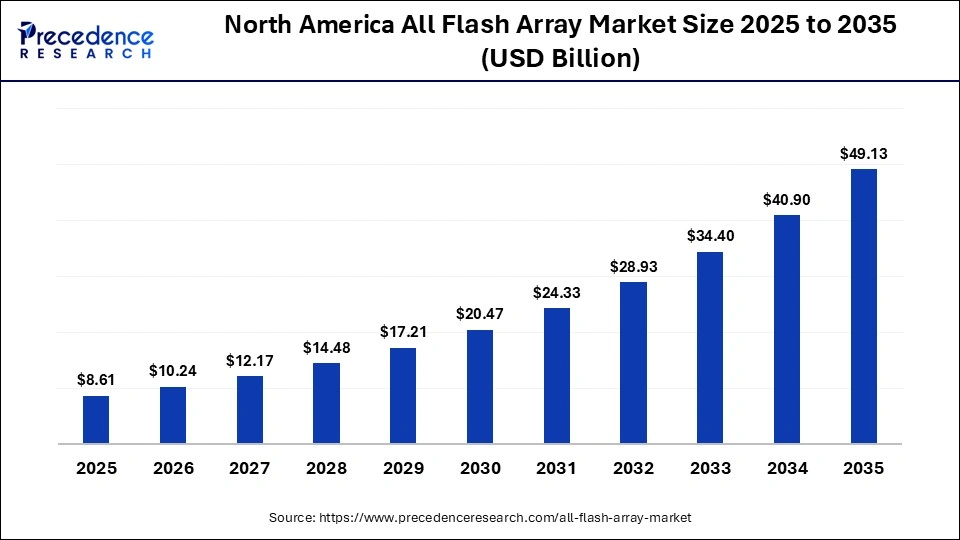
The North America all flash array market size is estimated at USD 8.61 billion in 2025 and is projected to reach approximately USD 49.13 billion by 2035, with a 19.02% CAGR from 2026 to 2035.
Why North America Dominated the All Flash Array Market?
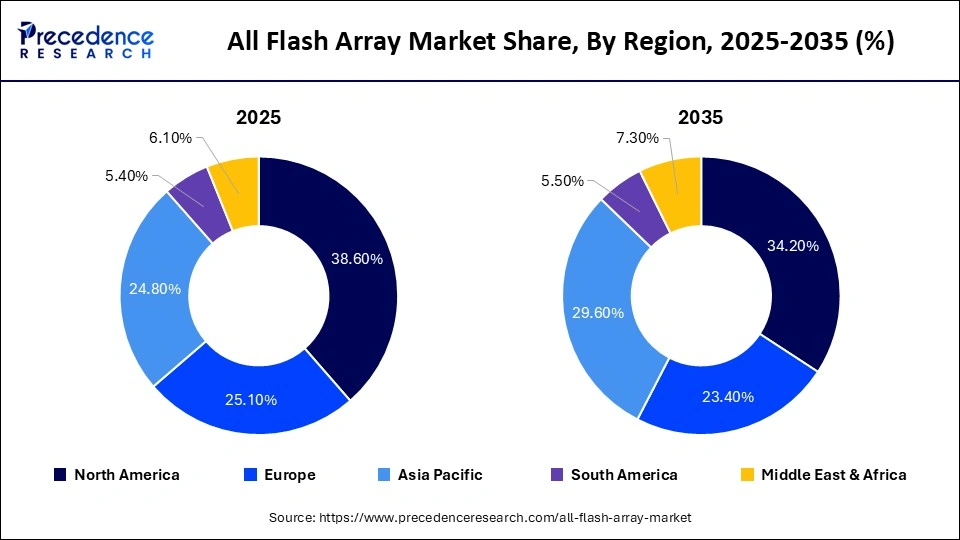
North America held the largest market share of 38.6% in 2025. This dominance was influenced by an environment that typically embraces technology before it has fully matured. A consistent demand for high performance storage emerged from hyperscale data centers, cloud service providers, and AI focused companies. The region capitalized on early adoption of NVMe technology and maintained a robust presence of storage vendors, which facilitated rapid innovation cycles. Instead of gradual integration, flash storage became the standard choice here, particularly where low latency and high uptime were regarded as essential operational criteria.
U.S. All Flash Array Market Size and Growth 2026 to 2035
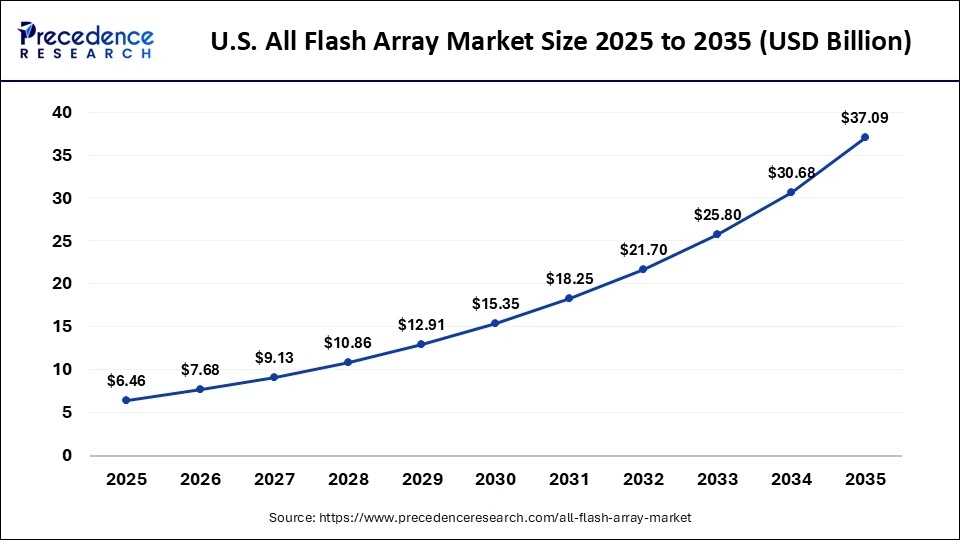
The U.S. all flash array market size is calculated at USD 6.46 billion in 2025 and is expected to reach nearly USD 37.09 billion in 2035, accelerating at a strong CAGR of 19.10% between 2026 and 2035.
U.S. Market Trends
The U.S. accounted for the largest share within North America, due to significant investments in cloud and AI. Companies in this region embraced all flash arrays for their performance benefits and to gain competitive advantages through quicker analytics capabilities, real-time processing efficiency, and scalable systems architecture. The ongoing expansion of data centers, coupled with the influence of leading storage vendors, contributed to aggressive adoption rates, frequently positioning flash not merely as an enhancement but rather as a fundamental necessity for contemporary workloads.
Will Europe Grow in the All Flash Array Market?
Europe held the second-largest share of 25.1% in 2025. Organizations are prioritizing organized IT change and juggling improved performance with regulations and cost containment. Manufacturing, finance, and public infrastructure have all seen high demand for all-flash arrays, for they all need to operate at the same level of speed while maintaining data integrity. It avoids a rush towards modernization and focuses on a phased incorporation of flash technology within current systems.
Germany Market Trends
Germany led the European market, supported by a strong industrial base and systematic adoption of digital transformation. Industries like manufacturing, automotive, and enterprise have become significantly more reliant on the use of all flash arrays to support automation of processes and data driven business practices. Aspects of this incorporation into the existing IT framework are seen to be thoughtful, rather than haphazard. The priority of Germany for data security and operational efficiency maintains steady levels of demand, so it is not seen as a high-growth anomaly, but as an absolute necessity within the larger regional market.
How is Asia-Pacific Growing in the All Flash Array Market?
Asia-Pacific is expected to grow at the fastest CAGR in the market during the forecast period, because new infrastructures are now driving that expansion. Demand in the cloud is being driven by the number of data centers, the number of people using cloud services, as well as programs in AI and other government backed work. Unlike even more mature markets, where a gradual transition is preferred to one where flash first is adopted at the onset of the development process, and performance and scalability are paramount, this region often gets caught doing the opposite.
China Market Trends
China is expected to lead growth within Asia-Pacific, supported by aggressive investments in its cloud infrastructure and AI technologies. Large local businesses and hyperscale companies are scaling quickly, meaning they always want high-performance storage. Implementation policies that facilitate data localization and widespread digital expansion further propel this adoption trend. Rather than just making small updates, the market is experiencing large investments, where all-flash arrays are serving as basic infrastructures configured to handle vast amounts of swiftly changing datasets.
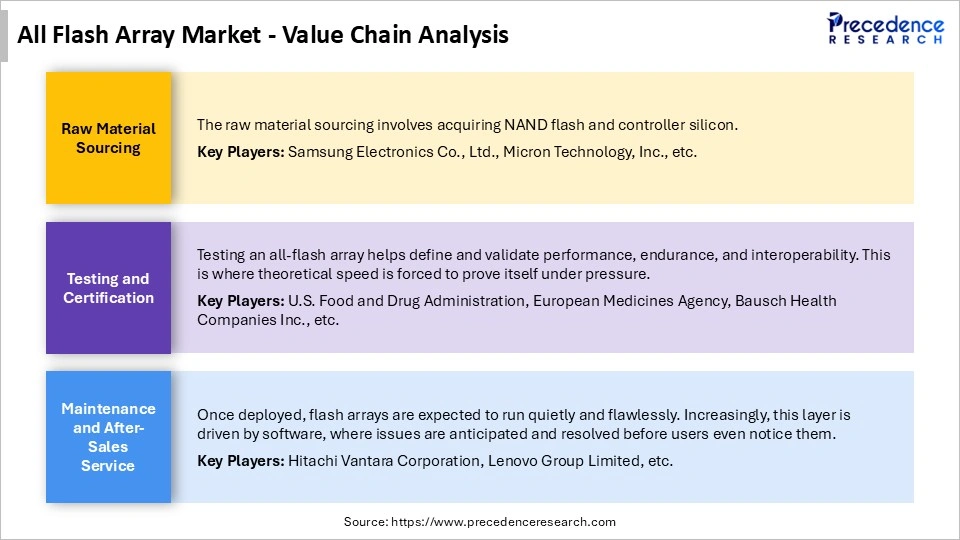
All Flash Array Market Value Chain Analysis
All Flash Array Market Companies
- Dell Technologies
- Hewlett Packard Enterprise
- NetApp
- Pure Storage
- IBM
- Hitachi Vantara
- Huawei
- Lenovo
- Fujitsu
- Infinidat
- Western Digital
- Oracle
- NEC
- DataDirect Networks
- IBM Storage
Recent Developments
- In March 2026, Arcfra launched Arcfra Enterprise Cloud Platform (AECP) 6.3 that delivers a landmark 4.6X performance increase and introduces native RPO+0 synchronous replication, offering a high-performance, cost effective alternative to legacy VMare based architectures. The system eliminates the need for expensive proprietary storage through deep architectural optimization. (Source: https://www.prnewswire.com)
- In March 2026, Enterprise Strategy Group released a technical validation report on Huawei's New-Gen OceanStor Dorado Converged All Flash Storage. The report showed that the product offers high performance, resilience, intelligent management, and total cost of ownership, delivering a compelling combination of high performance, strong resilience, and optimal TCO. (Source: https://e.huawei.com)
Segments Covered in the Report
By Architecture
- Scale-Up Arrays
- Scale-Out Arrays
- Disaggregated NVMe-oF Arrays
By Storage Type
- Block Storage
- File Storage
- Unified Storage
- Object-Integrated Storage
By Interface Protocol
- Fibre Channel
- iSCSI
- NVMe over Fabrics
- SAS
- Ethernet-Based NAS
By Deployment Model
- On-Premises
- Hybrid Cloud Integrated
- As-a-Service/Consumption-Based
By Organization Size
- Large Enterprises
- Small and Medium Enterprises
By Capacity Band
- Up to 20 TB
- 20 TB to 100 TB
- 100 TB to 500 TB
- Above 500 TB
By Workload Type
- Databases
- Virtualization and VDI
- Backup and Disaster Recovery
- AI and Analytics
- High Performance Computing
- File Sharing and Collaboration
By End User Industry
- BFSI
- IT and Telecom
- Healthcare and Life Sciences
- Government and Defense
- Manufacturing
- Retail and E-Commerce
- Media and Entertainment Others
By Region
- North America
- Latin America
- Europe
- Asia-pacific
- Middle and East Africa
For inquiries regarding discounts, bulk purchases, or customization requests, please contact us at sales@precedenceresearch.com
Frequently Asked Questions
Tags





Ask For Sample
No cookie-cutter, only authentic analysis – take the 1st step to become a Precedence Research client
 Get a Sample




 sales@precedenceresearch.com
 Schedule a Meeting
