



Antibody Discovery Market Size, Key Companies, Company Market Share, Patient Volume, Treatment Adoption Rates, Pricing Analysis, Regulatory Landscape, Competitive Positioning, and Demand Forecast
Antibody Discovery Market (By Methods: Phage Display, Hybridoma, Others; By Antibody Type: Humanized Antibody, Human Antibody, Chimeric Antibody, Murine Antibody; By End Users: Pharmaceutical and Biotechnology industry, Research laboratory, Academic laboratory) - Global Industry Analysis, Size, Trends, Leading Companies, Regional Outlook, and Forecast 2026 to 2035
Source: https://www.precedenceresearch.com/antibody-discovery-market
 Get a Sample
 Table Of Content


What is the Antibody Discovery Market Size?
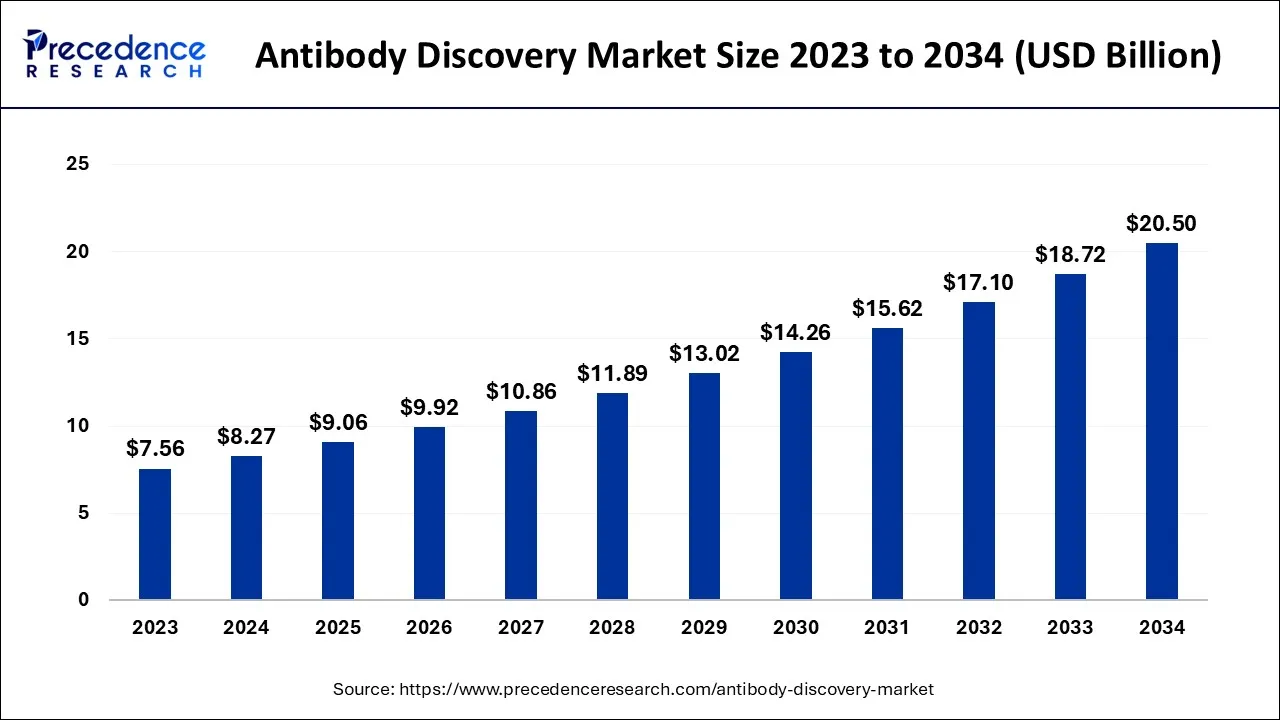
The global antibody discovery market is valued at USD 9.06 billion in 2025 and is predicted to increase from USD 9.92 billion in 2026 to approximately USD 22.28 billion by 2035, expanding at a CAGR of 9.42% from 2026 to 2035. Growing investment in the pharmaceutical & biotechnology sector, rising prevalence of infectious diseases, and demand for personalized medicine are driving the market.
Antibody Discovery Market Key Takeaways
- North America led the global market with the highest market share of 36% in 2025.
- Asia-Pacific is expected to grow at the largest CAGR of 8.3% between 2026 and 2035.
- By Method, the phage display segment contributed more than 47% of revenue share in 2025.
- By Method, the hybridoma segment is projected to expand at a notable CAGR of 10.7% during the projected period.
- By Antibody Type, the human antibody segment had the largest market share of 49% in 2025.
- By Antibody Type, the murine antibody segment is anticipated to grow at the fastest CAGR over the projected period.
- By End-user, the pharmaceutical and biotechnology industry segment contributed more than 41% of revenue share in 2025.
- By End-user, the academic laboratory segment is expected to grow at the fastest CAGR over the projected period.
What is the Antibody Discovery Market?
Antibody discovery involves identifying and developing antibodies that specifically bind to target molecules, such as proteins found on the surface of pathogens or diseased cells. This process is crucial for creating therapeutic antibodies to treat various conditions, including cancer, autoimmune disorders, and infectious diseases. The field of antibody discovery is rapidly expanding, fueled by innovative platforms, a growing understanding of immunology, and the application of sequencing and data science, which help uncover insights more efficiently. Common techniques in this area include phage display and hybridoma technology.
Artificial Intelligence: The Next Growth Catalyst in Antibody Discovery
AI is impacting the antibody discovery industry by integration, fundamentally re-engineering the antibody discovery lifecycle by drastically reducing lead times and enhancing the clinical success rates of therapeutic candidates. By leveraging machine learning for the high-throughput analysis of massive biological datasets, practitioners can execute rapid in silico modeling to predict binding affinities, structural integrity, and critical developability metrics such as solubility and immunogenicity.
Antibody Discovery Market Growth Factors
- The antibody discovery market is experiencing significant growth, driven by an aging population, an increase in chronic diseases, and a shift toward biologics that offer targeted therapeutic mechanisms. Emerging economies are seeing a rise in demand for antibody drugs due to increasing healthcare expenditures and improved accessibility to advanced treatments.
- The popularity of therapeutic antibodies, characterized by their specificity, potency, and versatility, is expected to further boost market growth. These drugs are demonstrating promising results in treating conditions like cancer and autoimmune diseases, thereby fueling their demand.
- Automation is playing a crucial role in advancing antibody discovery technologies. By integrating robotics and automated workflows, researchers can conduct high-throughput antibody screening with minimal manual intervention.
Market Outlook
- Market Growth Overview: The antibody discovery industry is expected to grow significantly between 2025 and 2034, driven by the rising cases of cancer, growing preference for biologics, and more investment in biopharmaceutical research and development.
- Sustainability Trends: Sustainability trends involve the adoption of green chemistry principles, minimizing animal use, and focusing on the entire product lifecycle.
- Major Investors: Major investors in the market include Danaher Corp., Thermo Fisher, Sartorius AG, Evotec, WuXi Biologics, and GenScript, alongside specialized firms like Abzena, Harbour BioMed, Twist Bioscience, and Biocytogen.
- Startup Economy: The startup economy is focused on integration of AI and machine learning, novel therapeutic modalities, and strategic collaboration and outsourcing.
Market Scope
| Report Coverage | Details |
| Growth Rate from 2026 to 2035 | CAGR of 9.42% |
| Market Size in 2025 | USD 9.06 Billion |
| Market Size by 2035 | USD 22.28 Billion |
| Largest Market | North America |
| Base Year | 2025 |
| Forecast Period | 2026 to 2035 |
| Segments Covered | By Methods, By Antibody Type, and By End Users |
| Regions Covered | North America, Europe, Asia-Pacific, Latin America, and Middle East & Africa |
Market Dynamics
Driver
Biologics and immunotherapy
Biologics and immunotherapy play pivotal roles in propelling the growth of the antibody discovery market. Biologics, encompassing monoclonal antibodies and protein-based therapeutics, have exhibited remarkable efficacy in treating a broad spectrum of ailments, ranging from cancer to autoimmune conditions. This success has engendered a mounting demand for novel antibodies custom-tailored to target specific disease markers.
Immunotherapy, a subset of biologics, has ushered in a paradigm shift in cancer treatment, mobilizing the body's own immune defenses against tumors. Notable examples include immune checkpoint inhibitors and CAR-T cell therapies, both heavily reliant on antibodies. This groundbreaking achievement has spurred fervent exploration into the development of fresh antibodies capable of modulating immune responses and amplifying the potency of immunotherapy.
The synergy between biologics and immunotherapy establishes fertile ground for antibody discovery. Researchers are actively seeking antibodies designed to home in on precise antigens found on cancer cells, obstruct immune checkpoints, or incite robust immune reactions against pathogens. This relentless pursuit of innovation and the creation of more efficacious biologics and immunotherapies propel investments, foster collaborative efforts, and drive advancements in antibody discovery techniques, ultimately catalyzing the expansion of the market.
In essence, the triumphs of biologics and immunotherapy affirm the indispensable role of antibodies in contemporary healthcare, rendering antibody discovery an ever-evolving and thriving domain.
Restraints
Antigen identification challenges
Antigen identification challenges pose a significant restraint on the growth of the antibody discovery market. The process of identifying suitable disease-specific antigens, which antibodies are designed to target, is often intricate and time-consuming. In cases of diseases with complex biology or limited known targets, researchers may struggle to pinpoint the right antigens, causing delays in the initiation of antibody discovery projects.
Furthermore, the absence of clearly defined antigens can hinder the development of highly specific antibodies, potentially resulting in off-target effects and diminished therapeutic effectiveness. This issue is particularly pronounced in diseases like certain cancers and infections, where the identification of distinct and accessible antigens can be a formidable endeavor.
Additionally, antigen identification challenges can increase the risk of project failure, as investing substantial resources into antibody development without a clear antigen target can lead to unsuccessful outcomes. Overcoming these challenges often requires innovative approaches, such as leveraging omics technologies and advanced screening methods, to enhance the identification and validation of relevant antigens, ultimately driving progress in the antibody discovery field.
Opportunities
Expanding therapeutic applications
Expanding therapeutic applications are creating substantial opportunities within the antibody discovery market. The remarkable versatility of antibodies as therapeutic agents has led to their adoption in a wide range of medical fields, including oncology, autoimmune diseases, infectious diseases, and more. As our understanding of disease mechanisms deepens, novel targets and treatment modalities are continually emerging, driving demand for antibodies tailored to address these evolving therapeutic needs. For example, the development of antibodies directed at specific cancer biomarkers has ushered in a transformative era in oncology treatment, promising more precision and efficacy.
In autoimmune ailments, antibodies designed to regulate immune responses hold potential for managing conditions like rheumatoid arthritis and multiple sclerosis. Moreover, as rare diseases gain more attention, antibody discovery provides an avenue to address unmet medical needs in these niche markets. Expanding therapeutic applications not only broaden the scope of antibody discovery but also offer the opportunity to improve patient outcomes and quality of life, making this field an exciting and dynamic space for research, innovation, and commercialization.
Segments Insights
Antibody Type Insights
Why did the Human Antibody Segment Hold the Largest Share of the Antibody Discovery Market in 2025?
The human antibody segment held the largest share of the antibody discovery market in 2025. This is due to the growing use of human antibodies in several applications due to their various advantages. Human antibodies have improved safety profiles, enhanced efficacy, and decreased immunogenicity. These antibodies are gaining popularity because of their higher specificity and stability, and lower costs. Their compatibility with human targets improves therapeutic effectiveness. Additionally, human antibodies have exhibited attractive clinical efficacy in clinical studies.
The murine antibody segment is anticipated to expand at the fastest rate over the projected period, because of its historical prominence and established research infrastructure. Murine antibodies are mainly discovered due to their easy and wealthy understanding and wild availability in mice. This antibody technology is well-developed with high affinity and specificity, which makes it ideal for target therapies.
Method Insights
Which Method of Antibody Discovery Dominated the Antibody Discovery Market in 2025?
The phase display segment dominated the antibody discovery market in 2025, due to its versatility, applicability, robustness, and other benefits. The quick screening of vast antibody libraries against target antigens is possible with phase display, allowing researchers to isolate candidates with the required binding properties. Phage display aids in the development of bispecific antibodies, monoclonal antibodies, and antibody-drug conjugates. These properties make it highly applicable across therapeutic areas such as autoimmune disorders, oncology, and infectious diseases.
The hybridoma segment is anticipated to expand at a significant rate during the projected period, due to its excellent ability to formulate monoclonal antibodies characterized by exceptional specificity. Antibodies derived from hybridoma are widely used in research and diagnostics, and they remain valuable for producing murine antibodies, which are then humanized for therapeutic use, thereby boosting the segment growth. This technology provides versatility in targeting a wide spectrum of diseases, making it applicable to a wide area of therapeutic and diagnostic uses.
End User Insights
Which End-User Segment Dominated the Antibody Discovery Market in 2025?
The pharmaceutical and biotechnology industry segment dominated the antibody discovery market in 2025, due to its strong R&D investments, well-developed infrastructure, and significant focus on developing innovative biologics. These industries are at the forefront of discovering, engineering, and commercializing therapeutic antibodies across oncology, neurology, and autoimmune diseases. The integration of cutting-edge technologies, such as AI-driven platforms and high-throughput screening, boosts the antibody discovery process.
The academic laboratory segment is anticipated to expand at the fastest rate over the projected period. This is due to the growing government and private funding for academic antibody discovery, the rising sophistication of university-based translational research programs, and the commercial collaborations between academic discovery groups and industry sponsors. This segment's contributions not only advance scientific knowledge but also play an important role in driving innovation and changing the future of antibody-based therapies.
Regional Analysis
Which Region Dominated the Antibody Discovery Market in 2025?
North America dominated the antibody discovery market in 2025. Several key factors contribute to the dominance of the antibody discovery market, including the rising prevalence of chronic diseases, substantial investments in research and development for advanced therapies, increasing demand for biologic treatments, an uptick in drug development activities by biotech and pharmaceutical companies, and the emergence of advanced technologies that facilitate the efficient creation of antibody-based drugs. Together, these factors are expected to uphold the region's leading position in the antibody discovery market.
U.S. Antibody Discovery Market Trends
The U.S. is at the forefront of the antibody discovery market, supported by a robust biotechnology ecosystem, advanced research and development infrastructure, and significant funding from both government and private investors. The high prevalence of cancer, autoimmune disorders, and infectious diseases generates strong demand for therapeutic antibodies. Additionally, the U.S. FDA's supportive regulatory pathways, such as fast-track and breakthrough therapy designations, further accelerate the development process.
Asia Pacific Antibody Discovery Market Trends
The Asia-Pacific region antibody discovery market is experiencing the fastest growth during the forecast period, driven by increased biotech investments, growing automation, and the adoption of artificial intelligence in key countries like China, Japan, South Korea, and India. There is a significant shift toward fully human and humanized antibodies to improve safety, specificity, and reduce immunogenicity across diverse patient populations.
China Antibody Discovery Market Trends
China is making notable progress in the antibody discovery market, evidenced by its rigorous clinical trials and preclinical studies. The high registration rate for drug approvals from domestic companies highlights the country's efforts to secure a leading position in the global market. Over the last decade, government policies in China have transformed the biopharmaceutical industry, supporting innovation and modernizing drug discovery, development, and review processes. This support has enabled Chinese biopharmaceutical companies to develop highly sophisticated drugs, such as antibody-drug conjugates (ADCs) and bispecific and multispecific antibodies.
Europe Antibody Discovery Market Trends
Europe antibody discovery market is also growing rapidly, due to strong biomedical research ecosystems, cutting-edge engineering technologies, and increased automation and artificial intelligence adoption. The demand for fully human and humanized antibodies reflects Europe's focus on reducing immunogenicity, enhancing safety, and improving specificity. Platforms such as phage display, transgenic animal models, and glycoengineering are vital for supporting rigorous translational research in early-stage projects and facilitating the development of targeted therapies for autoimmune, infectious, and oncology disorders.
Germany Antibody Discovery Market Trends
Germany is particularly strong in the antibody discovery market due to its robust biotechnology sector, top-tier research institutions, and a supportive regulatory environment. The country is home to numerous biotech startups and large pharmaceutical companies actively engaged in antibody research and development. Government programs and funding initiatives, such as those from the Federal Ministry of Education and Research (BMBF), promote innovation and collaboration between academia and industry. Germany's emphasis on high-quality research infrastructure, which includes state-of-the-art laboratories and clinical trial facilities, provides a solid foundation for early-stage discovery.
The UK Antibody Discovery Market Trends
The UK's rising clinical trial activities and foreign investment in biotech, rising focus on developing and utilizing advanced antibody formats, and significant trends in personalized and targeted therapies.
Middle East and Africa Antibody Discovery Market Trends
The Middle East and Africa antibody discovery market is primarily driven by the increasing prevalence of cancer, advancements in biotechnology, and the rising demand for targeted therapies. The market is also supported by growing investments in research and development, which are crucial for innovating new drug conjugates that enhance treatment efficacy and reduce side effects. Furthermore, strategic investments in healthcare infrastructure and biotechnology in the Middle East are fostering an environment conducive to drug discovery and development.
Saudi Arabia Antibody Discovery Market Trends
Saudi Arabia's healthcare industry is a significant driver of the country's antibody discovery market. As healthcare infrastructure continues to expand under the Saudi government's Vision 2030 initiative, the demand for advanced research tools, including research antibodies, has surged. A key factor driving the research antibodies market is the increasing focus on disease prevention and personalized medicine.
Latin America Antibody Discovery Market Trends
The Latin America antibody discovery market is anticipated to exhibit substantial growth. This remarkable trajectory is attributed to several factors, including significant advancements in biomedical sciences and the escalating prevalence of chronic illnesses worldwide. The research and development of novel therapies, along with the increasing demand for personalized medicine, are also major contributors to the expansion of the market. In Latin America, the expiration of patents protecting therapeutic monoclonal antibodies has opened doors for the development and approval of biosimilar versions of these drugs. Countries including Argentina, Bolivia, Brazil, Chile, Colombia, Ecuador, Mexico, Paraguay, Peru, and Uruguay all have approved biosimilar monoclonal antibodies.
Brazil Antibody Discovery Market Trends
The Brazil antibody discovery market is primarily driven by the rising prevalence of chronic conditions, such as cancer and autoimmune diseases, alongside a growing demand for cost-effective biologics within the Unified Health System (SUS). To address high costs and improve access within the SUS, the Brazilian government has implemented strategic public policies, such as the Production Development Partnership Program, to encourage local manufacturing and the adoption of biosimilars.
Value Chain Analysis of the Antibody Discovery Market
- Target Identification and Validation
This foundational stage involves identifying specific disease-related molecules (targets) that an antibody can bind to in order to produce a therapeutic effect. It
Key Players: Sino Biological - Antibody Discovery (Hit Generation and Lead Selection)
Following target validation, this stage focuses on generating a diverse pool of potential antibody candidates (hits) and selecting the most promising ones (leads) based on binding affinity and specificity.
Key Players: Creative Biolabs, GenScript Technology Corporation, Twist Bioscience, and AbCellera Biologics. - Preclinical and Clinical Development
Once an antibody candidate is optimized, it enters rigorous preclinical testing and subsequent multi-phase clinical trials in humans to evaluate its safety and efficacy. Key Players: Johnson & Johnson, Merck & Co., F. Hoffmann-La Roche Ltd., Charles River Laboratories, WuXi Biologics, and Aragen Life Sciences
Competitive Landscape
The global antibody discovery market is characterized by intense competition, regional strengths, and a blend of global and niche players. In developed regions such as North America and Europe, large firms including Danaher Corporation, Eurofins Scientific, and Charles River Laboratories dominate the market through scale, advanced research and development capabilities, and established partnerships with pharmaceutical giants. The advent of AI-powered and high-throughput discovery tools has emerged as a crucial differentiator, facilitating faster implementation in oncology, immunology, and infectious disease sectors. Strategic collaborations, acquisitions, and digital-first approaches for research and development and commercialization are further intensifying the competitive environment.
Antibody Discovery Market Companies
- Danaher Corporation: Danaher contributes by providing the critical instrumentation, reagents, and integrated workflow solutions through its various life sciences subsidiaries that are essential for antibody research, development, and manufacturing.
- Eurofins Scientific: As a contract research organization (CRO), Eurofins Discovery offers a comprehensive portfolio of services and products, including in vitro and in vivo platforms like phage display and hybridoma techniques, to generate and isolate therapeutic antibodies.
- Evotec: Evotec contributes to the antibody discovery industry through its integrated drug discovery and development capabilities, which are often enhanced by AI-driven technologies.
- Twist Bioscience: Twist Bioscience is a leader in synthetic biology, providing high-throughput, quality-controlled synthetic DNA that is crucial for building large, diverse antibody libraries.
- Charles River Laboratories: Charles River offers end-to-end contract research services, guiding clients from initial antibody discovery to preclinical development.
Antibody Discovery Market Companies
- Danaher Corporation
- Eurofins Scientific
- Evotec
- Twist Bioscience
- Charles River Laboratories
- Genscript Technology Corporation
- Biocytogen
- Sartorius AG
- Fairjourney Biologics S.A
- Creative Biolabs
Recent Developments
- In May 2026, Biocytogen announced the launch of the RenSuper Workstation, a next-generation AI-powered antibody discovery platform that offers immediate access to a comprehensive, experimentally validated library of fully human therapeutic antibody sequences. This platform is complemented by the RenSuper High-Throughput Antibody Manufacturing Automation Center, an entirely automated infrastructure designed to expedite antibody validation and production.
- In May 2024, Sanofi & OpenAI entered into a strategic partnership to build the world's first large language model (LLM) specifically trained on biological proteomic data to "write" new antibody sequences. This software accelerates drug development and brings new medicines to consumers more efficiently. (Source: https://www.sanofi.com)
- In September 2022, Abzena, a prominent player specializing in biologics and antibody drug conjugate discovery, development, and manufacturing, unveiled plans to enhance its R&D capabilities in Cambridge. This strategic move aims to bolster rapid antibody discovery efforts.
- In July 2022, Bio-Techne made a significant acquisition by adding Namocell to its portfolio. This acquisition not only expands Bio-Techne's product offerings but also diversifies its expertise into gene therapy development, cell engineering, cell line development, single cell genomics, and antibody discovery.
Segments Covered in the Report
By Methods
- Phage Display
- Hybridoma
- Others
By Antibody Type
- Humanized Antibody
- Human Antibody
- Chimeric Antibody
- Murine Antibody
By End Users
- Pharmaceutical and Biotechnology industry
- Research laboratory
- Academic laboratory
By Geography
- North America
- Europe
- Asia-Pacific
- Latin America
- Middle East and Africa
For inquiries regarding discounts, bulk purchases, or customization requests, please contact us at sales@precedenceresearch.com
Frequently Asked Questions





Ask For Sample
No cookie-cutter, only authentic analysis – take the 1st step to become a Precedence Research client
 Get a Sample
.webp)



 sales@precedenceresearch.com
 Schedule a Meeting
