



Automatic Door Market Forecast 2035: Trends, Technologies, and Growth Opportunities
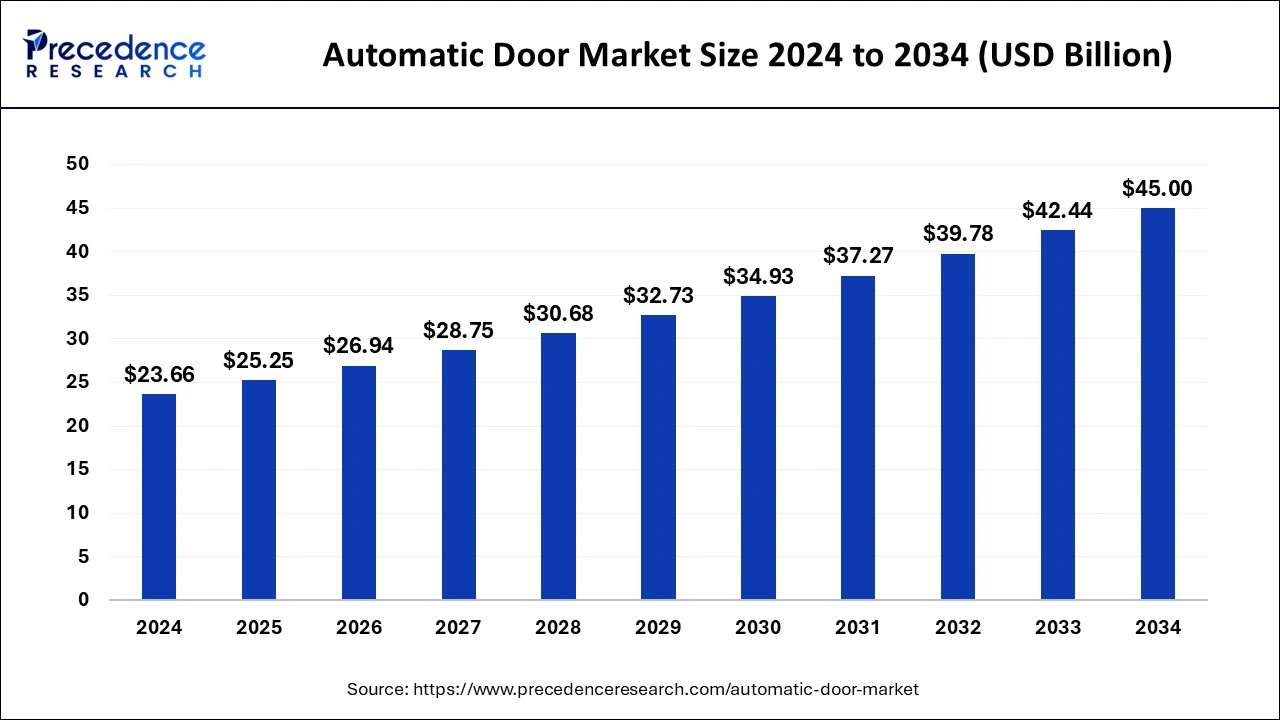
The global automatic door market size was valued at USD 25.25 billion in 2025 and is projected to reach USD 47.63 billion by 2035, growing at a CAGR of 6.55% from 2026 to 2035. Market growth is driven by increasing demand for touchless entry systems, smart building integration, energy-efficient infrastructure, enhanced security solutions, and accessibility compliance.
Source: https://www.precedenceresearch.com/automatic-door-market
 Get a Sample
 Table Of Content


What is the Automatic Door Market Size?
The global automatic door market size accounted for USD 25.25 billion in 2025 and is predicted to increase from USD 26.94 billion in 2026 to approximately USD 47.63 billion by 2035, expanding at a CAGR of 6.55% from 2026 to 2035. Growth of the market is driven by a growing need for touchless entry, smart building integration, plus energy-efficient infrastructure, and better security, along with accessibility compliance, healthcare expansion, and overall urbanization. It feels like smart city projects and AI and IoT-based automation are pushing automatic doors growth across global markets, pretty steadily.
Key Takeaways
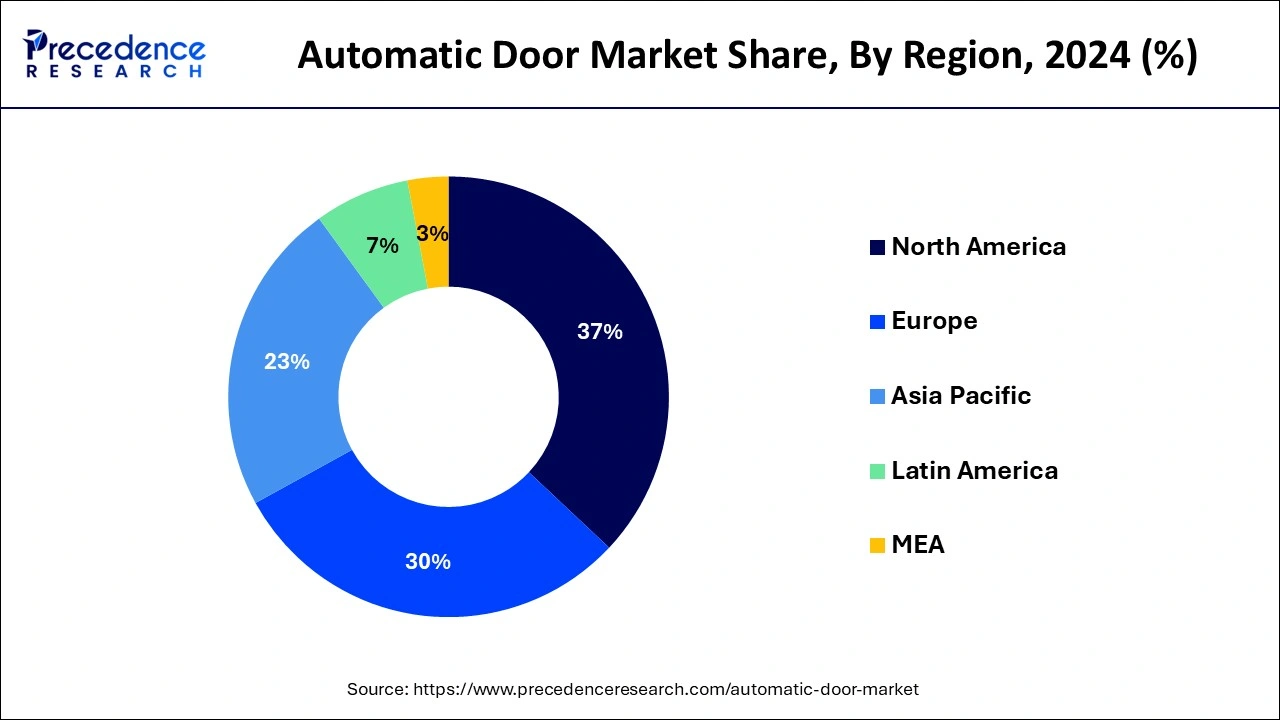
- North America dominated the automatic door market by holding 37% share in 2025.
- Asia-Pacific is expected to grow at the fastest CAGR during the forecast period.
- By door type, the sliding door segment dominated the market with the largest share of 42% in 2025.
- By door type, the swinging door segment is expected to be the fastest-growing during the forecast period.
- By function type, the sensor-based segment dominated the market with the largest share of 46% in 2025.
- By function type, the motion-based segment is the fastest-growing during the forecast period.
- By end-use type, the commercial segment dominated the market in 2025.
- By end-use type, the industrial segment is estimated to be the fastest growing during the forecast period.
Global Automatic Door Market Overview
The automatic door market involves technologically sophisticated door systems that are equipped with sensors, motion detectors, access control, and intelligent software platforms to open and close doors automatically. They are deployed in a variety of commercial, healthcare, transportation, industrial, and even residential applications to improve accessibility, safety, convenience, and energy efficiency.
The factors behind market growth are the increased demand for touchless entry solutions, smart building integration, strict accessibility regulations, and sustainability initiatives. Technological progress is surging as a result of industry consolidation, through mergers and acquisitions, with the expansion of government investment in smart infrastructure and public transportation projects also creating new opportunities for deployment. Today, automatic doors are increasingly becoming part of smarter buildings thanks to the addition of features such as IoT, AI, biometric authentication, and predictive maintenance.
Automatic Door Market Trends
- Intelligent Home Access Revolution: Automatic doors are an emerging part of smart home connectedness. Modern systems can easily be connected to home automation, security, voice assistants, and mobile apps. This has been growing the use of automatic doors from the commercial world into high-end residences, where convenience, security, and user experience are key.
- Rising Contactless Entry Experiences: The increasing concern for hygiene and public safety is driving up the demand for touchless automatic doors. The state-of-the-art infrared sensor, radar detection, and motion activation system provide hassle-free access without contact. Touch-free entry solutions are now being used more and more in healthcare facilities, retail establishments, airports, and office complexes to enhance user safety.
- Using Predictive Intelligence for Door Operations: AI and IoT technologies are driving automatic doors to become self-monitoring devices. Operational performance is constantly monitored by sensors, and they determine the condition of components and detect potential malfunctions before they happen. Predictive maintenance features help you minimize downtime, maintenance costs, and system reliability in high-traffic commercial and industrial settings.
- Mobile-Controlled Access Management: The automatic door is transforming how people enter and exit buildings, and the introduction of smartphone technology into the system is driving this change. Dedicated mobile applications are available for users to remotely monitor, lock, unlock, and configure entry systems. This trend increases the convenience, improves the security management, and offers any facility with real-time visibility of door operations, whether residential, commercial, or institutional.
- Energy-Smart Entrance Solutions: Energy-efficient automatic doors are being designed with considerations of sustainability goals in mind. The conditioned air loss due to advanced sealing technology, intelligent sensors, and optimized opening mechanisms is reduced and enhances environmental control. These systems can be used to minimize energy consumption and help optimize heating and cooling costs in buildings, and support green building certifications and energy conservation efforts.
- Accessibility-Centered Facility Design: Automatic door systems with unique functions are becoming more popular in hospitals, senior living communities, and public infrastructure projects. Low threshold entry, sound insulation, privacy-enhancing materials, and low energy use ensure that elderly patients and persons with disabilities can be reached and accommodated with greater ease and comfort, complying with regulations.
Key Technological Shifts and AI in the Automatic Door
Artificial intelligence (AI) is transforming automatic doors, from the usual electromechanical stuff into more intelligent access management platforms. Instead of just doing one routine action, AI-powered solutions look at real-time operational data and then try to make things better, like optimizing performance, improving safety, and yes, enhancing the overall user experience, which is kind of the point. The predictive maintenance algorithms continuously track motors, sensors, and mechanical parts to detect potential issues before they turn into a problem, cutting down maintenance expenses and downtime.
The AI vision system uses pattern recognition of pedestrian movements to automatically adjust door speed, opening time, and sensitivity according to traffic. The high-level object recognition technology helps doors to tell the difference between humans, animals, moving objects, and environmental changes, reducing false triggering and enhancing safety. Additionally, AI-driven facial recognition, behavior analysis, and threat detection systems also bolster security, making automatic doors a smart, intelligent entry point in today's smart building environment.
Automatic Door Market Growth Factors
- These automatic doors are the power doors in different settings. Improved automatic security doors may also provide enhanced security for the building.
- Enhanced energy efficiency of automatic doors may also help to enhance the energy efficiency of the building.
- Automatic doors are an important tool for enhancing accessibility for people who suffer from disability and also for everyone.
- Automatic doors are found in various sectors, including retail stores, office buildings, schools, and hospitals. These factors help to the growth of the automatic door market.
- For the community benefits by using the practical and convenience of automatic door openers, many businesses, contractors, architects, and building owners may create a more secure, efficient, and accessible environment.
Market Report Coverage and Key Metrics
| Report Scope | Details |
| Market Size in 2025 | USD 25.25 Billion |
| Market Size in 2026 | USD 26.94 Billion |
| Market Size by 2035 | USD 47.63 Billion |
| Market Growth Rate from 2026 to 2035 | CAGR of 6.55% |
| Largest Market | North America |
| Base Year | 2025 |
| Forecast Period | 2026 to 2035 |
| Segments Covered | Door Type, Function Type, End-use Type, and Regions |
| Regions Covered | North America, Europe, Asia-Pacific, Latin America, and Middle East & Africa |
Market Dynamics
Driver
Rising Demand for Touchless Hygiene and Convenience
The rising liking for contactless access solutions is sort of a key push behind the automatic door market, you know. Hospitals, retail outlets, airports, and office complexes are placing automatic doors more and more often, not just for speed but to boost hygiene, cut down direct touching, and keep people moving more easily through the space. After all the recent health focus, many organizations are putting extra emphasis on touchless infrastructure that feels safer and more convenient for users. Automatic doors also make things better for older adults and disabled people, while still helping with smooth transit in busy areas. And since smart facilities are still expanding all over the world, the need for frictionless, sanitary entry systems is likely to get stronger a lot.
Restraint
Operational Malfunctions and Maintenance Requirements
Though they offer benefits, automatic doors have their Share of problems, including sensor failures and maintenance requirements. Infrared sensors may get misaligned, become blocked, or become dirty and damaged, which can lead to failures and fluctuations in performance. Regular services and repairs can drive up building maintenance costs for building owners and facility managers. Also, unplanned failures can cause delays and adversely affect the user experience. The integration of sophisticated sensors, access control, and automation systems increases the maintenance challenges. These are the reasons why adoption might be constrained, especially in the price-sensitive residential and small-business markets.
Opportunity
Smart Building Ecosystems
The automatic door market offers great potential for the development and evolution of smart buildings. Modern automatic doors are being increasingly linked and connected to a Building Management System (BMS), to allow for centralized monitoring and control. These systems are synced with HVAC, security, surveillance, and access control systems to maximize efficiency. Smart integration optimizes energy savings by reducing conditioned air losses and ensures security with intelligent access management. The number of connected automatic door solutions is likely to significantly increase as governments and private entities spend a significant amount of money on smart infrastructure projects.
Segmentation Analysis
Door Type Insights
Which Door Type Segment Dominated the Automatic Door Market?
The sliding door segment dominated the market in 2025 because of its efficiency in space requirements, smooth operation, and robust market presence in commercial facilities. The use of sliding doors is widely prevalent in hospitals, airports, shopping centers, hotels, offices, and other buildings with a high volume of human traffic. This is complemented by their ability to support touchless technologies, accessibility, and energy-efficient operations. Further, the sliding door solutions are aesthetically pleasing and fully incorporate with recent building design, which has made them the top choice for many public and commercial infrastructure projects across the globe.
The swinging door segment is expected to grow at the fastest CAGR during the forecast period, due to the rising demand in healthcare, residential, and institutional applications. The flexibility of installation, reduced infrastructure demands, and compatibility with automatic and manual operation modes are all advantages of these doors. The growth of low-energy operators and accessibility designs is an additional factor of demand. Market growth will be aided by the increasing investment in healthcare facilities, assisted living centers, and public buildings. The segment also benefits from improved safety and intelligent access, further driving its growth.
Function Type Insights
The Sensor-Based Segment Dominated the Automatic Door Market in 2025
The sensor-based segment held the largest market share in 2025, as it offers touchless, convenient, and efficient access control. Motion sensors, infrared detectors, radar systems, and presence-detection technologies allow for smooth, touchless operation of the door. The growing emphasis on hygiene, accessibility, and streamlined operations has driven widespread implementation in the healthcare, retail, transport, and commercial industries. Energy savings are also enhanced with sensor-based automatic doors since they help to reduce the need for doors to open and conditioned air loss. The strong market demand for their reliability, convenience, and accessibility compliance remains.
A motion-based segment is expected to grow at the fastest CAGR during the forecast period, due to the growing demand for intelligent automation. Ongoing improvements to sensor accuracy, AI integration, and IoT connectivity are improving system performance and user experiences. Smart sensors allow for predictive maintenance, traffic monitoring, and adaptive door operations based on real-time conditions. The investments in smart buildings are rising, along with the increasing accessibility requirements and the need for touchless environments. The technological advancements are expected to further bolster the growth prospects of the segment globally.
End-use Type Insights
Why Did the Commercial Segment Dominate the Automatic Door Market?
The commercial segment dominated the market in 2025, owing to the high adoption in shopping malls, airports, office complexes, hotels, healthcare institutions, and educational institutions. Automatic doors are a vital part of commercial infrastructure because of their ease of use, accessibility needs, and requirements for hygiene. Modern automatic doors serve a variety of purposes, especially for businesses aiming to enhance convenience for their patrons, improve their operations, and manage their energy consumption. Moreover, government mandates about accessibility and public safety are ongoing to further encourage installation. The promising growth of the smart commercial buildings further strengthens the position of the segment in the market.
The industrial segment is expected to grow at the fastest CAGR during the forecast period, supported by the rising level of automation in manufacturing plants, warehouses, and logistics centers. Automatic doors provide efficiency of workflow, safety, and facilitate the smooth flow of goods and persons. The integration with various technologies of Industry 4.0, enterprise resource planning systems, and smart facility management platforms is helping to accelerate the adoption. High-speed industrial doors can play a significant role in maintaining environmental control, lowering energy use, and enhancing operational productivity. The investments in industrial automation are likely to see tremendous growth in the segment.
Market Regional Analysis: North America, Europe, Asia-Pacific
U.S. Automatic Door Market Size and Growth 2026 to 2035
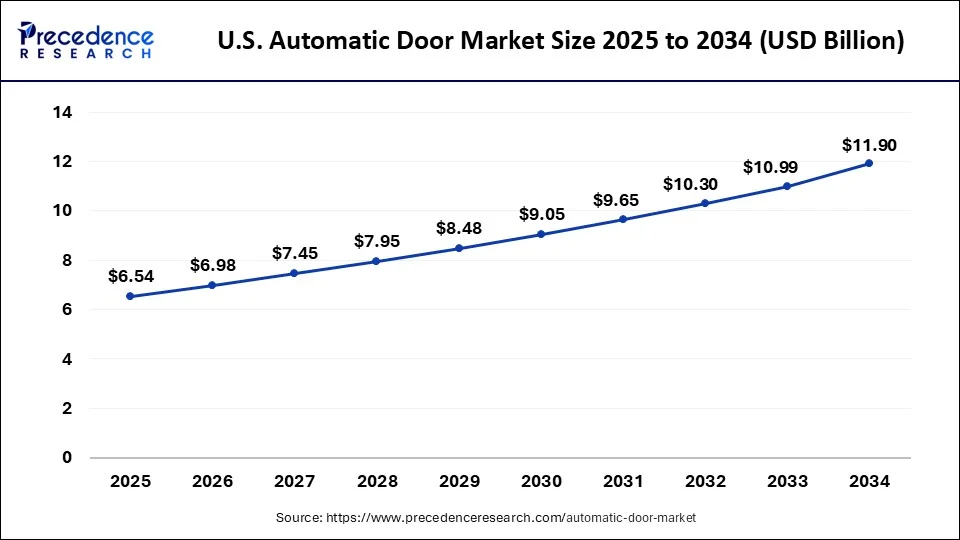
The U.S. automatic door market size was exhibited at USD 6.54 billion in 2025 and is projected to be worth around USD 12.66 billion by 2035, growing at a CAGR of 6.83% from 2026 to 2035.
U.S. Market Trends
An increasing number of automatic doors are being installed in hospitals, airports, retail centers, hotels, and office buildings in the U.S. market. The focus on hygiene, accessibility compliance, and building automation is driving uptake. Nationwide today, opportunities are emerging for sensor-based, AI-driven, energy-efficient, and connected automatic door systems thanks to infrastructure modernization efforts and investments in high-tech security systems.
How Did North America Lead The Automatic Door Market?
North America held a major market share in 2025, driven by the growing adoption of smart building technologies, the strict accessibility requirements, and high investments in commercial infrastructure. Demand is strong through health care, retail, airports, and office facilities. Innovation, modernization, and market expansion will continue to be advanced through growing integration of AI, IoT-connectivity, touchless access solutions, and energy-efficient building solutions.
How is Asia-Pacific Performing in the Automatic Door Market?
Asia-Pacific is expected to grow at the fastest CAGR during the forecast period, owing to rapid urbanization, industrialization, and infrastructure development. Installations are largely being driven by the expansion of smart city projects, transportation networks, and commercial construction. The growing focus on energy efficiency, accessibility compliance, and building automation systems in various regions continues to positively drive demand for advanced automatic door solutions.
India Market Trends
The growing commercial facility, modernization of the transportation system, and government-backed smart cities initiatives are creating a high-growth market in India. Automatic doors are being used more and more in airports, metro stations, hospitals, shopping malls, and corporate offices. Today, demand for touchless access, security, and energy-efficient solutions continues to drive adoption across a variety of end-use sectors.
What Are the Driving Factors of The Automatic Door Market in Europe?
Europe is expected to grow at a significant CAGR during the forecast period. With strict environmental laws, ease of access, and sustainability goals, Europe is anticipated to see substantial growth. With the growing trend of using green building methods and energy-saving materials, automatic doors have become more popular than ever. Healthcare infrastructure, commercial construction, and smart infrastructure investments continue to create favorable market conditions in the region steadily.
Germany Market Trends
Despite the economic downturn, Germany is one of the most important markets due to its high level of technology, building automation, innovative products, and its powerful manufacturing capacities. The need for smart access solutions, efficient entrance systems, and integrated building management platforms is growing. There are new opportunities available for automatic door companies across the nation today as a result of sustainability programs, the upgrading of commercial facilities, and investments in industrial automation.
What Are the Driving Factors of The Automatic Door Market in Latin America?
Latin America is expected to grow at a significant CAGR during the forecast period, due to urbanization, commercialization, and modernization of public infrastructure. Automatic doors are being used by businesses and institutions to make it easier, safer, and more efficient for people to use. The region offers ample opportunities to the market participants with respect to the healthcare infrastructure, retail, airport, and transportation developments.
Brazil Market Trends
Automatic door systems are gaining traction in Brazil, especially in hospitals, shopping centers, airports, office buildings, and hotels. Growth in markets is being aided by urban development projects and investments in infrastructure. The growing demand for touchless technologies, better security systems, and energy-efficient building systems is helping to drive automatic door growth across the nation's burgeoning building industry.
How are the Middle East and Africa performing in the Automatic Door Market?
The Middle East and Africa are expected to grow at a significant CAGR during the forecast period. Ongoing infrastructure development, smart city initiatives, and rising construction activities drive the market growth. Adoption is receiving some assistance from the growing investments in hospital facilities, transportation, and hospitality. The increasing focus on energy efficiency, cutting-edge security systems, and smart building technologies adds to the growth of the market regionally.
UAE Market Trends
Automatic door technologies are increasingly being adopted in the UAE for use in such key facilities as airports, luxury hotels, hospitals, shopping centers, and commercial buildings. Institutions are driving installations in the context of smart city programs and sustainable construction projects funded by the government. The demand for premium access solutions, improved security, touchless access, and energy-efficient infrastructure is further bolstering the country's role as a leading regional market.
Competitive Landscape: Leading Companies and Strategies
The automatic door market is semi-consolidated and is characterized by several major players, such as ASSA ABLOY, Dormakaba, GEZE GmbH, and Hörmann Group, who are competing with each other, partly by introducing new technology, with global reach and extensive product portfolios. Companies are expanding their positions through acquisitions, partnerships, manufacturing growth, and product development programs.
AI-driven predictive maintenance, IoT connectivity, biometric access control, and energy efficiency are among the critical features that give a project an edge over the others. There are start-up barriers, including capital needs, regulation and compliance, technology, and distribution. Smart building integration, sustainability, automation, and intelligent access management solutions will be the focus of future competition.
Automatic Door Market Top Companies and Their Offerings
- Record USA (RUSA): Manufactures high-quality sliding, swinging, revolving, and folding doors, along with burglar-resistant and hygienic options and solutions for commercial applications.
- Panasonic Corporation: Provides energy-efficient sliding and revolving doors with smart sensors, magnetic levitation, enhanced access controls, and hassle-free operation for contemporary building environments.
- Nabtesco Corporation: Provides sliding, swing, hermetic, and breakout doors designed to meet barrier-free access, reliability, hygiene, and healthcare facility needs.
- Horton Automatics: Manufacturers of commercial and industrial sliding, swinging, and revolving doors products, including special ICU / CCU entrance products for healthcare applications.
- GEZE GmbH: Customizable sliding, revolving, and integrated entrance systems designed with a focus on thermal insulation, architectural flexibility, energy efficiency, and building smartness.
Other Automatic Door Market Companies
- Zhejiang Seacon Door Technology Co., Ltd
- Wilcox Door Service Inc
- Vortex Industries, Inc
- Ultra Safe Security Doors
- TORMAX USA Inc
- Stanley Access Technologies (a part of Dormakaba)
- Royal Boon Edam International B.V.
- Entrematic
- Dormakaba Group
- ASSA ABLOY Entrance System
Recent Developments in the Automatic Door Market (2025–2026)
- In April 2026, Mumbai introduced its first non-AC local train featuring automatic closed doors to enhance safety for commuters, who traditionally risk hanging near train doors while avoiding heavy traffic for quicker travel. (Source: https://curlytales.com)
- In March 2026, Tesla's 2012 Model S introduced hidden door handles, leading to widespread adoption of electronic door releases in modern vehicles. This design simplifies manufacturing and reduces costs, but presents a critical issue: loss of power prevents door access after emergencies.
(Source: https://www.autoevolution.com) - In March 2024, in India, Lexus 350h luxury MPV was launched at Rs. 2 crores. It includes various features like a power sliding door switch, audio output systems, infrared sensors for power seat long slide rail, multi-position tip-up seat, and climate control.
- In October 2023, non-handed automatic swinging doors were released by the NABCO. They are used as both sides for right-handed and left-handed automatic swing door applications and are capable of 330 lbs door weight in low energy applications.
- In May 2022, a new bus sliding door 028d slim model, with safety and an eye on lightness, was launched by Spanish Masats. It is useful in the new autonomous vehicles, which give great safety system properties.
- In June 2023, a pure electric MPV Surpasses version model D1 was launched by BYD. In this type of model, there is the use of hidden door handles and electric sliding doors are used.
Segments Covered in the Report
By Door Type
- Sliding Door
- Swinging Door
- Folding Door
- Revolving Door
- Bi-fold Doors
- Others
By Function Type
- Sensor Based
- Motion Based
- Push Button
- Access Control
By End-use Type
- Residential
- Commercial
- HoReCa
- Shopping Malls
- Airports Hospitals
- Others (Retail Stores, etc.)
- Industrial
- Warehouse
- Manufacturing Facilities
By Region
- North America
- Asia Pacific
- Europe
- Latin America
- Middle East & Africa
For inquiries regarding discounts, bulk purchases, or customization requests, please contact us at sales@precedenceresearch.com
Frequently Asked Questions
Tags





Ask For Sample
No cookie-cutter, only authentic analysis – take the 1st step to become a Precedence Research client
 Get a Sample




 sales@precedenceresearch.com
 Schedule a Meeting
