



Automotive Human Machine Interface Market Size, Key Companies, Company Market Share, Vehicle Production Volume, Sales Performance, Export & Import Analysis, Technology Adoption, Competitive Positioning, and Demand Trends
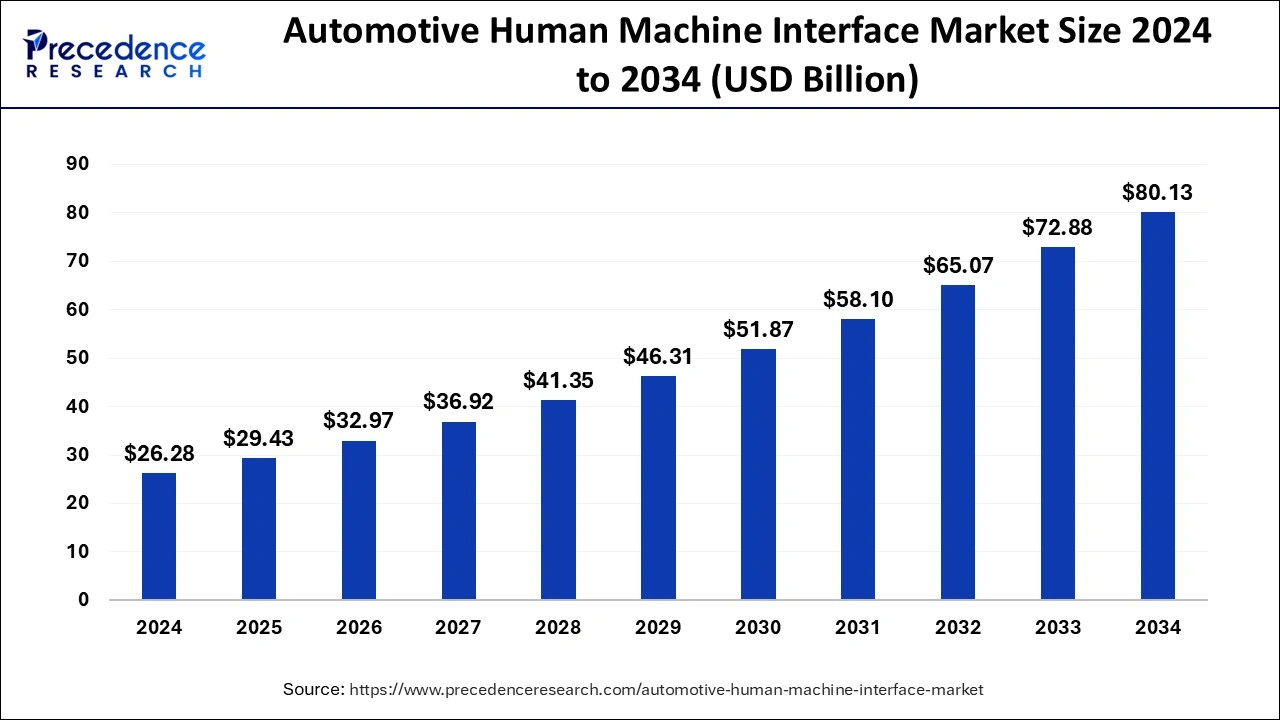
The global automotive human machine interface market size is calculated at USD 32.97 billion in 2026 and is forecasted to reach around USD 80.13 billion by 2034, a11.79elerating at a CAGR of 11.79% from 2025 to 2034. The North America automotive human machine interface market size surpassed USD 10.25 billion in 2024 and is expanding at a CAGR of 11.80% during the forecast period. The market sizing and forecasts are revenue-based (USD Million/Billion), with 2024 as the base year.
Source: https://www.precedenceresearch.com/automotive-human-machine-interface-market
 Get a Sample
 Table Of Content


Automotive Human Machine Interface Market Size and Forecast 2025 to 2034
The global automotive human machine interface market size was estimated at USD 32.97 billion in 2026 and is anticipated to reach around USD 80.13 billion by 2034, expanding at a CAGR of 11.79% from 2025 to 2034. The increasing demand for advanced features in luxury vehicles has boosted the growth of the automotive human machine interface (HMI) market.
Automotive Human Machine Interface Market Key Takeaways
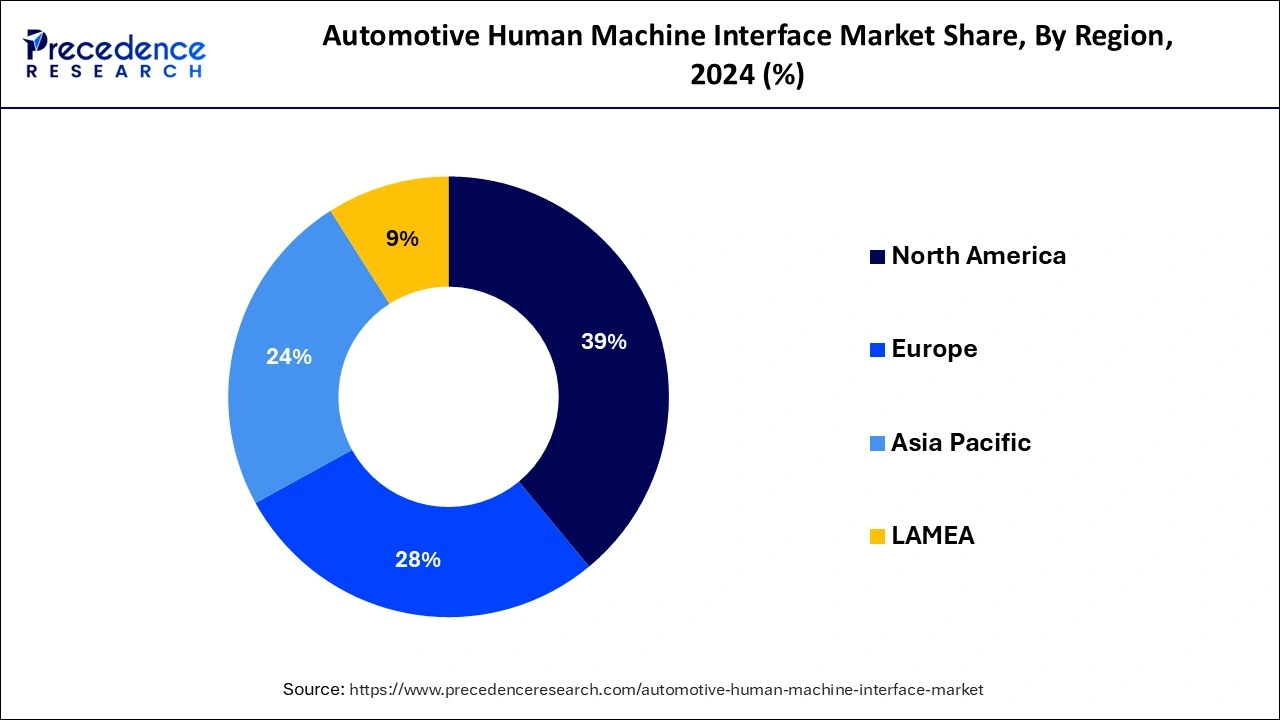
- North America led the global automotive human machine interface market with the largest market share of 39% in 2024.
- By technology, the visual segment has held the biggest market share in 2024.
- By technology, the acoustic segment is expected to grow at a remarkable CAGR during the forecast period.
- By product type, the instrument cluster segment captured the maximum market share in 2024.
- By product type, the heads-up display (HUD) segment is projected to grow at the fastest CAGR over the projected period.
- By vehicle type, the passenger vehicle segment accounted for the largest market share of 77% in 2024.
What is Automotive Human Machine Interface?
An automotive human machine interface includes hardware and software components that enable the driver and passengers to interact and control the car. Automotive HMI is a set of elements such as an instrument cluster, in-vehicle infotainment, or heads-up displays (HUD) that allow the driver to interact with the vehicle through touch, gesture, or voice interactions. Growing demand for advanced digital battery management displays, dashboards, energy analytic interfaces and smart navigation systems. Further, a significant rise in the number of electric and hybrid vehicles has increased the amount of HMI content per vehicle.
What is the Role of AI in Automotive Human Machine Interface (HMI) Market?
AI is creating noticeable impact in the automotive industry. Nowadays, automotive HMI developers have started integrating artificial intelligence (AI) in their systems for numerous applications. Firstly, AI helps in enhancing the design of HMI with the use of AI-powered assistants such as Alexa, Siri, Google Assistant, and some others that allow smooth human interactions with devices using natural language. Secondly, AI plays a prominent role in personalization inside the vehicle. AI algorithms helps in analyzing user behavior, preferences, and historical data to personalize interfaces according to individual users. Additionally, AI enhances predictive analytics for forecasting user actions and automating routine tasks in automotives. Thus, the advancements in AI is expected to positively impact the automotive human machine industry.
- In January 2024, Google launched an AI-based smart texting feature for android auto. This feature enable drivers aims in streamlining text-based communication by summarizing lengthy texts and messages.
Automotive Human Machine Interface Market Growth Factors
- A user interface or dashboard that connects a human to a machine, device, or a system is known as automotive human machine interface (HMI). While human machine interface (HMI) can also be referred to any screen that allows a user to interact with a device, it is most usually associated with industrial operations.
- The rise in consumer concern about safety and security features, as well as the adoption of superior interiors for automobiles, is the key factors driving the automotive human machine interface (HMI) market growth. Furthermore, the expansion of vehicle production and sales in Asia-Pacific's developing countries is driving the automotive human machine interface (HMI) market. The progress of communication systems and infotainment systems directly influences the growth of the automotive human machine interface (HMI) market.
- The technological advancements that are making the connected vehicles as the future of interaction and communication with other devices in a technology-driven environment are expected to be major factor boosting the demand for automotive human machine interface (HMI) in the market. In addition, the surge in demand for electric vehicles is driving the growth of automotive human machine interface (HMI) market during the forecast period.
- Furthermore, the potential to improve the driver's in-vehicle experience and provide flawless contact between the vehicle and its passengers is projected to complement the growing sales of automotive human machine interface (HMI), ensuring safe and rich on-road experience with diversified communication system.
Market Scope
| Report Coverage | Details |
| Growth Rate from 2025 to 2034 | CAGR of 11.79% |
| Market Size In 2025 | USD 29.43 Billion |
| Market Size In 2026 | USD 32.97 Billion |
| Market Size by 2034 | USD 80.13 Billion |
| Largest Market | North America |
| Base Year | 2024 |
| Forecast Period | 2025 to 2034 |
| Segment Covered | By Technology, By Product Type, and By Vehicle Type |
| Regions Covered | North America, Europe, Asia-Pacific, Latin America, and Middle East & Africa |
Segments Insights
Technology Insights
How did the Visual Segment Dominate the Automotive Human Machine Interface Market in 2025?
The visual segment dominated the market in 2025, due to widespread integration of digital displays. The visual human machine interface system enables data to be displayed visually on connected devices such as built-in screens on machines, tablets, and computer or laptop monitors. The visual human machine interface also provides real time data to the end-users. Visual displays have become an integral part of the car's user interface, improving both the driver's experience and the vehicle's aesthetic appeal.
The acoustic segment is estimated to be the most opportunistic segment during the forecast period, driven by stricter noise pollution regulations, growing demand for premium in-cabin experiences, and technological shifts toward electric vehicles. The key market players are utilizing innovative technologies for the growth of the human machine interface market. One such technology is acoustic technology. This technology helps in the reduction of the load of visual and sensory components of the HMI system.
Product Type Insights
Why did the Instrument Cluster Segment Dominate the Market in 2025?
The instrument cluster segment held the dominant share of the market in 2025, due to the rapid growth of electric vehicle sales. For a better user experience, key market players are utilizing improved graphic displays in automotive instrument clusters. Automotive instrument clusters are primarily a data source for the driver, which displays important information about the status of the vehicle. As the demand for connected and automated vehicles rises, the demand for digital instrument clusters is on the rise.
The heads-up display (HUD) segment is anticipated to grow at the fastest rate during the forecast period, due to growing demand for advanced driver assistance, navigation overlays, and improved safety features. The automotive heads-up display segment will rise at a rapid rate during the forecast period, owing to increased efforts to reduce road accidents and increased consumer awareness about vehicle and passenger safety.
Vehicle Type Insights
Which Vehicle Type Segment Dominated the Market in 2025?
The passenger vehicle segment accounted for the largest market share in 2025. The growing urban population and their commuting needs have contributed to the growth of the segment. Furthermore, consumers choose electric automobiles because of low operating and maintenance costs, with the growing trend of employing clean energy for vehicle production. Evolving consumer behavior, quick digitization, and OEM-led innovation in cockpit design are further driving the segment growth.
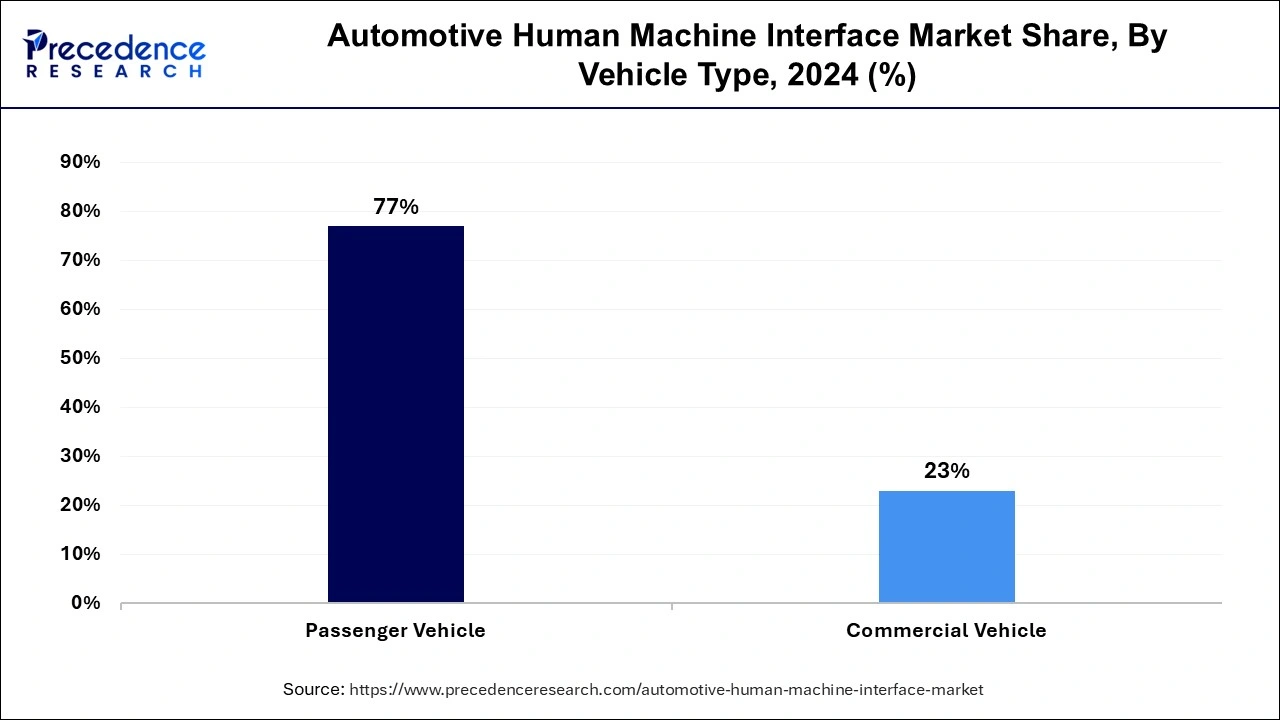
The commercial vehicle segment is expected to grow at the fastest CAGR during the forecast period, due to rapid urbanization, rising disposable income, and improved standard of living. Over the last few years, the demand for commercial vehicles has surged. This has led to the growing demand for commercial vehicles in most of the developed countries due to regional economic development. As a result, the commercial vehicle demand is expected to grow and develop at a fast rate. HMI facilitates interaction between drivers, passengers, and vehicles in commercial vehicles such as trucks, buses, and vans.
Regional Insights
Which Region Dominated the Automotive Human Machine Interface Market in 2025?
North America dominated the market in 2025, driven by the increase in the number of automotive manufacturers in places such as Michigan and Detroit. Also, the growing integration of HUD in cars along with numerous collaborations and partnerships among market players also drives market expansion. Moreover, the technological advancements in the automotive industry coupled with heightened consumer preference for aesthetics in modern vehicles further proliferates the industrial growth.
U.S. Automotive Human Machine Interface Market Size and Growth 2025 to 2034
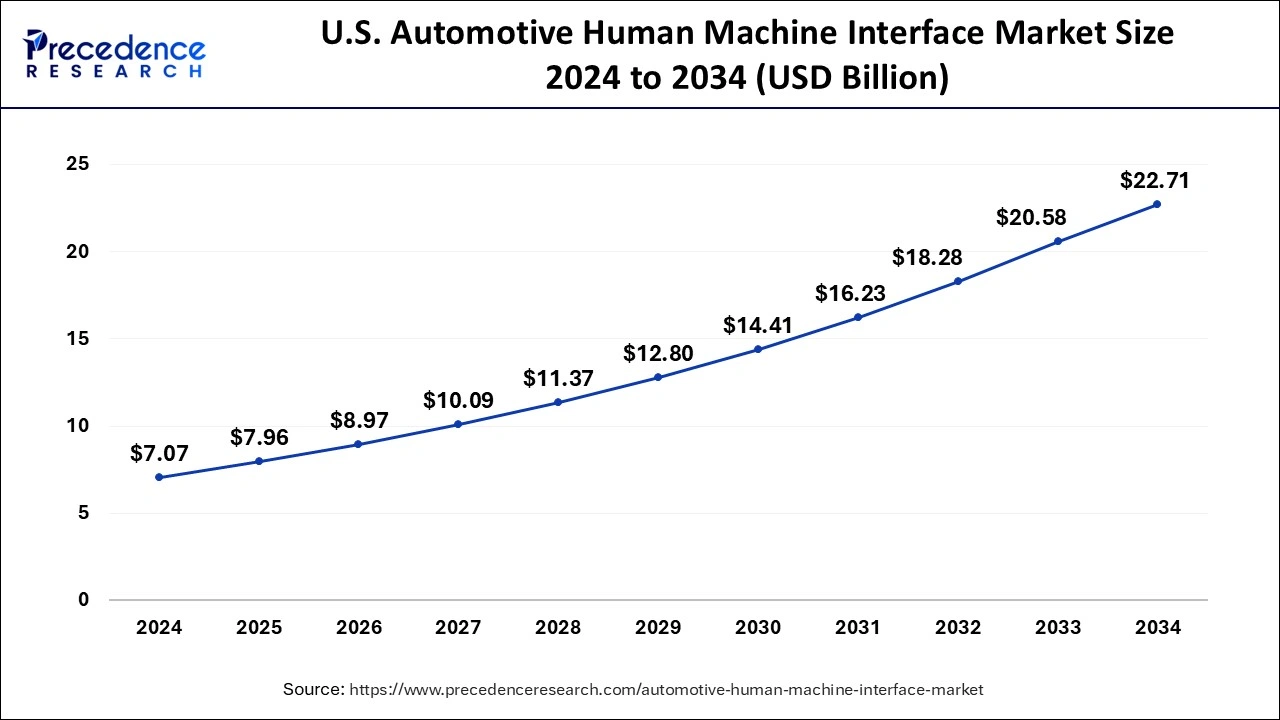
The U.S. automotive human machine interface market size was evaluated at USD 7.07 billion in 2024 and is predicted to be worth around USD 22.71 billion by 2034, rising at a CAGR of 12.37% from 2025 to 2034.
U.S. Market Trends
Demand for automotive HMI in the U.S. is driven by increasing demand for advanced in-car experiences, increasing use of infotainment systems, and convergence of voice, gesture, and touch controls. These innovations enhance convenience, safety, connectivity, and overall driver satisfaction in passenger as well as commercial vehicles. Modern vehicles now support a variety of HMIs, such as steering wheel controls, touchscreens, voice assistants like Alexa or Google Assistant, and gesture controls that enable drivers to perform functions without physically touching any interface.
Europe Automotive Human Machine Interface Market Trends
Europe is expected to grow at the fastest rate during the forecast period, due to the presence of a developed automotive industry with companies such as Volkswagen, Porsche, McLaren and some others. Also, the growing adoption of EVs due to heightened consumer awareness regarding emissions has further contributed to the market growth. Moreover, the increasing sales of luxury vehicles along with rapid investment in the automotive aftermarket industry has fostered the market expansion.
Germany Market Trends
Germany is the major market in Europe for human machine interface solutions. The market in Germany is poised for significant growth, driven by an increased demand for intuitive interfaces and advanced connectivity features in vehicles. Technological advancements in voice recognition, augmented reality, and AI-powered solutions are boosting the evolution of human-machine interfaces.
Asia Pacific Automotive Human Machine Interface Market Trends
The Asia Pacific automotive human machine interface sector is experiencing rapid growth, fueled by increasing vehicle digitalization and a rising demand for connected vehicles. This dynamic region, characterized by a mix of rapidly developing economies and diverse cultures, requires businesses to implement well-thought-out strategies for successful operations. The adoption of Industry 4.0 technologies, including human machine interface software, is accelerating due to government initiatives and private sector investments.
India Market Trends
India is witnessing robust growth, driven by several key factors. Firstly, the escalating demand for connected and autonomous vehicles has significantly contributed to the expansion of the HMI market. As vehicles become more sophisticated and integrated with advanced technologies, the need for intuitive and user-friendly interfaces becomes essential. Moreover, the increasing focus on enhancing the overall driving experience and safety features has spurred the adoption of advanced HMIs in automobiles.
Middle East and Africa Automotive Human Machine Interface Market Trends
The market in the Middle East and Africa is rapidly growing due to the rising demand for vehicle electrification. Major car manufacturers, including Volkswagen, Toyota, General Motors, Groupe PSA, and Mercedes-Benz, are investing in local assembly across North Africa, including countries like Morocco, Algeria, and Egypt, as well as in sub-Saharan markets such as Rwanda, Ethiopia, Kenya, and Ghana. South Africa stands out as the largest new vehicle market in the world and is home to the continent's most numerous vehicle manufacturing companies, while Nigeria is the most populous country in Africa.
Saudi Arabia Market Trends
The increasing adoption of connected and autonomous vehicle technologies, coupled with rising consumer demand for enhanced in-vehicle experiences, is significantly impacting the industry. In Saudi Arabia, there is a surge in AI startups focused on automotive innovation, supported by government funding and private investments. Groundbreaking partnerships between global corporations and Saudi companies broaden the potential for the automotive industry in the region.
Latin America Automotive Human Machine Interface Market Trends
The automotive industry is progressively adopting automation for various reasons, including the demand for higher production and improved efficiency. The growing popularity of connected cars and autonomous vehicles is expected to significantly boost the demand for automotive HMI products in Latin America over the coming years. Mexico and Brazil have developed automotive sectors, with Mexico producing over four million motor vehicles in 2023.
Brazil Market Trends
Brazil's position in the global automotive landscape is strengthened by a notable increase in manufacturing capabilities. The growing automotive sector is driving the demand for automotive HMI. According to Agência Brasil, automakers produced 2.65 million vehicles in Brazil in 2025, marking a 3.5% increase compared to 2024, which represents the best year for the automotive industry since 2019.
Key Companies & Market Share Insights
The automotive human machine interface (HMI) market is moderately fragmented with the presence of several local companies. These market players are striving to gain higher market share by adopting different marketing strategies, such as new product launch, investments, partnerships, and mergers & acquisitions. The companies are also spending on the development of improved products. Moreover, they are also focusing on competitive pricing.
The various developmental strategies such as new product launches, acquisition, partnerships,business expansion, investments, joint venture, and mergers fosters market growth and offers lucrative growth opportunities to the market players.
Automotive Human Machine Interface (HMI) Market Companies
- Bosch Inc.
- Denso Corporation
- Continental AG
- Alpine Electronics Inc.
- Panasonic Corporation
- Visteon Corporation
- Nuance Communications Inc.
- Clariaon Co. Ltd
- Harman
- Samsung Electronics Co. Ltd
Latest Announcements by Industry Leaders
- In April 2024, Michihiro Imada, the executive officer of Mazda mentioned that in the cockpit HMI area, Mazda will continuously evolve in the automotive HMI sector for delivering superior mobility experiences.
Recent Developments
- In March 2026, to meet the growing demand for HMI solutions, Microchip Technology announced the introduction of the AEC-Q100 Grade 2-qualified SAM9X75D5M System-in-Package, which integrates an Arm926EJ-S™ processor with 512 Mbit DDR2 SDRAM. This new product supports large display sizes of up to 10 inches and XGA resolution of 1024 × 768 pixels.
- In April 2026, Toulouse-based Nanomade, in collaboration with PolyIC, unveiled the development of a transparent film that seamlessly integrates capacitive touch and force sensing into a single flexible layer. The companies assert that this solution is the first of its kind to be realized in a fully transparent format, specifically targeting next-generation human-machine interface applications.
- In May 2026, Nauto unveiled new telematics capabilities that provide comprehensive visibility into vehicle tracking, utilization, misuse, and maintenance planning. The latest offering includes telematics in conjunction with AI-powered driver and vehicle safety features all consolidated within a single device and software platform.
- In January 2024, Antolin announced to inaugurate a manufacturing plant in Pune, India. This plant is opened to develop HMI systems and electronics for automotives.
- In November 2023, BCS Automotive Interface Solutions collaborated with UltraSense Systems. This collaboration is done for enhancing the capabilities of human machine interface (HMI) in automotives.
- In October 2023, Elektrobit launched Theming Engine. Theming Engine is a software that is designed for enabling in-car HMI customization in vehicles.
Segments Covered in the Report
By Technology
- Visual
- Acoustic
By Product Type
- Voice Control
- Central Display
- Instrument Cluster
- Steering Mounted Control
- Rear-seat Entertainment (RSE) Display
- Heads-up Display (HUD)
By Vehicle Type
- Passenger Vehicle
- Commercial Vehicle
By Geography
- North America
- Asia Pacific
- Europe
- Latin America
- Middle East and Africa
For inquiries regarding discounts, bulk purchases, or customization requests, please contact us at sales@precedenceresearch.com
Frequently Asked Questions





Ask For Sample
No cookie-cutter, only authentic analysis – take the 1st step to become a Precedence Research client
 Get a Sample




 sales@precedenceresearch.com
 Schedule a Meeting
