



Battery Swapping Market Trends, Companies, Revenue / Sales Performance, Manufacturing Yield, Fab Capacity, Export & Import Dynamics, Supply Chain Analysis, Competitive Landscape, and Growth Forecast
Battery Swapping Market (By Vehicle Type: Two-Wheeler, Three-Wheeler, Passenger Car, Commercial Vehicle; By Operation Type: Automated, Manual; By Service Type: Subscription, Pay Per Use) - Global Industry Analysis, Size, Trends, Leading Companies, Regional Outlook, and Forecast 2026 to 2035
Source: https://www.precedenceresearch.com/battery-swapping-market
 Get a Sample
 Table Of Content


What is Battery Swapping Market Size in 2026?
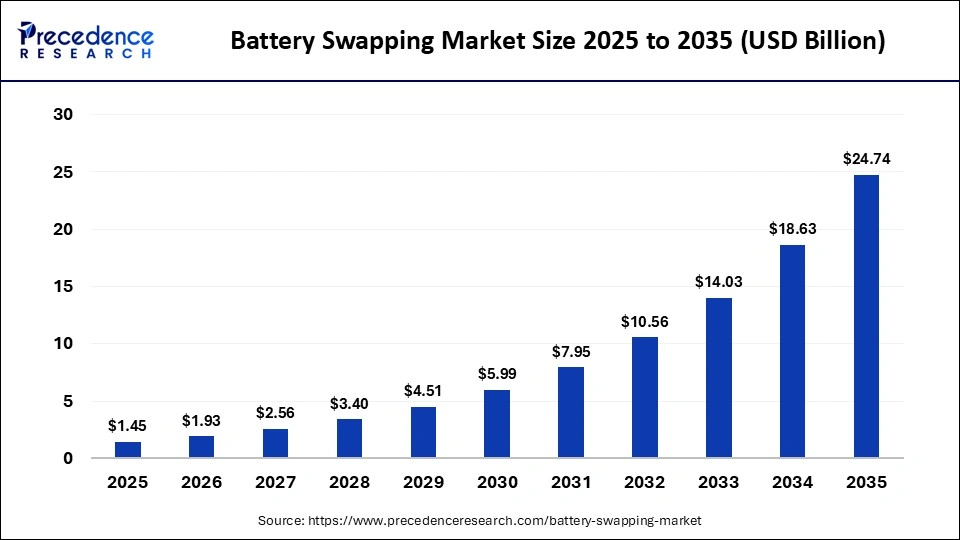
The global battery swapping market size was calculated at USD 1.45 billion in 2025 and is predicted to increase from USD 1.93 billion in 2026 to approximately USD 24.74 billion by 2035, expanding at a CAGR of 32.80% from 2026 to 2035. The growth of the market is driven by the rise in investment in battery swapping infrastructure. As the demand for Electric Vehicles (EVs) increases globally, battery swapping offers a promising solution to mitigate concerns over range anxiety and long charging times.
Key Takeaways
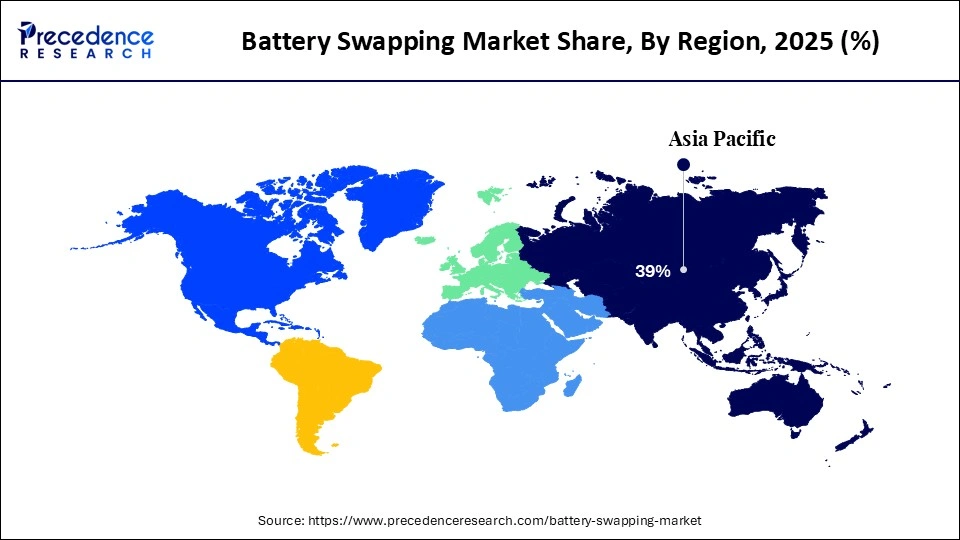
- By region, Asia Pacific dominated the market with the largest share of 39% in 2025.
- By region, North America is expected to grow at a significant CAGR during the forecast period.
- By vehicle type, the two-wheeler segment dominated the market with the largest share in 2025.
- By vehicle type, the three-wheeler segment is expected to grow at a significant CAGR during the forecast period.
- By operation type, the automated segment dominated the market with the largest share of 64% in 2025.
- By operation type, the manual segment is projected to grow at the fastest CAGR during the forecast period.
- By service type, the pay per use segment dominated the market share of 52% in 2025.
- By service type, the subscription segment is projected to grow at the fastest CAGR during the forecast period.
Market Overview
Battery swapping allows EV users to replace a depleted battery with a fully charged one in less than 5 minutes. This reduces downtime and lowers upfront vehicle costs by separating battery ownership from the vehicle under the battery-as-a-service (BaaS) model. It is particularly beneficial for last-mile delivery and fleet operators that require continuous vehicle usage. Additionally, governments worldwide are promoting cleaner transportation through incentive-supportive policies and stricter emission regulations. Majors such as zero-emission zones are being introduced to reduce transport-related pollution. Several nations have implemented ultra-low emission zones (ULEZ), encouraging the adoption of electric and low-emission vehicles.
How are Technological Advancements Influencing the Battery Swapping Market?
The battery swapping market is rapidly evolving with the integration of advanced technologies and artificial intelligence. Automated robotic systems enable quick and precise battery replacement, reducing manual effort and improving operational efficiency. AI-driven software monitors battery health, tracks performance data such as temperature and charge cycles, and predicts and maintains needs to extend battery life. Cloud and IoT connectivity allow real-time tracking of battery inventory, energy demand, and station performance across networks. Smart mobile applications help users locate nearby stations and check battery availability. Together, these innovations make battery swapping faster, smarter, and more reliable.
Battery Swapping Market Trends
- Increased Adoption of Electric Vehicles: The rising adoption of electric two-wheeler and three-wheeler vehicles is driving growth in the market. Manufacturers are now building EVs with swap-ready designs from the start. Companies like Honda have launched large-scale swab services while Battery Smart continues expanding its urban network. Meanwhile, CATL is working with automakers to standardize battery packs. With limited space for curb-side charging in dense cities, centralized swapping stations offer us a faster and more practical solution.
- Sustainability & Supportive Regulations: Battery swapping helps improve sustainability by extending battery life through proper maintenance and organized reuse, which also makes recycling easier and more efficient. At the same time, government support is speeding up market growth. For instance, India officially recognized the battery as a service model in 2025 and simplified power connection approvals for Swap stations. Stricter emission rules and low-emission zones in cities like London and Paris are encouraging the shift toward cleaner and more sustainable transport options.
- Global Expansion: The market is expanding globally through partnerships between automakers, energy companies, and city planners. In many developing markets, it offers a practical solution where grid access and charging infrastructure are limited. Several major cities across the world, including Shanghai, Delhi, London, and Los Angeles, are restricting internal combustion delivery vehicles during peak hours, creating strong demand for electric fleets. The model battery system supports commercial vehicles, helping operators reduce downtime costs through subscription models.
- Startup Ecosystem: Startups are actually shaping the market with innovative solutions such as AI-based battery health diagnostics Compact automated swap stations, and flexible subscription plans tailored for fleets and shared mobility services. For example, companies like Battery Smart are using data-driven platforms to optimize battery usage and station performance, making operations more efficient for urban transport providers.
Market Scope
| Report Coverage | Details |
| Market Size in 2025 | USD 1.45 Billion |
| Market Size in 2026 | USD 1.93 Billion |
| Market Size by 2035 | USD 24.74 Billion |
| Market Growth Rate from 2026 to 2035 | CAGR of 32.80% |
| Dominating Region | Asia Pacific |
| Fastest Growing Region | North America |
| Base Year | 2025 |
| Forecast Period | 2026 to 2035 |
| Segments Covered | Vehicle Type, Operation Type, Service Type, and region |
| Regions Covered | North America, Europe, Asia-Pacific, Latin America, and Middle East & Africa |
Segment Insights
Vehicle Type Insights
Why Did the Two-Wheeler Segment Dominate the Battery Swapping Market?
The two-wheeler segment dominated the market with the highest share in 2025 due to the high adoption of electric scooters and motorcycles in urban areas, especially in densely populated countries where affordability, short-distance commuting, and quick turnaround times are critical. Two-wheelers benefit most from battery swapping because smaller batteries are easier and faster to exchange, reducing downtime for riders. Two-wheelers are widely used for daily commuting because they are affordable and practical. Battery swapping fits well with this segment as urban riders value quick service, low cost, and minimal waiting time.
The three-wheeler segment is expected to grow at a significant rate during the forecast period. The growth of the segment is driven by the increasing adoption of electric auto-rickshaws and e-cargo vehicles in last-mile transportation and urban logistics. Battery swapping allows these vehicles to operate continuously without long charging downtimes, improving efficiency for fleet operators and ride-sharing services. Supportive government policies, rising fuel costs, and the push for clean urban transport are further driving the growth of this segment.
Operation Type Insights
What Made Automated the Dominant Segment in the Battery Swapping Market?
The automated segment dominated the market with the largest share of 64% in 2025, mainly because it offers higher efficiency and a smoother user experience. With the help of robotics, artificial intelligence, and advanced sensors, automated swapping stations can replace batteries quickly and accurately without human involvement. This makes the process faster, more reliable, and convenient for users. In busy urban areas and commercial fleet operations where every minute matters, automated systems can complete a battery exchange in just a few minutes, resulting in significantly less downtime.
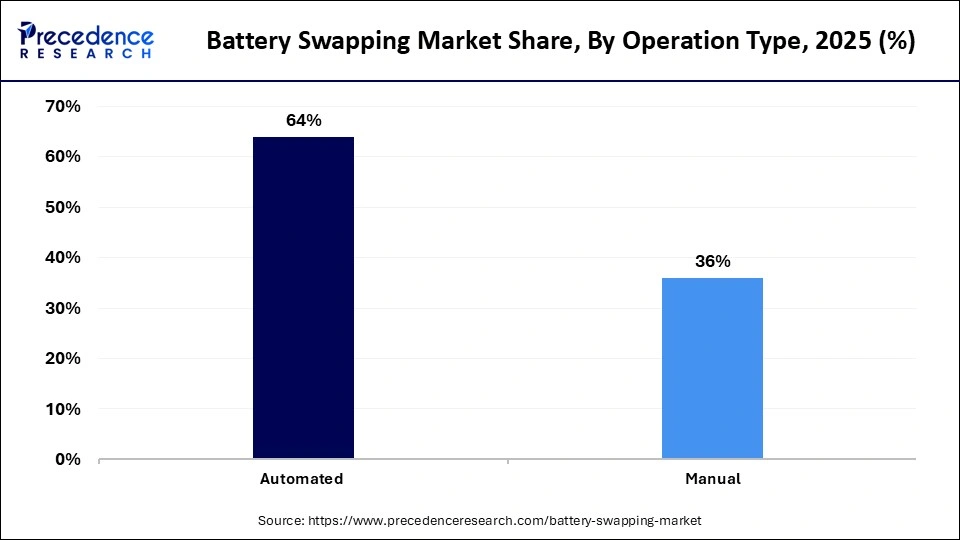
On the other hand, the manual segment is expected to grow at the fastest rate during the forecast period. Manual systems require lower initial investment and simpler infrastructure, making them suitable for emerging markets and smaller operators. They are easier to deploy in semi-urban and rural areas where full automation may not yet be practical. For many small businesses and fleet owners, manual shopping provides cost-effective and flexible solutions supporting faster expansion of battery swapping networks.
Service Type Insights
Why Did the Pay Per Use Segment Lead the Battery Swapping Market?
The pay per use segment dominated the market with a major share of 52% in 2025, as this model allows users to pay only when they swap a battery without any long-term commitment or large initial investment. It appeals to casual light riders, short-distance commuters, and delivery operators with variable demand. The pay-as-you-go approach offers financial flexibility and lowers entry barriers, making battery swapping more accessible to small plate owners and cost-sensitive users.
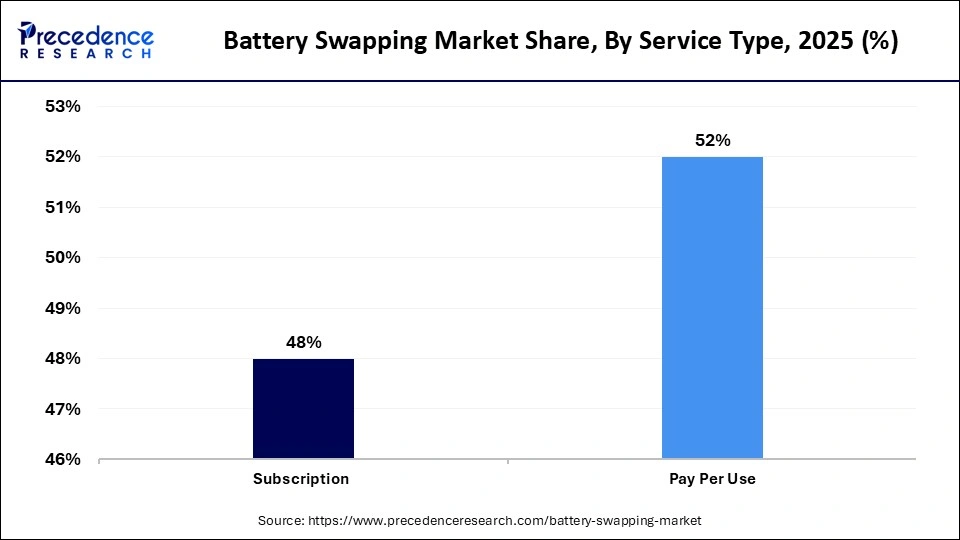
The subscription segment is expected to grow at the fastest rate in the upcoming period, driven by its offering of convenience and predictable costs. Under this model, users lease batteries instead of owning them, paying a fixed fee based on their usage needs. This reduces the upfront cost of owning an electric vehicle and lowers the amount paid at each swap, making expenses easier to manage. Rising availability of flexible subscription plans designed for individuals, delivery riders, and fleet operators is allowing businesses to choose plans that match their daily operational requirements.
Regional Insights
Asia Pacific Battery Swapping Market Size and Growth 2026 to 2035
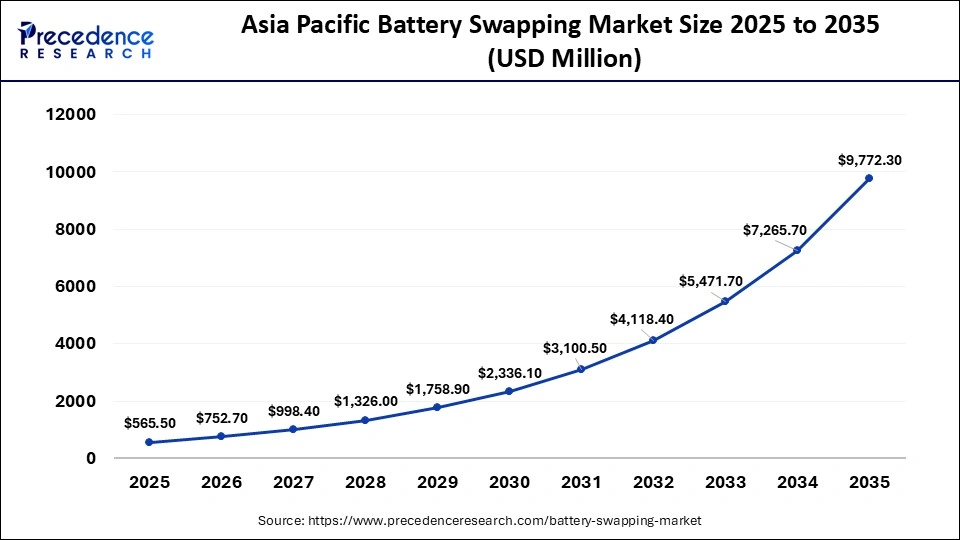
The Asia Pacific battery swapping market size is expected to be worth USD 9,772.30 million by 2035, increasing from USD 565.50 million by 2025, growing at a CAGR of 32.97% from 2026 to 2035
What Made Asia Pacific the Dominant Region in the Battery Swapping Market?
Asia Pacific dominated the battery swapping market with the highest share of 39% in 2025 and is expected to sustain its leading position in the coming years. This is mainly due to the region's rapid shift toward electric mobility, supported by favorable government policies and incentives. Countries like China, India, Japan, and South Korea are actively promoting electric two and three-wheelers to reduce emissions and improve urban transport. High population density and rapid urbanization have increased the need for quick and convenient mobility solutions, encouraging large-scale deployment of swapping infrastructure. The region also benefits from a strong manufacturing base, enabling cost-effective production and faster expansion through technological innovation and strategic partnerships with the major players in the region.
China Market Analysis
China's battery swapping market is growing rapidly, supported by strong government backing and continuous technological progress. Policy incentives, subsidies, and pilot programs have encouraged companies to invest in large-scale swapping infrastructure. At the same time, improvements in battery standardization and faster swapping systems have made it more practical and commercially viable. The need for quick energy replenishment is especially important for commercial EV fleet operators who cannot afford loan charging delays. Regarded as the world's largest EV hub, China provides a solid foundation for expanding battery swapping markets across cities.
India Market Analysis
India's battery swapping market is expanding at a faster rate, mainly driven by the rapid adoption of electric two- and three-wheelers in urban areas. As more consumers and delivery operators choose EVs, the demand for fast and convenient energy solutions is increasing. The government had introduced supportive policies, financial incentives, and clear guidelines to promote swapping infrastructure and standardization. Battery swapping is particularly beneficial for commercial drivers to reduce downtime and keep vehicles on the road longer, with rising urban mobility needs and support from the government.
How is the Opportunistic Rise of North America in the Market?
North America is expected to grow at a significant rate in the battery swapping market. Strong policy support, financial incentives, and rising acceptance of electric vehicles are accelerating the market. The region's focus on reducing emissions and improving convenience for urban commuters has increased interest in faster alternatives to conventional charging. The growing use of electric two-wheelers and light commercial vehicles, particularly for last-mile delivery, is further driving demand for battery swapping solutions. In addition, new startups and established EV technology firms are expanding swap station networks through partnerships with logistics providers and shared mobility operators. The rise of micro mobility trends in several U.S. cities, along with state-level clean energy initiatives and higher consumer awareness, is creating a solid foundation for sustained market growth.
U.S. Market Analysis
The U.S. battery swapping market is steadily growing, supported by federal funding programs that encourage innovation in electric charging technologies. The government's efforts to expand the battery swapping infrastructure, combined with private sector investments, are strengthening the overall ecosystem. Several companies are rapidly developing and deploying battery swapping systems, especially for commercial fleets and specialized vehicle applications. Industry players such as Ample are advancing the technology through strategic collaborations with fleet operators, helping to integrate battery swapping into mainstream electric mobility solutions.
Battery Swapping Market Companies
- Contemporary Amperex Technology Co., Limited (CATL)
- BYD Company Ltd.
- NIO Inc.
- Gogoro Inc.
- Ample Inc.
- Aulton
- BAIC Group
- Renovo Auto
- Sun Mobility
- Kwang Yang Motor Co., Ltd.
- Lithion power
- TGOOD
- Okiya
- Lithium Werk's
- Energica Motor Company
- Cenntro Automotive
Recent Developments
- In October 2025, India deployed its full fleet of battery-swappable heavy-duty electric trucks at Jawaharlal Nehru Port Authority, with plans to electrify up to 90% of its truck fleet by 2026, supported by swap station infrastructure.
- In December 2025, Battery Smart crossed 100 million battery swaps, becoming the first Indian company to reach this milestone, and launched an Rs 10 crore Driver Welfare Fund to support its EV driver community. (Source: https://www.v3cars.com)
- In January 2026, Kandi Technologies partnered with Qiji Energy, a subsidiary of Contemporary Amperex Technology Co., Ltd., to jointly deploy scalable heavy truck battery swap stations under CATL's large network. (Source: http://ir.kandigroup.com)
- In February 2026, NIO Inc. announced plans to build more than 1000 new battery swap stations in 2025 and begin construction of 5th generation swap station technology, which will enhance compatibility and service efficiency.
- In March 2025, the Indian Ministry of Power released national guidelines recognizing battery swapping as an alternative to EV charging, creating a formal framework for the installation and operation of swap stations. (Source: https://powermin.gov.in)
- In March 2025, the Shanghai municipal government introduced subsidies for battery swap stations, including 40% investment support for cross-brand stations and 20% for single-brand infrastructure, along with energy cost incentives.
Segments Covered in the Report
By Vehicle Type
- Two-Wheeler
- Three-Wheeler
- Passenger Car
- Commercial Vehicle
By Operation Type
- Automated
- Manual
By Service Type
- Subscription
- Pay Per Use
By Region
- North America
- Europe
- Asia-Pacific
- Latin America
- Middle East & Africa
For inquiries regarding discounts, bulk purchases, or customization requests, please contact us at sales@precedenceresearch.com
Frequently Asked Questions





Ask For Sample
No cookie-cutter, only authentic analysis – take the 1st step to become a Precedence Research client
 Get a Sample




 sales@precedenceresearch.com
 Schedule a Meeting
